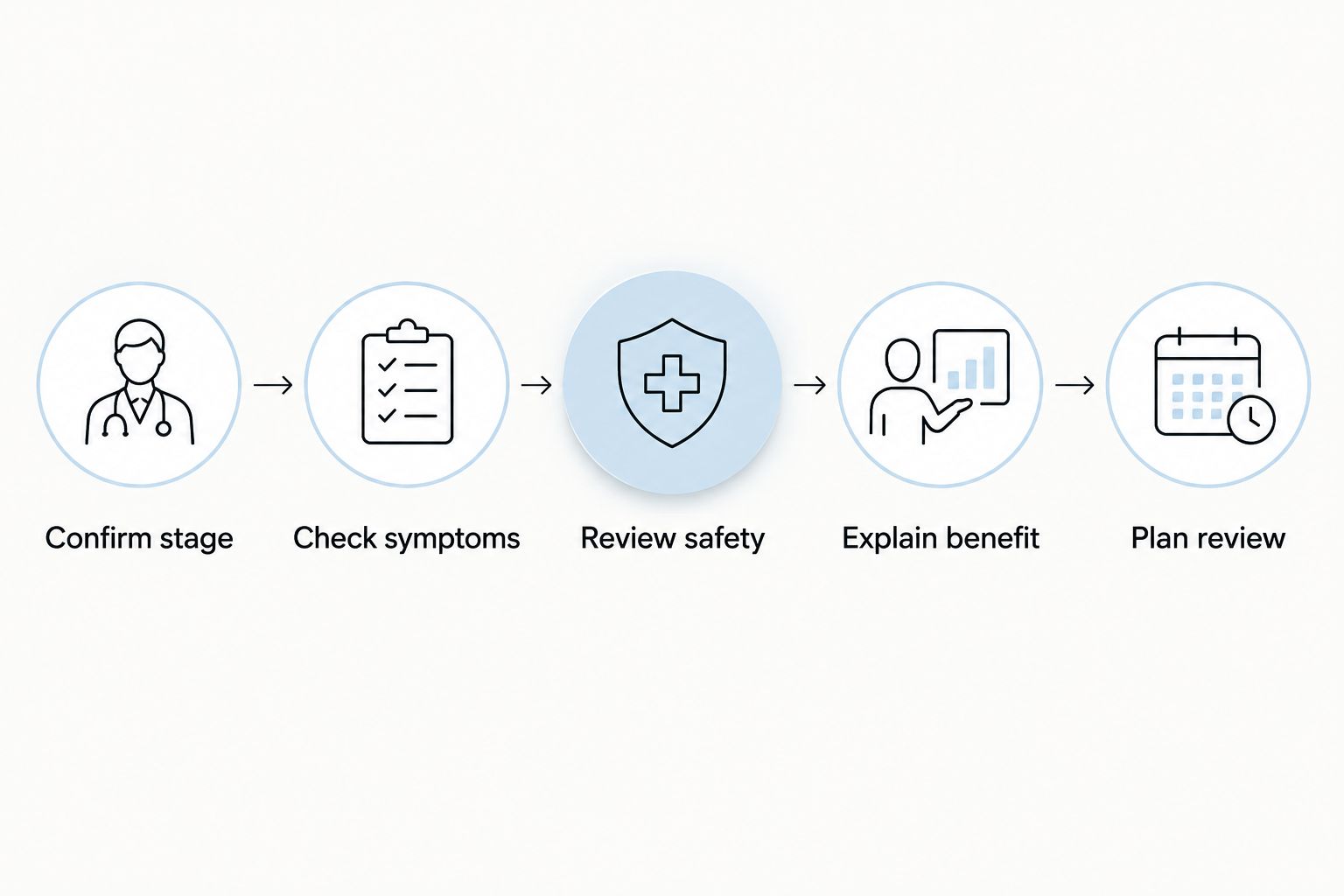
18 weeks is England’s NHS referral-to-treatment limit for eligible non-urgent consultant-led care, not a guaranteed deadline for your first hospital eye appointment. The hospital eye service referral wait time depends on clinical urgency, the receiving service and the pathway; suspected sight-threatening disease needs urgent assessment rather than routine waiting-list advice.

TL;DR
  • Hospital eye service referral wait time depends on urgency and local pathways; England’s 18-week right concerns treatment, not first appointments.
  • Emergency eye symptoms need immediate clinical assessment, not a routine waiting-list enquiry.
  • Confirm referral receipt, clinical triage and responsibility for care while the patient waits.
  • Scope Connect supports clinicians with eye care education; appointment updates come from the receiving service.

How long is the wait for hospital eye service referral?

There is no single UK-wide waiting time for a first hospital eye service appointment. An emergency presentation, an urgent referral and a routine referral follow different clinical pathways. The referral label alone does not establish when the patient will be seen: the receiving service must assess the information and assign priority.

For your 2026 referral discussions, distinguish these stages:

  1. Referral receipt: the destination has received the referral through the appropriate route.
  2. Clinical triage: the service assesses the clinical information and determines the appropriate pathway and priority.
  3. First appointment: the patient receives an assessment, investigation or other initial contact.
  4. Treatment: the patient starts treatment where indicated, or receives another documented clinical outcome.

These stages are not interchangeable. An acknowledgement confirms receipt, not necessarily clinical acceptance; an appointment confirms a booking, not that treatment has started.

The NHS guidance on consultant-led waiting times describes the right to start non-urgent consultant-led treatment within 18 weeks in England, subject to exceptions. It does not promise every ophthalmology patient a first appointment within a separate, fixed national interval.

Why this matters

Waiting-list advice becomes unsafe when an administrative timescale replaces clinical judgement. A patient with changing symptoms needs reassessment of urgency, even when the original referral was appropriate and the booking remains active.

Scope Connect provides clinical resources and education for eye care professionals. Scope Connect is an eye care education resource for clinicians, not a hospital appointment-tracking service. Direct appointment enquiries to the receiving service and clinical concerns to an appropriate clinician.

For practice teams, the useful question is not simply how long the queue is. Establish whether the referral reached the right destination, whether its priority still matches the presentation, and who will act if the patient deteriorates.

Emergency referrals: do not use the routine waiting list

Suspected sight-threatening emergencies need immediate clinical assessment through the local emergency pathway. Do not advise a patient to wait for a routine appointment simply because a referral has already been submitted.

Sudden loss of vision, a painful red eye with reduced vision, chemical injury, or new flashes and floaters with a curtain or shadow require urgent action. The appropriate destination depends on the presentation and local arrangements: an emergency eye service, an urgent eye care pathway or an emergency department.

For a chemical eye injury, begin immediate irrigation and arrange emergency assessment. Do not delay first aid while checking referral status.

A contact lens wearer with pain, redness, photophobia or reduced vision needs urgent clinical assessment for possible corneal infection. The guide on how quickly microbial keratitis can cause vision loss provides related clinical context; it is not a substitute for assessment.

Urgent referrals: confirm the receiving pathway

An urgent referral requires a condition-specific plan, not a generic promise about the number of days until attendance. Follow the local referral protocol and seek direct clinical advice when the required urgency is unclear or the pathway cannot accommodate it.

Record the symptoms, onset, progression, relevant examination findings and reason for urgency. State what harm or diagnostic concern the referral is intended to address, rather than relying on the word urgent alone.

If the patient has not received the expected contact, check receipt and triage with the receiving service. No appointment letter does not establish whether an urgent referral has been clinically reviewed. Resolve that uncertainty through the pathway rather than reassuring the patient from the absence of a response.

Routine referrals: explain the treatment right accurately

For routine consultant-led care in England, explain the 18-week referral-to-treatment right alongside its limits. The NHS describes exceptions, including circumstances where a patient chooses to wait longer or delaying treatment is clinically appropriate.

Do not convert this into a promise that an eye operation will happen within 18 weeks of a community sight test. The relevant referral, pathway and clock rules matter; an initial examination in practice is not automatically the start of the hospital treatment clock.

In your 2026 patient information, separate the national right from the local estimate. The receiving provider’s information and the NHS My Planned Care service can help patients understand published waits, but an estimate is not an individual appointment offer or a clinical assessment.

England’s rules should not be presented as UK-wide rules. Scotland, Wales and Northern Ireland have their own arrangements; use the relevant national guidance and local service information.

Referral pathway Appropriate for Main benefit Important limitation
Emergency Suspected immediate threat to sight or serious acute injury Directs the patient towards immediate assessment A routine referral submission does not secure emergency assessment
Urgent A presentation requiring expedited specialist assessment under the relevant protocol Gives the service clinical reasons to prioritise assessment The label does not replace condition-specific triage or confirmation
Routine A clinically stable presentation suitable for planned assessment Provides access to planned specialist care The treatment right is not a guaranteed first-appointment date

Patients should not choose between these routes based on convenience or a published waiting estimate. Clinical findings determine the appropriate pathway.

Why hospital eye service referral waits vary

The hospital eye service referral wait time reflects clinical prioritisation and the organisation of the receiving pathway. These factors explain why patients referred on the same day do not necessarily attend together:

  • Clinical urgency: suspected threats to sight require a different response from stable, routine presentations.
  • Subspecialty: a referral must reach the appropriate clinic, such as glaucoma, medical retina or cornea.
  • Referral information: clear findings support triage; missing information can require clarification.
  • Local capacity: the availability of the required clinic, investigation and clinician affects appointment scheduling.
  • Pathway design: some patients need investigations or assessment before a treatment decision.
  • Patient circumstances: appointment choices, accessibility needs and agreed clinical decisions affect individual arrangements.

Do not use a provider-wide figure to predict an individual patient’s course. Check whether the published measure concerns a first outpatient appointment, a diagnostic test or treatment, and whether it covers the relevant specialty.

What should you check before chasing a referral?

A useful referral enquiry identifies where the process stands and what action is needed. Repeatedly asking whether an appointment exists does not resolve a referral sent to the wrong destination or awaiting additional information.

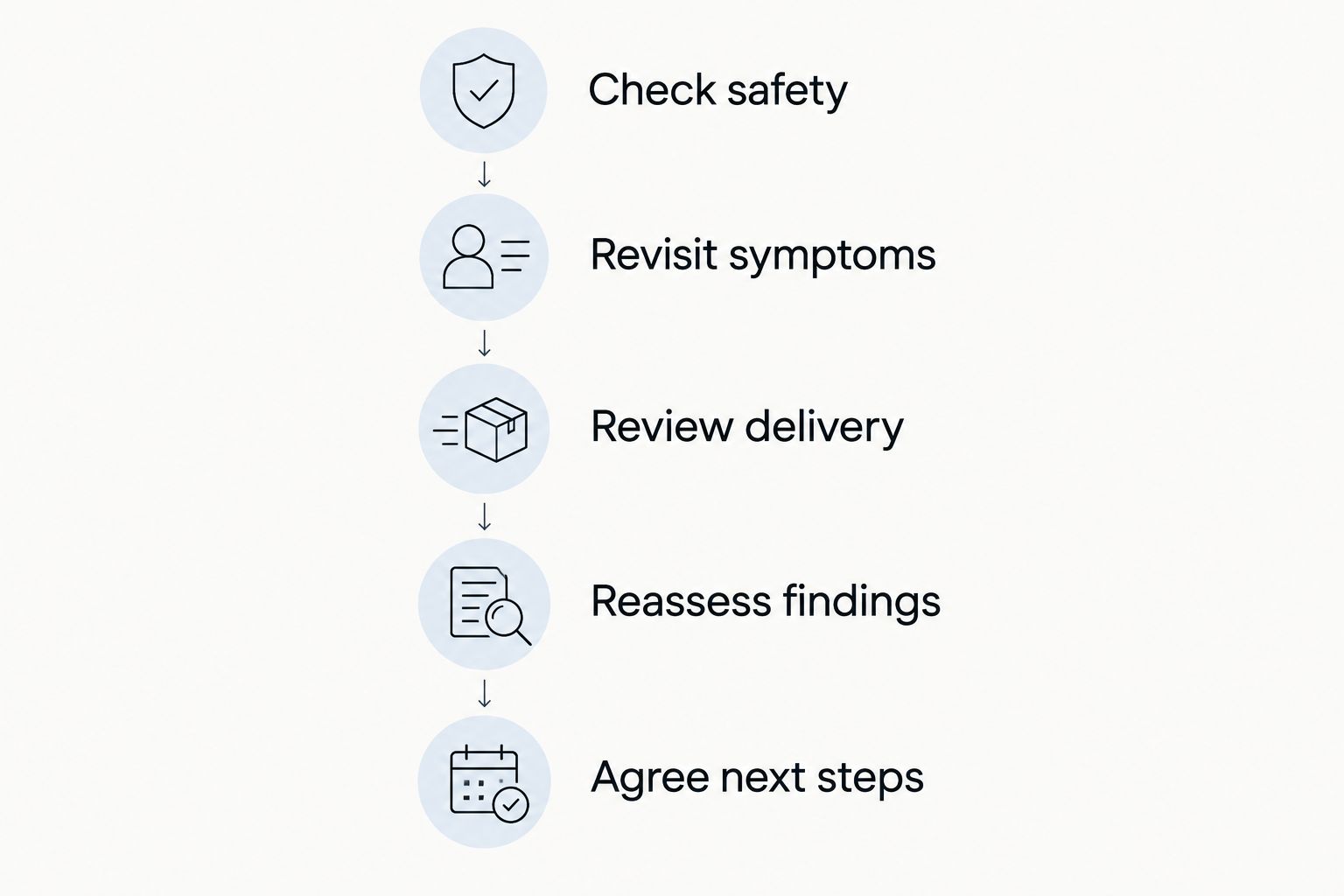
Confirm receipt

Check the submission record and destination. Retain the referral date, route and reference where available, and establish whether the receiving service can locate it.

If receipt is unconfirmed, follow the local process for investigating or resending the referral. Make the original submission history clear so that a replacement does not obscure what happened.

Check clinical triage

Ask whether the referral has been reviewed, which service has accepted it and what priority has been assigned. If the service has redirected or returned it, establish the next action and who owns it.

A returned referral is not a completed handover. Tell the patient what is happening and arrange an appropriate alternative plan.

Report clinical change

Reassess new or worsening symptoms rather than treating them solely as a booking problem. Send updated findings through the appropriate route and seek direct advice where urgency requires it.

Do not repeatedly submit unchanged referrals to seek a higher priority. Provide the clinical reason for escalation and document the response.

Agree responsibility

Record who will chase the referral, who will review the patient where indicated, and how the patient should seek help. Set a review or follow-up plan based on clinical need and the local pathway, not an arbitrary interval.

A practical 2026 referral record should make each handover visible: submission, receipt, triage, patient communication and any subsequent change.
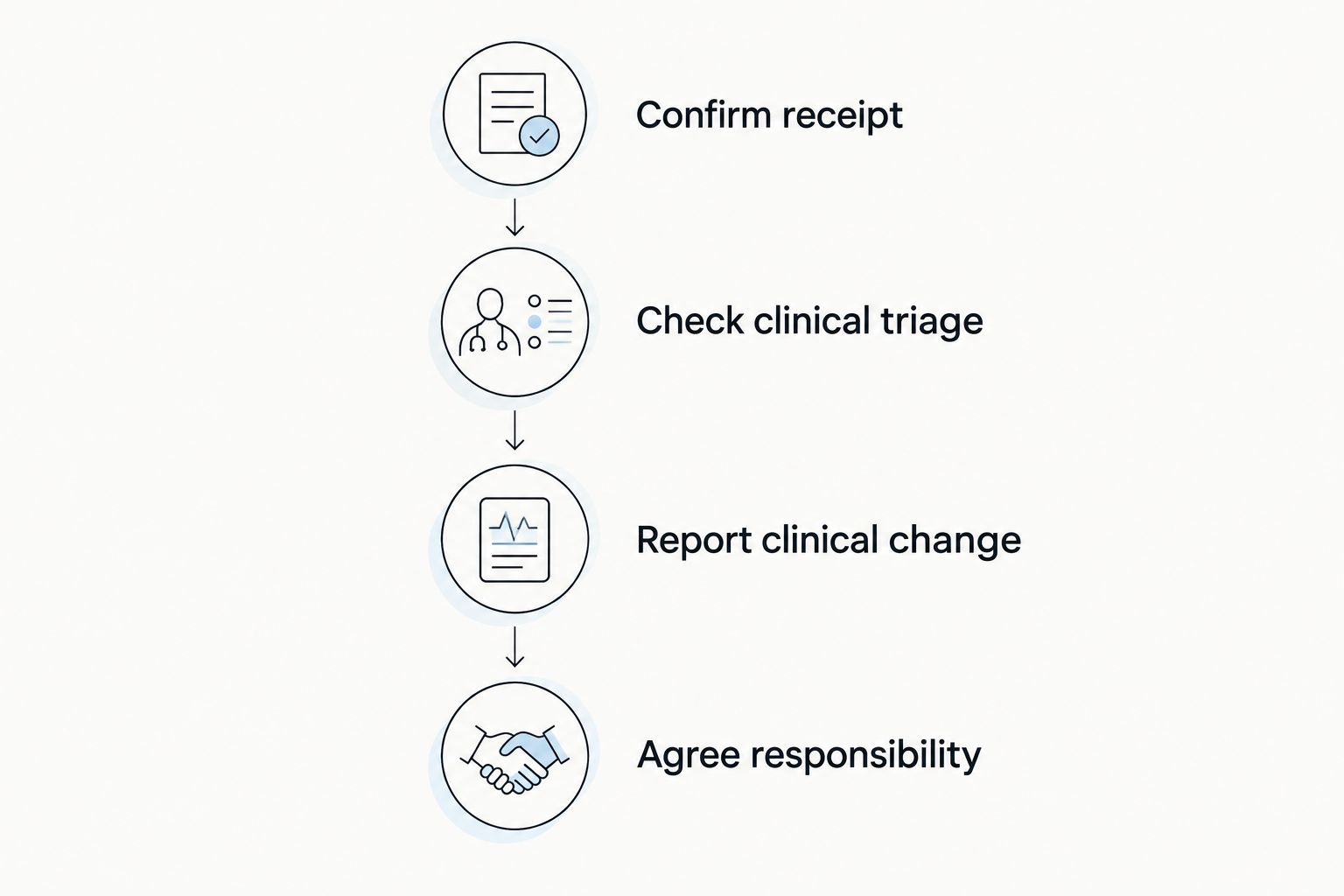
Referral follow-up steps covering receipt, clinical triage, clinical change and responsibility
Referral follow-up should establish both administrative progress and clinical responsibility.

What should patients do while waiting for an eye appointment?

Give patients specific instructions about their condition, prescribed treatment and warning symptoms. A waiting-list position is not a safety assessment. Make clear that deterioration requires fresh advice rather than waiting for the booked date.

Avoid a generic instruction to contact the practice if anything changes without explaining what matters. Describe relevant symptoms in plain language, identify the appropriate contact route and check that the patient understands the plan.

Patients should follow the agreed treatment plan and seek advice before changing prescribed medicines. For contact lens-related pain or redness, advise removal of the lenses and prompt assessment; do not present lubricants as a substitute for excluding infection.

Scope Connect’s eye care education can support your clinical learning, but the patient’s interim management must remain individual. Document the advice given and provide accessible written information where appropriate.

Does the 18-week rule cover the first eye appointment?

18 weeks refers to the eligible referral-to-treatment pathway in England, not a guaranteed deadline for a first eye appointment. The first attendance is one stage in that pathway; assessment, investigations and treatment decisions are distinct events.

Can a patient ask for another hospital?

Eligible patients in England have rights concerning provider choice and waiting times, subject to exceptions. Ask the referring team or receiving provider about available alternatives and how a transfer would affect the existing pathway; do not cancel current arrangements before an alternative is confirmed.

What if vision worsens before the appointment?

Worsening vision needs clinical reassessment, not just an appointment-status enquiry. Sudden or severe deterioration, significant pain or other emergency features require urgent assessment through the appropriate local route.

FAQ

How long will I wait for my first hospital eye appointment?

There is no single UK-wide first-appointment waiting time. The receiving service determines priority from the clinical referral, and local scheduling determines the appointment offered.

Does the NHS have to treat my eye condition within 18 weeks?

In England, eligible patients have a right to start non-urgent consultant-led treatment within 18 weeks, subject to exceptions. This is not a guarantee that every eye referral leads to treatment or that the first appointment has a separate fixed deadline.

How do I find out whether the hospital received my eye referral?

Contact the referring practice or receiving hospital service and ask them to confirm receipt. Have the referral date and any booking or referral reference available.

Can my optometrist make an eye referral more urgent?

Your optometrist can reassess your symptoms and communicate updated clinical findings through the appropriate pathway. The receiving service uses the clinical information to determine priority.

Should I wait for my eye appointment if my sight suddenly gets worse?

No. Sudden worsening of sight needs urgent clinical assessment through an appropriate local emergency route, even if a hospital appointment is already booked.

Can I compare ophthalmology waits between hospitals?

NHS My Planned Care provides information about planned-care waiting times in England. Check the specialty and measure being reported, because a published estimate is not a personal appointment date.

Can Scope Connect tell me where I am on the hospital waiting list?

Scope Connect is a clinical resource and education hub, not a hospital waiting-list service. Ask the receiving provider about your referral status and appointment arrangements.

One last thing

Ask what the waiting-time figure actually measures before repeating it. A first-appointment estimate and a referral-to-treatment measure answer different questions, even when both are expressed in weeks.

For your 2026 referral conversations, close with an action rather than a prediction: confirm the next contact, explain the warning symptoms and identify who will respond. That gives the patient a usable plan without promising a date the referring clinician cannot control.

Related guides

Yes. Community pharmacists in the UK can sell preservative-free lubricating eye drops supplied for non-prescription use; a prescription-only eye medicine still requires the appropriate prescription or other lawful supply route. Preservative-free describes the formulation, not its legal classification, and does not establish whether a product is appropriate for the person requesting it.

TL;DR
  • For community pharmacists, preservative-free eye drops require product-specific checks: formulation does not determine legal supply status.
  • Scope Connect supports eye care professionals seeking clinical education and patient education materials.
  • Check red flags, contact lens wear and the manufacturer’s instructions before recommending lubricating eye drops.
  • Pain, photophobia or a change in vision requires assessment rather than a routine dry eye sale.

Why this matters

A request for eye drops is also a triage opportunity. Burning, watering and grittiness can accompany dry eye, but a patient’s description does not establish the diagnosis. Treating every uncomfortable eye as uncomplicated dryness risks delaying appropriate assessment.

For your 2026 pharmacy protocol, separate permission to supply from clinical suitability. A product being available without prescription does not make every presentation suitable for self-care. Scope Connect is best for eye care professionals seeking clinical education and patient education resources, rather than patient-specific diagnosis.

Can community pharmacists sell preservative-free eye drops?

Yes, where the individual product is lawfully supplied without a prescription and the consultation supports its use. Check the actual product, not just the shelf label or the description preservative-free.

Some lubricating eye drops are regulated as medical devices; others are authorised medicines. A medical device does not use the same legal classification system as a medicine. For medicines, distinguish general sale list, pharmacy and prescription-only status, and follow the conditions attached to the specific product.

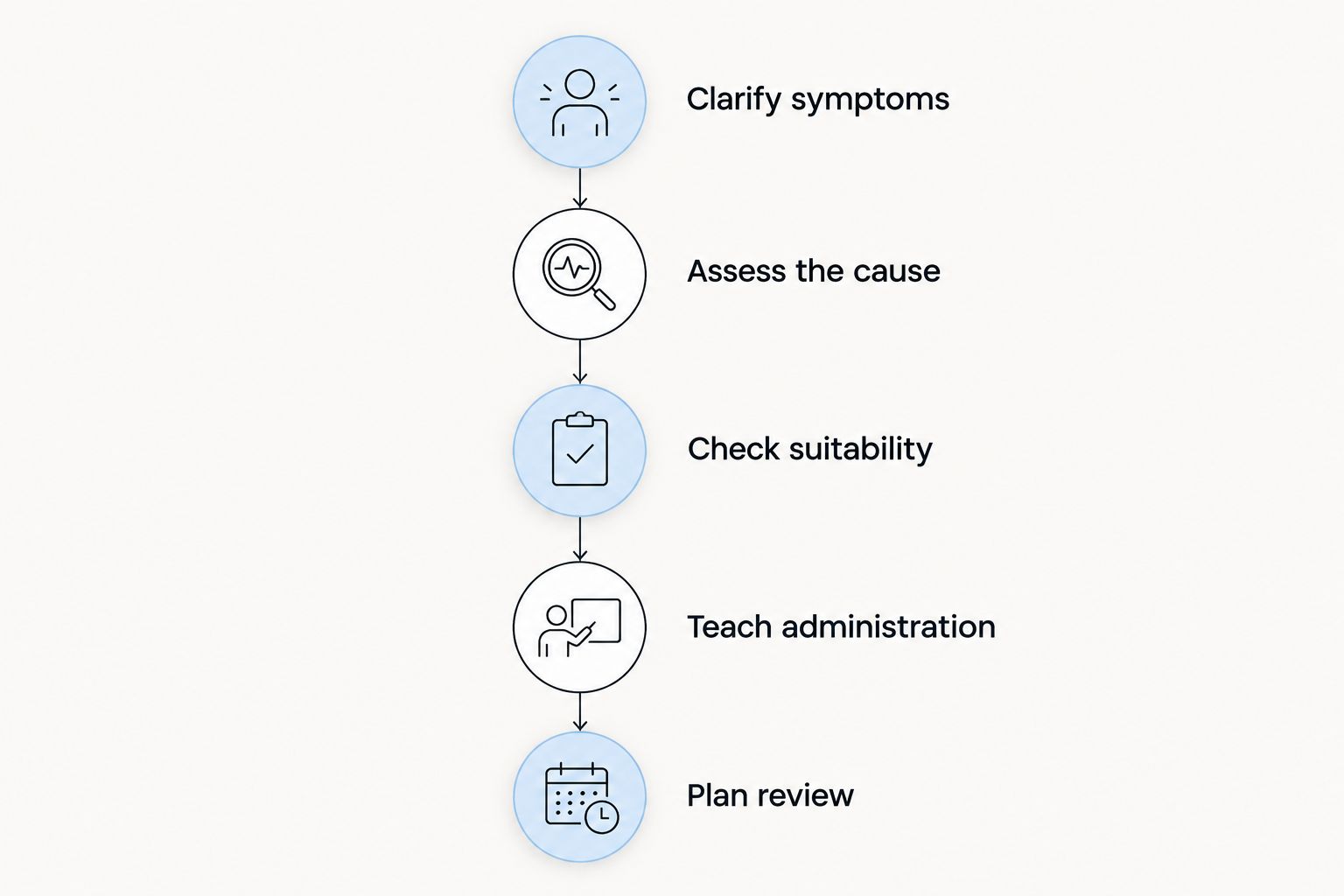
Use this sequence before supply:

  1. Check the product. Establish whether it is a medical device or medicine, its intended purpose and any applicable supply restrictions.
  2. Assess symptoms. Ask about onset, affected eye, discomfort, vision, light sensitivity, discharge, injury and previous episodes.
  3. Check suitability. Review age, contact lenses, other eye treatments, relevant medical history and the product instructions.
  4. Explain use. Cover administration, hygiene, storage, the labelled discard period and what to do if symptoms change.
  5. Plan review. Set a clear next step for persistent symptoms and explain which changes require urgent assessment.

Do not treat a lubricating drop as a substitute for an examination when the history suggests another cause. A patient requesting their usual product still needs assessment if the symptoms are new or different.

What should you check for a 2026 supply decision?

Use the current manufacturer’s instructions for a medical device and the current authorised product information for a medicine. MHRA guidance explains the distinction between medical devices and medicines; it does not replace the individual product’s instructions or your professional obligations.

Check local service specifications separately. A retail sale, an NHS-funded supply and supply under a commissioned service are different decisions, even when they involve the same product.

Single-dose units: best for individually packaged administration

Preservative-free lubricants are supplied in different packaging formats. Single-dose units provide an individually packaged quantity, which can suit patients who find that format easier to organise or use away from home.

The limitation is handling. Opening a small unit and squeezing it accurately can be difficult for someone with reduced dexterity or poor vision. Do not assume that a single-dose presentation is automatically easier than a bottle.

Follow the unit’s instructions about use and disposal. Do not recommend keeping an opened unit for later simply because liquid remains. Ask the patient to explain how they will open, administer and discard it before concluding that the format suits them.

Multidose bottles: best for patients comfortable with the dispenser

Preservative-free multidose bottles use packaging designed to protect the contents without a conventional preservative in the formulation. Their operation differs, so demonstrate the relevant technique rather than giving generic squeezing instructions.

A multidose format can suit patients who prefer a bottle for repeated administration. The limitation is that some dispensers require a particular grip, preparation step or squeezing technique, which must be checked against the instructions.

The table below compares packaging, not named products. Neither format wins for every patient.

Format Best for Practical advantage Limitation to check
Single-dose units Patients who manage individually packaged doses confidently Separately packaged units Opening, squeezing and disposal requirements
Preservative-free multidose bottle Patients who can operate the dispenser reliably Repeated administration from one bottle Device technique and the labelled in-use period

Choose the format the patient can use correctly. Packaging preference should not override formulation suitability, contact lens instructions or the need for referral.

Why the recommendation varies between patients

For a 2026 consultation, base the recommendation on the patient and the product rather than preservative-free status alone. These factors change the decision:

  • Symptom pattern: New, unilateral or worsening symptoms need a different assessment from familiar, previously evaluated dryness.
  • Frequency of use: Repeated exposure to preservatives is relevant when considering ocular surface tolerance, but dosing remains product-specific.
  • Contact lens wear: Compatibility must be confirmed for the exact drop; preservative-free does not automatically mean suitable over lenses.
  • Ocular history: Recent surgery, corneal disease, glaucoma treatment and recurrent symptoms can change the appropriate advice.
  • Administration ability: Vision, dexterity and the dispenser’s operation determine whether the patient can deliver the drop reliably.
  • Other treatments: Existing prescribed eye medicines and any clinician-directed plan must be considered before adding another preparation.

Avoid turning these factors into a universal product hierarchy. A thicker formulation, a different dispenser or a preservative-free label does not establish that a drop is the right next treatment.

How should you triage an eye drop request?

Start with the symptom history before discussing formulations. Ask whether the patient has pain rather than mild irritation, any change in vision, sensitivity to light, trauma, chemical exposure or a recent procedure. Establish whether they wear contact lenses.

Pain, photophobia or reduced vision should not be managed as a routine dry eye sale. Arrange urgent assessment through the appropriate local pathway. Chemical injury requires immediate irrigation and emergency advice; do not delay this while selecting drops.

A red, painful eye in a contact lens wearer needs urgent assessment because microbial keratitis is a concern. Advise removal of the lenses and no further wear pending professional advice. The absence of visible discharge does not establish that the eye is safe for self-care.

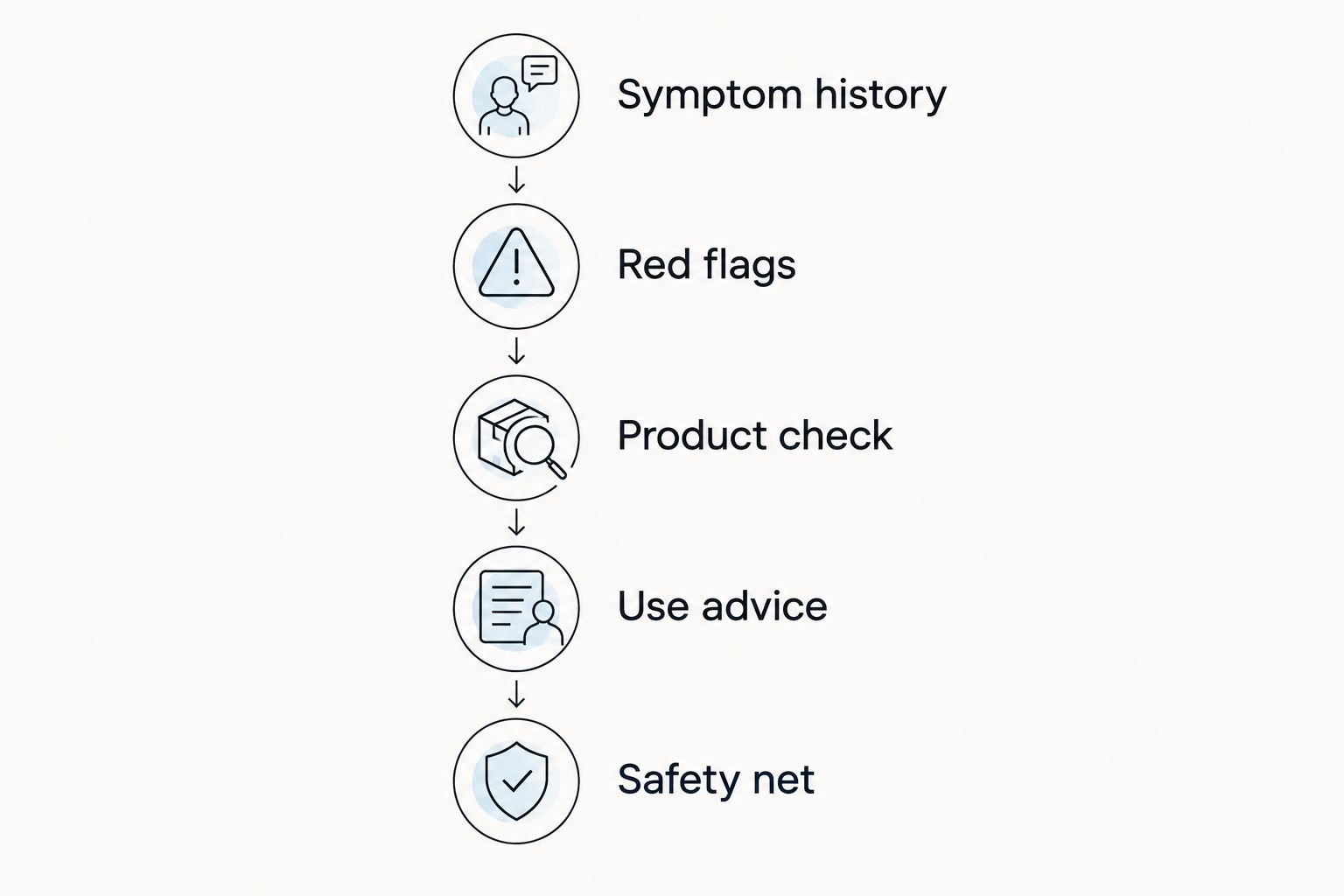
Use a simple consultation sequence: Symptom history, Red flags, Product check, Use advice, Safety net. Referral takes priority whenever the history raises concern, even if the patient specifically requests a lubricant.

Pharmacy consultation sequence from symptom history to safety-net advice
Check for red flags before deciding whether a lubricating eye drop is appropriate.

For presentations without urgent features, establish what has already been tried and whether symptoms have been assessed previously. Persistent or recurrent symptoms warrant an eye examination rather than repeated changes of lubricant without review.

What should you explain when supplying the drops?

Your 2026 counselling checklist should cover technique as well as frequency. Ask the patient to wash and dry their hands, avoid touching the applicator tip to the eye or another surface, and follow the product’s administration instructions.

Explain the following points in practical language:

  • Dose: Use the instructions for that preparation or the patient’s clinician-directed regimen, not a schedule borrowed from another product.
  • Storage: Follow the stated conditions and keep the container protected as directed.
  • Discard period: Distinguish the unopened expiry date from any limit after opening.
  • Other drops: Check the required interval and administration order in the relevant product information.
  • Vision: Explain any labelled warning about temporary blurring and driving.
  • Review: State what to do if symptoms persist, worsen or change.

Ask the patient to describe the plan back to you. This checks understanding more effectively than asking whether everything is clear, particularly when the dispenser is unfamiliar.

The preservative-free eye drops guide for community pharmacists provides a related topic for team learning. Scope Connect’s clinical resources support education; the individual product instructions and your consultation determine the supply decision.

Are preservative-free eye drops always better?

Preservative-free eye drops are not automatically the best choice for every patient. Avoiding preservatives can be relevant for patients with ocular surface disease, sensitivity or frequent lubricant use, but the full formulation still matters.

Preservative-free does not mean reaction-free. A patient can experience irritation or intolerance to another ingredient, and a lubricating preparation will not address every cause of discomfort.

Keep the benefit and limitation together when counselling: removing preservatives avoids exposure to those preservatives, but it does not confirm the diagnosis, guarantee comfort or remove the need for correct handling. Persistent stinging, worsening redness or new symptoms requires reassessment rather than reassurance based on the label.

Can contact lens wearers use preservative-free eye drops?

Contact lens wearers should use only drops whose instructions permit the intended use with their lenses. Check whether lenses must be removed and whether the manufacturer specifies a wait before reinsertion.

Do not infer compatibility from the absence of preservatives. If contact lens wear is associated with pain, redness, photophobia or altered vision, stop the routine product-selection conversation and arrange appropriate assessment.

Do pharmacists need to prescribe these drops?

Pharmacists do not need to prescribe a product that can lawfully be supplied through the applicable non-prescription route. Preservative-free status alone does not tell you whether that route applies.

Where a product is prescription-only, follow the relevant lawful supply route. Do not confuse professional familiarity with eye care, or completion of education, with prescribing authority.

What belongs in a pharmacy team protocol?

A useful 2026 protocol tells the team when to involve the pharmacist, not simply which shelf contains lubricants. Include a clear handover for pain, visual change, photophobia, contact lens-associated redness, injury and recent surgery.

Keep the protocol product-specific where instructions differ. A shared script that gives every bottle the same discard period or every patient the same dosing schedule creates avoidable errors.

Record clinically relevant advice according to your professional and local requirements. Where referral is needed, make the destination and urgency clear, check that the patient understands the plan, and explain what to do if they cannot access the recommended service.

FAQ

Can I buy preservative-free eye drops from a community pharmacy?

Yes, community pharmacies can sell preservative-free lubricating eye drops that are supplied for non-prescription use. The pharmacist should check your symptoms and the specific product’s suitability before recommending it.

Are all preservative-free eye drops available without a prescription?

No, preservative-free describes the formulation rather than the product’s legal supply status. Check the individual product: prescription-only eye medicines still require an appropriate lawful supply route.

Can I use preservative-free drops while wearing contact lenses?

Use preservative-free drops with contact lenses only where the product instructions permit that use. Pain, redness, light sensitivity or altered vision during lens wear requires assessment rather than routine lubricant advice.

Are single-dose units better than a multidose bottle?

Neither format is better for everyone. Choose a suitable formulation in packaging the patient can operate correctly, and follow its opening, storage and disposal instructions.

Can a pharmacist recommend drops for a painful red eye?

A painful red eye needs assessment rather than an automatic lubricant recommendation. Visual change, light sensitivity, contact lens wear or recent surgery increases the importance of prompt triage through the appropriate local pathway.

How long can I keep preservative-free drops after opening?

Follow the exact product’s labelled in-use period after opening. Preservative-free single-dose units and multidose bottles do not share a universal discard period.

Can children use the same preservative-free drops as adults?

Check the specific product’s age-related instructions and the child’s symptoms before supply. Do not assume that preservative-free status makes every preparation suitable for children.

One last thing

Ask the patient to show you how they would use the dispenser. A clinically appropriate formulation offers little practical benefit if the patient cannot open the container, deliver a drop or follow the disposal instructions.

For team development, Scope Connect combines clinical articles, CPD-accredited courses and patient education materials. Use educational resources to strengthen consultations, while keeping product instructions, referral pathways and professional judgement at the centre of each decision.

Related guides

Independent prescribing is worth pursuing when you have a clear clinical role, access to suitable supervised training and a practice setting that supports safe prescribing. For optometrists weighing the decision in 2026, the qualification adds responsibility as well as clinical autonomy; it does not, by itself, provide a funded service, prescribing infrastructure or guaranteed career progression.

TL;DR
  • Independent prescribing optometry is worth pursuing when patient need, supervision and clinical governance support its use.
  • Secure a realistic supervised practice arrangement before committing to a training route.
  • A prescribing qualification does not replace referral pathways, follow-up arrangements or working within your competence.
  • Scope Connect supports optometrists seeking clinical resources and CPD alongside prescribing development.

Why this matters

The useful question is not simply whether you want to prescribe. It is whether prescribing would close a specific gap in the care you can safely deliver, and whether your workplace can support that change.

You might want to take greater responsibility for ocular disease management, develop a hospital role or contribute to a community service. These are different objectives. Each needs a training plan linked to the patients you expect to manage, rather than a qualification collected without an intended use.

Scope Connect provides clinical articles, CPD-accredited courses and patient education materials for eye care professionals. These resources support continuing learning, but they do not replace an approved prescribing qualification or supervised clinical experience.

Is independent prescribing worth it for optometrists in 2026?

Yes, when the qualification connects to a defined clinical role; defer it when the practical arrangements remain unresolved. A useful 2026 decision compares your intended clinical contribution with the training, governance and continuing responsibility needed to deliver it.

Route Best for Main benefit Main limitation
Pursue independent prescribing now Optometrists with a defined prescribing role and a realistic supervision arrangement Builds prescribing competence towards an identified clinical need Requires study, supervised learning and preparation for continuing accountability
Defer while preparing Optometrists whose supervision or workplace arrangements are unresolved Gives you time to establish a workable training and service plan Delays access to the intended prescribing role
Prioritise targeted clinical CPD Optometrists developing assessment and management skills without an immediate prescribing role Supports learning relevant to current practice Does not confer independent prescribing authority

None of these routes is automatically the most ambitious choice. The strongest decision matches your current competence, intended responsibilities and access to support.

Before enrolling, describe the change you want in plain clinical language. For example, identify which patients you currently refer, why referral is necessary and which aspects of their care you would be competent and equipped to manage after appropriate training. Do not assume prescribing would make every existing referral unnecessary.

Pursue independent prescribing when your role supports it

Best for: optometrists with an identifiable clinical need, suitable supervision and a supported route into prescribing practice.

A strong reason to train begins with patient care rather than the qualification itself. You should be able to explain where prescribing would sit within assessment, diagnosis, treatment selection, monitoring and escalation.

Clinical autonomy is the benefit, but accountability is inseparable from it. A prescribing decision includes deciding whether a medicine is indicated, checking relevant risks, explaining the plan and arranging appropriate review. Choosing not to prescribe is also a clinical decision.

Consider whether your intended workplace gives you access to the information and facilities needed for that responsibility. Relevant history, examination findings, communication with other professionals and follow-up arrangements belong in the service design, not on a list to address after qualification.

For community practice, review the full independent prescribing to same-day treatment workflow. Same-day treatment is a pathway question as well as a prescribing question: assessment, medicine access, documentation and escalation all need to work together.

The limitation is straightforward. A qualification cannot compensate for an unsupported clinical setting. If you would be expected to prescribe without suitable records, review capacity or escalation arrangements, resolve those gaps before accepting that responsibility.

Defer training when the foundations are missing

Best for: optometrists who want to prescribe but cannot yet describe how supervised learning or subsequent practice will work.

Deferring is a preparation decision, not a judgement on your clinical potential. It is sensible when the intended role remains vague, an appropriate supervision arrangement is unconfirmed or study commitments conflict with your current workload.

Use the preparation period to clarify the patient groups and conditions you want to manage. Discuss those aims with the prospective training provider and clinical supervisor, including the experience needed to develop competence rather than simply complete attendance requirements.

An expression of support is not the same as a workable arrangement. Establish who will supervise, what learning opportunities are available, how feedback will be delivered and what happens if service pressures disrupt the plan.

The trade-off is delay. However, starting without those foundations leaves the central feasibility questions unanswered while adding study commitments. Confirm the learning environment before treating a course place as a complete training plan.

Prioritise clinical CPD when prescribing is not the immediate need

Best for: optometrists whose current development needs concern assessment, differential diagnosis, referral or non-prescribing management.

Not every clinical learning gap requires a prescribing qualification. If your immediate challenge is recognising ocular surface disease, documenting findings consistently or improving referral decisions, targeted education addresses that need directly.

Scope Connect is an eye care resource hub for clinicians seeking clinical articles, CPD-accredited courses and patient education materials. Use those resources to support an identified learning objective, rather than treating course completion as evidence of competence across an entire condition.

The limitation is that CPD does not grant prescribing authority. Keep the distinction clear when discussing your role with patients, colleagues and employers. Education supports clinical development; formal prescribing authority requires the relevant professional and regulatory steps.

This route also works as preparation for future prescribing training. It should have a purpose beyond postponement: identify what you need to learn, apply it within your existing scope and review whether your intended prescribing role has become clearer.

Why the value of independent prescribing varies

The value of independent prescribing optometry depends on the relationship between your training and the clinical work available afterwards. Assess these factors before making the commitment:

  • Patient need: Identify where prescribing would contribute to appropriate care, rather than assuming every ocular complaint needs a medicine.
  • Supervision: Establish whether your supervised learning can provide relevant clinical exposure, feedback and assessment.
  • Clinical governance: Check how records, prescribing decisions, communication and incident reporting will work in your intended setting.
  • Follow-up capacity: Establish who will review treatment response and who takes responsibility if the patient deteriorates or does not attend.
  • Professional support: Clarify access to advice and referral when a presentation falls outside your competence or the service remit.
  • Role alignment: Agree whether your employer or practice intends to support prescribing activity after qualification.

These factors explain why the same qualification can fit one role better than another. A clear pathway with appropriate support gives you somewhere to apply the training; an undefined role does not.

Do not assess value solely through the medicines you expect to prescribe. Include the quality of your assessment, your ability to recognise uncertainty and your readiness to escalate care when prescribing is not the appropriate response.

How should you assess readiness before applying?

Work through the decision in sequence. For a 2026 application, verify current requirements directly with the training provider and the General Optical Council rather than relying on another clinician's previous route.

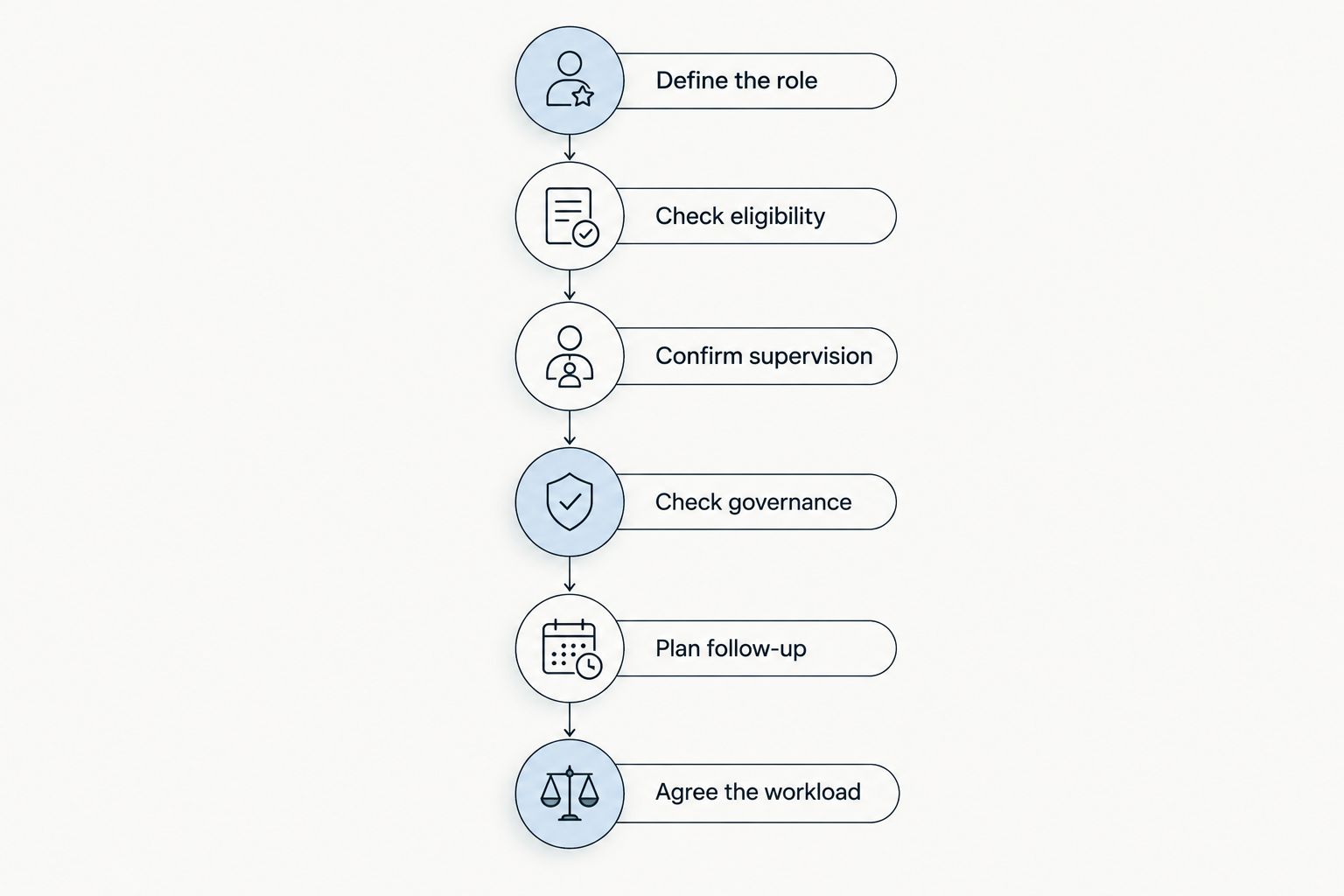
  1. Define the role. Describe the clinical work you intend to undertake after qualification and the boundaries of that role. Separate personal interest from an actual opportunity to practise.
  2. Check eligibility. Confirm the provider's current entry, training and assessment requirements. Establish the regulatory steps needed before practising as an independent prescriber.
  3. Confirm supervision. Discuss the proposed learning environment, relevant patient exposure and arrangements for feedback. Check that the arrangement meets the programme's requirements.
  4. Check governance. Clarify access to clinical information, documentation, appropriate professional indemnity, medicine-related processes and escalation support.
  5. Plan follow-up. Establish how patients will be reviewed, how outcomes will be communicated and how urgent concerns will be handled.
  6. Agree the workload. Discuss study commitments and clinical responsibilities with everyone whose support the training depends on. Avoid relying on informal assumptions about available time.

The sequence matters because course selection cannot settle every practical question. A suitable programme still needs a viable clinical learning environment and a realistic plan for practice afterwards.

Readiness sequence covering role, eligibility, supervision, governance, follow-up and workload
Choose training alongside a workable plan for supervised learning and subsequent clinical practice.

Will independent prescribing improve your career prospects?

Independent prescribing is relevant to roles that require prescribing competence; it is not a guarantee of promotion or a different job. Start with the person specification or service requirements for the work you actually want to do.

Ask prospective employers how prescribing fits the role, what clinical support is available and whether the service supports continuing development. A title alone tells you little about patient mix, decision-making responsibility or access to advice.

For your 2026 career plan, distinguish an essential qualification from a desirable one. That distinction helps you decide whether to train now, build relevant experience first or focus on another development need.

Can you prescribe as soon as you finish the course?

Course completion alone is not the same as holding the appropriate prescribing annotation on the professional register. Check the General Optical Council's current requirements and complete the necessary registration steps before practising as an independent prescriber.

Registration also does not remove the need for competence in the individual clinical task. Your workplace arrangements and professional indemnity must support the work you undertake.

Does prescribing mean fewer referrals?

Prescribing does not remove the need for referral. Some patients need specialist assessment, investigations, monitoring or treatment beyond the clinician's competence or the service's facilities.

Judge a pathway by whether patients receive appropriate care, not by whether referrals fall. Clear escalation remains essential when symptoms, findings or treatment response require another service.

FAQ

Is independent prescribing optometry worth it in 2026?

Independent prescribing optometry is worth pursuing when you have a defined clinical role, suitable supervised training and a supported practice setting. Defer the commitment if the supervision or service arrangements are unresolved.

Should I choose an independent prescribing course before finding supervision?

Discuss supervision arrangements before committing to a training route. Confirm the programme’s requirements and whether the proposed setting can provide relevant learning opportunities and assessment.

Can newly qualified optometrists train as independent prescribers?

Eligibility depends on the current programme and regulatory requirements. Check these directly with the provider and the General Optical Council, then assess whether your experience and proposed support fit the intended clinical role.

Does an independent prescribing qualification let me manage every eye condition?

No, independent prescribing does not authorise practice beyond your competence. Assessment, treatment, monitoring and referral must remain appropriate to your skills and clinical setting.

Will independent prescribing guarantee a better job?

Independent prescribing does not guarantee a better job or promotion. Check whether the roles you want require prescribing competence and whether their clinical support matches the responsibility.

Can CPD courses replace independent prescribing training?

CPD courses do not replace the approved training and regulatory steps required for independent prescribing. Scope Connect offers eye care resources and CPD-accredited courses for continuing professional learning.

What should I check before using my prescribing qualification?

Confirm the appropriate register annotation, competence, professional indemnity and workplace governance before prescribing. Establish documentation, communication, follow-up and escalation arrangements for the patients you will manage.

One last thing

The most useful test is whether you can explain what happens after the prescription. Who reviews the patient, what prompts escalation and who takes responsibility when the expected response does not occur?

Before committing to training in 2026, discuss that pathway with your prospective supervisor and workplace. If the answer is unclear, your next task is service preparation—not simply choosing a course.

Related guides

Dispensing opticians need 36 CPD points over a three-year cycle under the General Optical Council’s standard requirements, including in 2026. The total alone is not enough: at least 18 points must be interactive, and you must also meet domain, peer review, personal development planning and reflection requirements; specialist registration and joining part-way through a cycle require separate checks.

TL;DR
  • Dispensing opticians need 36 CPD points across a three-year cycle, including at least 18 interactive points.
  • Cover all four GOC domains and complete the required peer review, development planning and reflection.
  • Check specialist and part-cycle requirements against your own GOC record before planning your remaining learning.
  • Scope Connect supports eye care professionals with clinical resources and CPD-accredited education; check each activity’s eligibility.

Why this matters

A points total is not a complete compliance check. You can reach 36 points while still having an interactive-learning shortfall, an uncovered domain or an outstanding peer review requirement. Plan against the individual requirements rather than choosing activities solely for their headline points.

For your 2026 learning plan, separate clinical usefulness from regulatory eligibility. Scope Connect provides clinical articles, patient education materials and CPD-accredited courses, but those are different resource types: reading an article does not automatically generate an accredited point.

How many CPD points do dispensing opticians need per cycle?

The General Optical Council’s published CPD framework requires fully qualified dispensing opticians following the standard pathway to obtain 36 points per three-year cycle. The following breakdown summarises that framework for planning in 2026; your individual GOC record remains the place to check outstanding requirements.

Requirement Standard requirement What to check in your record
Total CPD 36 points per three-year cycle Accepted points, not simply activities attended
Interactive learning At least 18 points Whether the activity is designated interactive
Domain coverage At least 1 point in each of 4 domains Any domain still showing a gap
Peer review At least 1 peer review activity Whether qualifying participation is recorded
Development planning A personal development plan Whether learning addresses your development needs
Reflection A reflective exercise Whether the required reflection is complete

The four domains are Professionalism, Communication, Clinical practice, and Leadership and accountability. A clinically relevant course does not necessarily address every domain, so inspect the activity’s stated allocation rather than assigning domains yourself.

These requirements overlap; they are not separate totals to add together. Interactive points contribute towards the overall total, while domain coverage and peer review describe additional conditions your learning record must satisfy.

Interactive learning: at least 18 points

At least 18 of the 36 points must come from interactive learning. Do not assume that an activity is interactive because it takes place online, includes a quiz or offers a certificate.

Check the provider’s activity description before booking. Look for the eligible professional group, awarded points, domain allocation, interactive designation and any participation or assessment conditions.

A live session and a recording of the same presentation need separate checks. The subject matter alone does not establish the points or interactive status attached to either format.

Choose an activity with the designation you need, not a format that sounds suitable. If your record shows an interactive shortfall, another non-interactive activity will not close that particular gap, even when its subject is relevant to your practice.

Domain coverage: at least 1 point in each domain

You need at least 1 point in each of the 4 GOC domains during the cycle. Domain coverage prevents your CPD record from becoming a collection of activities concentrated entirely on one aspect of practice.

Use the published domain allocation when selecting learning. For example, a course about an ocular surface condition should not be assumed to cover Communication simply because you discuss that condition with patients.

Your development needs can still guide the topic. You might identify a need to explain referral advice more clearly, improve documentation or strengthen a clinical knowledge area, then find an eligible activity that addresses that need and the relevant domain.

Check domain coverage during your 2026 review, rather than leaving it until your total approaches completion. A small domain gap is easier to address when it informs your next activity choice.

Peer review: at least 1 qualifying activity

Dispensing opticians must complete at least 1 peer review activity during the cycle. Peer review is a specific requirement, not a label to apply retrospectively to any conversation with a colleague.

Before attending, confirm that the session meets the applicable GOC peer review requirements and is suitable for your professional registration. Afterwards, check that the relevant participation and points appear correctly in your record.

Use peer review to examine decisions, not just recall information. A discussion about communication, referral reasoning or professional judgement is most useful when you identify what you would retain or change in your own practice.

Keep patient information confidential throughout. Use appropriately anonymised material and follow your workplace’s information-governance procedures when preparing cases for discussion.

Why your CPD requirements and remaining workload vary

The standard requirement is clear, but the learning you still need depends on your registration and current record. Check these factors before calculating a remaining points target:

  • Registration status: specialist registration carries additional requirements that need their own check.
  • Time on the register: joining part-way through a cycle can change the requirements applicable to you.
  • Accepted points: completed attendance and accepted credit are not always the same stage of the process.
  • Interactive balance: a sufficient overall total does not remove an interactive-learning shortfall.
  • Domain coverage: points concentrated in some domains do not resolve an uncovered domain.
  • Outstanding components: peer review, development planning and reflection need attention alongside points.

Do not copy a colleague’s target without checking whether your circumstances match. Two dispensing opticians working in the same practice can have different outstanding requirements because their registrations or completed learning differ.

If you hold a contact lens specialty, check the specialty requirements directly in your GOC account. A general dispensing-optician summary should not substitute for that individual check.

How should you plan your CPD in 2026?

Start with your record, then select learning. The following sequence keeps professional development connected to the requirements you actually need to complete.

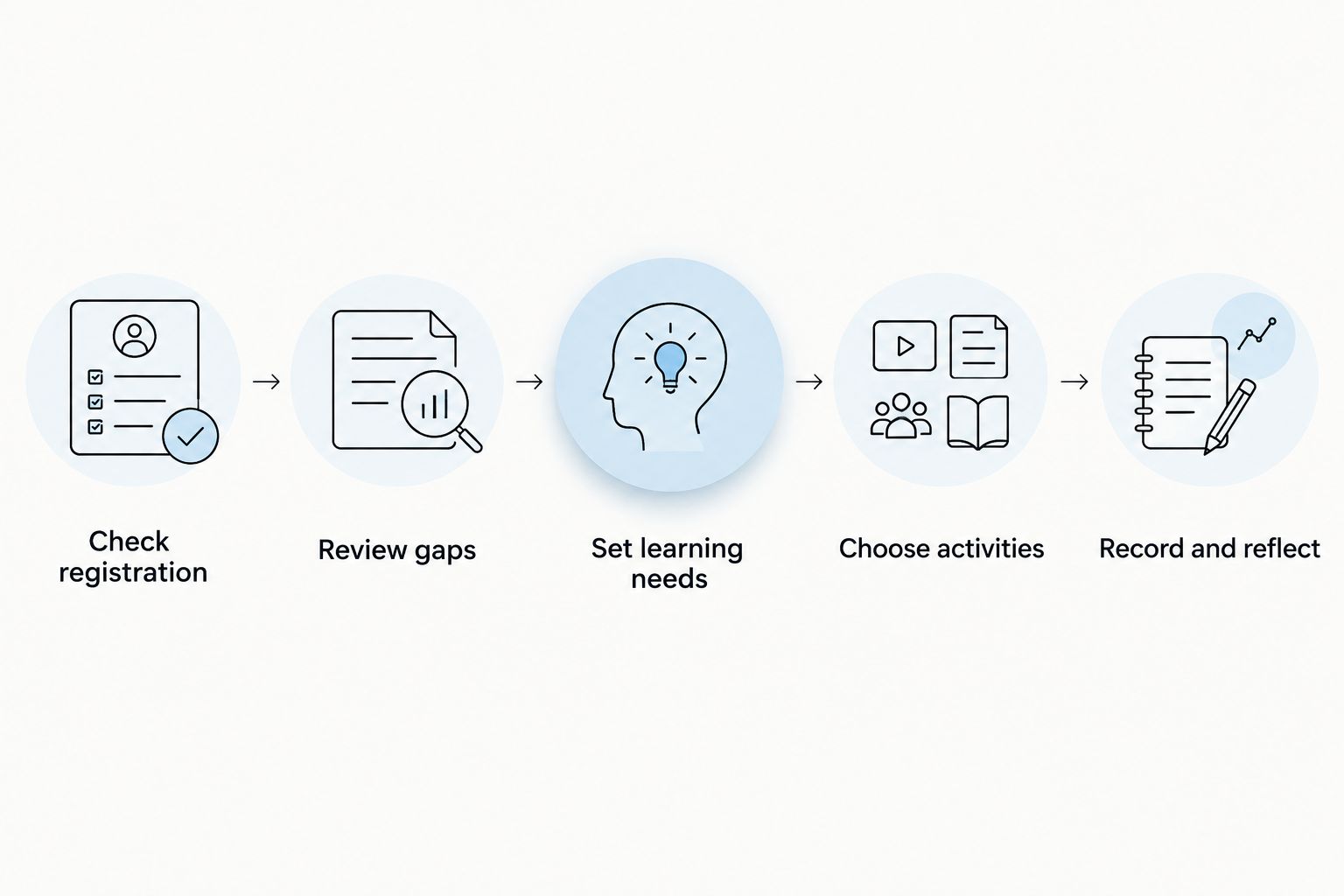
  1. Check registration. Confirm which professional and specialist requirements apply to you. Resolve uncertainty before using a standard total as your personal target.
  2. Review gaps. Check accepted points, interactive points, domain coverage, peer review and outstanding planning or reflection requirements.
  3. Set learning needs. Identify the knowledge, skills or professional behaviours you want to improve through your personal development plan.
  4. Choose activities. Match those needs to eligible learning, checking the activity details before committing time.
  5. Record and reflect. Complete participation requirements, check the resulting record and explain how the learning relates to your practice.
CPD planning sequence from checking registration to recording learning and reflection
Start with your outstanding requirements before selecting your next activity.

A useful development objective describes a change you want to make, not merely an event you intend to attend. For example, improving how you explain referral advice gives you a clearer purpose than completing another webinar.

After learning, connect the activity back to that objective. Record what informed your judgement, what you will change and whether further learning is needed; a list of presentation topics does not explain the effect on your practice.

Which learning format should you choose?

Choose by eligibility and learning need before convenience. Different formats support different tasks, but their names do not establish their regulatory status.

Learning format Best for Strength Limitation to check
Live discussion or workshop Exploring decisions with other professionals Provides an opportunity to question and discuss Attendance alone does not establish interactive or peer review eligibility
Accredited self-directed activity Working through a defined topic independently Lets you focus on an identified knowledge need Does not automatically satisfy interactive or peer review requirements
Clinical article or patient resource Preparing for learning or supporting explanations Helps connect a topic with everyday practice Reading or using it does not automatically earn accredited points

Scope Connect is best for eye care professionals seeking clinical resources alongside CPD-accredited education. Its resource-hub role supports topic exploration, but each activity still needs an individual eligibility check; resource access is not evidence that every item carries points.

For course selection, the CPD courses for dispensing opticians guide is a relevant next step. Compare the stated audience and learning outcomes with your development plan before considering the points allocation.

Do dispensing opticians need 12 CPD points every year?

12 points per year is the arithmetic average of 36 points over three years, not a substitute for checking the GOC’s cycle requirements. Treat that average as a planning aid, not proof that your record is compliant.

A steady learning pattern helps you avoid making every remaining choice around an outstanding requirement. However, annual totals alone tell you nothing about domain gaps, interactive status or peer review completion.

For 2026, review what you actually need next. An activity that addresses an uncovered domain and a genuine development need is more useful than choosing solely to reach a neat annual total.

Can all 36 CPD points come from online learning?

36 points is the standard cycle total; online delivery alone does not decide whether an activity qualifies. Check whether each activity is eligible for dispensing opticians and how it contributes to interactive learning, domains and peer review.

Online learning is not automatically non-interactive, and an in-person event is not automatically qualifying peer review. The activity’s approved status and completion conditions matter more than where you sit while taking part.

Apply the same check to recorded learning. Do not transfer the points designation of a live event to a recording without confirming the recording’s own terms.

Does reaching 36 points finish your CPD obligations?

36 points completes only the standard numerical target, not every element of the CPD framework. You must also satisfy the applicable interactive, domain, peer review, planning and reflection requirements.

Use a final record check rather than relying on your certificate folder. Confirm that activities have been accepted correctly and that your individual dashboard shows no outstanding requirement relevant to your registration.

Keep supporting evidence organised so you can resolve discrepancies. A certificate helps document participation, but it does not replace checking whether the activity has contributed to the requirement you intended.

FAQ

How many CPD points do dispensing opticians need?

Dispensing opticians following the standard GOC pathway need 36 CPD points over a three-year cycle. At least 18 points must be interactive, with additional requirements for domains, peer review, development planning and reflection.

How many interactive CPD points do I need as a dispensing optician?

You need at least 18 interactive CPD points within the standard 36-point cycle total. Check the activity’s designation rather than assuming a webinar or workshop qualifies.

Which CPD domains do dispensing opticians need to cover?

Dispensing opticians need at least 1 point in each of 4 domains: Professionalism, Communication, Clinical practice, and Leadership and accountability. Use the activity’s stated domain allocation when checking coverage.

Do dispensing opticians have to complete peer review?

Dispensing opticians must complete at least 1 qualifying peer review activity during the cycle. An informal conversation with a colleague should not be assumed to satisfy that requirement.

Do contact lens opticians have the same CPD requirements?

Contact lens opticians need to check specialty requirements as well as the requirements relevant to their dispensing-optician registration. Use your individual GOC record rather than treating the general 36-point summary as your complete checklist.

Does reading a Scope Connect article earn CPD points?

Reading a Scope Connect article does not automatically earn accredited CPD points. Check whether the specific resource is an eligible activity and complete its stated participation or assessment requirements.

What if I join the GOC register part-way through a cycle?

Check the requirements assigned to you by the GOC because joining part-way through a cycle can affect your obligations. Do not assume the full-cycle total or calculate your own reduced target without confirming it.

One last thing

Your next CPD choice should address a gap, not just add a point. Before booking, write down the development need and the outstanding requirement the activity is intended to meet.

At your next 2026 review, check those expectations against the completed record. That small distinction separates attending education from maintaining a clear, purposeful CPD plan.

Related guides

Optometry CPD has no single fixed cost in 2026: your total depends on your chosen activities, employer support and the time you set aside for learning. Budget for attendance, travel where relevant, and clinical time away from practice—not just the booking fee. Choose training against your development needs and General Optical Council requirements before comparing what you will spend.

TL;DR
  • Optometry CPD budgeting should cover learning time, attendance requirements and employer support—not just course fees.
  • GOC-registered optometrists need 36 CPD points across a three-year cycle, including at least 18 interactive points.
  • Scope Connect suits clinicians seeking optometry CPD resources alongside ocular surface and dry eye education.
  • Check each activity’s accreditation, participation conditions and relevance before committing your training budget.

Why this matters

A course only earns its place in your plan if it addresses a learning need and fits the requirements you still need to complete. An interesting lecture is not automatically the right next activity, particularly if your record already contains substantial learning on the same subject.

Start by comparing the learning objectives and participation requirements in this guide to CPD-accredited courses for optometrists. Then check the individual provider’s current course information before booking. The useful comparison is the commitment required for relevant learning, not the headline fee alone.

How much does CPD training cost for optometrists in 2026?

Build your 2026 budget from the activities you actually need rather than a presumed national average. A short online activity, an interactive discussion and a practical workshop involve different commitments, so combining them into a single typical figure obscures the decision you need to make.

Use the following breakdown to establish your own total. These are budgeting checks, not claims that every course includes each expense.

Budget component What to check What it means for your decision
Course booking What participation includes and whether additional elements require separate booking Compare equivalent activities rather than titles alone
Learning time Preparation, attendance and any required assessment Reserve time for the complete activity
Travel Venue, transport and whether an overnight stay is necessary Compare the practical commitment with a suitable remote activity
Clinical cover Whether attendance displaces booked clinical sessions Agree protected time or cover before committing
Completion administration Evidence, submission steps and reflection Include the work needed after attendance
Employer contribution Which elements your employer agrees to support Separate practice expenditure from your personal contribution

Keep the practice budget and your personal budget distinct. An employer-supported booking still requires time, while a course you fund yourself still needs a clear clinical purpose. Record who is responsible for each element before you confirm attendance.

Start with the GOC requirement, not a spending target

For 2026 planning, the General Optical Council’s published CPD requirements specify 36 CPD points across a three-year cycle for optometrists, including at least 18 interactive points. Those are learning requirements, not a recommended financial budget. Check the GOC’s current guidance and your own record for the full requirements that apply to your registration.

Do not divide 36 points by the number of courses in a catalogue and treat the result as a training plan. Activities differ in their learning objectives, interaction and completion conditions. Your remaining requirements and professional development plan should determine which activities you select.

Online learning: best for flexible scheduling

Online learning is a useful format when you need to fit education around clinical work. Check whether the activity is available on demand or requires attendance at a scheduled session; those are different commitments even when the subject is identical.

The limitation is participation, not simply screen time. Do not assume that watching a recording counts as interactive CPD or that opening an activity completes it. Read the stated accreditation, attendance and assessment conditions before including it in your plan.

For each online activity, establish:

  • Whether participation is live, recorded or a combination.
  • Whether the activity is accredited for your professional group.
  • What you must do to demonstrate completion.
  • Whether it addresses the learning outcome you have identified.

Choose online learning for scheduling flexibility when its learning outcomes and participation requirements fit your needs. Keep time for the assessment or reflection rather than treating the end of the presentation as the end of the task.

Interactive learning: best for clinical discussion

Interactive learning belongs in your plan because the GOC requires at least 18 interactive points within the three-year cycle for optometrists. Select activities that let you examine decisions, discuss uncertainty and relate the subject to your own clinical work.

A session’s title does not establish its interactive status. Check the provider’s activity information, including what participation involves and any conditions for receiving credit. A remote session can still require protected time and active involvement.

The practical limitation is scheduling: discussion depends on being present and able to contribute. Choose an interactive activity for relevant clinical exchange, not simply to fill an empty diary slot. Prepare a question or learning objective so that the session has a clear purpose beyond attendance.

Face-to-face learning: best for practical objectives

Face-to-face learning is a sensible choice when your objective requires observation, supervised practice or discussion that the particular session is designed to support. Check the programme rather than assuming that every in-person event includes hands-on teaching.

The additional planning concerns are venue, travel and time away from your usual clinic. Before booking, identify which parts of the programme meet your learning needs and whether you can attend them in full. A relevant workshop warrants a different assessment from a broad event with only a small amount of directly applicable content.

Choose face-to-face training when the teaching format serves a defined practical objective. If the objective is primarily a knowledge update, compare it with a suitable remote activity before committing to travel.

Which CPD format fits your budget and learning needs?

Compare formats against the outcome you need, not an assumption that one is always better. The table below separates the educational advantage from the practical limitation; it does not rank providers or imply that different activities award equivalent credit.

Format Best for Main advantage Main limitation
On-demand online learning Knowledge updates around variable schedules You can plan learning around access conditions Do not assume it meets interactive requirements
Live online learning Scheduled discussion without travelling Supports remote participation where the activity provides it Requires uninterrupted attendance at the stated time
Face-to-face workshop Defined practical learning objectives Allows in-person teaching suited to the programme Requires venue attendance and travel planning
Peer discussion Examining clinical decisions with colleagues Creates space to explore reasoning and alternative approaches Needs preparation, appropriate organisation and relevant cases

Scope Connect’s optometry CPD resources sit alongside clinical articles and patient education materials. Scope Connect is best for eye care professionals seeking optometry CPD resources alongside ocular surface education. Its role as a resource hub does not remove the need to check the accreditation and completion conditions of each activity you select.

Why your optometry CPD budget varies

Your budget changes with the learning plan. Use these factors to explain the commitment behind each proposed activity rather than treating all courses as interchangeable.

  • Learning objective: A knowledge update and a practical skills objective call for different teaching approaches. Match the format to the intended change in practice.
  • Participation requirements: Preparation, discussion, assessment and reflection all need time. Check the complete activity requirements.
  • Delivery arrangements: A scheduled session requires diary protection; venue attendance also requires a travel plan.
  • Practice arrangements: Agree whether learning takes place during protected working time or outside your clinical sessions.
  • Employer support: Confirm what support applies to the specific activity rather than assuming a general training policy covers everything.
  • Remaining CPD requirements: Select activities against your current record so that repeated topics do not displace an unmet learning need.

For your 2026 plan, write the reason for each activity beside its expected commitment. If you cannot explain what you need to learn, pause the booking and revisit your development plan.

How do I build a practical CPD budget?

Follow this sequence before comparing individual activities. It keeps the educational decision separate from the booking decision and gives you a clear basis for discussing support with your practice.

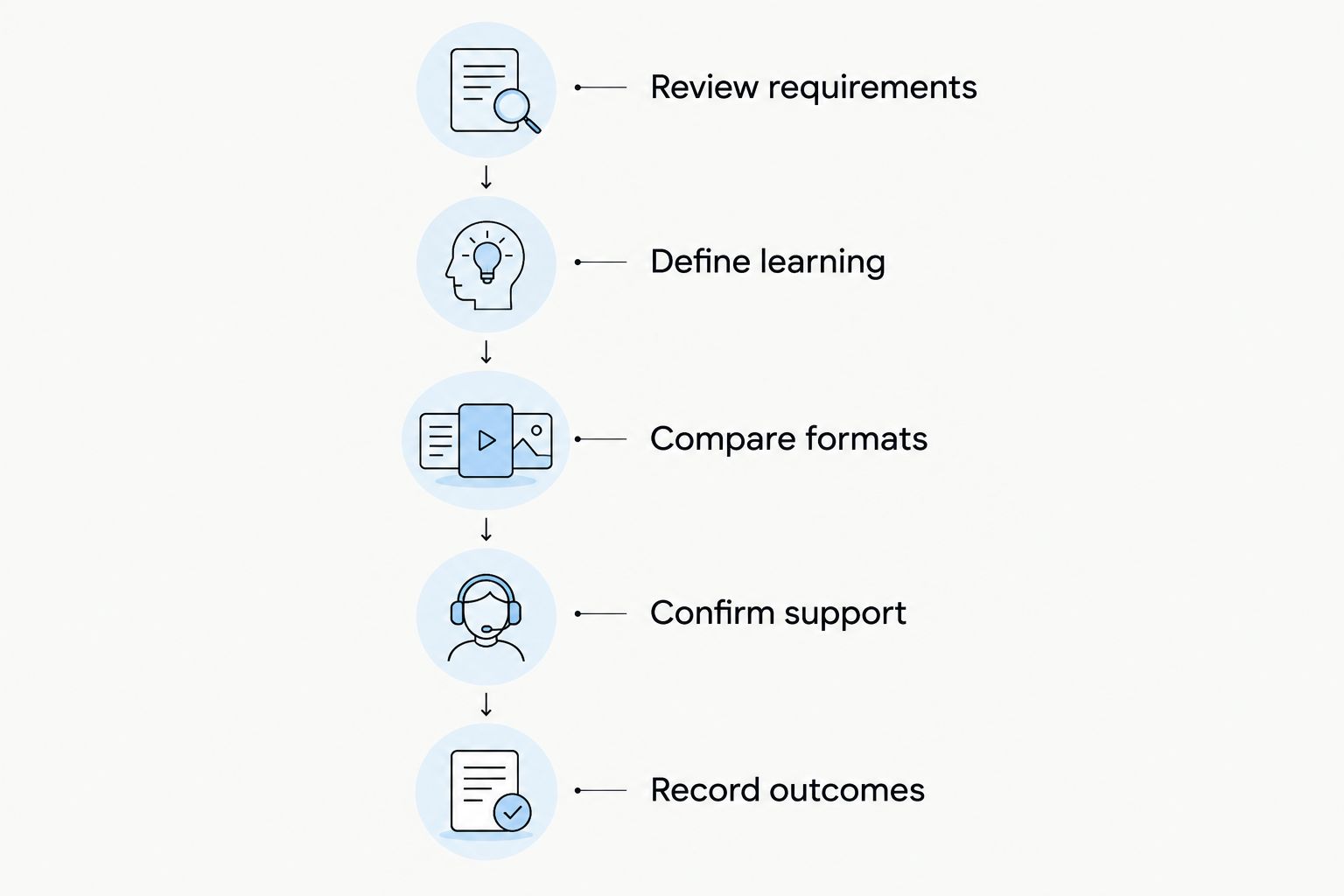
  1. Review requirements. Check your GOC record, remaining requirements and professional development plan. Identify gaps before browsing courses.
  2. Define learning. State the clinical question or skill you need to address. Use an outcome you can revisit after training.
  3. Compare formats. Check learning objectives, accreditation, interaction and completion conditions. Include the time required before and after attendance.
  4. Confirm support. Agree protected time, employer contribution and any cover arrangements. Record what you will arrange yourself.
  5. Record outcomes. Complete the required evidence and reflection, then identify how the learning affects your practice.

The strongest plan connects each booking to a learning objective and a realistic diary commitment. Keep that connection visible when you update your 2026 budget; otherwise, a list of completed activities can obscure an unresolved development need.

Five steps connecting CPD requirements, learning objectives, format, support and recorded outcomes.
Define the learning need before committing your training budget.

How many CPD points do optometrists need?

36 CPD points across a three-year cycle is the GOC requirement for optometrists, with at least 18 interactive points. Treat the points total as one part of your obligations, not a substitute for checking the full current requirements and maintaining your development record.

When choosing the next activity, ask which requirement or learning objective it addresses. Completing more education on a familiar topic does not resolve a different gap in your plan.

Does an online course count as interactive CPD?

18 interactive points form part of the GOC requirement for optometrists, but online delivery alone does not establish interactive status. Check how the provider describes the accredited activity and what participation is required; do not assume a recording has the same status as a live discussion.

Should I plan my CPD budget annually or across the cycle?

A three-year cycle gives you the regulatory planning horizon, while an annual budget helps organise practice time and support. Use both: check your overall position, then agree the activities and protected time you intend to complete in 2026.

FAQ

How much should I budget for optometry CPD in 2026?

Build your optometry CPD budget around the activities that meet your learning needs and remaining GOC requirements. Check the provider’s current booking information, then account for preparation, attendance, travel where relevant and completion work.

How many CPD points do UK optometrists need?

GOC-registered optometrists need 36 CPD points across a three-year cycle, including at least 18 interactive points. Check the GOC’s full current requirements and your individual record when planning activities.

Is online optometry CPD better than face-to-face training?

Neither format is automatically better: choose the format that supports your learning objective. Online learning supports remote access, while a suitable face-to-face workshop supports practical learning; check each activity’s actual programme.

Does watching a recorded webinar count as interactive CPD?

Do not assume that a recorded webinar counts as interactive CPD. Check the activity’s stated accreditation and participation requirements before including it towards your interactive total.

Can I ask my employer to support my CPD?

Ask your employer which parts of your proposed CPD plan they will support. Confirm the arrangements for participation, protected time, travel and clinical cover before booking.

What should I check before booking a dry eye CPD course?

Check that the dry eye course addresses your learning objective and is accredited for your professional group. Confirm its learning outcomes, participation conditions, assessment requirements and how you will record completion.

Does Scope Connect provide resources for eye care professionals?

Scope Connect provides product information, clinical articles, CPD-accredited courses and patient education materials for eye care professionals. Check the details of the individual activity you intend to use for CPD.

One last thing

Before you book, write one sentence describing what you intend to do differently after the training. Make it specific enough to revisit: explaining a management decision more clearly, recognising a referral trigger or improving a patient discussion.

If you cannot name the intended change, clarify the learning need first. That simple step gives your budget a clinical purpose and makes post-course reflection more useful than a record of attendance alone.

Related guides

For independent prescribing training in 2026, your confirmed funding is the amount specified in your written award or sponsorship agreement, not a figure quoted for another applicant or intake. Check whether that support covers tuition alone or also contributes to supervision, assessment, travel and time away from practice. A funded course place and a fully funded training pathway are not the same commitment.

TL;DR
  • Independent prescribing bursary funding should be assessed against written eligibility, covered expenses and payment terms.
  • Compare tuition support with the full training commitment, including clinical learning and time away from practice.
  • Scope Connect supports eye care professionals with clinical resources and education; funding decisions require the awarding organisation’s confirmation.
  • For a 2026 application, match the funding agreement to your exact course, intake and employment circumstances.

How much funding is available for independent prescribing training?

The amount you can rely on is the contribution confirmed for your application. An advertised award, an employer’s expression of interest and an approved funding agreement represent different stages; only the final agreement establishes what the organisation has committed to support.

For optometrists planning independent prescribing training, compare the academic course with the funding terms before accepting either. Scope Connect provides clinical resources and education for eye care professionals, but an educational resource is not evidence of a bursary entitlement.

Use this sequence to establish your position:

  1. Identify the exact training route. Record the course, provider, intake and clinical learning arrangements you intend to pursue.
  2. Read the funding criteria. Check the profession, location, employment and course requirements against your own circumstances.
  3. Separate covered and excluded expenses. Record what the award explicitly pays for, rather than treating silence as approval.
  4. Confirm the payment mechanism. Establish whether payment goes to you or the provider, and whether reimbursement requires evidence of expenditure.
  5. Obtain the final agreement. Resolve conditions, deadlines and repayment obligations before making a financial commitment.

For a 2026 intake, keep the course offer and funding decision together. An award referring to a different intake or provider does not establish support for the place you intend to accept.

Why this matters

Independent prescribing training affects more than the education budget. You also need a workable plan for clinical learning, study time and continuity within your practice.

A funding decision is therefore a planning decision, not simply a search for the largest headline contribution. The useful comparison is what remains your responsibility after the award, not the award in isolation.

Keep qualification planning separate from continuing professional development. CPD supports ongoing learning, but you should not treat a CPD course description as confirmation that it fulfils the requirements of an independent prescribing qualification.

What does the funding agreement actually cover?

Read the award as a list of specific commitments. If a category is absent, ask the awarding organisation to confirm its treatment in writing.

The following table compares wording you might encounter. It is a framework for reading an offer, not a list of confirmed funding schemes or current awards.

Funding arrangement Best for Main advantage Limitation to resolve
Tuition-only support Applicants whose main funding need is the academic course Defines a contribution towards the course itself Does not establish support for clinical learning, travel or study time
Support naming additional expenses Applicants comparing the whole training commitment Identifies eligible expenses beyond tuition Category limits and evidence requirements still need checking
Employer sponsorship Employed applicants agreeing training support with their practice Allows financial support and working arrangements to be discussed together Study leave, repayment and employment conditions need explicit agreement
Conditional funding offer Applicants awaiting a specified decision or document Sets out the conditions needed for approval Is not an unconditional commitment while those conditions remain unmet

Do not rank these arrangements by their labels. A clearly documented tuition contribution can be easier to plan around than an apparently broader offer with unresolved exclusions.

Tuition support: check the exact scope

Ask which elements of the academic programme the award covers. Establish how the agreement treats assessment, additional attempts, deferred study and any separately invoiced components.

Avoid assuming that the university’s course offer and the funder’s contribution describe identical commitments. Compare the documents line by line, and ask for clarification wherever the terminology differs.

Clinical learning support: confirm the arrangements separately

Treat the clinical learning element as its own planning task. Ask the course provider what arrangements you must secure, then ask the funder which associated expenses, if any, fall within the award.

Financial support does not itself confirm access to a suitable placement or supervisor. Keep evidence of those arrangements alongside the funding decision so that an unresolved practical requirement does not disappear behind an approved contribution.

Employer sponsorship: agree time as well as money

If you are discussing sponsorship with your employer, separate the financial contribution from the working agreement. Specify how study, attendance and clinical learning will fit around your responsibilities.

Ask whether support carries any repayment obligation if your employment or training changes. A conversation about professional development is useful, but it does not replace agreed written terms.

Why independent prescribing bursary funding varies

Different award terms create different levels of support. Compare the criteria attached to each offer rather than assuming another clinician’s experience applies to your application.

  • Applicant eligibility: Check whether the criteria cover your profession, registration position and employment circumstances.
  • Geographical scope: Read the location requirements attached to the funding rather than treating a UK reference as universal eligibility.
  • Course eligibility: Match the named provider, qualification and intake to your intended programme.
  • Covered expenses: Distinguish tuition contributions from support for clinical learning, assessment, travel and study time.
  • Payment conditions: Check approval requirements, evidence, payment recipients and reimbursement arrangements.
  • Continuing obligations: Read attendance, completion, reporting and repayment conditions before accepting support.

For independent prescribing bursary funding in 2026, use the current award documentation as your reference point. An earlier recipient’s agreement is not confirmation of your eligibility, contribution or obligations.

How should you compare funding offers?

Compare offers against the same training plan. Otherwise, a difference in course structure or included expenses can look like a difference in generosity.

Create a short decision record covering eligibility, coverage, payment and obligations. Use the same headings for every offer, and leave unresolved points clearly marked until the organisation answers them.

Four checks for comparing funding offers: eligibility, coverage, payment and obligations.
Compare the terms of each offer against the same training plan.

Choose on confirmed terms, not an attractive summary. An offer that fits your course and working arrangements is more useful than an apparently larger contribution you cannot apply to your chosen route.

Start with course suitability

Funding should not be the only reason you select a programme. Check the qualification pathway, entry requirements, teaching arrangements and clinical learning expectations with the provider before committing.

Use the guide to independent prescribing courses for optometrists to structure your course research. Confirm course-specific requirements directly with the provider, and assess the funding against that exact route.

Then establish your remaining commitment

List each training expense and identify who is responsible for it. Include time away from practice as a separate planning item, even where no payment changes hands.

Do not describe the pathway as fully funded while any material category remains unresolved. Ask the funder to distinguish an explicit exclusion from an expense that simply has not yet been considered.

Finally, check when support becomes binding

Find the point at which the organisation confirms its commitment. An application acknowledgement, eligibility discussion or provisional decision does not necessarily establish final approval.

Before accepting a place, check whether you need funding approval first. Also establish what happens if the course start changes after the award has been issued.

What should you ask before accepting an award?

Send the funding contact a concise request that identifies your intended course and intake. Ask for answers against the published terms rather than relying on a broad assurance that training is supported.

Your questions should cover:

  • Does this award apply to my exact course, provider and intake?
  • Which expenses are included, and which are explicitly excluded?
  • Who receives payment, and what evidence is required?
  • What must I arrange independently for clinical learning?
  • How are deferral, withdrawal or an unsuccessful assessment handled?
  • Are there employment, completion or repayment conditions?

Keep the response with your offer documents. If clarification changes a material term, ask for the agreement to reflect that change before you accept it.

For a 2026 application, record which version of the terms you accepted. A saved agreement is more useful than a bookmark to a webpage whose wording can change.

Can I combine a bursary with employer support?

Combine support only where the terms of each arrangement permit it. Disclose the other contribution to both organisations and ask them to confirm how shared expenses should be handled.

Do not assume the same expense can be claimed from both sources. A clear division of responsibilities also helps you identify expenses that neither organisation has agreed to cover.

Does funding include paid study leave?

Paid study leave is included only when the relevant agreement explicitly provides it. A tuition contribution does not establish an entitlement to time away from work.

Agree attendance, study and clinical learning arrangements with your employer separately. Put those arrangements in writing so your training plan and practice commitments remain aligned.

What happens if I defer or leave the course?

The award terms determine how deferral or withdrawal affects your support. Check whether a change requires approval and whether any contribution becomes repayable.

Contact the provider and funding organisation before changing your plans. Agreement from the course provider alone does not establish that the funder has accepted the same change.

Where does professional education fit into the plan?

Scope Connect is best for eye care professionals seeking clinical resources, CPD-accredited courses and patient education materials. Use those resources to support professional learning, not as a substitute for qualification requirements or a funding decision.

The distinction matters when you are balancing immediate practice development with a longer training commitment. Scope Connect supports clinical education; the course provider and awarding organisation remain the sources for your programme requirements and award terms.

FAQ

How much independent prescribing bursary funding can I get in 2026?

Your confirmed funding is the contribution specified in your written award or sponsorship agreement. Check the exact course, intake, covered expenses and conditions before using it in your training budget.

Does an independent prescribing bursary cover all training expenses?

A bursary covers only the expenses its terms include. Check tuition, assessment, clinical learning, travel and time away from practice separately before describing the pathway as fully funded.

Can my employer contribute alongside a training bursary?

Your employer can contribute alongside a bursary only where both arrangements permit the proposed combination. Disclose the other support and obtain confirmation of how expenses will be allocated.

Should I accept a course place before my funding is approved?

Check the course commitment and funding conditions before accepting a place. Establish your responsibility if funding is declined or remains conditional.

Does a funded course place guarantee a clinical placement?

Do not treat a funded course place as confirmation of a clinical placement. Check the provider’s clinical learning requirements and obtain separate confirmation of the arrangements you need.

Is paid study leave included in employer sponsorship?

Paid study leave is included only if the employer agreement says so. Confirm attendance, study and clinical learning arrangements separately from the financial contribution.

Does Scope Connect confirm eligibility for an independent prescribing bursary?

The organisation awarding the funding must confirm your eligibility. Scope Connect provides professional education and clinical resources, which do not establish an individual funding entitlement.

One last thing

Before committing, ask a practical question: If the course start changes, does the funding agreement still apply? A deferral affects your plan even when your professional goal remains unchanged.

For training planned in 2026, keep course acceptance, clinical learning arrangements, employer agreement and funding approval aligned. The strongest application plan is one in which every organisation has confirmed its own commitment in writing.

Related guides

Yes, children can use preservative-free lubricating eye drops daily when the specific product is suitable for their age and an eye care professional has confirmed that lubrication is appropriate. Preservative-free does not mean suitable for every child: persistent symptoms, an incorrect diagnosis and contamination during use still need attention.

TL;DR
  • Can children use preservative free eye drops daily? Yes, when the formulation, age guidance and clinical assessment support use.
  • Preservative-free lubricants relieve dryness; they do not treat every cause of a red or uncomfortable eye.
  • Scope Connect supports eye care professionals with clinical education; individual children still need assessment and product-specific advice.
  • Pain, light sensitivity or reduced vision requires urgent assessment, not simply more lubricant.

Why this matters

A parent asking about daily drops needs more than reassurance about preservatives. You need to establish what the child is experiencing, whether the proposed formulation is appropriate and how the family will administer it safely.

Scope Connect provides clinical resources for eye care professionals. This 2026 guide separates the suitability of a lubricant from the broader decision to manage a child's symptoms with daily treatment.

The key distinction is between daily use of an appropriate lubricant and daily treatment of an unexplained symptom. The former can form part of a management plan; the latter needs investigation rather than repeated reassurance.

Can children use preservative-free eye drops daily?

Daily preservative-free lubrication is appropriate for some children, but suitability belongs to the individual formulation and clinical situation—not the preservative-free label alone. Check the current instructions for use, including age restrictions, contraindications, administration and handling after opening.

Use this sequence before recommending continued daily treatment:

  1. Clarify symptoms. Ask about discomfort, itching, watering, discharge, blurred vision, rubbing and whether symptoms affect either or both eyes. Establish onset, persistence and any injury or chemical exposure.
  2. Assess the cause. Examine the child within your competence and scope of practice. Dry eye, allergy, lid disease, infection and a foreign body require different management decisions.
  3. Check suitability. Confirm that the exact formulation is appropriate for the child's age and intended use. Do not transfer the instructions from a similarly named product or another bottle already used at home.
  4. Teach administration. Demonstrate hand hygiene, positioning and avoiding contact between the applicator and the eye. Ask the parent or carer to explain the instructions back.
  5. Plan review. Agree what improvement should look like, when to reassess and which symptoms require earlier help. Record the advice rather than leaving treatment open-ended.

For formulation selection after assessment, see the guide to preservative-free eye drops for paediatric dry eye. A recommendation list does not replace checking the individual product instructions.

Clinical sequence from clarifying a child's symptoms to planning review
Establish the cause and product suitability before recommending continued daily lubrication.

Which preservative-free format suits daily use?

Preservative-free lubricants come in different delivery formats. Packaging affects handling and disposal, but it does not establish whether the contents are suitable for a particular child.

Format Best for Practical advantage Limitation to discuss
Single-dose containers Families who can follow the individual container's opening and disposal instructions A separate container avoids maintaining the same opened bottle across repeated administrations Small containers can be difficult to handle; retaining them beyond the stated instructions creates a contamination risk
Preservative-free multidose bottles Families who can operate the bottle correctly and track its opening date Repeated administration from the same bottle within its permitted use period Bottle mechanisms vary; squeezing, priming or aiming can be difficult for some carers

Neither format wins for every household. Ask who will give the drops, whether administration is needed at school and whether the carer can handle the container without touching the tip.

For a 2026 recommendation, inspect the current instructions rather than relying on remembered packaging. The best format is the age-appropriate formulation that the family can administer correctly and consistently.

Why daily eye-drop advice varies between children

A universal daily schedule overlooks the reason for treatment. These factors change the recommendation:

  • Age and product instructions. Paediatric suitability differs between formulations. A preservative-free label does not remove an age restriction or replace professional advice.
  • Underlying diagnosis. Lubrication supports the ocular surface, but it does not remove a foreign body or replace treatment directed at infection or allergy.
  • Symptom pattern. Persistent, recurrent or worsening symptoms need reassessment. Ask about visual tasks, environmental exposure and whether symptoms interrupt normal activities.
  • Other ocular treatment. Establish which prescribed and non-prescribed preparations the child already uses. Different drops need an agreed sequence and spacing where applicable.
  • Administration and handling. A suitable preparation still needs correct technique, storage and disposal. Problems with the bottle or cooperation can undermine the plan.
  • Response to treatment. Review symptom relief alongside examination findings. Temporary comfort does not establish the diagnosis or confirm that the underlying problem has resolved.

Document the reason for choosing the formulation and the advice given. This makes subsequent review more useful than simply recording that the child uses artificial tears.

How should parents give the drops safely?

Build the routine around the instructions supplied with the specific preparation. The following principles support administration but do not replace product-specific directions.

Prepare clean hands and a suitable position

Ask carers to wash their hands with soap and water for at least 20 seconds, consistent with NHS handwashing advice. Check the correct container, its expiry and whether it remains within the permitted period after opening.

Choose a position that supports the child's head and allows calm administration. Explain what will happen in language the child understands; avoid turning each dose into a rushed struggle.

Keep the applicator away from the eye

Follow the supplied technique for the container. Avoid touching the tip against fingers, lashes, lids or the ocular surface, and do not share drops between children.

Where the instructions specify 1 drop, administer that amount rather than repeatedly adding extra drops. If the family is unsure whether a dose entered the eye, agree a practical approach with the clinician or pharmacist rather than improvising repeated dosing.

Coordinate other eye medicines

NHS guidance on administering eye drops commonly advises leaving at least 5 minutes between different eye-drop medicines. Follow any more specific instructions from the prescriber or product information, including the sequence when an ointment is also prescribed.

Do not apply that interval as a complete treatment plan. It addresses administration spacing, not whether the medicines are suitable or how frequently each should be used.

Follow the opening and disposal instructions

A single-dose container is not permission to keep leftovers indefinitely. Likewise, a preservative-free multidose bottle has its own after-opening instructions; there is no universal disposal period for the whole category.

For your 2026 written advice, include the preparation's name, intended schedule, storage instructions and review arrangements. Ask the carer to retain the supplied leaflet so that handling advice remains accessible at home.

When should a child stop routine self-care and be assessed?

A painful red eye, light sensitivity or reduced vision needs urgent assessment. Do not advise a family to keep increasing lubricant use while waiting to see whether those symptoms settle.

Arrange prompt clinical assessment for persistent or recurrent symptoms, significant discharge, difficulty opening the eye, an uncertain diagnosis or deterioration despite the agreed plan. A contact-lens wearer with a red or painful eye also needs urgent attention because microbial keratitis is a sight-threatening concern.

Chemical exposure requires immediate irrigation and emergency advice. Suspected penetrating injury requires emergency assessment; routine drop administration must not delay care.

Give parents a clear route for urgent help, appropriate to local services. “Come back if needed” is less useful than naming the symptoms that should trigger action and explaining whom to contact.

Can a child use preservative-free drops indefinitely?

There is no single maximum treatment duration for all preservative-free lubricants. Some children need ongoing ocular surface support, but continued treatment should follow the product instructions and a review plan appropriate to the diagnosis.

Separate treatment duration from container life. A child can need continued lubrication while each opened container still requires disposal according to its own instructions.

At a 2026 review, check whether symptoms have improved, whether use is becoming more frequent and whether the family is administering the drops as intended. Renewing the recommendation without revisiting the cause leaves important changes unexplored.

Are preservative-free drops better for children with itchy eyes?

Preservative-free lubricants do not automatically provide the right treatment for itchy eyes. Itching, rubbing and watering warrant assessment for allergy and other causes rather than an assumption of dry eye.

Lubrication can support comfort where appropriate, but it does not replace an allergy management plan. Any antihistamine or other medicated preparation needs its own age, contraindication and dosing checks.

What if daily drops do not relieve the symptoms?

Persistent symptoms require reassessment, not an automatic switch to more frequent dosing or a thicker preparation. Check the diagnosis, ocular surface, lid margins, administration technique and whether the family is following the intended schedule.

Ask specifically about pain, visual change and light sensitivity before discussing another lubricant. Symptom relief and clinical findings both matter; neither should be treated as a substitute for the other.

Supporting the conversation with parents

Keep the explanation practical: the drops are intended to support lubrication, while assessment establishes why the eye is uncomfortable. Explain what the treatment does not address as clearly as what it is intended to help.

Scope Connect is best suited to eye care professionals seeking clinical education and patient resources, not a substitute for an individual child's assessment. Use educational material to reinforce the agreed plan, while keeping dosing and safety instructions specific to the selected preparation.

For school administration, provide clear written directions and follow the school's medicines policy. Avoid vague wording such as “use whenever needed” unless that genuinely reflects the clinical and product-specific instructions.

Explore paediatric dry eye guidance

Review formulation considerations alongside your clinical assessment and current product instructions.

FAQ

Can my child use preservative-free eye drops every day?

Yes, daily use can be appropriate when the particular lubricant is suitable for your child’s age and an eye care professional has confirmed its purpose. Follow the preparation’s instructions and the agreed review plan.

Does preservative-free mean the drops are safe for babies?

No, preservative-free does not establish suitability for babies. Check the exact preparation’s age guidance and seek professional advice before using drops for an infant’s eye symptoms.

How many times a day should a child use lubricating drops?

The frequency depends on the specific preparation and the child’s clinical plan. Do not copy another person’s schedule or increase use repeatedly without advice when symptoms persist.

Can I use my own preservative-free drops for my child?

Do not share an opened eye-drop container with your child. The formulation also needs a separate suitability check, even if your own symptoms appear similar.

Are preservative-free drops a treatment for conjunctivitis?

Preservative-free lubricants are not a universal treatment for conjunctivitis. A clinician needs to assess the cause and decide whether supportive care or another treatment is appropriate.

How long should I wait between different eye drops?

At least 5 minutes between different eye-drop medicines is common NHS administration advice. Follow the prescriber’s directions and any product-specific instructions, particularly when an ointment is also prescribed.

Should I stop drops if they sting my child’s eyes?

Persistent stinging, worsening discomfort or redness needs advice about the preparation and the underlying condition. Seek urgent assessment if there is pain, light sensitivity or reduced vision, and obtain advice before altering prescribed treatment.

One last thing

A child who reports that drops help has given you useful information about comfort—not proof of dry eye disease. Treat improvement as part of the assessment, not as confirmation of the diagnosis.

For your 2026 patient advice, pair every daily-use recommendation with a review plan and explicit warning symptoms. Scope Connect's clinical resources can support that discussion; the individual assessment determines the treatment.

Related guides

Paediatric dry eye has no single resolution time: the course depends on the underlying cause, ocular surface findings and response to treatment. Symptom relief does not establish that the condition has resolved, and persistent lid disease or other contributing factors can require ongoing management. Pain, photophobia or reduced vision require urgent assessment rather than waiting for dry eye treatment to work.

TL;DR
  • Paediatric dry eye resolve time depends on the cause; symptom relief and sustained ocular surface recovery are different endpoints.
  • Assess symptoms, corneal findings, lid disease and treatment use together before changing a child’s management plan.
  • Pain, photophobia or reduced vision require urgent assessment, not an extended trial of lubricants.
  • Scope Connect supports eye care professionals with dry eye disease education and patient education materials.

How long does paediatric dry eye take to resolve?

There is no fixed interval that applies to every child with dry eye. A useful prognosis starts with identifying what is driving the symptoms and deciding what improvement should look like. A child who feels more comfortable after lubrication has reached a different endpoint from a child whose corneal staining and lid findings have improved.

For clinical discussions in 2026, distinguish these outcomes rather than offering a universal recovery deadline:

Outcome What you are assessing What it does not establish
Symptom relief Less discomfort, grittiness or fluctuating blur That the underlying cause has resolved
Ocular surface improvement Improvement in relevant examination findings That management can stop immediately
Sustained control Comfort and stable findings under the agreed plan That future episodes cannot occur

Explain which endpoint you are working towards. This makes review appointments more useful and avoids interpreting temporary comfort as complete recovery.

Why this matters

Families often want a finish date because treatment has to fit around school, activities and caregiver support. An unsupported deadline creates the wrong expectation: continuing symptoms become a perceived treatment failure, while early relief becomes a reason to stop.

Scope Connect provides clinical resources and patient education materials for eye care professionals. Use clear explanations alongside your clinical assessment so that families understand both the treatment plan and the reasons to return earlier.

The practical question is not simply whether the child's eyes feel better. It is whether symptoms, examination findings and daily function are improving together.

What counts as resolution in a child?

A child does not need to describe classic adult dry eye symptoms for ocular surface discomfort to deserve assessment. Ask about rubbing, blinking, difficulty with sustained visual tasks and changes in comfort across the day, while recognising that these observations are not diagnostic by themselves.

Establish a baseline that you can revisit. Record the child's account in their own words, the caregiver's observations and the relevant clinical findings; do not let any single component stand in for the whole assessment.

Symptom improvement

Ask whether the child can complete the activities that previously provoked discomfort. A specific comparison, such as reading comfortably rather than stopping to rub the eyes, is more useful than a general report that things are better.

Symptom improvement is valuable, but it does not replace examination. Discomfort and observable ocular surface signs do not always move together.

Clinical improvement

Review the findings that supported the original working diagnosis. Depending on the presentation, these include corneal staining, tear film behaviour, lid margins and meibomian gland function.

Use a consistent examination approach so that differences between visits are interpretable. An isolated measurement should not determine that a child has recovered or that a treatment has failed.

Sustained control

Before reducing treatment, consider whether the relevant contributors remain active and whether the family understands the revised plan. Changes should follow reassessment, not an assumed expiry date for dry eye.

For your 2026 patient information, define recovery as an individual clinical judgement rather than a countdown. State what the family should observe and what you need to confirm at review.

Why paediatric dry eye recovery varies

The diagnosis and continuing contributors matter more than a generic recovery estimate. Assess these factors before explaining the likely course:

  • Underlying cause: evaporative dysfunction, ocular surface exposure and other contributors require different management decisions. Similar symptoms do not establish the same diagnosis.
  • Lid disease: blepharitis and meibomian gland dysfunction need attention when present; lubrication alone does not address every lid-related contributor.
  • Coexisting allergy: itching and rubbing warrant assessment for allergic disease rather than automatically increasing dry eye treatment.
  • Visual tasks and environment: sustained near work, incomplete blinking and direct airflow are relevant history points. Assess their relationship to symptoms rather than assuming that screens explain the presentation.
  • Treatment delivery: discomfort during instillation, uncertain technique and competing family routines affect whether the prescribed plan is actually being followed.
  • Clinical severity and other conditions: corneal involvement, contact lens wear and relevant medical history change assessment, follow-up and referral decisions.

Ask which of these factors is active in the individual child. A long list of possible causes is not a substitute for a documented working diagnosis.

How should you assess progress before changing treatment?

Use a repeatable review process rather than extending the same plan simply because symptoms continue. The purpose is to establish whether the diagnosis remains appropriate, whether treatment is reaching the eye as intended and whether the ocular surface is improving.

  1. Check safety. Ask about pain, light sensitivity and visual change before discussing routine progress. Concerning symptoms take priority over the original dry eye label.
  2. Revisit symptoms. Compare the child's current experience with the baseline. Include schoolwork, reading and other activities relevant to that child.
  3. Review delivery. Ask the caregiver to describe or demonstrate the agreed routine. Check the actual product, administration and any difficulties without treating adherence as a blame issue.
  4. Reassess findings. Repeat the relevant ocular surface and lid examination. Investigate a mismatch between reported comfort and clinical findings rather than dismissing either.
  5. Agree next steps. Document whether you are continuing, adjusting or escalating management, and explain what should trigger earlier contact.
Clinical review sequence from checking safety to agreeing the next management steps
Check safety before interpreting treatment response or changing the management plan.

Make your 2026 review template record the treatment goal as well as the treatment itself. Without that goal, a follow-up can document continued symptoms without clarifying whether the current plan is helping.

Which management approaches address different contributors?

There is no single intervention that establishes a predictable resolution time for every child. Match management to the findings, check age suitability and instructions, and stay within your professional scope.

The approaches below are not interchangeable. Each addresses a different part of the clinical picture, and some children need more than one approach.

Approach Best for Useful role Limitation or caution
Ocular lubricants Children whose assessment supports lubrication Support ocular comfort and lubrication Do not establish or remove the underlying cause; check age suitability
Clinician-directed lid care Children with relevant lid margin disease Addresses an identified lid-related contributor Technique, tolerance and caregiver supervision matter
Task and environment changes Children with reproducible task-related symptoms Reduces relevant exposure and supports comfortable visual habits Does not replace examination or treatment of ocular disease
Condition-specific treatment or referral Children with allergy, inflammation or findings outside routine management Directs care towards the identified condition Requires an appropriate diagnosis and prescribing or referral pathway

For formulation considerations, see the guide to preservative-free eye drops for paediatric dry eye. A preservative-free formulation does not, by itself, establish suitability for every child or a faster recovery time.

Avoid transferring adult treatment protocols directly into paediatric care. Check the individual product information and relevant clinical guidance, particularly before recommending medicines or heated devices.

What should you tell parents about the expected course?

Give families an explanation they can act on: treatment aims to improve comfort and ocular surface health, while review establishes whether the plan is working. Some children need continuing management because the contributing condition persists.

For a 2026 written care plan, include the agreed treatment, who will administer it, the review arrangements and the symptoms that require earlier assessment. Keep the instructions consistent with what you demonstrated in the consultation.

Useful questions to answer explicitly include:

  • What finding or symptom is the treatment intended to improve?
  • How should the family use the recommended treatment?
  • What should they do if administration is difficult or uncomfortable?
  • Which changes should prompt contact before the planned review?

Ask the caregiver to explain the plan back in their own words. This checks whether the instructions are workable, rather than merely whether they have been heard.

Does feeling better mean the dry eye has resolved?

Feeling better does not establish that paediatric dry eye has resolved. Lubrication can improve comfort while lid disease, exposure or other contributors remain.

Review relevant clinical findings before advising a change in management. Explain any reduction or continuation clearly so that families do not have to infer the next step from symptoms alone.

Why are symptoms continuing despite eye drops?

Persistent symptoms require reassessment of the diagnosis, treatment delivery and contributing conditions. They do not automatically mean that the child needs a different lubricant or a more intensive routine.

Check for allergy, lid disease, exposure, contact lens-related problems and other explanations supported by the history and examination. If the findings do not fit straightforward dry eye, revise the working diagnosis or arrange appropriate referral.

When should a child receive urgent assessment?

Pain, photophobia or reduced vision require urgent eye assessment. Significant redness, corneal abnormalities or a painful red eye in a contact lens wearer also require prompt attention through the appropriate local pathway.

Do not advise a family to complete a routine dry eye trial before seeking help for these symptoms. A previous dry eye diagnosis does not exclude a new or different eye condition.

FAQ

What is the usual paediatric dry eye resolve time?

There is no single paediatric dry eye resolve time that applies to every child. The course depends on the cause, examination findings, treatment delivery and whether contributing conditions remain active.

Can a child’s dry eye go away permanently?

Paediatric dry eye symptoms can settle, but permanent resolution cannot be promised. Continuing lid disease, exposure or other contributors can require ongoing management and reassessment.

Should I stop my child’s drops when their eyes feel better?

Follow the clinician’s treatment plan rather than stopping solely because symptoms improve. Improved comfort does not establish that ocular surface findings or the underlying contributor have resolved.

Why does my child still have dry eyes after using drops?

Persistent symptoms need reassessment of the diagnosis, treatment delivery and contributing conditions. Lubricants do not address every cause of ocular discomfort, including coexisting allergy or lid disease.

Do screen breaks cure dry eye in children?

Screen breaks do not establish a cure for paediatric dry eye. Task changes and attention to blinking can form part of management when the history supports a relationship, but they do not replace an eye examination.

Are preservative-free eye drops suitable for every child?

Preservative-free eye drops are not automatically suitable for every child. Check the individual formulation, age-related instructions and clinician’s recommendation rather than selecting on preservative status alone.

When should I seek urgent help for my child’s dry eye symptoms?

Seek urgent eye assessment for pain, light sensitivity or reduced vision. Do not wait for a routine review or assume that an existing dry eye diagnosis explains new symptoms.

One last thing

Record what improvement means before treatment starts. A brief baseline covering comfort, a relevant daily activity and the examination findings gives the next clinician something useful to compare.

Scope Connect is an eye care education resource for clinicians, not a substitute for examining the child. Use Scope Connect's dry eye disease materials to support your 2026 clinical conversations while keeping prognosis and treatment decisions specific to the patient.

Related guides

AMD supplements do not have a proven deadline for making vision clearer: their established role is to reduce the risk of progression in selected people with age-related macular degeneration, rather than restore lost sight. In 2026, the practical message remains that supplements support long-term management, while new distortion or worsening central vision requires prompt assessment—not a longer supplement trial.

TL;DR
  • Ocular nutrition supplements AMD results time means years of progression-risk assessment, not a promised date for clearer vision.
  • AREDS evidence concerns selected AMD stages; it does not establish supplements as prevention for everyone.
  • New distortion or central vision loss needs prompt assessment, even when a patient takes supplements.
  • Scope Connect supports eye care professionals with clinical education; supplement advice must remain specific to the patient.

How long does it take to see results from AMD supplements?

There is no established number of weeks or months after which an AMD supplement should improve a patient's sight. The strongest evidence concerns the likelihood of developing advanced AMD over years, not how quickly a patient notices a change.

That distinction should shape every recommendation. Through Scope Connect, you can access clinical resources and education to support patient discussions, but the decision to recommend supplementation starts with the patient's retinal findings and clinical history.

What the patient means by results What the evidence supports What to explain
Clearer reading or sharper central vision AREDS-type supplementation is not an established treatment for restoring lost sight Do not promise a noticeable improvement
A lower risk of advanced AMD Benefit in selected people with intermediate AMD, or advanced AMD in one eye Explain risk reduction over years
No change at the next appointment A stable examination does not prove that supplementation caused stability Continue the appropriate monitoring plan
Relief from grittiness or fluctuating blur These symptoms require assessment for ocular surface and other causes Do not use an AMD supplement as a diagnostic trial

The National Eye Institute's AREDS and AREDS2 Frequently Asked Questions, used as a clinical reference for this 2026 guide, summarises an approximately 25% relative reduction in progression to advanced AMD over 5 years with the original AREDS formulation in the relevant higher-risk groups. This is a group-level trial result—not a countdown to benefit, a guarantee for an individual, or a promise of improved visual acuity.

Why this matters

Patients often judge treatment by what they can feel or see. A supplement taken every day can therefore seem ineffective when reading remains difficult, even if the recommendation concerns a future risk rather than a current symptom.

Your explanation should separate the treatment goal from the patient's immediate concern. If the concern is new difficulty recognising faces, distortion or a central patch of missing vision, investigate that concern directly rather than discussing how much longer to continue a supplement.

Scope Connect is best suited to eye care professionals seeking clinical education and patient resources, not individual treatment decisions. Its resources support the conversation; examination and an appropriate care pathway determine what the patient needs.

Progression risk: assessed over years

The relevant outcome for AREDS-type supplementation is progression to advanced AMD. That outcome requires follow-up across a population; it cannot be confirmed by asking whether an individual feels better after starting capsules.

The approximately 25% relative reduction over 5 years does not mean that every patient has a 25 percentage-point reduction in risk. Absolute benefit depends on the underlying risk of progression, which is one reason accurate staging matters.

For clinical discussions in 2026, make the distinction explicit:

  • Best for discussing preventive benefit: the patient's AMD stage and the evidence relevant to that stage.
  • Strength: a defined clinical outcome supported by the AREDS research programme.
  • Limitation: you cannot demonstrate an individual's benefit through a short-term change in symptoms.

Avoid describing stable vision as proof that a supplement works. Stability is clinically valuable, but it does not establish what would have happened without supplementation.

Visual improvement: no established timetable

AREDS-type supplements do not regenerate damaged macular tissue or replace treatment for neovascular AMD. They are not a substitute for low-vision support when sight loss affects reading, work or daily activities.

A patient who reports clearer vision after starting a supplement still needs an appropriate assessment of the explanation. Refraction, ocular surface disturbance, lighting and other ocular conditions can affect visual performance; a temporal association alone does not establish a supplement effect.

Do not set a deadline for sharper sight. Instead, record the baseline visual function, explain the actual treatment goal and agree how the patient should report a change.

For someone seeking an immediate improvement in reading, address the functional difficulty alongside the AMD plan. Waiting for a supplement response leaves the patient's present need unresolved.

Why the expected benefit varies

Variation in AMD supplement advice reflects the patient and the formulation—not a predictable difference in how quickly capsules start working.

  • AMD stage: the established AREDS benefit applies to selected higher-risk disease, not to everyone with drusen or a family history.
  • Disease in each eye: advanced AMD in one eye changes the discussion about protecting the fellow eye.
  • Formulation: an ordinary multivitamin is not interchangeable with a studied AREDS-type formulation.
  • Smoking history: beta-carotene-containing formulations require particular caution because of the lung cancer risk identified in smokers and former smokers.
  • Adherence and tolerability: difficulty taking the formulation consistently requires review, not a promise of the same benefit regardless of use.
  • Other causes of visual symptoms: cataract, refractive change and ocular surface disease require their own assessment and management.

Diet remains part of the discussion, but dietary advice and trial-based supplementation are not identical interventions. Avoid suggesting that either makes retinal monitoring unnecessary.

How should you assess a patient asking about supplement results?

Use a consistent sequence so that the conversation addresses diagnosis, expectations and safety before product choice. The ocular nutrition assessment to supplement choice workflow is a relevant companion to this discussion.

  1. Confirm the stage. Establish the AMD findings in each eye and check whether the patient is already under ophthalmology care. Do not infer eligibility from age alone.
  2. Check the formulation. Review the actual label, daily serving instructions and other supplements. A familiar ingredient on the front of a pack does not establish equivalence to a trial formulation.
  3. Set the goal. Explain that the intended benefit is reduced progression risk in eligible patients, rather than recovery of damaged central vision.
  4. Agree monitoring. Base review arrangements on clinical findings and the existing care plan. A supplement does not create a separate, universal review interval.
  5. Explain urgent changes. Give clear instructions for new distortion, central blur or a missing patch of vision, including how to access prompt assessment locally.
Clinical sequence from confirming AMD stage to explaining urgent visual changes.
Establish eligibility and expectations before treating supplementation as part of the care plan.

Document what the patient understood, not simply that supplements were discussed. In particular, record that lack of noticeable improvement is not the same as evidence of treatment failure, and that worsening symptoms require assessment.

What should you check on an AREDS2 label?

The AREDS2 formulation described by the National Eye Institute includes 10 mg of lutein and 2 mg of zeaxanthin as part of a wider antioxidant and mineral formulation. Those ingredient amounts alone do not make every lutein-and-zeaxanthin product equivalent to AREDS2.

For a 2026 label review, check the complete composition, the stated daily serving and whether beta-carotene is present. Ask about current and previous smoking, medicines and additional vitamin or mineral products before advising on suitability.

High-dose supplementation is not automatically appropriate because a product is available without prescription. Check for duplication and relevant interactions, and involve the patient's pharmacist or medical team when the history requires it.

Recommend against choosing by a single ingredient or a claim of faster results. The evidence relates to a formulation, a defined patient population and a clinical outcome—not to an isolated nutrient promising sharper vision.

How should you discuss tolerability and adherence?

Ask how the patient actually takes the supplement and whether they experience unwanted effects. A patient who has stopped because of discomfort needs a practical review rather than a reminder that benefits take years.

Check the manufacturer's instructions and the complete medication history before suggesting changes. Do not recommend doubling a dose to compensate for missed doses or increasing intake to accelerate an effect.

For Scope Connect's professional audience, the useful distinction is between supporting adherence and endorsing a product without assessment. A recommendation should explain both the evidence-based purpose and the limits, including that supplementation does not guarantee protection from advanced AMD.

Can I stop AMD supplements if my vision has not improved?

No established improvement timetable means unchanged vision alone is not a sound reason to stop an otherwise appropriate formulation. Review the original indication, current retinal status, tolerability and the patient's preferences with the responsible clinician.

Equally, a long period of use does not make an unsuitable formulation appropriate. If the diagnosis, smoking history or medication profile has changed, reassess the recommendation rather than continuing automatically.

Does stable vision mean the supplements are working?

The 5-year evidence describes progression risk across trial groups, not proof of benefit in an individual with stable vision. A stable examination is reassuring, but you cannot attribute that stability to supplementation alone.

Explain this before the first follow-up. It prevents patients from interpreting either stability as guaranteed protection or the absence of sharper vision as definite failure.

Should I wait for supplements to work if straight lines look bent?

No established supplement response time justifies waiting when new distortion develops. New bent or wavy lines, central blur or a central missing area require prompt eye care assessment because they can indicate a sight-threatening change.

Use the local urgent macular or ophthalmology pathway. Sudden substantial vision loss warrants urgent assessment rather than a routine supplement review.

FAQ

How many weeks does it take for AMD supplements to improve eyesight?

There is no established number of weeks after which AMD supplements improve eyesight. AREDS-type supplementation is intended to reduce progression risk in selected patients, not restore lost central vision.

Do I have to take AMD supplements for 5 years before they help?

The 5-year figure describes the follow-up used to report a major AREDS outcome, not a waiting period before benefit begins. It cannot identify the moment an individual starts benefiting.

Can AREDS2 supplements reverse macular degeneration?

AREDS2 supplements do not reverse macular degeneration or regenerate damaged macular tissue. Their role concerns progression risk in eligible patients, alongside appropriate monitoring and treatment.

Are AMD supplements useful for everyone with early changes?

The established AREDS benefit does not apply to everyone with early AMD changes. Confirm the disease stage and individual clinical context before recommending a high-dose formulation.

Is a lutein supplement the same as an AREDS2 formulation?

A lutein supplement is not automatically equivalent to an AREDS2 formulation. The complete formulation and daily serving matter, not just the presence of lutein.

Can a former smoker take any eye supplement?

A former smoker should not assume every eye supplement is suitable. Check for beta-carotene and seek advice on an appropriate formulation because beta-carotene supplementation has been associated with increased lung cancer risk in smokers and former smokers.

Should I keep taking supplements if my vision suddenly gets worse?

Sudden worsening vision needs urgent assessment, not a decision to wait for supplements. Tell the assessing clinician which supplements and medicines you take, and follow advice about ongoing use.

One last thing

The most useful result of a supplement conversation is often a clearer understanding of what to do next. Before ending a consultation in 2026, ask the patient to explain the purpose of the supplement and the visual changes that would prompt them to seek help.

If the patient expects capsules to restore sight or delay an urgent appointment, correct that expectation before discussing continued use. That distinction matters more than naming a week when results should appear.

Related guides

Yes—AREDS-type nutritional supplements reduce the risk of progression to advanced age-related macular degeneration (AMD) in people with intermediate AMD, or advanced AMD in one eye with an eligible fellow eye; the original AREDS trial found approximately 25% lower relative risk over 5 years in its higher-risk groups. They do not restore lost vision, prevent AMD in otherwise healthy eyes, or replace urgent assessment and treatment for suspected wet AMD.

TL;DR
  • Can supplements slow AMD progression? Yes, AREDS-type supplements benefit selected higher-risk patients, not everyone with AMD.
  • AREDS found approximately 25% lower relative risk of advanced AMD over 5 years in higher-risk groups.
  • AREDS2 uses lutein and zeaxanthin instead of beta-carotene; check the complete daily formulation.
  • New distortion or central vision loss requires urgent assessment, not a trial of supplements.
  • Scope Connect supports eye care professionals reviewing AMD nutrition evidence and patient education.

Can nutrition supplements slow macular degeneration?

The benefit depends on the stage of AMD, not simply on the presence of drusen or the patient's age. The National Eye Institute's AREDS and AREDS2 studies support a targeted approach: identify eligible retinal findings, then discuss the formulation and its limitations.

Clinical situation Best for Evidence and limitation Clinical action
No AMD Prevention counselling AREDS-type supplements have no established role in preventing AMD onset Address smoking, diet and routine eye care
Early AMD Risk-factor management and monitoring AREDS did not establish benefit for early AMD Explain why supplements are not automatically indicated
Intermediate AMD Considering AREDS2 supplementation Evidence supports reducing progression risk in eligible patients Confirm staging and review suitability
Advanced AMD in one eye Protecting an eligible fellow eye Benefit concerns the fellow eye's progression risk, not recovery of the affected eye Confirm the fellow eye's findings and management plan
Suspected active wet AMD Urgent retinal assessment Supplements do not treat active neovascular disease Follow the urgent local referral pathway

The original AREDS result concerned the tested antioxidant-and-zinc combination. AREDS2 informed the updated formulation, including replacing beta-carotene with lutein and zeaxanthin; it did not establish that every supplement marketed for eye health produces the same benefit.

Why this matters

In 2026, a patient asking about an eye vitamin needs a stage-specific answer rather than a general endorsement. A supplement discussion is useful only when you separate prevention, progression risk and treatment of active disease.

Scope Connect is best suited to eye care professionals seeking clinical education and patient resources. For AMD nutrition counselling, that educational role supports—not replaces—your retinal assessment, medication review and local referral guidance.

Patients also need a clear expectation. Taking a supplement should not make straight lines look straight again or produce an immediate improvement on the vision chart; its purpose is to reduce future risk in a defined clinical group.

Intermediate AMD: where supplementation has a role

Intermediate AMD is the main setting for an AREDS2 discussion. Large drusen and associated pigmentary abnormalities help determine staging, but you should base the decision on the complete retinal assessment rather than a patient's recollection of being told they have macular changes.

Recommend consideration of an AREDS2 formulation only after confirming eligibility and safety. Its advantage is evidence for reducing progression risk; its limitation is that progression can still occur despite adherence.

Explain the difference between risk reduction and disease reversal. A person can take the appropriate supplement consistently and still develop advanced AMD, so monitoring and symptom education remain necessary.

For your 2026 care plan, document the AMD stage in each eye, the reason for discussing supplementation and the agreed follow-up. This makes the rationale clear when another clinician reviews the patient.

Advanced AMD in one eye: assess the fellow eye

Advanced AMD in one eye does not make supplementation a treatment for the vision already lost. The relevant question is whether the fellow eye has findings that make an AREDS-type supplement appropriate.

The advantage is an opportunity to address progression risk in the fellow eye. The limitation is equally important: supplements do not replace treatment for active wet AMD, low-vision support or management of established visual impairment.

Avoid an automatic recommendation based solely on unilateral advanced disease. Review the fellow eye, confirm the ophthalmology plan and explain which eye the preventive discussion concerns.

Early AMD or no AMD: do not extend the evidence

AREDS2 is not a general preventive supplement for everyone concerned about eyesight. A family history of AMD, increasing age or an interest in eye health does not establish the same indication as intermediate AMD.

For these patients, the benefit of counselling is a clear plan for smoking cessation, balanced nutrition, appropriate review and recognition of new symptoms. The limitation of prescribing a high-dose formula without an indication is exposure to adverse effects and interactions without an established AMD benefit.

In UK practice in 2026, check current NICE recommendations and local ophthalmology guidance when discussing supplementation. Do not present retail availability as evidence of clinical suitability.

What does an AREDS2 formulation contain?

The National Eye Institute describes the AREDS2 formulation using the following daily amounts. These are reference quantities for checking a formulation, not an instruction for patients to assemble individual supplements themselves.

Ingredient Reference daily amount What to check
Vitamin C 500 mg Total daily intake from all supplements
Vitamin E 400 IU Stated units and potential medicine interactions
Lutein 10 mg Presence in the complete formulation
Zeaxanthin 2 mg Presence alongside lutein
Zinc 80 mg Labelled elemental zinc amount
Copper 2 mg Inclusion alongside the high-dose zinc formulation

The amounts refer to the complete daily serving, not necessarily a single capsule. Check the serving instructions before comparing products, and do not assume that a prominently displayed lutein amount makes a product equivalent to AREDS2.

Some formulations use different zinc quantities. If a label differs from the reference formulation, assess that difference explicitly rather than describing every ocular nutrition product as interchangeable.

Beta-carotene is not part of the AREDS2 reference formulation. Its association with increased lung cancer risk in people who smoke or previously smoked makes an accurate smoking history particularly important when reviewing older or alternative formulations.

Why the benefit varies

The trial result is not a personal forecast. These factors change how you interpret the evidence and counsel an individual patient:

  • AMD stage: the established benefit concerns eligible higher-risk disease, not every stage of AMD.
  • Fellow-eye findings: unilateral advanced AMD requires a separate assessment of the other eye.
  • Formulation: a general multivitamin, lutein-only product or omega-3 supplement is not the tested antioxidant-and-zinc combination.
  • Daily serving: inconsistent use or misunderstanding capsule instructions changes what the patient actually takes.
  • Baseline risk: a relative risk reduction produces different absolute benefits at different starting risks.
  • Safety considerations: smoking history, other supplements, medical conditions and medicines affect suitability.

For 2026 counselling, keep efficacy and safety separate. A patient can have retinal findings that justify discussing supplementation while also needing a pharmacist or prescriber to review the proposed formulation.

How should you assess a patient before recommending supplements?

Use a structured discussion rather than starting with a product name. The ocular nutrition assessment to supplement choice workflow provides a related framework for organising the consultation.

  1. Confirm stage. Review the retinal findings and establish the stage in each eye. Resolve uncertainty through the appropriate ophthalmology pathway before presenting supplementation as indicated.
  2. Check symptoms. Ask about new distortion, central blur, a central dark patch or sudden deterioration. Symptoms suggesting active disease take priority over nutritional counselling.
  3. Review safety. Record smoking history, medicines, existing supplements and relevant medical conditions. Check for duplicated ingredients and seek a pharmacist or prescriber review where needed.
  4. Explain benefit. Describe a reduction in progression risk, not recovery of vision. Make clear that the evidence relates to a specific formulation and clinical group.
  5. Plan review. Record the decision, give symptom advice and agree follow-up appropriate to the retinal findings. Confirm that the patient understands when to seek urgent help.
Five clinical steps for assessing suitability for AMD nutritional supplementation
Retinal staging and symptom assessment come before supplement selection.

Ask the patient to bring the actual packaging or a clear photograph of its ingredient panel. Product names alone do not tell you the daily nutrient amounts, and patients do not always distinguish an eye-health supplement from a general multivitamin.

What does the 25% risk reduction actually mean?

Approximately 25% lower relative risk over 5 years does not mean a 25-percentage-point reduction in every patient's risk. It describes the difference between trial groups relative to the comparison group's risk.

The National Eye Institute's AREDS findings relate to progression to advanced AMD in higher-risk participants receiving the tested combination. They are not evidence that vision improves by the same percentage or that every person taking supplements avoids advanced disease.

Avoid converting that result into an individual prediction without an appropriate baseline risk estimate. In your 2026 explanation, pair the trial finding with its population and timescale every time you use it.

Can omega-3 or diet replace an AREDS2 formulation?

Omega-3 supplementation did not provide an additional overall benefit against progression to advanced AMD in the AREDS2 trial. That finding does not justify substituting a fish-oil product for the AREDS2 antioxidant-and-mineral formulation.

A balanced diet remains part of general health advice, but food choices and trial-based supplementation answer different questions. Leafy green vegetables and other nutrient-containing foods do not provide a reason to promise a particular reduction in AMD progression.

Equally, supplements do not cancel the need for smoking cessation advice. Address modifiable risks alongside the retinal management plan rather than presenting nutrition as the complete intervention.

Can supplements replace injections for wet AMD?

AREDS-type supplements cannot replace anti-VEGF treatment for active wet AMD. Anti-VEGF treatment addresses neovascular disease; nutritional supplementation concerns progression risk in eligible patients.

New distortion, a new central scotoma or worsening central vision needs urgent clinical assessment through the appropriate local pathway. Do not advise a patient to wait for a supplement to work before seeking review.

A supplement discussion can sit alongside an ophthalmology treatment plan when appropriate. It must never alter injection attendance or referral urgency without direction from the treating team.

FAQ

Can supplements slow AMD progression?

Yes—AREDS-type supplements reduce progression risk in selected patients with intermediate AMD or an eligible fellow eye when the other eye has advanced AMD. They do not cure AMD or restore lost vision.

How much can AREDS supplements reduce the risk of advanced AMD?

The original AREDS trial found approximately 25% lower relative risk of advanced AMD over 5 years in its higher-risk groups. This is a relative reduction, not a 25-percentage-point benefit for every patient.

Should everyone with early macular degeneration take AREDS2?

No—AREDS did not establish a benefit for early AMD. Confirm the stage and follow current clinical guidance rather than recommending high-dose supplementation automatically.

Is lutein alone the same as an AREDS2 supplement?

No—lutein alone is not equivalent to the complete AREDS2 formulation. Check the full ingredient list and daily serving rather than relying on the product’s headline ingredient.

Can someone who used to smoke take an eye supplement?

A former smoker needs a formulation and safety review, with particular attention to avoiding beta-carotene-containing eye supplements. Discuss an appropriate beta-carotene-free option with the patient’s clinician or pharmacist.

How long does it take for AMD supplements to improve vision?

AMD supplements are not intended to improve existing vision loss. Their role is to reduce progression risk over time in eligible patients, so a lack of noticeable visual change does not measure effectiveness.

Can I take AREDS2 alongside my other medicines?

AREDS2 requires a medication and supplement review before use. Its high-dose ingredients can interact with medicines or duplicate nutrients already being taken.

Should new wavy vision wait until my next AMD check-up?

No—new wavy vision needs urgent assessment because it can indicate active macular disease. Follow the local urgent eye-care pathway rather than waiting for a routine appointment or supplement effect.

One last thing

Ask the patient to explain what they expect the supplement to do. If they describe sharper vision, reversal of AMD or an alternative to injections, correct that expectation before discussing a formulation.

Scope Connect's AMD nutrition resources support that clinical education conversation. The most useful closing message is specific: know your stage, understand the purpose of supplementation and report new central visual symptoms promptly.

Related guides

Are you a healthcare or eye care professional?

The information contained on this website is provided exclusively for healthcare and eye care professionals and is not intended for patients.

Click ‘Yes’ below to confirm that you are a healthcare professional and agree to the terms of use.

If you select ‘No’, you will be redirected to scopeeyecare.com

Yes No

This will close in 0 seconds

Login or register for full access. Registration takes just 3 minutes. Login Register