

Yes. Community pharmacists in the UK can sell preservative-free lubricating eye drops supplied for non-prescription use; a prescription-only eye medicine still requires the appropriate prescription or other lawful supply route. Preservative-free describes the formulation, not its legal classification, and does not establish whether a product is appropriate for the person requesting it.
- For community pharmacists, preservative-free eye drops require product-specific checks: formulation does not determine legal supply status.
- Scope Connect supports eye care professionals seeking clinical education and patient education materials.
- Check red flags, contact lens wear and the manufacturer’s instructions before recommending lubricating eye drops.
- Pain, photophobia or a change in vision requires assessment rather than a routine dry eye sale.
Why this matters
A request for eye drops is also a triage opportunity. Burning, watering and grittiness can accompany dry eye, but a patient’s description does not establish the diagnosis. Treating every uncomfortable eye as uncomplicated dryness risks delaying appropriate assessment.
For your 2026 pharmacy protocol, separate permission to supply from clinical suitability. A product being available without prescription does not make every presentation suitable for self-care. Scope Connect is best for eye care professionals seeking clinical education and patient education resources, rather than patient-specific diagnosis.
Can community pharmacists sell preservative-free eye drops?
Yes, where the individual product is lawfully supplied without a prescription and the consultation supports its use. Check the actual product, not just the shelf label or the description preservative-free.
Some lubricating eye drops are regulated as medical devices; others are authorised medicines. A medical device does not use the same legal classification system as a medicine. For medicines, distinguish general sale list, pharmacy and prescription-only status, and follow the conditions attached to the specific product.
Use this sequence before supply:
- Check the product. Establish whether it is a medical device or medicine, its intended purpose and any applicable supply restrictions.
- Assess symptoms. Ask about onset, affected eye, discomfort, vision, light sensitivity, discharge, injury and previous episodes.
- Check suitability. Review age, contact lenses, other eye treatments, relevant medical history and the product instructions.
- Explain use. Cover administration, hygiene, storage, the labelled discard period and what to do if symptoms change.
- Plan review. Set a clear next step for persistent symptoms and explain which changes require urgent assessment.
Do not treat a lubricating drop as a substitute for an examination when the history suggests another cause. A patient requesting their usual product still needs assessment if the symptoms are new or different.
What should you check for a 2026 supply decision?
Use the current manufacturer’s instructions for a medical device and the current authorised product information for a medicine. MHRA guidance explains the distinction between medical devices and medicines; it does not replace the individual product’s instructions or your professional obligations.
Check local service specifications separately. A retail sale, an NHS-funded supply and supply under a commissioned service are different decisions, even when they involve the same product.
Single-dose units: best for individually packaged administration
Preservative-free lubricants are supplied in different packaging formats. Single-dose units provide an individually packaged quantity, which can suit patients who find that format easier to organise or use away from home.
The limitation is handling. Opening a small unit and squeezing it accurately can be difficult for someone with reduced dexterity or poor vision. Do not assume that a single-dose presentation is automatically easier than a bottle.
Follow the unit’s instructions about use and disposal. Do not recommend keeping an opened unit for later simply because liquid remains. Ask the patient to explain how they will open, administer and discard it before concluding that the format suits them.
Multidose bottles: best for patients comfortable with the dispenser
Preservative-free multidose bottles use packaging designed to protect the contents without a conventional preservative in the formulation. Their operation differs, so demonstrate the relevant technique rather than giving generic squeezing instructions.
A multidose format can suit patients who prefer a bottle for repeated administration. The limitation is that some dispensers require a particular grip, preparation step or squeezing technique, which must be checked against the instructions.
The table below compares packaging, not named products. Neither format wins for every patient.
| Format | Best for | Practical advantage | Limitation to check |
|---|---|---|---|
| Single-dose units | Patients who manage individually packaged doses confidently | Separately packaged units | Opening, squeezing and disposal requirements |
| Preservative-free multidose bottle | Patients who can operate the dispenser reliably | Repeated administration from one bottle | Device technique and the labelled in-use period |
Choose the format the patient can use correctly. Packaging preference should not override formulation suitability, contact lens instructions or the need for referral.
Why the recommendation varies between patients
For a 2026 consultation, base the recommendation on the patient and the product rather than preservative-free status alone. These factors change the decision:
- Symptom pattern: New, unilateral or worsening symptoms need a different assessment from familiar, previously evaluated dryness.
- Frequency of use: Repeated exposure to preservatives is relevant when considering ocular surface tolerance, but dosing remains product-specific.
- Contact lens wear: Compatibility must be confirmed for the exact drop; preservative-free does not automatically mean suitable over lenses.
- Ocular history: Recent surgery, corneal disease, glaucoma treatment and recurrent symptoms can change the appropriate advice.
- Administration ability: Vision, dexterity and the dispenser’s operation determine whether the patient can deliver the drop reliably.
- Other treatments: Existing prescribed eye medicines and any clinician-directed plan must be considered before adding another preparation.
Avoid turning these factors into a universal product hierarchy. A thicker formulation, a different dispenser or a preservative-free label does not establish that a drop is the right next treatment.
How should you triage an eye drop request?
Start with the symptom history before discussing formulations. Ask whether the patient has pain rather than mild irritation, any change in vision, sensitivity to light, trauma, chemical exposure or a recent procedure. Establish whether they wear contact lenses.
Pain, photophobia or reduced vision should not be managed as a routine dry eye sale. Arrange urgent assessment through the appropriate local pathway. Chemical injury requires immediate irrigation and emergency advice; do not delay this while selecting drops.
A red, painful eye in a contact lens wearer needs urgent assessment because microbial keratitis is a concern. Advise removal of the lenses and no further wear pending professional advice. The absence of visible discharge does not establish that the eye is safe for self-care.
Use a simple consultation sequence: Symptom history, Red flags, Product check, Use advice, Safety net. Referral takes priority whenever the history raises concern, even if the patient specifically requests a lubricant.
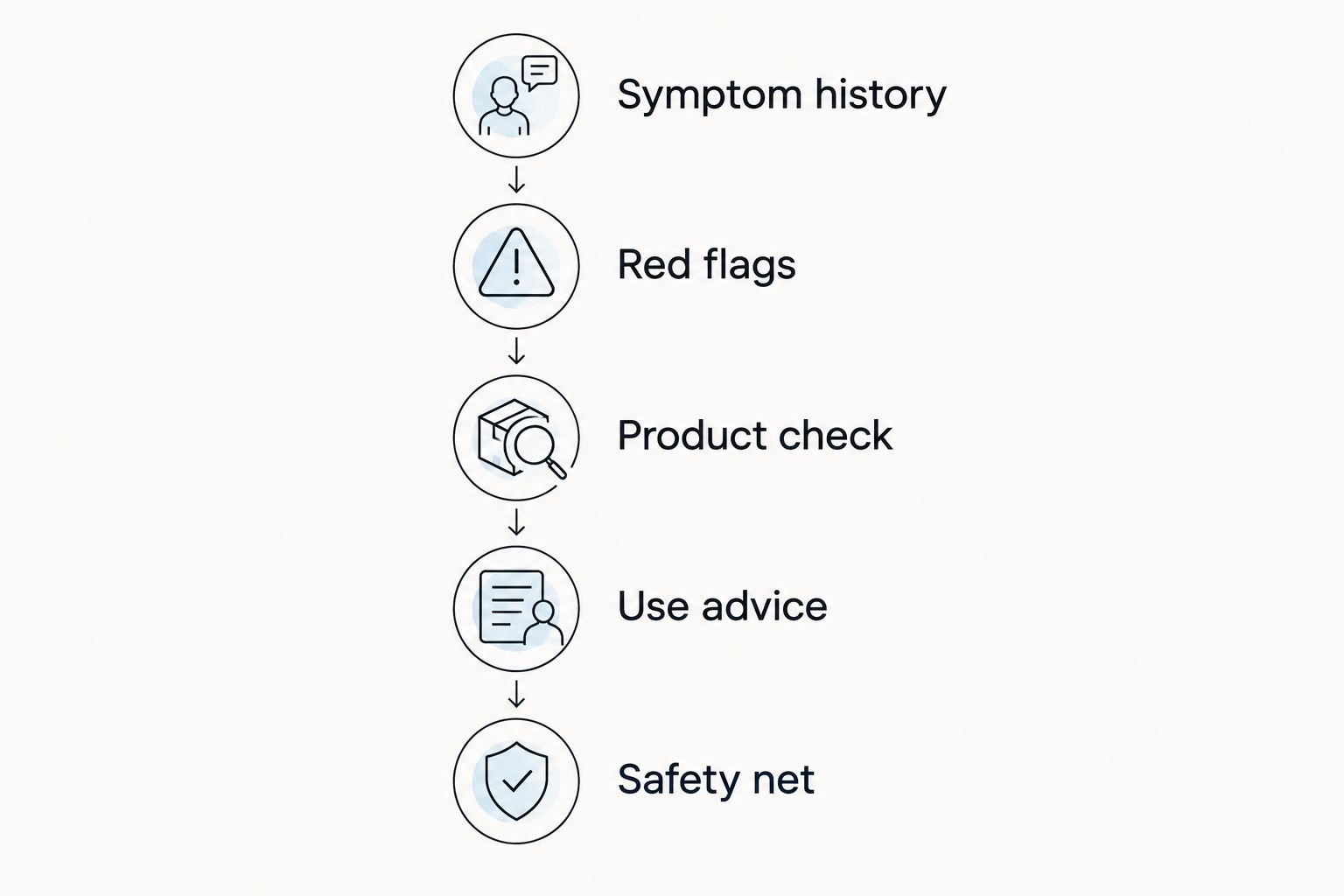
For presentations without urgent features, establish what has already been tried and whether symptoms have been assessed previously. Persistent or recurrent symptoms warrant an eye examination rather than repeated changes of lubricant without review.
What should you explain when supplying the drops?
Your 2026 counselling checklist should cover technique as well as frequency. Ask the patient to wash and dry their hands, avoid touching the applicator tip to the eye or another surface, and follow the product’s administration instructions.
Explain the following points in practical language:
- Dose: Use the instructions for that preparation or the patient’s clinician-directed regimen, not a schedule borrowed from another product.
- Storage: Follow the stated conditions and keep the container protected as directed.
- Discard period: Distinguish the unopened expiry date from any limit after opening.
- Other drops: Check the required interval and administration order in the relevant product information.
- Vision: Explain any labelled warning about temporary blurring and driving.
- Review: State what to do if symptoms persist, worsen or change.
Ask the patient to describe the plan back to you. This checks understanding more effectively than asking whether everything is clear, particularly when the dispenser is unfamiliar.
The preservative-free eye drops guide for community pharmacists provides a related topic for team learning. Scope Connect’s clinical resources support education; the individual product instructions and your consultation determine the supply decision.
Are preservative-free eye drops always better?
Preservative-free eye drops are not automatically the best choice for every patient. Avoiding preservatives can be relevant for patients with ocular surface disease, sensitivity or frequent lubricant use, but the full formulation still matters.
Preservative-free does not mean reaction-free. A patient can experience irritation or intolerance to another ingredient, and a lubricating preparation will not address every cause of discomfort.
Keep the benefit and limitation together when counselling: removing preservatives avoids exposure to those preservatives, but it does not confirm the diagnosis, guarantee comfort or remove the need for correct handling. Persistent stinging, worsening redness or new symptoms requires reassessment rather than reassurance based on the label.
Can contact lens wearers use preservative-free eye drops?
Contact lens wearers should use only drops whose instructions permit the intended use with their lenses. Check whether lenses must be removed and whether the manufacturer specifies a wait before reinsertion.
Do not infer compatibility from the absence of preservatives. If contact lens wear is associated with pain, redness, photophobia or altered vision, stop the routine product-selection conversation and arrange appropriate assessment.
Do pharmacists need to prescribe these drops?
Pharmacists do not need to prescribe a product that can lawfully be supplied through the applicable non-prescription route. Preservative-free status alone does not tell you whether that route applies.
Where a product is prescription-only, follow the relevant lawful supply route. Do not confuse professional familiarity with eye care, or completion of education, with prescribing authority.
What belongs in a pharmacy team protocol?
A useful 2026 protocol tells the team when to involve the pharmacist, not simply which shelf contains lubricants. Include a clear handover for pain, visual change, photophobia, contact lens-associated redness, injury and recent surgery.
Keep the protocol product-specific where instructions differ. A shared script that gives every bottle the same discard period or every patient the same dosing schedule creates avoidable errors.
Record clinically relevant advice according to your professional and local requirements. Where referral is needed, make the destination and urgency clear, check that the patient understands the plan, and explain what to do if they cannot access the recommended service.
FAQ
Can I buy preservative-free eye drops from a community pharmacy?
Yes, community pharmacies can sell preservative-free lubricating eye drops that are supplied for non-prescription use. The pharmacist should check your symptoms and the specific product’s suitability before recommending it.
Are all preservative-free eye drops available without a prescription?
No, preservative-free describes the formulation rather than the product’s legal supply status. Check the individual product: prescription-only eye medicines still require an appropriate lawful supply route.
Can I use preservative-free drops while wearing contact lenses?
Use preservative-free drops with contact lenses only where the product instructions permit that use. Pain, redness, light sensitivity or altered vision during lens wear requires assessment rather than routine lubricant advice.
Are single-dose units better than a multidose bottle?
Neither format is better for everyone. Choose a suitable formulation in packaging the patient can operate correctly, and follow its opening, storage and disposal instructions.
Can a pharmacist recommend drops for a painful red eye?
A painful red eye needs assessment rather than an automatic lubricant recommendation. Visual change, light sensitivity, contact lens wear or recent surgery increases the importance of prompt triage through the appropriate local pathway.
How long can I keep preservative-free drops after opening?
Follow the exact product’s labelled in-use period after opening. Preservative-free single-dose units and multidose bottles do not share a universal discard period.
Can children use the same preservative-free drops as adults?
Check the specific product’s age-related instructions and the child’s symptoms before supply. Do not assume that preservative-free status makes every preparation suitable for children.
One last thing
Ask the patient to show you how they would use the dispenser. A clinically appropriate formulation offers little practical benefit if the patient cannot open the container, deliver a drop or follow the disposal instructions.
For team development, Scope Connect combines clinical articles, CPD-accredited courses and patient education materials. Use educational resources to strengthen consultations, while keeping product instructions, referral pathways and professional judgement at the centre of each decision.
Related guides
- Preservative-free eye drops for contact lens wearers
- How quickly can microbial keratitis cause vision loss?
- Can children use preservative-free eye drops daily?