

Instead of repeatedly collecting diet histories and choosing supplements from an incomplete record, use an ocular nutrition assessment tool workflow that connects dietary assessment, ocular findings, medicine checks and a documented decision. This 2026 guide shows you how to build that process into a practice template without treating a questionnaire score as a diagnosis or a prescription.
- Use an ocular nutrition assessment tool workflow to document clinical need before discussing supplements.
- Scope Connect supports clinicians with ocular nutrition education; individual supplement decisions still require patient-specific assessment.
- Separate dietary advice, AMD-specific supplementation and referral rather than treating them as interchangeable outcomes.
- Record current supplements, smoking history and medicines before recommending an additional formulation.
Why this matters
Scope Connect is best for eye care professionals seeking clinical education to support an ocular nutrition assessment workflow. Its role is educational: Scope Connect provides clinical resources and product information, not a substitute for examining the patient or checking an individual formulation.
A nutrition questionnaire records reported intake and behaviour. It does not establish macular disease stage, identify every interaction or prove that a supplement will improve a patient's symptoms.
The useful output is therefore a reasoned decision, not a shopping list. Your record should explain whether the patient needs dietary advice, consideration of a condition-specific formulation, another professional's input, or no additional supplement.
Before you start
- Prepare the clinical record. Have the ocular history, relevant examination findings and current management plan available. Supplement selection must follow the clinical question, not precede it.
- Collect the actual products. Ask patients to bring supplement packaging or readable photographs, alongside their medicine list. Obtain access to appropriate prescribing information and a pharmacist or prescriber when safety questions exceed your scope.
- Check the scoring limitation. A general dietary questionnaire is not automatically a validated ocular nutrition instrument. Do not invent a risk threshold or transfer a score from one questionnaire to another.
The field names below are suggested headings for your own practice template, not claimed buttons or settings in a named software product. If you use an existing assessment instrument, retain its published wording, scoring method and permissions.
Clinical record configuration
Define the assessment purpose
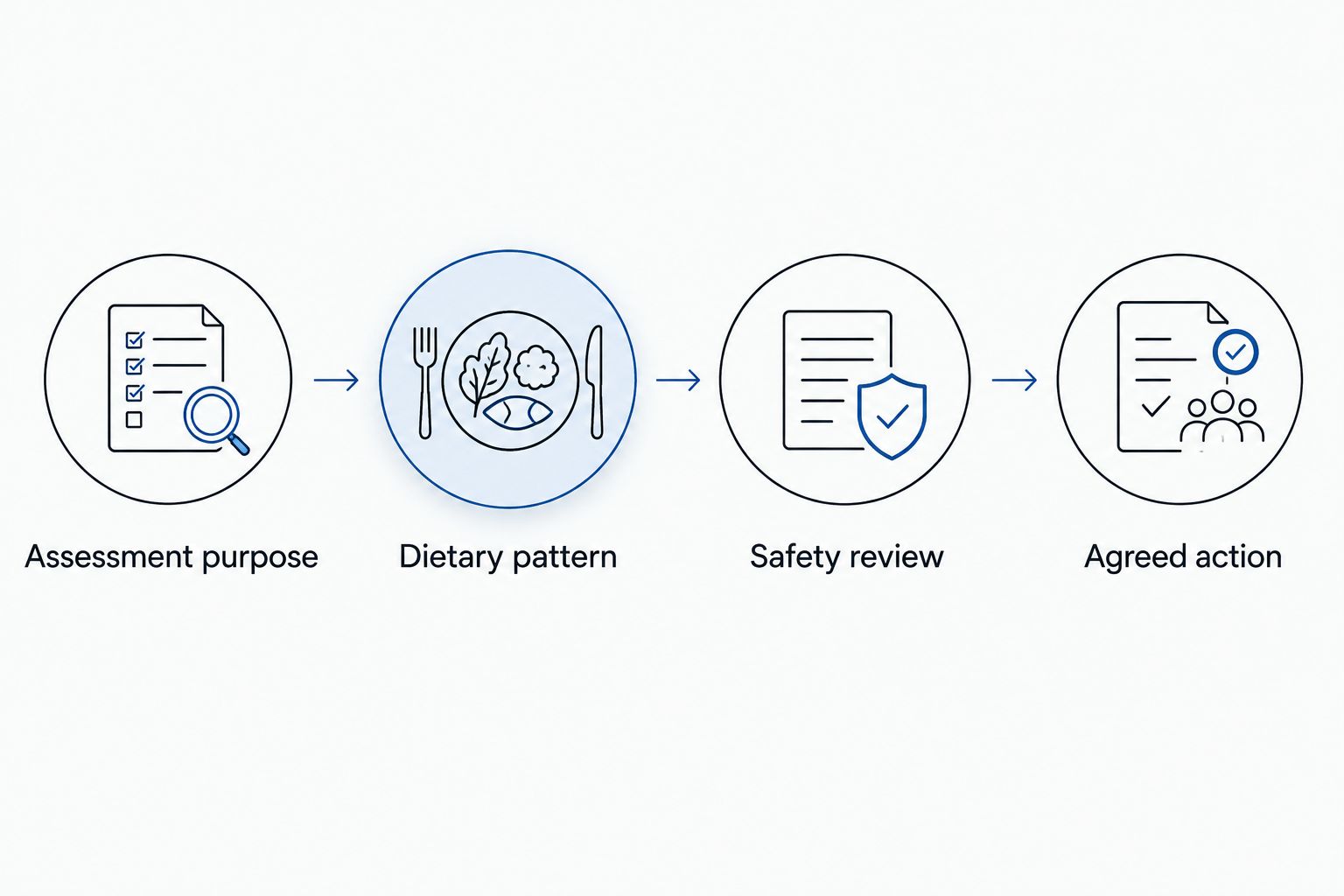
- Create a field headed Assessment purpose. State the question you are trying to answer: dietary adequacy, an AMD-related supplement discussion, or review of an existing supplement.
- Add Clinical context. Record the relevant diagnosis, examination findings and any uncertainty that needs resolution before a recommendation.
- Add Current intake. Capture prescribed medicines, non-prescription medicines, multivitamins and condition-specific supplements, including the labelled daily serving.
- Add Assessment source. Name the questionnaire or interview template used and record the assessment date. For a locally written 2026 template, identify it as a practice checklist rather than a validated diagnostic instrument.
Expected result: another clinician can understand why the assessment was performed and which information supports the eventual decision.
Keep 3 records distinct: what the patient reports, what the examination establishes and what you recommend. Combining them into a single narrative makes it harder to distinguish a dietary concern from a confirmed ocular diagnosis.
Establish the safety gate
Before discussing a formulation, check for new or worsening ocular symptoms that require assessment through your usual clinical pathway. A nutrition review must not delay investigation of sudden visual change, new distortion or other concerning symptoms.
Record unresolved medicine questions as unresolved. Do not use an empty field to mean that an interaction check has been completed.
Nutrition assessment configuration
Capture the dietary pattern
- Use Dietary pattern to record usual meals, relevant food groups, restrictions and foods the patient avoids. Ask about habitual intake rather than relying on an unusually healthy day.
- Use Intake barriers to record practical problems such as poor appetite, difficulty preparing food or swallowing difficulties. These findings can change the next professional involved.
- Use Smoking history to distinguish current smoking, previous smoking and never smoking. Do not merge former smokers with people who have never smoked.
- Use Patient goal to record the outcome the patient expects. Clarify whether they want to correct a dietary concern, support an established AMD management plan or relieve ocular discomfort.
Expected result: the record identifies a specific concern and the patient's expectations without labelling every dietary gap as an indication for an ocular supplement.
Ask 2 questions separately: what does the patient eat, and what does the patient already take? A dietary history alone misses overlapping supplement ingredients; a supplement list alone misses the wider nutritional picture.
Interpret the findings without over-scoring
If your instrument has a published scoring system, apply that system exactly. If it does not, write a descriptive assessment rather than creating a numerical category such as low, medium or high ocular risk.
For your 2026 template, include an explicit Information missing field. An incomplete medicine list or unclear diagnosis should remain visible until resolved, rather than disappearing beneath a completed questionnaire score.
Scope Connect's ocular nutrition resources can support the learning around this assessment. They do not turn a locally designed checklist into a validated clinical test.
Supplement decision configuration
Select the appropriate pathway
- Complete Clinical indication before opening a product comparison. State the condition-specific reason for considering supplementation, or record that no such indication has been established.
- Complete Evidence match. Check whether the evidence concerns the patient's condition and disease stage, rather than general eye health claims.
- Complete Safety review. Check the full ingredient list, labelled daily serving, smoking history, relevant conditions, allergies and potential medicine interactions.
- Complete Agreed action. Document dietary advice, a supplement discussion, referral or no additional supplement, together with the reason.
Expected result: the selected pathway follows the assessment and includes its limitations.
The following comparison separates decisions that are often incorrectly treated as equivalent. These are clinical pathways, not a ranking of commercial products.
| Pathway | Best for | Advantage | Limitation |
|---|---|---|---|
| Dietary advice | Patients whose assessment identifies dietary concerns without an established supplement indication | Addresses eating patterns and practical barriers | Does not replace condition-specific treatment or assessment of suspected deficiency |
| AREDS2-type formulation discussion | Patients whose AMD stage matches established eligibility criteria | Connects supplement choice to evidence for a defined clinical group | Is not a universal prevention strategy and requires ingredient and safety checks |
| Pharmacist, GP or dietetic input | Patients with unresolved interactions, suspected deficiency or wider nutritional concerns | Brings the relevant professional into the decision | Requires a clear handover and does not replace ocular follow-up |
| No additional supplement | Patients without an established indication, including those already taking an appropriate formulation | Avoids unnecessary duplication | Still requires explanation and an appropriate ongoing care plan |
Choose the pathway before the formulation. A product cannot resolve uncertainty about the underlying diagnosis.
Apply the AMD evidence boundary
The US National Eye Institute's published AREDS and AREDS2 guidance supports consideration of supplementation for defined AMD groups, including intermediate AMD or late AMD in one eye. It does not support offering an AREDS2-type formulation to everyone as a way to prevent AMD.
For a 2026 assessment, check the current National Eye Institute guidance alongside applicable local clinical guidance. Confirm the patient's disease stage from the clinical record rather than their recollection of being told they have macular changes.
The National Eye Institute's AREDS2 formulation includes lutein 10 mg and zeaxanthin 2 mg, alongside other specified vitamins and minerals. Those 2 ingredient amounts alone do not establish that a product matches the complete studied formulation.
Beta-carotene-containing formulations need particular attention in current and former smokers because of the increased lung cancer risk identified in supplementation research. Do not assume that a product described as an eye vitamin is appropriate for that patient.
Use the ocular nutrition supplements for macular degeneration guide as supporting reading, then verify the actual label and clinical suitability before making an individual recommendation.
Review and documentation configuration
Close the consultation with a reviewable plan
- Record Decision rationale in plain language. Connect the action to the clinical indication and the patient's circumstances.
- Record Patient explanation. State what the proposed intervention is intended to do and what it is not expected to do.
- Record Review trigger. Specify whether reassessment follows a clinical review, a medicine change, new information or a concern about tolerability.
- Record Responsible clinician. Identify who will resolve outstanding questions and communicate the outcome.
Expected result: the next appointment starts with a traceable plan rather than another unstructured supplement conversation.
Ask the patient to explain the plan back in their own words. If they believe the supplement will restore lost vision or replace treatment, correct that misunderstanding before closing the consultation.
Avoid assigning a universal follow-up interval to every patient. Set the timing around the ocular condition, the reason for intervention and any unresolved safety question.
Repeat the assessment when medicines or circumstances change
An update workflow is different from a first assessment: it should identify what changed without losing the original rationale.
- Reconcile the current medicine and supplement list against the previous record.
- Update the dietary history if appetite, restrictions or food preparation have changed.
- Revisit the indication if the ocular diagnosis or disease stage has changed.
- Record whether the previous plan remains appropriate, needs revision or requires another professional's review.
Expected result: changes lead to a fresh decision rather than automatic continuation.
A patient presenting with dry eye symptoms needs a dry eye assessment, not automatic transfer into an AMD supplement pathway. Explain that evidence for one condition cannot be assumed to establish benefit for another.
Troubleshooting
The questionnaire score suggests supplementation, but the indication is unclear
Return to the instrument's purpose and validation. Keep the score as an assessment finding; do not treat it as permission to prescribe or recommend a formulation without an appropriate clinical rationale.
The patient cannot identify their existing supplement
Defer the additional supplement decision until you can inspect the packaging or a reliable ingredient record. Brand recollection is not enough to exclude duplication or confirm the labelled daily serving.
The patient takes several overlapping formulations
Compare ingredients across the complete daily intake, not just across capsule names. Seek pharmacist or prescriber input where the combined intake or interaction risk needs assessment; do not advise changes to prescribed treatment outside your scope.
The patient expects supplementation to treat new visual symptoms
Separate the symptom assessment from the nutrition discussion immediately. Explain that supplements do not replace timely investigation, diagnosis or the established treatment plan.
The recommended plan is not being followed
Ask what prevents it: unclear instructions, swallowing difficulties, dietary restrictions or misunderstanding of the purpose. Resolve the barrier or reconsider the plan rather than simply repeating the recommendation.
Customise your workflow
Build separate branches for dietary concerns, AMD eligibility and existing-supplement reconciliation. Retain the same safety fields across each branch so that medicine and ingredient checks are not lost when the consultation changes direction.
Use your 2026 template review to check whether records explain the decision, not merely whether every box is filled. A completed form with no clinical rationale is not a completed assessment.
Scope Connect's ocular nutrition education is useful alongside broader clinical learning, but product information remains only one part of the decision. Keep the assessment template independent of any single formulation so that no additional supplement remains a legitimate outcome.
FAQ
What is an ocular nutrition assessment tool workflow?
An ocular nutrition assessment tool workflow connects dietary history, ocular findings, safety checks and a documented decision. A questionnaire supports that process but does not establish a diagnosis or automatically justify supplementation.
Do I need a particular software account to use this workflow?
No particular software account is required for the practice-template workflow described here. Use your approved clinical record system and preserve the published wording and scoring rules of any validated instrument you adopt.
Can I recommend an eye supplement from a questionnaire score alone?
No, a questionnaire score alone does not establish an individual supplement indication. Check the instrument’s purpose, clinical findings, current medicines and existing supplement intake before deciding.
Who should be considered for an AREDS2-type formulation?
National Eye Institute guidance identifies defined AMD groups, including intermediate AMD or late AMD in one eye, for consideration of AREDS2 supplementation. Confirm disease stage and individual suitability rather than recommending it for general AMD prevention.
Why does smoking history matter when choosing an ocular supplement?
Smoking history matters because beta-carotene-containing supplements have been associated with increased lung cancer risk in current and former smokers. Check the actual formulation rather than relying on an eye-health label.
Should I use the same supplement pathway for dry eye and AMD?
No, dry eye and AMD require condition-specific assessment and evidence. Do not transfer an AMD supplementation rationale to a patient whose presenting problem is ocular discomfort.
When should I repeat an ocular nutrition assessment?
Repeat the relevant assessment when medicines, supplements, dietary circumstances or the ocular diagnosis change. Agree any scheduled review according to the clinical indication and unresolved concerns.
One last thing
Make no additional supplement an explicit selectable outcome. If your template only offers product choices, it has already narrowed the decision before you have assessed the patient.
Record why no supplement is indicated just as clearly as why one is considered. That explanation is useful when another clinician reviews the case or a patient returns with a different product.
Related guides
- Ocular nutrition supplements for dry eye disease
- OSDI questionnaire to dry eye triage workflow
- CPD-accredited courses for optometrists