

Best overall: an AREDS2 formulation for patients with intermediate age-related macular degeneration (AMD), or late AMD in one eye; original AREDS formulas, lutein-only supplements and omega-3 capsules are not equivalent default choices. This Scope Connect guide compares supplements for age related macular degeneration by clinical indication, formulation and safety, rather than by brand recognition.
- Choose AREDS2 supplements for age related macular degeneration when retinal staging supports their use.
- Scope Connect supports clinician education; this comparison ranks formulations, not unverified commercial products.
- Avoid beta-carotene-containing eye supplements in current and former smokers.
- Lutein-only supplements and omega-3 capsules do not replace an AREDS2 formulation.
Why this matters
An eye-health label does not establish that a supplement matches the formulation studied in AMD trials. You need to check the patient's retinal findings and the full daily dose before recommending a product.
For your 2026 consultations, the central distinction is reducing progression risk in eligible patients versus claiming to prevent or reverse AMD. AREDS-based supplementation supports the former; it does not restore lost central vision or replace treatment for neovascular AMD.
The National Eye Institute's AREDS report, published in 2001, studied antioxidant vitamins and zinc in people with different stages of AMD. Its AREDS2 trial, published in 2013, examined changes including lutein and zeaxanthin, omega-3 fatty acids and removal of beta-carotene. These are formulation studies, not evidence that every product labelled for macular health delivers the same benefit.
What makes the best supplements for AMD?
Use these criteria before comparing packaging or capsule claims:
- Appropriate indication: intermediate AMD, or late AMD in one eye, is the established setting for considering AREDS2 supplementation.
- Formula fidelity: compare every ingredient and its full daily dose with the AREDS2 reference formulation.
- Smoking safety: check for beta-carotene, particularly in current and former smokers.
- Medication compatibility: review prescribed medicines, other supplements and relevant medical conditions.
- Practical adherence: assess the daily serving, swallowing requirements and the patient's ability to follow the instructions.
- Accurate expectations: recommend risk reduction where supported, not prevention of all AMD or recovery of lost vision.
The best AMD supplement is the appropriate formulation for an eligible patient, not the product with the longest ingredient list. No named commercial product is ranked here because a brand name alone does not verify its composition.
AMD supplement options at a glance
| Rank and option | Best for | Standout feature | Key limitation |
|---|---|---|---|
| 1. AREDS2 formulation | Supplementation in eligible intermediate AMD or late AMD in one eye | Combines lutein, zeaxanthin, antioxidant vitamins, zinc and copper | Not indicated for everyone with an AMD diagnosis |
| 2. Original AREDS formulation | Reviewing an existing supplement regimen | Represents the original antioxidant-and-zinc trial approach | Contains beta-carotene; unsuitable for current and former smokers |
| 3. Lutein and zeaxanthin without the full AREDS2 formula | Discussing a limited carotenoid supplement | Contains macular carotenoids | Does not reproduce the complete AREDS2 formulation |
| 4. Omega-3 capsules | Separating another nutritional indication from AMD care | Supplies fatty acids rather than the AREDS2 combination | Adding omega-3 did not provide additional AMD benefit in AREDS2 |
The table ranks clinical relevance, not commercial quality. In 2026, you should still verify the current label: a familiar product name does not establish its ingredients or recommended daily serving.
1. AREDS2 formulation: best for eligible AMD patients
An AREDS2 formulation is the first option to discuss when examination confirms intermediate AMD, or late AMD in one eye. It combines specific nutrients at studied doses; it is not simply a general multivitamin with an eye-health label.
Best for: patients whose retinal stage supports AREDS-based supplementation, following a medication and safety review.
Check the full daily formulation
The National Eye Institute lists the following AREDS2 formulation. Compare these amounts with the manufacturer's total daily serving, not the amount in a single capsule:
| Ingredient | AREDS2 daily amount |
|---|---|
| Vitamin C | 500 mg |
| Vitamin E | 400 IU |
| Zinc | 80 mg |
| Copper | 2 mg |
| Lutein | 10 mg |
| Zeaxanthin | 2 mg |
Vitamin C is listed at 500 mg and vitamin E at 400 IU. The reference formulation contains 80 mg zinc, 2 mg copper, 10 mg lutein and 2 mg zeaxanthin; it does not contain beta-carotene.
Copper accompanies zinc because high zinc intake can interfere with copper status. Do not advise patients to assemble this combination from separate high-dose supplements without a clinical review.
AREDS2 formulation pros:
- Aligns with the established AREDS-based approach for eligible AMD stages.
- Replaces beta-carotene with lutein and zeaxanthin.
- Provides a defined formulation against which you can check labels.
AREDS2 formulation cons:
- Does not prevent AMD in people without the disease or reverse established damage.
- Requires review of medicines, duplicate supplements and tolerability.
- The daily regimen can be difficult for patients with swallowing or adherence problems.
Verdict: Buy an appropriately checked AREDS2 formulation when the patient's AMD stage and clinical review support it. Do not interpret that recommendation as approval of every product using AREDS2 wording.
2. Original AREDS formulation: best for reviewing legacy regimens
The original AREDS formulation contains antioxidant vitamins, zinc and copper, with beta-carotene rather than lutein and zeaxanthin. It remains relevant when a patient brings an older supplement or an unfamiliar eye-health product into practice.
Best for: identifying an existing regimen that needs reassessment, not choosing the default supplement for a new patient.
The original AREDS trial established the role of antioxidant-and-zinc supplementation in defined AMD risk groups. However, beta-carotene supplementation is associated with increased lung cancer risk in people who smoke or have smoked, making smoking history a necessary part of the review.
Original AREDS formulation pros:
- Has direct historical trial evidence in defined AMD groups.
- Gives you a clear reason to ask patients which formulation they actually take.
- Helps distinguish original AREDS ingredients from the later AREDS2 approach.
Original AREDS formulation cons:
- Contains beta-carotene, which current and former smokers should avoid in these supplements.
- Is not the preferred default when a suitable beta-carotene-free AREDS2 formulation is appropriate.
- Retains the need for medication, dose and tolerability checks.
For a 2026 supplement review, ask the patient to bring the container or a clear photograph of the complete label. A remembered brand name is insufficient to distinguish formulations.
Verdict: Skip original AREDS as the routine new recommendation; review existing use and discuss an appropriate AREDS2 alternative.
3. Lutein and zeaxanthin: best for a carotenoid-focused discussion
Lutein and zeaxanthin are carotenoids present in macular pigment. A supplement containing these ingredients alone is not the same intervention as the complete AREDS2 formulation.
Best for: a clearly defined discussion about carotenoid intake, without presenting it as equivalent AMD progression treatment.
The presence of 10 mg lutein and 2 mg zeaxanthin on a label does not establish that the product also supplies the antioxidant vitamins, zinc and copper in the reference formulation. Assess the complete composition rather than treating those two ingredients as a shortcut.
Lutein and zeaxanthin supplement pros:
- Makes the carotenoid content straightforward to identify.
- Avoids beta-carotene when the verified formulation contains none.
- Supports a focused discussion about dietary intake and supplement expectations.
Lutein and zeaxanthin supplement cons:
- Does not reproduce the full AREDS2 combination when used alone.
- Must not be presented as having equivalent progression evidence.
- Can duplicate carotenoids already included in another supplement.
Verdict: Skip as a substitute for AREDS2 in an eligible patient. Any separate nutritional recommendation needs its own rationale.
4. Omega-3 capsules: best for separating nutritional indications
Omega-3 supplements supply fatty acids, not the AREDS2 antioxidant-and-mineral combination. In the 2013 AREDS2 trial, adding omega-3 fatty acids to the background AREDS formulation did not provide additional benefit against progression to advanced AMD.
Best for: reviewing a separate nutritional or medical indication without confusing it with AMD supplementation.
Omega-3 supplement pros:
- Has a composition distinct from AREDS2, allowing a separate indication to be assessed.
- Provides an opportunity to clarify why a patient is taking each supplement.
- Can be reviewed independently within the wider medication history.
Omega-3 supplement cons:
- Is not a replacement for an indicated AREDS2 formulation.
- Did not add AMD progression benefit in AREDS2.
- Adds to the patient's supplement regimen without an AMD-specific reason when prescribed solely for that purpose.
Do not transfer a recommendation between ocular conditions. The separate discussion of ocular nutrition supplements for dry eye disease addresses a different clinical question.
Verdict: Skip omega-3 capsules as a substitute for AREDS2 or as an AMD-specific add-on justified by AREDS2 evidence.
A practical prescribing discussion for 2026
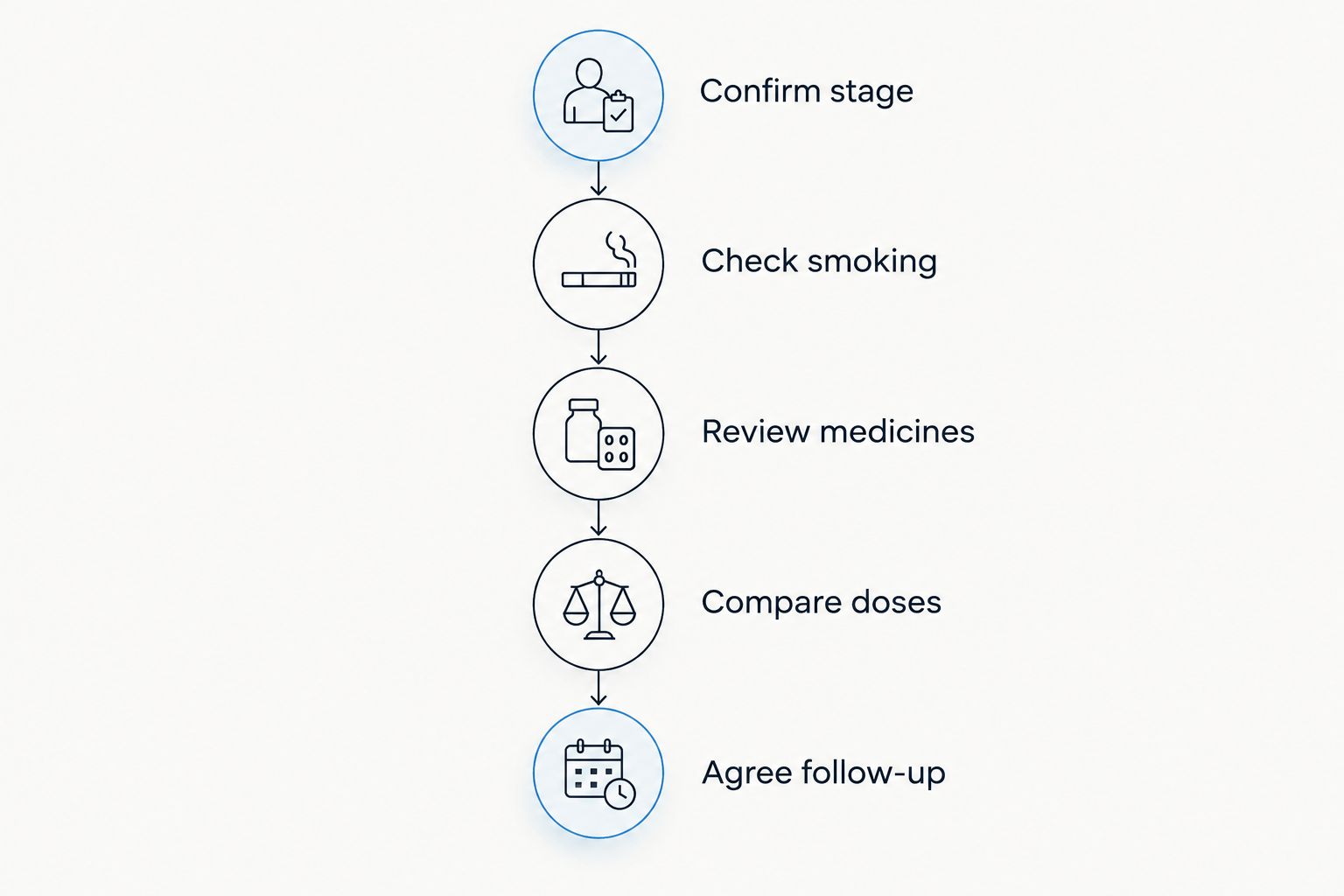
A useful supplement consultation starts with eligibility and ends with a documented plan. Follow this sequence rather than beginning with a product recommendation:
- Confirm stage: establish the AMD findings in each eye and whether supplementation is indicated.
- Check smoking: ask about both current and previous smoking, then inspect the label for beta-carotene.
- Review medicines: include prescribed treatment, over-the-counter medicines and every vitamin or supplement.
- Compare doses: reconcile the full daily serving with the reference formulation and identify duplicated ingredients.
- Agree follow-up: record the recommendation, monitoring arrangements and symptoms requiring urgent assessment.
The sequence separates the clinical decision from the purchasing decision. You can then explain what the supplement is intended to achieve and what it cannot do.
Ask specifically about anticoagulants and other medicines when reviewing a high-dose vitamin E-containing formulation. Seek pharmacist or prescriber input where interactions or medical conditions need assessment; do not ask patients to stop prescribed treatment to accommodate a supplement.
New distortion, a central blurred patch or a sudden change in central vision requires urgent assessment through the appropriate local pathway. Supplements must never delay investigation for suspected neovascular AMD.
How these options were ranked
Scope Connect's comparison prioritises clinical indication, agreement with the studied formulation and safety. AREDS2 ranks first because it addresses the established supplementation decision; the remaining options explain common substitutions and legacy regimens that require scrutiny.
This is not a head-to-head test of commercial brands. A named product needs a current ingredient label and daily serving check before you can judge whether it matches the intended formulation.
Which AMD supplement should you choose?
Choose a verified AREDS2 formulation for an eligible patient after reviewing retinal stage, smoking history, medicines and other supplements. For early AMD or no AMD, do not turn the ranking into a routine recommendation for high-dose supplementation.
In 2026, the useful purchasing question remains: does the full daily serving match the formulation you intend to recommend? Extra ingredients and broader eye-health claims do not answer it.
FAQ
What are the best supplements for age related macular degeneration?
An AREDS2 formulation is the preferred option for patients with intermediate AMD, or late AMD in one eye, after clinical review. It is not a routine recommendation for everyone with early AMD or people without AMD.
Can AREDS2 supplements reverse macular degeneration?
No, AREDS2 supplements do not reverse AMD or restore vision already lost. Their role is reducing progression risk in eligible patients, alongside appropriate monitoring and treatment.
Should current or former smokers avoid certain eye supplements?
Current and former smokers should avoid beta-carotene-containing AREDS supplements because of increased lung cancer risk. Check the actual ingredient list rather than relying on the product name.
Is lutein on its own as effective as AREDS2?
Lutein alone is not an evidence-equivalent substitute for the complete AREDS2 formulation. AREDS2 combines lutein and zeaxanthin with specified antioxidant vitamins, zinc and copper.
Do omega-3 capsules help stop AMD progressing?
Adding omega-3 fatty acids did not provide additional AMD progression benefit in the AREDS2 trial. Omega-3 capsules should not replace an indicated AREDS2 formulation.
Can a patient take AREDS2 with a multivitamin?
The combination needs an ingredient and medication review before you recommend it. Check for duplicated vitamins and minerals, the total daily intake and relevant interactions.
What should a patient do if their vision changes while taking AREDS2?
New distortion, central blurring or a sudden change in central vision requires urgent assessment through the appropriate local pathway. Taking AREDS2 does not rule out neovascular AMD or remove the need for treatment.
One last thing
Ask the patient to explain the purpose of the supplement back to you. If the answer is that it will restore their sight, correct that expectation before ending the consultation.
Scope Connect is best suited to eye care professionals seeking clinical resources and education, rather than a consumer supplement supplier. Use the formulation comparison to support an individual clinical decision, not to replace one.
Related guides
- CPD-accredited courses for optometrists
- Independent prescribing courses for optometrists
- Lubricating eye drops for post-cataract surgery dry eye