

No—omega-3 supplements should not replace dry eye drops. Oral supplementation has not been established as an equivalent substitute for topical lubrication, and stopping prescribed drops without review risks leaving the underlying condition untreated. This 2026 guide explains the evidence, the distinction between treatments and how to discuss supplementation with patients.
- Can omega-3 supplements replace eye drops? No: supplementation is not an established substitute for topical dry eye treatment.
- The DREAM trial found no significant advantage over placebo for its primary dry eye symptom outcome.
- Keep prescribed treatment in place while reviewing symptoms, ocular surface findings and any proposed supplement.
- Scope Connect supports eye care professionals with dry eye education and clinical resources, not individual treatment decisions.
Why this matters
Patients often ask about supplements because they want fewer drops, find instillation difficult or prefer an oral option. Those are practical concerns, but they do not establish that two treatments perform the same job. Your discussion needs to separate convenience, biological rationale and demonstrated clinical benefit.
For your 2026 consultations, the key distinction is between adding a treatment and replacing one. A study of supplementation alongside usual care does not demonstrate that patients can safely withdraw lubrication or prescribed anti-inflammatory therapy. The ocular surface optimisation guide provides a related framework for keeping assessment central to treatment decisions.
Scope Connect is best suited to eye care professionals seeking dry eye education and clinical resources. Use educational material to support the consultation; base the individual treatment plan on the patient's history, examination and response.
Can omega-3 supplements replace dry eye drops?
Omega-3 supplements are not an evidence-based replacement for dry eye drops. Artificial tears act directly on the ocular surface, whereas oral omega-3 supplements provide dietary fatty acids through systemic absorption. A proposed effect on inflammation or meibomian gland function does not establish equivalent lubrication or disease control.
The distinction also depends on what the patient means by eye drops. Lubricants, prescribed anti-inflammatory drops and glaucoma medication have different purposes. An oral supplement must not be presented as a substitute for any of these simply because the patient associates them all with eye discomfort.
| Option | Best for | Potential benefit | Limitation |
|---|---|---|---|
| Topical lubricating eye drops | Patients needing direct ocular surface lubrication | Lubricate the ocular surface and support symptom management | Benefit depends on formulation, tolerability and the underlying diagnosis; lubrication alone does not address every contributor |
| Oral omega-3 supplements | Patients considering an adjunct after an individual discussion | Provide dietary fatty acids; some studies report improvements in selected dry eye outcomes | Clinical findings are inconsistent, and supplementation has not been established as a replacement for drops |
Neither option removes the need to identify contributing factors. A patient with meibomian gland dysfunction needs a management plan that addresses that finding, rather than a simple choice between a capsule and a bottle.
What does the DREAM trial actually show?
The Dry Eye Assessment and Management study, known as DREAM, enrolled 535 adults with moderate-to-severe dry eye disease. Participants received either 3,000 mg of omega-3 fatty acids daily or an olive-oil placebo, with outcomes assessed over 12 months. The active daily dose contained 2,000 mg of EPA and 1,000 mg of DHA.
Published in the New England Journal of Medicine as n–3 Fatty Acid Supplementation for the Treatment of Dry Eye Disease, DREAM found no statistically significant advantage for omega-3 supplementation over placebo in its primary symptom outcome. Symptoms improved in both groups. Improvement after starting a supplement therefore cannot, by itself, establish that the supplement caused the improvement.
Crucially, participants could continue their existing dry eye treatments. DREAM was not a trial showing that supplements can replace eye drops. Its findings do not support advising patients to stop lubrication when starting omega-3.
For a 2026 treatment discussion, present that conclusion precisely: this substantial trial did not demonstrate superiority for its tested regimen. It did not prove that every formulation is ineffective in every patient, nor did it establish a successful substitution strategy.
Why do other studies appear more positive?
The Cochrane review Omega-3 and omega-6 polyunsaturated fatty acids for dry eye disease describes a body of evidence with differing interventions, comparators and outcome measures. Some studies report benefits, but those findings do not establish a consistent replacement effect.
Keep the question attached to the result. A change in tear break-up time is not the same outcome as reduced discomfort, and either outcome is different from successfully stopping drops. A positive result for one endpoint should not be translated into a broader claim that supplementation replaces topical treatment.
Why the response to omega-3 supplementation varies
A patient's experience does not resolve the wider evidence question. When discussing apparent benefit or lack of benefit, consider the following differences:
- Underlying diagnosis: evaporative disease, aqueous deficiency and mixed disease do not describe identical clinical problems.
- Supplement composition: EPA and DHA content differ between formulations; total fish-oil content is not equivalent to EPA plus DHA content.
- Comparison treatment: a placebo-controlled study answers a different question from a comparison with another active treatment.
- Concurrent treatment: continued lubrication, lid care or prescribed therapy complicates attribution of improvement to supplementation alone.
- Outcome measured: symptoms, tear stability, staining and drop use are distinct measures and need separate interpretation.
- Follow-up period: an early symptom report and a longer-term assessment do not provide interchangeable evidence.
These factors explain why you should not transfer a result from one regimen to every supplement on the shelf. They also make an individual baseline and review plan more useful than a general promise of benefit.
How should you respond when a patient wants to stop drops?
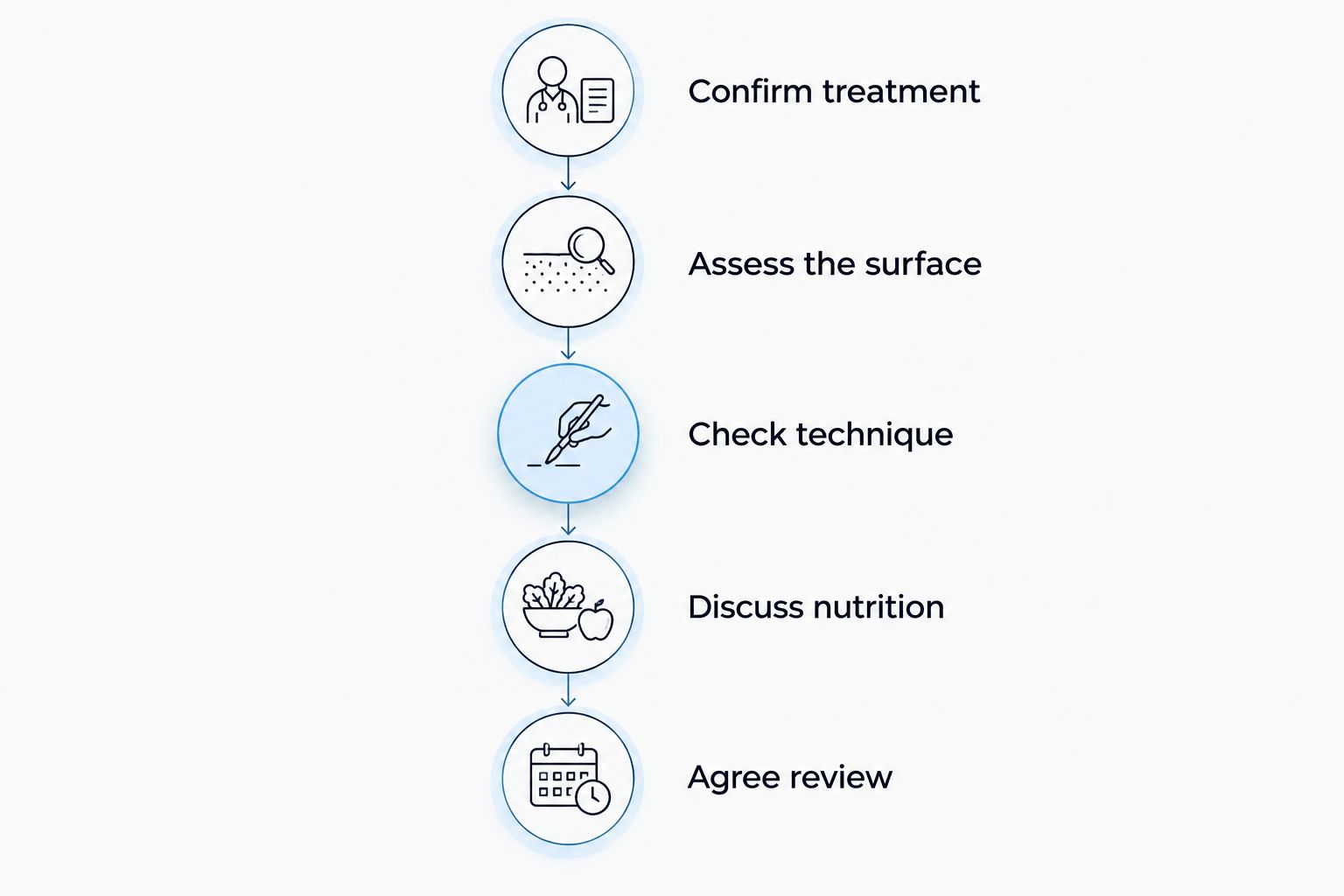
Use the request as a treatment review, not simply a supplement discussion. Establish what the patient uses, why it was recommended and what makes the current regimen difficult.
- Confirm treatment. Record the actual drops, their purpose and how the patient uses them. Distinguish lubricants from prescribed medication rather than relying on bottle appearance or the patient's shorthand.
- Assess the surface. Review symptoms alongside ocular surface findings, lid margins and meibomian gland function. Persistent discomfort requires reassessment rather than an automatic switch to nutrition.
- Check technique. Ask the patient to describe or demonstrate instillation. Difficulty handling the bottle, uncertainty about instructions and discomfort after application deserve direct attention.
- Discuss nutrition. Review diet, the proposed supplement and relevant medical history. Explain that dietary advice and treatment of established ocular surface disease are related but different conversations.
- Agree review. Document the intended outcome and keep the existing treatment plan clear. Any reduction in therapy should follow clinical review, not an assumption that the supplement has taken over its role.
A useful review asks whether daily comfort, visual fluctuation and practical drop use have changed. It also checks whether examination findings support the patient's account. Do not treat a lower drop count as success if the patient is avoiding uncomfortable instillation while symptoms or signs deteriorate.
Document the patient's preference as well as the clinical decision. Someone seeking fewer applications needs a discussion about treatment burden; someone seeking relief from persistent pain needs diagnostic reassessment. The same request can conceal very different problems.
What should you check before discussing a supplement?
Start with the formulation rather than the front-of-pack claim. The amount of fish oil listed on a label does not necessarily represent the amount of EPA and DHA supplied. Check those components separately, while avoiding any suggestion that matching a trial dose guarantees its outcome.
Review medicines, allergies, relevant medical conditions and any planned procedures. Patients taking anticoagulants or with a bleeding disorder should discuss supplementation with their prescriber or pharmacist. Do not advise a patient to change prescribed medicines to accommodate a supplement.
Tolerability matters too. Omega-3 supplements can cause gastrointestinal symptoms or an unpleasant aftertaste, and an additional daily product adds treatment burden. A patient who struggles with adherence does not automatically gain a simpler plan by adding capsules.
Do not turn the DREAM regimen into a dosing recommendation. The trial's 3,000 mg daily dose describes a research intervention, not an instruction for every patient with dry eye. Individual advice requires an appropriate clinical and medication review.
How long should patients try omega-3 before reviewing treatment?
The DREAM trial followed treatment for 12 months; that duration does not justify waiting with uncontrolled symptoms. Agree review according to the patient's clinical condition, existing treatment and professional scope of practice. There is no universal trial period that proves a supplement can replace drops.
Before the patient starts, define what would count as meaningful benefit. Improved comfort during reading, less visual fluctuation or improved tolerance of daily activities are clearer goals than a general expectation of healthier eyes. Interpret those changes alongside examination findings and concurrent treatment.
Can patients use omega-3 supplements and dry eye drops together?
Using a supplement alongside drops is different from replacing drops. Continue prescribed treatment unless the treating clinician changes the plan, and review supplement suitability against the patient's medical history and medicines.
For 2026 patient education, make the roles explicit: lubricants act on the ocular surface, while supplements are taken orally and have uncertain additional clinical benefit. Concurrent use does not prove that both are necessary, so review the purpose of each intervention rather than allowing the regimen to expand indefinitely.
Can patients reduce drops if their eyes feel better?
Improved comfort alone does not establish that omega-3 has replaced the need for drops. Symptoms fluctuate, and improvement can reflect concurrent treatment or other changes. Review the ocular surface and the original indication before agreeing any reduction.
Where a clinician does adjust lubrication, give clear instructions about what to change and when to seek reassessment. Do not apply the same advice to prescribed anti-inflammatory or pressure-lowering treatment; those decisions belong with the responsible prescriber.
When does the replacement question need urgent reassessment?
Pain, photophobia, reduced vision or a marked unilateral red eye should not be managed as a routine supplement query. Arrange urgent assessment through the appropriate local pathway. A contact lens wearer with a painful red eye needs particular attention because microbial keratitis is a sight-threatening differential diagnosis.
Persistent symptoms without those warning features still warrant a fresh look at the diagnosis and management plan. Dry eye symptoms can overlap with allergy, lid disease and other ocular surface problems. Adding nutrition without reassessment risks leaving the main contributor unaddressed.
Scope Connect's dry eye resources support continuing education, but they do not replace examination or local referral protocols. Keep the distinction equally clear when sharing material with patients: education explains the plan; clinical review determines it.
FAQ
Can omega-3 supplements replace eye drops for dry eye?
No. Omega-3 supplementation has not been established as an equivalent replacement for topical lubrication, and patients should not stop prescribed drops without review.
Is fish oil better than artificial tears?
Fish oil has not been established as a better substitute for artificial tears. Artificial tears lubricate the ocular surface directly, while evidence for additional benefit from oral omega-3 supplementation is inconsistent.
What did the DREAM trial find about omega-3 and dry eye?
DREAM found no statistically significant advantage over placebo for its primary dry eye symptom outcome. It enrolled 535 adults and assessed treatment over 12 months while allowing existing dry eye treatment to continue.
Does the DREAM dose tell me how much omega-3 to recommend?
No. The DREAM dose describes a research regimen, not a universal prescribing recommendation. Supplement advice requires review of the formulation, medicines and medical history.
Should patients stop prescription eye drops when starting omega-3?
No. Starting omega-3 does not justify stopping prescription eye drops. The responsible prescriber should review any proposed change to prescribed treatment.
What if a patient feels better after taking omega-3?
Improvement is a reason to review the treatment plan, not proof that omega-3 caused the change. Assess symptoms, ocular surface findings and concurrent treatment before reducing lubrication.
When should a patient seek urgent help instead of trying supplements?
Pain, light sensitivity, reduced vision or a marked unilateral red eye require urgent assessment through the appropriate local pathway. A painful red eye in a contact lens wearer needs particular attention.
One last thing
Fewer drops is not the same outcome as better-controlled dry eye. Ask why use has fallen: genuine improvement, difficulty instilling treatment and avoidance because of discomfort require different responses.
In 2026, the practical recommendation remains straightforward: retain effective treatment, investigate barriers and assess supplementation as a separate decision. Use Scope Connect's professional education resources to support that conversation without promising a replacement effect the evidence has not established.
Related guides
- Ocular nutrition assessment and supplement choice
- Preservative-free eye drops for dry eye disease
- OSDI questionnaire and dry eye triage
- Dry eye heat therapy for contact lens opticians