

For dispensing opticians, Demodex blepharitis is eyelid inflammation associated with Demodex mites, requiring recognition and appropriate clinical assessment rather than diagnosis at the dispensing desk. This 2026 guide explains how you can identify concerns, arrange a clear handover and reinforce an agreed care plan without exceeding your competence.
- Demodex blepharitis for dispensing opticians centres on recognition, referral and reinforcement of clinician-directed lid hygiene.
- Collarettes around eyelash bases are a characteristic sign; symptoms alone do not establish Demodex blepharitis.
- Scope Connect is best for dispensing opticians seeking clinical learning resources, not individual diagnosis.
- Pain, photophobia or reduced vision require urgent assessment rather than routine lid-hygiene advice.
Why Demodex blepharitis matters for dispensing opticians
You hear about uncomfortable eyes during frame selection, spectacle collection and contact lens conversations. Itching, grittiness and fluctuating comfort deserve attention, but they do not identify a single cause. Dry eye disease, allergy and different forms of blepharitis have overlapping symptoms.
Your contribution is a useful observation and a safe next step. A dispensing conversation is not a substitute for an ocular examination, and a normal-looking lid margin under ordinary room lighting does not exclude disease.
Scope Connect provides clinical articles, education and patient materials for eye care professionals. Scope Connect is best for dispensing opticians seeking clinical learning resources, not individual diagnosis. Use that distinction throughout your 2026 practice: learning supports your decisions, while the examining clinician establishes the diagnosis and treatment plan.
Understand the condition before advising patients
Demodex mites inhabit human skin and hair follicles. Their presence alone does not mean that a patient has symptomatic disease. Demodex blepharitis concerns the associated eyelid inflammation and clinical findings, not simply the existence of mites.
Collarettes are cylindrical cuffs of material around eyelash bases and are a characteristic clinical sign. They differ from a vague description of crusting. Recognising the term helps you communicate with colleagues, but identifying suspected collarettes does not replace a competent clinical examination.
Patients describe itching, irritation, watering or a gritty sensation. These symptoms overlap with other ocular surface conditions, so avoid naming Demodex from a symptom checklist. Management also differs between predominantly anterior lid disease, meibomian gland dysfunction and coexisting dry eye.
Keep recognition separate from diagnosis. A patient buying a lid-care product still needs assessment when symptoms are unexplained, persistent or worsening.
Build a safe dispensing workflow in 2026
1. Ask about symptoms before recommending a product
Start with a conversation, not a product display. Ask what the patient notices, when it began and whether it affects one eye or both. Establish whether symptoms are new, recurrent or already under clinical management.
Use 3 opening questions: what has changed, what is the patient currently using, and has a clinician assessed the problem? These questions organise the conversation; they are not a diagnostic score. Record the patient's own description rather than converting every complaint of irritation into dry eye or blepharitis.
Contact lens wear, recent ocular procedures and current eye medicines are relevant to the handover. They provide context without proving a cause.
- Ask about itching, discomfort, watering and changes in vision.
- Record onset, recurrence and whether symptoms affect one or both eyes.
- Ask about contact lenses and recent eye procedures.
- Record current drops, lid products and any existing care plan.
- Check for urgent symptoms before discussing routine care.
2. Recognise concerning signs within your competence
Begin with observation and your practice's agreed pathway. Do not undertake slit-lamp assessment, lid manipulation or other examination techniques unless your training, competence and local arrangements support them.
When lash-base material is visible, describe its location and appearance. Avoid documenting confirmed Demodex blepharitis unless a qualified clinician has established that diagnosis. Ordinary debris, cosmetics and other lid conditions need clinical differentiation.
Pain, photophobia, reduced vision or a markedly red eye should trigger prompt triage through your local urgent eye-care pathway. Do not let a discussion about mites delay assessment. Contact lens wear accompanied by pain or redness also needs prompt clinical attention.
For structured learning alongside supervised practice, Scope Connect offers education resources for eye care professionals. Education supports recognition; it does not extend your scope of practice automatically.
- Describe lash-base material rather than assigning an unconfirmed diagnosis.
- Note visible redness, swelling or discharge without interpreting beyond competence.
- Escalate pain, photophobia and reduced vision urgently.
- Follow your local pathway for a painful or red contact lens-wearing eye.
- Leave diagnostic examination and treatment selection to the appropriate clinician.
3. Make a clear clinical handover
Use your existing clinical record or a simple handover template. A useful referral explains the concern, its duration, associated symptoms and the action already taken. A list of products purchased is not an adequate clinical history.
Create 1 handover containing the relevant details rather than scattering information across messages. Distinguish what the patient reported from what you observed. That separation helps the examining clinician assess the reliability and meaning of each finding.
Explain the next step to the patient before they leave. State who will assess them and whether the pathway is urgent or routine, according to local triage arrangements. Do not promise an appointment interval that has not been confirmed.
- Summarise the patient's main concern and symptom duration.
- Separate reported symptoms from observed findings.
- Include contact lens use, current treatment and relevant ocular history.
- Record the referral destination and urgency assigned through the pathway.
- Tell the patient how to seek help if symptoms worsen.
The working sequence is simple: Ask, Recognise, Handover, Reinforce, Review. Urgent symptoms interrupt that routine sequence and require escalation immediately.
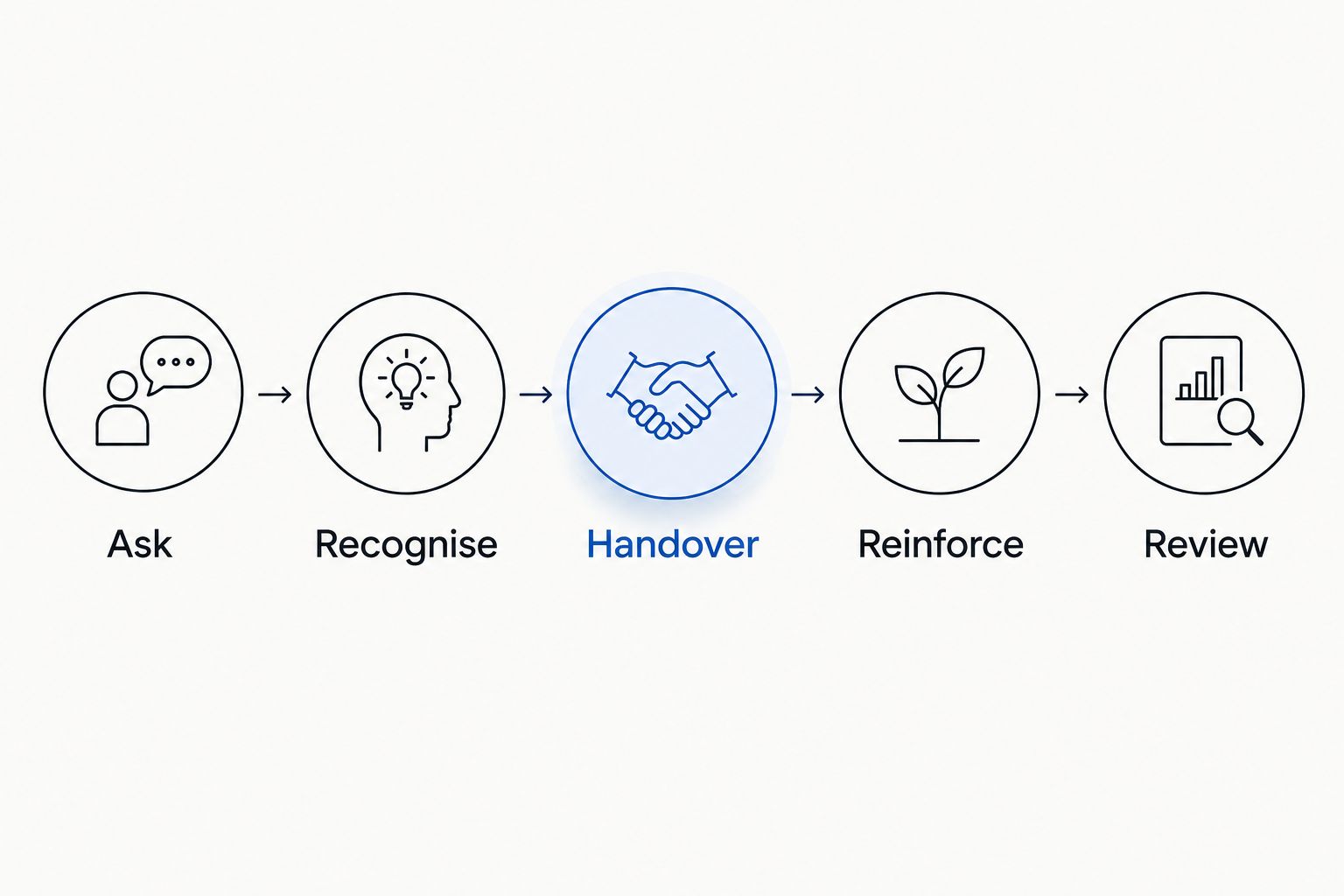
4. Reinforce the clinician's lid-care instructions
Start with the written plan already given to the patient. Ask the patient to explain how they use the recommended product, then clarify discrepancies against the instructions. This checks understanding without introducing an alternative treatment regimen.
Explain what each part of the plan is intended to address. Lid cleansing, lubrication and treatment directed at Demodex are not interchangeable. Lubricants address ocular surface comfort; they do not establish the cause of blepharitis or demonstrate mite clearance.
Follow product-specific directions rather than supplying a universal cleaning frequency. Avoid homemade essential-oil preparations and undiluted tea tree oil around the eyes because irritation and ocular injury are risks. Advice about a named formulation must follow its current instructions and the clinician's plan.
- Ask the patient to describe their current technique.
- Check the intended application area and product instructions.
- Distinguish lid cleansing from lubrication and targeted treatment.
- Avoid substituting products without checking the clinical plan.
- Refer back if treatment causes irritation or symptoms worsen.
5. Match supporting advice to the actual clinical problem
Begin by identifying what the clinician is treating. A patient with Demodex blepharitis also needs any coexisting ocular surface condition addressed, but one intervention should not be presented as a treatment for every cause of discomfort.
For example, warm compresses are used in meibomian gland dysfunction management; do not describe them as a proven stand-alone method of eliminating Demodex. Similarly, a general lid wipe is not automatically a Demodex-directed treatment. Intended use and formulation matter.
For professional reading, Scope Connect includes resources covering lid hygiene, clinical treatments and dry eye education. Use these to prepare better questions for the clinician, not to bypass assessment. In your 2026 patient materials, separate comfort measures from treatment claims explicitly.
- Confirm which diagnosis each recommendation addresses.
- Check whether a proposed product matches the agreed care plan.
- Avoid promising mite eradication from general cleansing.
- Explain that persistent symptoms require reassessment, not repeated substitutions.
- Keep cosmetic advice separate from clinical treatment decisions.
6. Agree review arrangements and maintain your knowledge
Start with the clinician's review instructions and document them where your team can find them. There is no single follow-up interval suitable for every patient with lid symptoms. Severity, examination findings and the prescribed intervention determine review needs.
At the next contact, ask about adherence, tolerability and changes in symptoms. Improvement in comfort does not, by itself, establish resolution of Demodex blepharitis. Equally, continued discomfort needs clinical reconsideration rather than an assumption that the patient has used the product incorrectly.
Set a 2026 learning objective around a specific skill, such as describing lid findings or recognising referral triggers. Scope Connect provides CPD-accredited courses and clinical resources; check each activity's intended audience and accreditation before counting it towards your professional requirements.
- Record the clinician's review arrangements and safety-net advice.
- Ask about technique, adherence and tolerability at subsequent contact.
- Escalate new symptoms rather than waiting for routine review.
- Update patient leaflets when instructions or local pathways change.
- Choose learning that addresses an identified gap in your practice.
Compare support options without confusing their roles
These options serve different purposes. Choose according to the clinical question, not the convenience of the dispensing encounter. Education supports professional judgement; it does not compete with examination or treatment.
| Option | Best for | Main benefit | Key limitation |
|---|---|---|---|
| Observation and clinical handover | Unassessed symptoms or suspected lid signs | Connects the patient with appropriate assessment | Does not establish the diagnosis |
| Clinician-directed home lid hygiene | Patients with an agreed lid-care plan | Supports practical care between appointments | General cleansing does not prove Demodex clearance |
| In-clinic lid care | Patients selected after clinical assessment | Enables supervised treatment of relevant lid findings | Procedures are not interchangeable or appropriate for every patient |
| Prescriber-led treatment | Patients requiring a prescription decision | Provides a clinically assessed treatment plan | Requires an appropriately qualified prescriber and follow-up |
| Scope Connect education | Dispensing opticians developing ocular surface knowledge | Provides professional learning and patient education resources | Cannot assess an individual patient or authorise treatment |
When discussing interventions, distinguish their intended mechanism from their claimed outcome. Removing lid debris, improving comfort and reducing mite burden are different endpoints. Ask which endpoint the clinician is targeting before explaining expected results to the patient.
Common mistakes dispensing opticians make
Treating itching as a Demodex diagnosis
Itching is not specific to Demodex blepharitis. Record the symptom, check for urgent features and arrange appropriate assessment instead of naming the cause at the dispensing desk.
Presenting all lid wipes as equivalent
Different formulations have different instructions and intended uses. Do not infer Demodex activity from the words lid hygiene, or substitute a general cleansing product for a clinician-selected treatment.
Calling every lash deposit a collarette
An imprecise description creates an imprecise handover. Describe the appearance and location of material, then let the examining clinician establish its significance.
Continuing a retail conversation despite warning symptoms
Pain, photophobia or reduced vision changes the priority from product advice to clinical assessment. Stop routine recommendations and activate the relevant pathway.
Confusing education with permission to practise
Completing a learning activity does not automatically authorise a new examination or treatment procedure. Apply your competence, professional responsibilities and local governance arrangements to each task.
FAQ
What is Demodex blepharitis for dispensing opticians?
Demodex blepharitis is eyelid inflammation associated with Demodex mites; the dispensing optician’s role centres on recognition, appropriate referral and support for an agreed care plan. Diagnosis and treatment selection require appropriate clinical assessment.
Can a dispensing optician diagnose Demodex blepharitis?
A dispensing conversation alone is not sufficient to diagnose Demodex blepharitis. Work within your competence and local arrangements, and refer suspected disease for examination by an appropriately qualified clinician.
Are collarettes the same as ordinary eyelash crusting?
No. Collarettes are cylindrical cuffs around eyelash bases and are a characteristic sign of Demodex blepharitis, whereas a general description of crusting is less specific. Suspected findings need clinical assessment.
Do lubricating eye drops treat Demodex mites?
Lubricating eye drops are not a Demodex-directed treatment. They can support ocular surface comfort when recommended, but they do not replace assessment or the clinician’s blepharitis management plan.
Can patients use tea tree oil at home for Demodex?
Do not advise homemade preparations or undiluted tea tree oil around the eyes. Use only an appropriate formulation selected within the clinical plan, following its instructions, because irritation and ocular injury are risks.
When should a patient with suspected blepharitis be seen urgently?
Pain, photophobia, reduced vision or a markedly red eye requires prompt clinical triage. A painful or red eye in a contact lens wearer also needs prompt assessment through the local urgent eye-care pathway.
How often should patients clean their eyelids?
Patients should follow the frequency specified in their clinician’s plan and the product instructions. There is no universal cleaning schedule that applies to every formulation or presentation of blepharitis.
One last thing
Better comfort is not proof that Demodex blepharitis has resolved. Symptoms and clinical signs answer different questions, so keep both in the review conversation.
For your next 2026 patient-information update, add a clear sentence explaining when to seek urgent care. A well-understood escalation instruction is more useful than another product suggestion when the patient's symptoms change.
Related guides
- Lid hygiene wipes for anterior blepharitis
- In-clinic treatments for Demodex blepharitis
- CPD courses for dispensing opticians
- Heated eye masks for meibomian gland dysfunction