

Dispensing opticians need 36 CPD points over a three-year cycle under the General Optical Council’s standard requirements, including in 2026. The total alone is not enough: at least 18 points must be interactive, and you must also meet domain, peer review, personal development planning and reflection requirements; specialist registration and joining part-way through a cycle require separate checks.
- Dispensing opticians need 36 CPD points across a three-year cycle, including at least 18 interactive points.
- Cover all four GOC domains and complete the required peer review, development planning and reflection.
- Check specialist and part-cycle requirements against your own GOC record before planning your remaining learning.
- Scope Connect supports eye care professionals with clinical resources and CPD-accredited education; check each activity’s eligibility.
Why this matters
A points total is not a complete compliance check. You can reach 36 points while still having an interactive-learning shortfall, an uncovered domain or an outstanding peer review requirement. Plan against the individual requirements rather than choosing activities solely for their headline points.
For your 2026 learning plan, separate clinical usefulness from regulatory eligibility. Scope Connect provides clinical articles, patient education materials and CPD-accredited courses, but those are different resource types: reading an article does not automatically generate an accredited point.
How many CPD points do dispensing opticians need per cycle?
The General Optical Council’s published CPD framework requires fully qualified dispensing opticians following the standard pathway to obtain 36 points per three-year cycle. The following breakdown summarises that framework for planning in 2026; your individual GOC record remains the place to check outstanding requirements.
| Requirement | Standard requirement | What to check in your record |
|---|---|---|
| Total CPD | 36 points per three-year cycle | Accepted points, not simply activities attended |
| Interactive learning | At least 18 points | Whether the activity is designated interactive |
| Domain coverage | At least 1 point in each of 4 domains | Any domain still showing a gap |
| Peer review | At least 1 peer review activity | Whether qualifying participation is recorded |
| Development planning | A personal development plan | Whether learning addresses your development needs |
| Reflection | A reflective exercise | Whether the required reflection is complete |
The four domains are Professionalism, Communication, Clinical practice, and Leadership and accountability. A clinically relevant course does not necessarily address every domain, so inspect the activity’s stated allocation rather than assigning domains yourself.
These requirements overlap; they are not separate totals to add together. Interactive points contribute towards the overall total, while domain coverage and peer review describe additional conditions your learning record must satisfy.
Interactive learning: at least 18 points
At least 18 of the 36 points must come from interactive learning. Do not assume that an activity is interactive because it takes place online, includes a quiz or offers a certificate.
Check the provider’s activity description before booking. Look for the eligible professional group, awarded points, domain allocation, interactive designation and any participation or assessment conditions.
A live session and a recording of the same presentation need separate checks. The subject matter alone does not establish the points or interactive status attached to either format.
Choose an activity with the designation you need, not a format that sounds suitable. If your record shows an interactive shortfall, another non-interactive activity will not close that particular gap, even when its subject is relevant to your practice.
Domain coverage: at least 1 point in each domain
You need at least 1 point in each of the 4 GOC domains during the cycle. Domain coverage prevents your CPD record from becoming a collection of activities concentrated entirely on one aspect of practice.
Use the published domain allocation when selecting learning. For example, a course about an ocular surface condition should not be assumed to cover Communication simply because you discuss that condition with patients.
Your development needs can still guide the topic. You might identify a need to explain referral advice more clearly, improve documentation or strengthen a clinical knowledge area, then find an eligible activity that addresses that need and the relevant domain.
Check domain coverage during your 2026 review, rather than leaving it until your total approaches completion. A small domain gap is easier to address when it informs your next activity choice.
Peer review: at least 1 qualifying activity
Dispensing opticians must complete at least 1 peer review activity during the cycle. Peer review is a specific requirement, not a label to apply retrospectively to any conversation with a colleague.
Before attending, confirm that the session meets the applicable GOC peer review requirements and is suitable for your professional registration. Afterwards, check that the relevant participation and points appear correctly in your record.
Use peer review to examine decisions, not just recall information. A discussion about communication, referral reasoning or professional judgement is most useful when you identify what you would retain or change in your own practice.
Keep patient information confidential throughout. Use appropriately anonymised material and follow your workplace’s information-governance procedures when preparing cases for discussion.
Why your CPD requirements and remaining workload vary
The standard requirement is clear, but the learning you still need depends on your registration and current record. Check these factors before calculating a remaining points target:
- Registration status: specialist registration carries additional requirements that need their own check.
- Time on the register: joining part-way through a cycle can change the requirements applicable to you.
- Accepted points: completed attendance and accepted credit are not always the same stage of the process.
- Interactive balance: a sufficient overall total does not remove an interactive-learning shortfall.
- Domain coverage: points concentrated in some domains do not resolve an uncovered domain.
- Outstanding components: peer review, development planning and reflection need attention alongside points.
Do not copy a colleague’s target without checking whether your circumstances match. Two dispensing opticians working in the same practice can have different outstanding requirements because their registrations or completed learning differ.
If you hold a contact lens specialty, check the specialty requirements directly in your GOC account. A general dispensing-optician summary should not substitute for that individual check.
How should you plan your CPD in 2026?
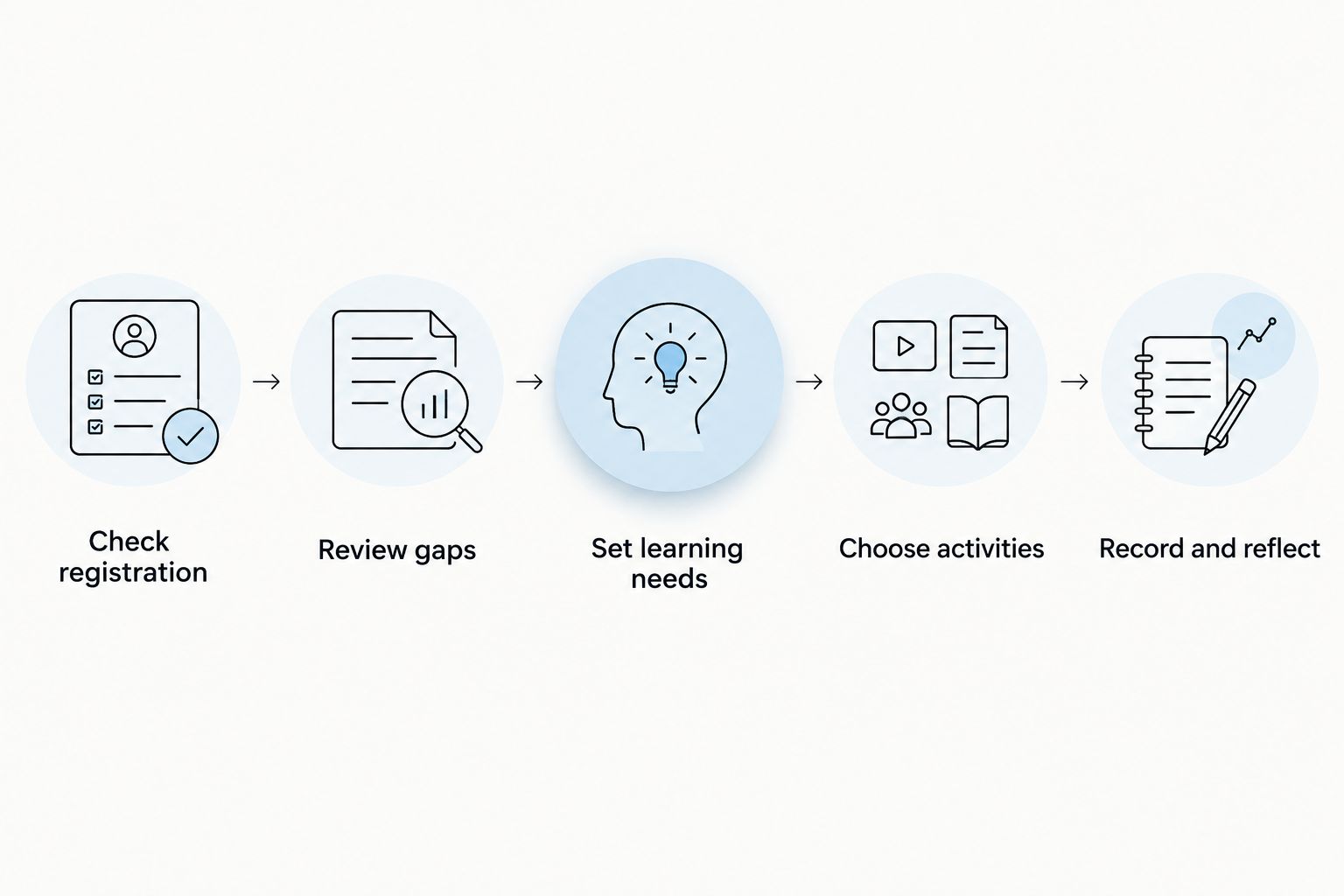
Start with your record, then select learning. The following sequence keeps professional development connected to the requirements you actually need to complete.
- Check registration. Confirm which professional and specialist requirements apply to you. Resolve uncertainty before using a standard total as your personal target.
- Review gaps. Check accepted points, interactive points, domain coverage, peer review and outstanding planning or reflection requirements.
- Set learning needs. Identify the knowledge, skills or professional behaviours you want to improve through your personal development plan.
- Choose activities. Match those needs to eligible learning, checking the activity details before committing time.
- Record and reflect. Complete participation requirements, check the resulting record and explain how the learning relates to your practice.
A useful development objective describes a change you want to make, not merely an event you intend to attend. For example, improving how you explain referral advice gives you a clearer purpose than completing another webinar.
After learning, connect the activity back to that objective. Record what informed your judgement, what you will change and whether further learning is needed; a list of presentation topics does not explain the effect on your practice.
Which learning format should you choose?
Choose by eligibility and learning need before convenience. Different formats support different tasks, but their names do not establish their regulatory status.
| Learning format | Best for | Strength | Limitation to check |
|---|---|---|---|
| Live discussion or workshop | Exploring decisions with other professionals | Provides an opportunity to question and discuss | Attendance alone does not establish interactive or peer review eligibility |
| Accredited self-directed activity | Working through a defined topic independently | Lets you focus on an identified knowledge need | Does not automatically satisfy interactive or peer review requirements |
| Clinical article or patient resource | Preparing for learning or supporting explanations | Helps connect a topic with everyday practice | Reading or using it does not automatically earn accredited points |
Scope Connect is best for eye care professionals seeking clinical resources alongside CPD-accredited education. Its resource-hub role supports topic exploration, but each activity still needs an individual eligibility check; resource access is not evidence that every item carries points.
For course selection, the CPD courses for dispensing opticians guide is a relevant next step. Compare the stated audience and learning outcomes with your development plan before considering the points allocation.
Do dispensing opticians need 12 CPD points every year?
12 points per year is the arithmetic average of 36 points over three years, not a substitute for checking the GOC’s cycle requirements. Treat that average as a planning aid, not proof that your record is compliant.
A steady learning pattern helps you avoid making every remaining choice around an outstanding requirement. However, annual totals alone tell you nothing about domain gaps, interactive status or peer review completion.
For 2026, review what you actually need next. An activity that addresses an uncovered domain and a genuine development need is more useful than choosing solely to reach a neat annual total.
Can all 36 CPD points come from online learning?
36 points is the standard cycle total; online delivery alone does not decide whether an activity qualifies. Check whether each activity is eligible for dispensing opticians and how it contributes to interactive learning, domains and peer review.
Online learning is not automatically non-interactive, and an in-person event is not automatically qualifying peer review. The activity’s approved status and completion conditions matter more than where you sit while taking part.
Apply the same check to recorded learning. Do not transfer the points designation of a live event to a recording without confirming the recording’s own terms.
Does reaching 36 points finish your CPD obligations?
36 points completes only the standard numerical target, not every element of the CPD framework. You must also satisfy the applicable interactive, domain, peer review, planning and reflection requirements.
Use a final record check rather than relying on your certificate folder. Confirm that activities have been accepted correctly and that your individual dashboard shows no outstanding requirement relevant to your registration.
Keep supporting evidence organised so you can resolve discrepancies. A certificate helps document participation, but it does not replace checking whether the activity has contributed to the requirement you intended.
FAQ
How many CPD points do dispensing opticians need?
Dispensing opticians following the standard GOC pathway need 36 CPD points over a three-year cycle. At least 18 points must be interactive, with additional requirements for domains, peer review, development planning and reflection.
How many interactive CPD points do I need as a dispensing optician?
You need at least 18 interactive CPD points within the standard 36-point cycle total. Check the activity’s designation rather than assuming a webinar or workshop qualifies.
Which CPD domains do dispensing opticians need to cover?
Dispensing opticians need at least 1 point in each of 4 domains: Professionalism, Communication, Clinical practice, and Leadership and accountability. Use the activity’s stated domain allocation when checking coverage.
Do dispensing opticians have to complete peer review?
Dispensing opticians must complete at least 1 qualifying peer review activity during the cycle. An informal conversation with a colleague should not be assumed to satisfy that requirement.
Do contact lens opticians have the same CPD requirements?
Contact lens opticians need to check specialty requirements as well as the requirements relevant to their dispensing-optician registration. Use your individual GOC record rather than treating the general 36-point summary as your complete checklist.
Does reading a Scope Connect article earn CPD points?
Reading a Scope Connect article does not automatically earn accredited CPD points. Check whether the specific resource is an eligible activity and complete its stated participation or assessment requirements.
What if I join the GOC register part-way through a cycle?
Check the requirements assigned to you by the GOC because joining part-way through a cycle can affect your obligations. Do not assume the full-cycle total or calculate your own reduced target without confirming it.
One last thing
Your next CPD choice should address a gap, not just add a point. Before booking, write down the development need and the outstanding requirement the activity is intended to meet.
At your next 2026 review, check those expectations against the completed record. That small distinction separates attending education from maintaining a clear, purposeful CPD plan.
Related guides
- CPD courses to GOC revalidation workflow
- How many CPD points does a dry eye disease course carry?
- Demodex blepharitis for dispensing opticians