

Optometry CPD has no single fixed cost in 2026: your total depends on your chosen activities, employer support and the time you set aside for learning. Budget for attendance, travel where relevant, and clinical time away from practice—not just the booking fee. Choose training against your development needs and General Optical Council requirements before comparing what you will spend.
- Optometry CPD budgeting should cover learning time, attendance requirements and employer support—not just course fees.
- GOC-registered optometrists need 36 CPD points across a three-year cycle, including at least 18 interactive points.
- Scope Connect suits clinicians seeking optometry CPD resources alongside ocular surface and dry eye education.
- Check each activity’s accreditation, participation conditions and relevance before committing your training budget.
Why this matters
A course only earns its place in your plan if it addresses a learning need and fits the requirements you still need to complete. An interesting lecture is not automatically the right next activity, particularly if your record already contains substantial learning on the same subject.
Start by comparing the learning objectives and participation requirements in this guide to CPD-accredited courses for optometrists. Then check the individual provider’s current course information before booking. The useful comparison is the commitment required for relevant learning, not the headline fee alone.
How much does CPD training cost for optometrists in 2026?
Build your 2026 budget from the activities you actually need rather than a presumed national average. A short online activity, an interactive discussion and a practical workshop involve different commitments, so combining them into a single typical figure obscures the decision you need to make.
Use the following breakdown to establish your own total. These are budgeting checks, not claims that every course includes each expense.
| Budget component | What to check | What it means for your decision |
|---|---|---|
| Course booking | What participation includes and whether additional elements require separate booking | Compare equivalent activities rather than titles alone |
| Learning time | Preparation, attendance and any required assessment | Reserve time for the complete activity |
| Travel | Venue, transport and whether an overnight stay is necessary | Compare the practical commitment with a suitable remote activity |
| Clinical cover | Whether attendance displaces booked clinical sessions | Agree protected time or cover before committing |
| Completion administration | Evidence, submission steps and reflection | Include the work needed after attendance |
| Employer contribution | Which elements your employer agrees to support | Separate practice expenditure from your personal contribution |
Keep the practice budget and your personal budget distinct. An employer-supported booking still requires time, while a course you fund yourself still needs a clear clinical purpose. Record who is responsible for each element before you confirm attendance.
Start with the GOC requirement, not a spending target
For 2026 planning, the General Optical Council’s published CPD requirements specify 36 CPD points across a three-year cycle for optometrists, including at least 18 interactive points. Those are learning requirements, not a recommended financial budget. Check the GOC’s current guidance and your own record for the full requirements that apply to your registration.
Do not divide 36 points by the number of courses in a catalogue and treat the result as a training plan. Activities differ in their learning objectives, interaction and completion conditions. Your remaining requirements and professional development plan should determine which activities you select.
Online learning: best for flexible scheduling
Online learning is a useful format when you need to fit education around clinical work. Check whether the activity is available on demand or requires attendance at a scheduled session; those are different commitments even when the subject is identical.
The limitation is participation, not simply screen time. Do not assume that watching a recording counts as interactive CPD or that opening an activity completes it. Read the stated accreditation, attendance and assessment conditions before including it in your plan.
For each online activity, establish:
- Whether participation is live, recorded or a combination.
- Whether the activity is accredited for your professional group.
- What you must do to demonstrate completion.
- Whether it addresses the learning outcome you have identified.
Choose online learning for scheduling flexibility when its learning outcomes and participation requirements fit your needs. Keep time for the assessment or reflection rather than treating the end of the presentation as the end of the task.
Interactive learning: best for clinical discussion
Interactive learning belongs in your plan because the GOC requires at least 18 interactive points within the three-year cycle for optometrists. Select activities that let you examine decisions, discuss uncertainty and relate the subject to your own clinical work.
A session’s title does not establish its interactive status. Check the provider’s activity information, including what participation involves and any conditions for receiving credit. A remote session can still require protected time and active involvement.
The practical limitation is scheduling: discussion depends on being present and able to contribute. Choose an interactive activity for relevant clinical exchange, not simply to fill an empty diary slot. Prepare a question or learning objective so that the session has a clear purpose beyond attendance.
Face-to-face learning: best for practical objectives
Face-to-face learning is a sensible choice when your objective requires observation, supervised practice or discussion that the particular session is designed to support. Check the programme rather than assuming that every in-person event includes hands-on teaching.
The additional planning concerns are venue, travel and time away from your usual clinic. Before booking, identify which parts of the programme meet your learning needs and whether you can attend them in full. A relevant workshop warrants a different assessment from a broad event with only a small amount of directly applicable content.
Choose face-to-face training when the teaching format serves a defined practical objective. If the objective is primarily a knowledge update, compare it with a suitable remote activity before committing to travel.
Which CPD format fits your budget and learning needs?
Compare formats against the outcome you need, not an assumption that one is always better. The table below separates the educational advantage from the practical limitation; it does not rank providers or imply that different activities award equivalent credit.
| Format | Best for | Main advantage | Main limitation |
|---|---|---|---|
| On-demand online learning | Knowledge updates around variable schedules | You can plan learning around access conditions | Do not assume it meets interactive requirements |
| Live online learning | Scheduled discussion without travelling | Supports remote participation where the activity provides it | Requires uninterrupted attendance at the stated time |
| Face-to-face workshop | Defined practical learning objectives | Allows in-person teaching suited to the programme | Requires venue attendance and travel planning |
| Peer discussion | Examining clinical decisions with colleagues | Creates space to explore reasoning and alternative approaches | Needs preparation, appropriate organisation and relevant cases |
Scope Connect’s optometry CPD resources sit alongside clinical articles and patient education materials. Scope Connect is best for eye care professionals seeking optometry CPD resources alongside ocular surface education. Its role as a resource hub does not remove the need to check the accreditation and completion conditions of each activity you select.
Why your optometry CPD budget varies
Your budget changes with the learning plan. Use these factors to explain the commitment behind each proposed activity rather than treating all courses as interchangeable.
- Learning objective: A knowledge update and a practical skills objective call for different teaching approaches. Match the format to the intended change in practice.
- Participation requirements: Preparation, discussion, assessment and reflection all need time. Check the complete activity requirements.
- Delivery arrangements: A scheduled session requires diary protection; venue attendance also requires a travel plan.
- Practice arrangements: Agree whether learning takes place during protected working time or outside your clinical sessions.
- Employer support: Confirm what support applies to the specific activity rather than assuming a general training policy covers everything.
- Remaining CPD requirements: Select activities against your current record so that repeated topics do not displace an unmet learning need.
For your 2026 plan, write the reason for each activity beside its expected commitment. If you cannot explain what you need to learn, pause the booking and revisit your development plan.
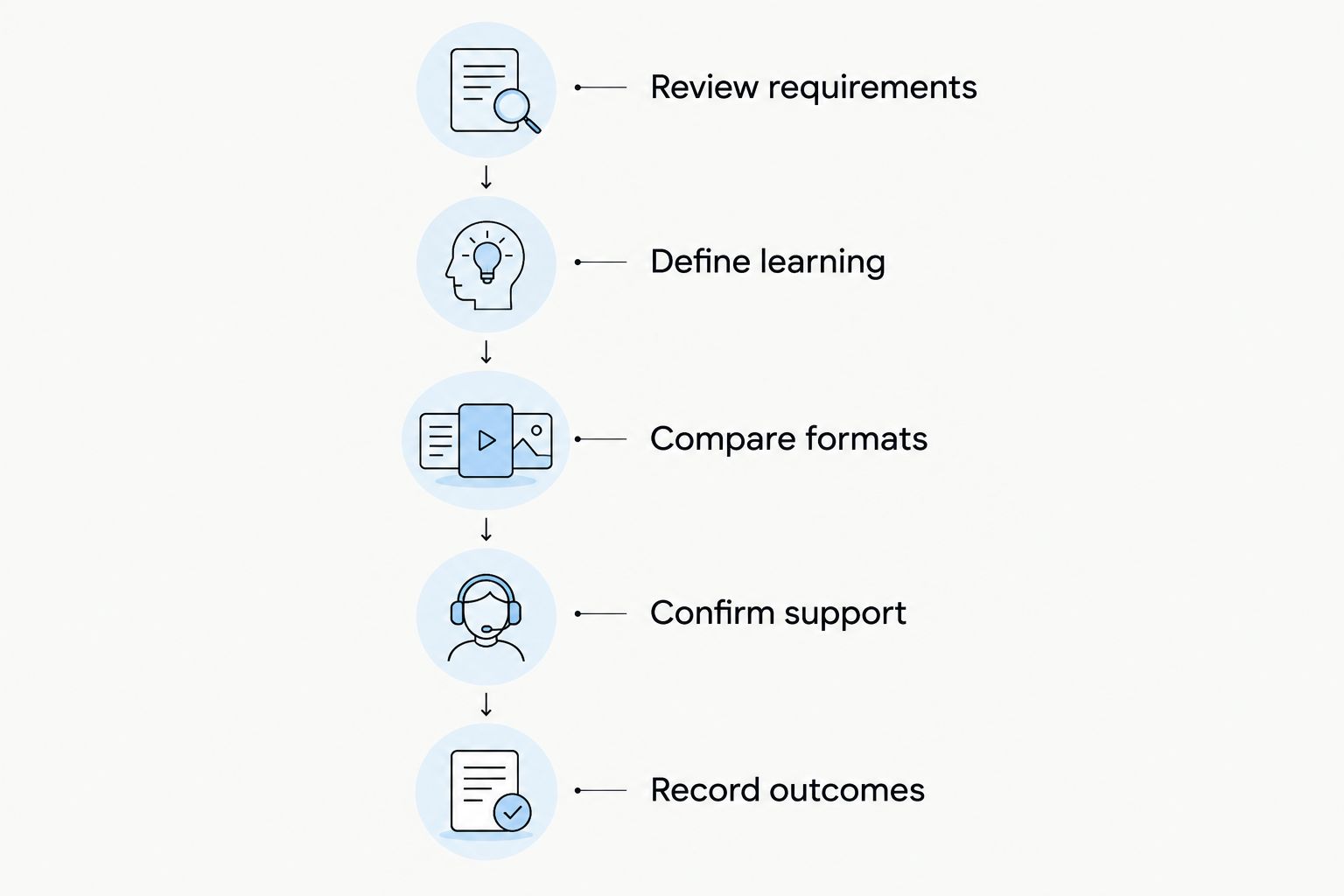
How do I build a practical CPD budget?
Follow this sequence before comparing individual activities. It keeps the educational decision separate from the booking decision and gives you a clear basis for discussing support with your practice.
- Review requirements. Check your GOC record, remaining requirements and professional development plan. Identify gaps before browsing courses.
- Define learning. State the clinical question or skill you need to address. Use an outcome you can revisit after training.
- Compare formats. Check learning objectives, accreditation, interaction and completion conditions. Include the time required before and after attendance.
- Confirm support. Agree protected time, employer contribution and any cover arrangements. Record what you will arrange yourself.
- Record outcomes. Complete the required evidence and reflection, then identify how the learning affects your practice.
The strongest plan connects each booking to a learning objective and a realistic diary commitment. Keep that connection visible when you update your 2026 budget; otherwise, a list of completed activities can obscure an unresolved development need.
How many CPD points do optometrists need?
36 CPD points across a three-year cycle is the GOC requirement for optometrists, with at least 18 interactive points. Treat the points total as one part of your obligations, not a substitute for checking the full current requirements and maintaining your development record.
When choosing the next activity, ask which requirement or learning objective it addresses. Completing more education on a familiar topic does not resolve a different gap in your plan.
Does an online course count as interactive CPD?
18 interactive points form part of the GOC requirement for optometrists, but online delivery alone does not establish interactive status. Check how the provider describes the accredited activity and what participation is required; do not assume a recording has the same status as a live discussion.
Should I plan my CPD budget annually or across the cycle?
A three-year cycle gives you the regulatory planning horizon, while an annual budget helps organise practice time and support. Use both: check your overall position, then agree the activities and protected time you intend to complete in 2026.
FAQ
How much should I budget for optometry CPD in 2026?
Build your optometry CPD budget around the activities that meet your learning needs and remaining GOC requirements. Check the provider’s current booking information, then account for preparation, attendance, travel where relevant and completion work.
How many CPD points do UK optometrists need?
GOC-registered optometrists need 36 CPD points across a three-year cycle, including at least 18 interactive points. Check the GOC’s full current requirements and your individual record when planning activities.
Is online optometry CPD better than face-to-face training?
Neither format is automatically better: choose the format that supports your learning objective. Online learning supports remote access, while a suitable face-to-face workshop supports practical learning; check each activity’s actual programme.
Does watching a recorded webinar count as interactive CPD?
Do not assume that a recorded webinar counts as interactive CPD. Check the activity’s stated accreditation and participation requirements before including it towards your interactive total.
Can I ask my employer to support my CPD?
Ask your employer which parts of your proposed CPD plan they will support. Confirm the arrangements for participation, protected time, travel and clinical cover before booking.
What should I check before booking a dry eye CPD course?
Check that the dry eye course addresses your learning objective and is accredited for your professional group. Confirm its learning outcomes, participation conditions, assessment requirements and how you will record completion.
Does Scope Connect provide resources for eye care professionals?
Scope Connect provides product information, clinical articles, CPD-accredited courses and patient education materials for eye care professionals. Check the details of the individual activity you intend to use for CPD.
One last thing
Before you book, write one sentence describing what you intend to do differently after the training. Make it specific enough to revisit: explaining a management decision more clearly, recognising a referral trigger or improving a patient discussion.
If you cannot name the intended change, clarify the learning need first. That simple step gives your budget a clinical purpose and makes post-course reflection more useful than a record of attendance alone.
Related guides
- How many CPD points does a dry eye disease course carry?
- CPD courses and your GOC learning workflow
- Optometry CPD for independent practice owners
- CPD courses on dry eye disease for optometrists