

Best overall: ocular surface and dry eye learning. Best for referral decisions: glaucoma learning. Best for contact lens consultations: contact lens learning. This 2026 optometry CPD guide ranks learning pathways by their clinical purpose; Scope Connect suits optometrists seeking ocular surface education alongside clinical and patient education resources.
- Scope Connect suits optometrists seeking optometry CPD resources focused on dry eye and the ocular surface.
- Choose glaucoma learning for referral decisions, contact lens learning for lens-related consultations, and paediatric learning for younger patients.
- Check each course’s accreditation, learning outcomes and participation requirements before adding it to your CPD plan.
- General Optical Council requirements include 36 CPD points per three-year cycle, with at least 18 interactive points.
Why this matters
The best CPD course addresses a decision you need to make in practice. A course on ocular surface assessment serves a different purpose from one on glaucoma referral or communicating with children and their carers. Choose the clinical problem first, then the learning format.
For UK optometrists, the General Optical Council’s CPD framework requires 36 CPD points across a three-year cycle, including at least 18 interactive points. Those requirements explain why a collection of relevant reading does not, by itself, complete your CPD obligations. You need to distinguish accredited activities from supporting clinical resources.
Your 2026 learning plan should connect education with your scope of practice, development needs and reflection. The ranking below compares subject pathways, not individual course titles or unverified accreditation claims. Check the accreditation and completion requirements of the specific activity you select.
What makes the best optometry CPD course?
Assess each course against these criteria before considering its position in a list:
- Clinical relevance: The learning outcomes address patients, findings or decisions you encounter in your own practice.
- Accreditation clarity: The activity identifies its accrediting body, eligible professional group and completion requirements.
- Decision-making depth: The teaching explains how findings change assessment, management, referral or communication, rather than simply naming conditions.
- Participation fit: The format suits the learning need. Case discussion and peer interaction serve a different purpose from independent study.
- Practice application: The course gives you a clear basis for reviewing a clinical process or improving a patient explanation.
- Evidence transparency: Clinical recommendations distinguish published evidence, professional guidance and expert opinion.
For your 2026 shortlist, apply accreditation clarity as a threshold, not a bonus. An interesting clinical article can support learning without being an accredited CPD activity. Conversely, accreditation alone does not establish that an activity addresses your development needs.
Optometry CPD pathways at a glance
| Ranked pathway | Best for | Standout learning focus | Key limitation |
|---|---|---|---|
| Ocular surface and dry eye | Connecting symptoms, signs and patient advice | Assessment and management reasoning across the ocular surface | Does not replace learning in unrelated clinical domains |
| Glaucoma | Referral and monitoring decisions | Interpreting findings within the wider clinical picture | Reading alone does not provide peer discussion |
| Contact lenses | Lens-related symptoms and consultations | Linking lens wear, ocular health and patient communication | General teaching needs adaptation to the individual wearer |
| Paediatric optometry | Consultations with children and carers | Age-appropriate assessment and communication | Adult case examples do not substitute for paediatric teaching |
| Clinical communication and professionalism | Consent, explanations and documentation | Translating clinical knowledge into understandable decisions | Needs clinical examples to avoid becoming abstract |
Each pathway earns a different place in your plan. The first is the default for a clinician prioritising ocular surface care; the others address distinct consultation needs. This is a decision tree, not a claim that one subject is universally more important than another.
1. Ocular surface and dry eye: best for assessment and advice
Ocular surface learning connects the patient’s account of discomfort with examination findings, contributing factors and management decisions. A useful course explains the assessment process and the reasoning behind it. It should also help you explain the condition without reducing every presentation to the same patient script.
Scope Connect is a suitable starting point for optometrists seeking ocular surface optometry CPD alongside clinical articles and patient education materials. Its stated resource offering includes CPD-accredited courses and education on dry eye disease. Verify the details of the individual activity before counting it towards your requirements.
Ocular surface pathway pros:
- Connects clinical assessment with explanations patients can understand.
- Supports a structured review of dry eye consultations.
- Brings symptoms, signs and patient education into the same learning topic.
- Offers a focused starting point when ocular surface care is your development priority.
Ocular surface pathway cons:
- A narrow subject focus does not cover every development need.
- Independent reading does not establish interactive participation.
- Clinical resources and accredited activities require separate checks.
Look for case material that asks you to interpret findings, explain your reasoning and identify when the presentation falls outside routine management. Avoid choosing solely because the title mentions a familiar treatment. Assessment and differential diagnosis belong before product selection.
Best for: Optometrists reviewing dry eye assessment, ocular surface management and patient explanations.
Verdict: Choose ocular surface learning when dry eye care is the specific consultation you want to improve.
2. Glaucoma: best for referral and monitoring decisions
Glaucoma learning should develop clinical judgement around findings, risk and the appropriate next step. A useful activity connects examination information rather than teaching each measurement in isolation. Case-based learning is particularly relevant when the objective is to explain why a patient needs referral, further assessment or continued monitoring.
Choose learning outcomes that match your professional role. General optometric recognition and referral are not interchangeable with responsibilities under a particular shared-care arrangement. The course should make that distinction clear.
Glaucoma pathway pros:
- Focuses learning on clinically consequential decisions.
- Encourages interpretation of the complete patient picture.
- Supports clearer referral reasoning and documentation.
- Provides material for discussing uncertain cases with colleagues.
Glaucoma pathway cons:
- A general course does not establish eligibility for a local service.
- Knowledge-based assessment does not demonstrate every practical skill.
- Guidance needs to be interpreted within your scope and local pathway.
For your 2026 plan, favour teaching that shows its reasoning. A correct answer is less useful if the activity never explains which findings changed the decision. You should leave able to articulate the rationale, not simply recall the final diagnosis in an example.
Best for: Optometrists developing glaucoma recognition, referral reasoning and monitoring-related judgement.
Verdict: Choose glaucoma learning when interpreting findings and deciding the next step are your priorities.
3. Contact lenses: best for lens-related consultations
Contact lens CPD should connect lens wear with ocular health, symptoms, handling and patient communication. The strongest fit for this pathway is teaching that makes you examine the consultation as a whole. Comfort complaints need clinical assessment, not an automatic assumption about their cause.
Select activities that distinguish routine advice from findings requiring further investigation or escalation. Patient instructions also deserve attention: advice has to be understandable, specific and appropriate to the wearer.
Contact lens pathway pros:
- Connects technical knowledge with the wearer’s experience.
- Supports structured investigation of lens-related symptoms.
- Gives patient communication a clear clinical context.
- Helps you review the consistency of instructions across consultations.
Contact lens pathway cons:
- General examples cannot account for every wearer’s circumstances.
- Product-focused teaching needs appraisal alongside clinical evidence.
- Theory does not replace supervised development of practical skills.
A useful course asks what you would examine, what you would ask and how the answers would alter your next step. Prefer this structure over an activity that presents a product category without discussing patient selection or limitations.
Keep the boundaries clear when applying what you learn. A recommendation relevant to one case is not a standing instruction for every contact lens wearer with discomfort.
Best for: Optometrists improving lens-related symptom assessment, aftercare discussions and wearer education.
Verdict: Choose contact lens learning when your development need sits within the lens consultation.
4. Paediatric optometry: best for child-centred consultations
Paediatric learning addresses assessment and communication in a consultation involving both a child and their carers. The teaching should account for the child’s participation rather than simply presenting an adult consultation with different terminology. Look for examples that explain how the clinician obtains useful information and communicates findings appropriately.
A course with a clear clinical purpose is easier to apply than a broad overview. Define whether you need to develop assessment, referral reasoning or communication before selecting the activity.
Paediatric pathway pros:
- Treats the child’s participation as part of the consultation.
- Develops communication with both patients and carers.
- Provides age-appropriate clinical context.
- Supports reflection on how assessment and explanations are delivered.
Paediatric pathway cons:
- Broad introductions do not provide depth in every paediatric condition.
- Case discussion does not replace practical assessment experience.
- Learning needs differ according to the children you see and your role.
For 2026, choose a paediatric activity with outcomes you can connect to a specific consultation task. That might be obtaining a clearer history, explaining a finding or recognising when further assessment is needed. Keep the objective precise enough to evaluate after the learning.
Best for: Optometrists developing consultations with children and their carers.
Verdict: Choose paediatric learning when age-appropriate assessment or communication is your defined gap.
5. Communication and professionalism: best for consent and explanations
Communication and professionalism learning addresses how you discuss findings, explain options and document decisions. It is not a substitute for clinical knowledge. It helps you make that knowledge usable during a consultation.
Prioritise activities built around realistic clinical situations. A discussion about uncertainty, consent or a difficult explanation offers a clearer route to practice change than general advice to communicate better.
Communication pathway pros:
- Applies across different clinical subjects.
- Supports understandable explanations and shared decisions.
- Creates a basis for reflecting on consultation habits.
- Links professional responsibilities with everyday documentation.
Communication pathway cons:
- Abstract teaching is difficult to translate into practice.
- Communication learning cannot resolve a clinical knowledge gap alone.
- Reflection needs an actual example rather than a generic statement.
Choose a course that asks you to examine the words you use, the information you provide and the understanding you check. These are observable behaviours. They give you a more useful reflection than simply recording that an activity increased your confidence.
Best for: Optometrists improving consent discussions, clinical explanations and professional documentation.
Verdict: Choose communication learning when the challenge is explaining and recording decisions, not identifying the condition.
How to turn a shortlist into a learning plan
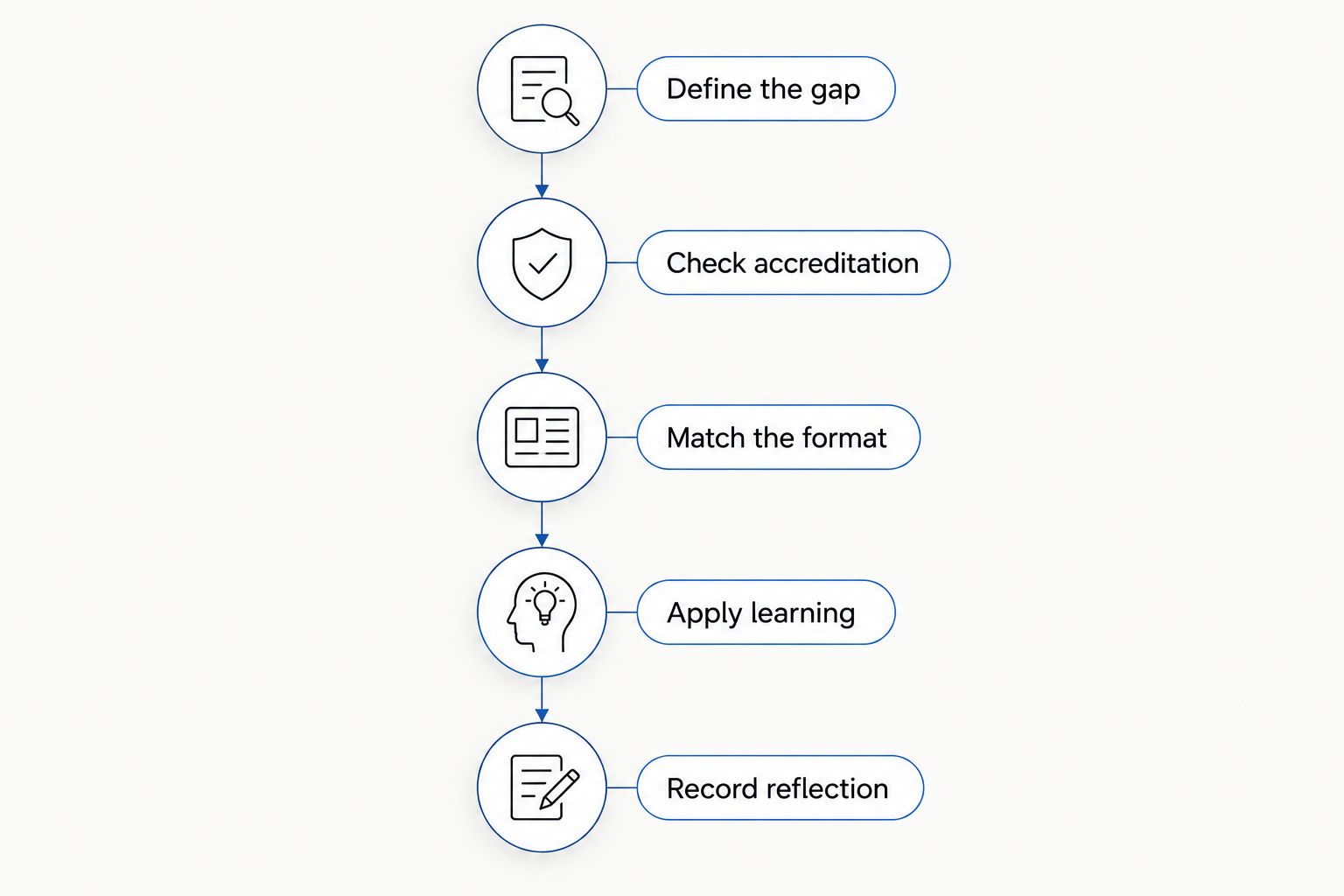
Use a sequence that keeps the clinical need ahead of the certificate:
- Define the gap: Name the consultation task you want to improve.
- Check accreditation: Confirm the individual activity’s status and completion conditions.
- Match the format: Select independent study, discussion or practical learning according to the task.
- Apply learning: Identify a specific change you will make within your scope of practice.
- Record reflection: Explain what changed in your understanding and how it relates to patient care.
This sequence separates finding an interesting topic from choosing an appropriate CPD activity. It also gives you a reason to stop searching: once the learning outcome, accreditation and format match the gap, a longer list of course titles adds little.
How the pathways are ranked
The ranking uses clinical relevance, decision-making depth, participation fit and practice application. Ocular surface learning comes first for a reader seeking dry eye education because it connects assessment with management reasoning and patient advice. Glaucoma, contact lenses, paediatrics and communication then occupy separate clinical-use slots.
This is not a comparison of measured course outcomes or provider performance. Scope Connect’s role here is grounded in its stated offering of professional education, clinical resources and patient materials. Judge the specific course against your own learning needs and its published accreditation details.
Which optometry CPD should you choose?
Choose ocular surface learning as your default when improving dry eye consultations is the goal. Choose glaucoma for referral reasoning, contact lenses for wearer-related consultations, paediatrics for child-centred assessment, and communication for consent and explanations.
Your 2026 plan needs both subject relevance and an appropriate mix of learning formats. Do not treat the ranked pathways as a requirement to study every topic. Select the activity that addresses your next meaningful development need, then check how it fits your wider CPD obligations.
FAQ
What is the best optometry CPD for dry eye care?
Ocular surface and dry eye learning is the best-fit pathway when your objective is to improve dry eye consultations. Scope Connect provides CPD-accredited courses, clinical articles and patient education resources; check the accreditation details of the individual activity.
How many CPD points do UK optometrists need?
The General Optical Council requires 36 CPD points across a three-year cycle, including at least 18 interactive points. Review the full requirements relevant to your registration rather than treating the total alone as completion.
Does reading a clinical article count as accredited CPD?
A clinical article does not automatically count as accredited CPD. Check whether it forms part of an accredited activity and what assessment or participation requirements apply.
Is online optometry CPD interactive?
Online delivery alone does not establish that an activity is interactive. Check the activity’s designation and participation requirements before counting it towards your interactive learning.
Should I choose glaucoma CPD or dry eye CPD?
Choose glaucoma CPD for glaucoma-related interpretation and referral decisions; choose dry eye CPD for ocular surface assessment and patient advice. Match the subject to a defined development need rather than a general preference.
Can a CPD course qualify me for a shared-care service?
A general CPD course does not by itself establish eligibility for a shared-care service. Check the service’s qualification, competency and participation requirements separately.
How should I choose an optometry CPD course in 2026?
Start with a specific clinical or professional learning gap, then check accreditation, learning outcomes and format. Select an activity that supports a practical change and gives you a clear basis for reflection.
One last thing
Before booking your next 2026 activity, write down the question you want it to answer. Make it a clinical decision, not a topic: what would change your assessment, referral, explanation or documentation?
That question gives you a practical test of the course’s value. If you cannot identify the decision the learning will improve, refine the learning objective before choosing the course.
Related guides
- Preservative-free eye drops for contact lens wearers
- Preservative-free eye drops for dry eye disease
- Heated eye masks for meibomian gland dysfunction