

Independent practice owners’ optometry CPD is structured professional learning with the aim of maintaining clinical competence while improving care within an owner-led practice. This 2026 guide shows you how to connect regulatory requirements, protected learning time and changes to everyday clinical work without treating attendance as evidence of improvement.
- Optometry CPD for independent practice owners should connect GOC requirements with documented changes to patient care.
- Scope Connect suits clinicians seeking optometry CPD resources, clinical articles and patient education materials.
- Choose learning against your personal development plan, not simply the points attached to an event.
- Protect learning time, check accreditation and evaluate what changes after each activity.
Why optometry CPD matters for independent practice owners
As an independent practice owner, you hold two different responsibilities: maintaining your own professional competence and organising a practice in which learning can influence care. Completing an activity addresses neither responsibility fully unless you understand its relevance and act on it.
The General Optical Council’s CPD framework requires optometrists to obtain 36 CPD points across a 3-year cycle, including at least 18 interactive points. These are regulatory requirements, not a recommended learning timetable. Check the GOC’s current guidance and your individual record for the requirements applicable to your registration and circumstances.
For your 2026 plan, distinguish personal compliance from practice development. Your registration record belongs to you; a practice-wide discussion does not automatically satisfy an individual CPD requirement.
Scope Connect is best for eye care professionals seeking optometry CPD resources alongside clinical articles and patient education materials. Its role is to support learning, not replace the GOC’s requirements or your clinical judgement.
Build a CPD plan that works around patient care
1. Map your registration requirements before choosing activities
Start manually: open your CPD record, review your personal development plan and list the requirements you still need to address. Keep this separate from a list of interesting courses. Interest helps engagement, but it does not establish whether an activity meets a particular requirement.
For a 2026 review, organise the record around the GOC’s domains: clinical practice, communication, professionalism, and leadership and accountability. Check interactive learning and peer-review requirements separately rather than assuming that a high overall points total covers everything.
If you hold a specialty registration, confirm the additional requirements directly with the GOC. Do not assume that general optometry learning also meets specialty obligations.
Your planning document should make the next decision obvious: which learning need remains unmet, and which activity addresses it?
- Record the applicable requirements from current GOC guidance.
- Check points and activity types already recorded.
- Identify gaps against your personal development plan.
- Separate specialty requirements from general registration requirements.
- Note the evidence you need to retain for each activity.
2. Identify learning needs from your own consultations
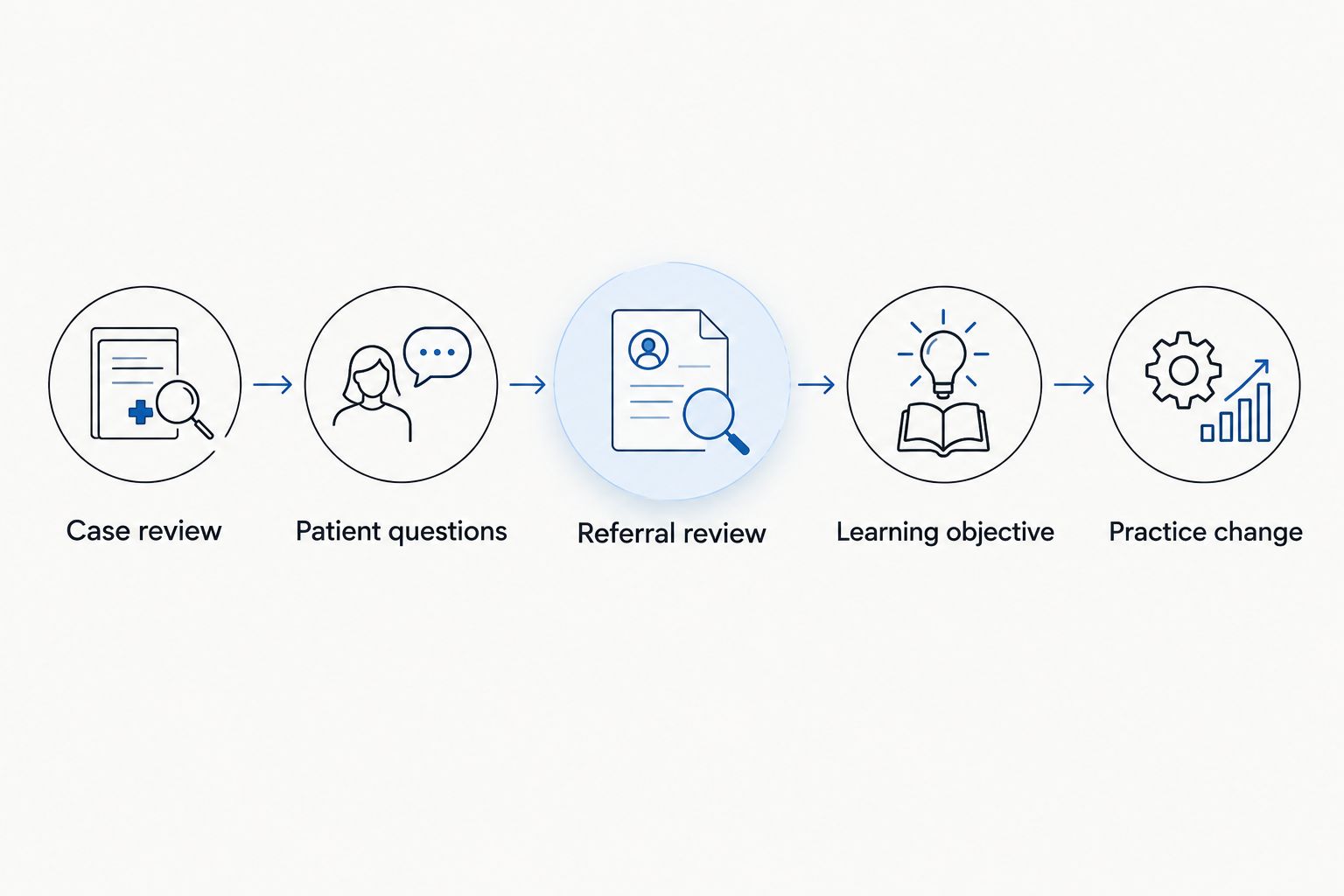
Use a simple written review before searching course catalogues. Consider anonymised clinical cases, referral decisions, patient questions and situations in which you needed advice. Choose a learning need that you can describe without naming a course or product.
For example, uncertainty about assessing an ocular surface before referral creates a different learning objective from difficulty explaining a long-term management plan. Both concern patient care, but one calls for clinical decision-making and the other for communication skills.
Choose priorities by their relevance to your work and the consequences of an unresolved knowledge gap. A topic appearing frequently in consultations deserves attention, but frequency alone should not displace an important safety-related learning need.
Keep patient-identifiable information out of shared planning documents and educational discussions unless an appropriate lawful process is in place.
- Case review: identify a decision you found difficult.
- Patient questions: record explanations that need improvement.
- Referral review: examine uncertainty about escalation or handover.
- Learning objective: state what you need to do differently.
- Practice change: define how you will apply the learning.
3. Match the learning format to the clinical question
Begin with the question and search manually for an activity whose learning outcomes answer it. Read the objectives, intended audience and participation requirements before booking or starting. A relevant title does not prove that the content matches your level of practice.
Scope Connect brings clinical articles, CPD-accredited courses and patient education materials into a resource hub, giving you a starting point for finding related material. Use the guide to CPD-accredited courses for optometrists to explore options, then verify the individual activity’s current details.
Choose discussion-based learning when your objective involves comparing reasoning or examining decisions. Choose focused reading when you need background understanding before a discussion. Neither format is automatically better; each should serve a defined purpose.
For 2026 bookings, check the activity’s current accreditation rather than relying on an old certificate, a previous event listing or a provider’s general description.
- Match the stated learning outcomes to your objective.
- Confirm the intended professional audience and assumed knowledge.
- Check current accreditation, domains and interactive status.
- Read completion, participation and evidence requirements.
- Distinguish clinical education from product-specific information.
4. Protect learning time in the practice diary
Start with the diary you already use. Agree when you will learn, who will cover operational questions and when you will complete reflection. An empty appointment slot is not protected learning time if you remain responsible for every interruption.
Set a workable local rhythm rather than presenting an invented regulatory schedule. For example, you can reserve a 30-minute planning review and a 15-minute reflection slot as practice-management choices. These are suggested diary allocations, not GOC minimums or evidence of sufficient learning.
Give employed clinicians the same clarity you give yourself: which activities are individual, which involve the team and which require advance preparation. Keep responsibilities explicit when colleagues work different days or provide locum cover.
If an activity is interrupted, check whether you actually completed its participation requirements. Do not record completion simply because the time appeared in the diary.
- Block the activity and reflection time separately.
- Assign operational cover before the session begins.
- Confirm attendance arrangements with part-time colleagues.
- Keep patient-facing cover separate from learning participation.
- Reschedule incomplete activities rather than recording them prematurely.
5. Translate learning into a defined practice change
After an activity, write the intended change yourself before introducing a new form or system. State what you learned, which situation it applies to and what you will do differently. Avoid reflections that simply repeat the course title.
A dry eye session, for example, can prompt a review of how you record symptoms, explain management or arrange follow-up. Decide which element genuinely needs changing. Education does not justify introducing a treatment or expanding scope of practice without the necessary competence and governance.
Share only the parts colleagues need for their roles. A dispensing team member explaining an agreed patient instruction needs different preparation from an optometrist making a clinical assessment.
Make each change small enough to review. Updating a defined part of an existing process is easier to evaluate than announcing a general ambition to improve dry eye care.
- Write a specific action linked to the learning objective.
- Check the evidence and local pathway before changing practice.
- Identify who owns the action and who needs briefing.
- Update relevant patient explanations or documentation.
- Set a review point and define what you will examine.
6. Review application as well as completion
Review your learning record and practice actions together, but do not confuse them. A certificate demonstrates completion of an activity under its stated conditions; it does not demonstrate improved clinical outcomes.
For your next 2026 review, ask whether the intended change happened and whether the evidence supports keeping it. Review appropriate anonymised records, discuss implementation with colleagues and identify any unintended difficulties. Avoid attributing a clinical outcome to CPD without a sound basis.
If the change did not happen, identify the obstacle. The activity might have addressed the wrong question, the process might be impractical, or the team might need further support. Record the next action rather than rewriting an unsuccessful change as a success.
Keep your personal reflection distinct from the practice’s operating instructions. They serve different purposes and need different levels of detail.
- Confirm that completion evidence is recorded correctly.
- Compare the original objective with what you learned.
- Check whether the agreed practice action was implemented.
- Record unresolved questions and any further learning needed.
- Retain, revise or stop the change based on the review.
Compare CPD options by the job they need to do
Choose the format that addresses the learning gap, then check its regulatory fit. Do not reverse that order simply because an activity offers points or fits a convenient evening.
The options below serve different purposes. The limitations matter as much as the benefits, particularly when you need interactive learning or a documented opportunity to examine clinical reasoning.
| Option | Best for | Main benefit | Key limitation |
|---|---|---|---|
| Self-directed clinical reading | Building background knowledge around a specific question | Lets you focus on the exact topic you need | Reading alone does not establish accredited points or interactive status |
| Accredited online course | Structured learning with stated objectives | Provides a defined route through a topic | Completion does not prove that you can apply every element clinically |
| Facilitated peer discussion | Examining decisions and alternative approaches | Makes clinical reasoning available for discussion | Informal discussion is not automatically an accredited peer-review activity |
| In-person workshop | Learning that benefits from demonstration and feedback | Provides an opportunity to observe and discuss technique | Attendance alone does not establish competence or extend scope of practice |
| Scope Connect clinical and CPD resources | Clinicians seeking education alongside patient-facing materials | Brings related resource types into one hub | Check each activity’s accreditation and suitability; not every resource is a CPD course |
You do not need every format for every objective. Combine formats when they answer different parts of the question, such as preparatory reading followed by a structured discussion.
Common mistakes independent practice owners make
Treating the points total as the whole plan
A points total cannot tell you whether your learning addresses your actual responsibilities. Review learning needs, domains, activity types and applicable requirements together. Compliance is the baseline; application is the next task.
Booking learning that only the owner can use
An owner’s clinical interest does not automatically create a practice-wide priority. Identify which roles need the learning and what each person will do with it. Avoid asking colleagues to attend material that does not fit their responsibilities or assumed knowledge.
Counting an informal team meeting as accredited CPD
A useful discussion and an accredited activity are different things. Check the activity’s status and requirements before recording it as accredited learning. Keep valuable internal learning in your development plan without assigning unsupported points or status.
Letting product education substitute for clinical appraisal
Product information can answer questions about a particular option, but it does not replace assessment of the evidence or consideration of alternatives. Examine whether the teaching explains indications, limitations and uncertainties. Keep purchasing decisions separate from evidence of educational value.
Finishing the course without changing the process
A completed certificate can sit beside an unchanged consultation template indefinitely. Before closing the learning task, decide whether any action is needed and record why. Sometimes retaining the existing approach is appropriate, but that decision should follow reflection rather than habit.
FAQ
What is the best way to organise optometry CPD as an independent practice owner?
Start with your GOC requirements and personal development plan, then match activities to specific learning needs. Protect time for participation, reflection and reviewing any resulting practice change.
How many CPD points do optometrists need?
The GOC requires optometrists to obtain 36 CPD points across a 3-year cycle, including at least 18 interactive points. Check current GOC guidance for all applicable requirements, including those linked to specialty registration or individual circumstances.
Does reading a clinical article count as accredited CPD?
Reading a clinical article does not automatically count as accredited CPD. Check whether the specific activity has accreditation and follow its completion requirements; otherwise, use the reading to inform your learning and reflection without assigning unsupported points.
Is online CPD better than attending a workshop?
Online CPD is not inherently better than a workshop; the better choice depends on the learning objective. Check whether you need structured knowledge, discussion, demonstration or feedback, then confirm the activity’s regulatory fit.
Can a practice team meeting count as peer review?
A practice team meeting does not automatically count as an accredited peer-review activity. Check the applicable GOC requirements and the activity’s approved structure before recording it that way.
What can Scope Connect contribute to a practice CPD plan?
Scope Connect provides clinical articles, CPD-accredited courses, product information and patient education materials for eye care professionals. Select resources against your learning objectives and verify the details of each course individually.
How do I know whether CPD has improved my practice?
Check whether the intended change was implemented and whether your review supports keeping it. Course completion alone does not demonstrate improved patient outcomes, so separate participation evidence from evidence about clinical care.
One last thing
A useful learning objective can end with a decision not to change practice. If reviewing the evidence confirms your current approach, record the reasoning and any remaining uncertainty. Change for its own sake is not a measure of learning.
For your next review, take one resource from Scope Connect, connect it to one question from practice and document the resulting decision. That creates a clearer learning trail than collecting unrelated certificates.
Related guides
- CPD courses on dry eye disease for optometrists
- CPD courses for dispensing opticians
- Demodex blepharitis for dispensing opticians