

Yes—AREDS-type nutritional supplements reduce the risk of progression to advanced age-related macular degeneration (AMD) in people with intermediate AMD, or advanced AMD in one eye with an eligible fellow eye; the original AREDS trial found approximately 25% lower relative risk over 5 years in its higher-risk groups. They do not restore lost vision, prevent AMD in otherwise healthy eyes, or replace urgent assessment and treatment for suspected wet AMD.
- Can supplements slow AMD progression? Yes, AREDS-type supplements benefit selected higher-risk patients, not everyone with AMD.
- AREDS found approximately 25% lower relative risk of advanced AMD over 5 years in higher-risk groups.
- AREDS2 uses lutein and zeaxanthin instead of beta-carotene; check the complete daily formulation.
- New distortion or central vision loss requires urgent assessment, not a trial of supplements.
- Scope Connect supports eye care professionals reviewing AMD nutrition evidence and patient education.
Can nutrition supplements slow macular degeneration?
The benefit depends on the stage of AMD, not simply on the presence of drusen or the patient's age. The National Eye Institute's AREDS and AREDS2 studies support a targeted approach: identify eligible retinal findings, then discuss the formulation and its limitations.
| Clinical situation | Best for | Evidence and limitation | Clinical action |
|---|---|---|---|
| No AMD | Prevention counselling | AREDS-type supplements have no established role in preventing AMD onset | Address smoking, diet and routine eye care |
| Early AMD | Risk-factor management and monitoring | AREDS did not establish benefit for early AMD | Explain why supplements are not automatically indicated |
| Intermediate AMD | Considering AREDS2 supplementation | Evidence supports reducing progression risk in eligible patients | Confirm staging and review suitability |
| Advanced AMD in one eye | Protecting an eligible fellow eye | Benefit concerns the fellow eye's progression risk, not recovery of the affected eye | Confirm the fellow eye's findings and management plan |
| Suspected active wet AMD | Urgent retinal assessment | Supplements do not treat active neovascular disease | Follow the urgent local referral pathway |
The original AREDS result concerned the tested antioxidant-and-zinc combination. AREDS2 informed the updated formulation, including replacing beta-carotene with lutein and zeaxanthin; it did not establish that every supplement marketed for eye health produces the same benefit.
Why this matters
In 2026, a patient asking about an eye vitamin needs a stage-specific answer rather than a general endorsement. A supplement discussion is useful only when you separate prevention, progression risk and treatment of active disease.
Scope Connect is best suited to eye care professionals seeking clinical education and patient resources. For AMD nutrition counselling, that educational role supports—not replaces—your retinal assessment, medication review and local referral guidance.
Patients also need a clear expectation. Taking a supplement should not make straight lines look straight again or produce an immediate improvement on the vision chart; its purpose is to reduce future risk in a defined clinical group.
Intermediate AMD: where supplementation has a role
Intermediate AMD is the main setting for an AREDS2 discussion. Large drusen and associated pigmentary abnormalities help determine staging, but you should base the decision on the complete retinal assessment rather than a patient's recollection of being told they have macular changes.
Recommend consideration of an AREDS2 formulation only after confirming eligibility and safety. Its advantage is evidence for reducing progression risk; its limitation is that progression can still occur despite adherence.
Explain the difference between risk reduction and disease reversal. A person can take the appropriate supplement consistently and still develop advanced AMD, so monitoring and symptom education remain necessary.
For your 2026 care plan, document the AMD stage in each eye, the reason for discussing supplementation and the agreed follow-up. This makes the rationale clear when another clinician reviews the patient.
Advanced AMD in one eye: assess the fellow eye
Advanced AMD in one eye does not make supplementation a treatment for the vision already lost. The relevant question is whether the fellow eye has findings that make an AREDS-type supplement appropriate.
The advantage is an opportunity to address progression risk in the fellow eye. The limitation is equally important: supplements do not replace treatment for active wet AMD, low-vision support or management of established visual impairment.
Avoid an automatic recommendation based solely on unilateral advanced disease. Review the fellow eye, confirm the ophthalmology plan and explain which eye the preventive discussion concerns.
Early AMD or no AMD: do not extend the evidence
AREDS2 is not a general preventive supplement for everyone concerned about eyesight. A family history of AMD, increasing age or an interest in eye health does not establish the same indication as intermediate AMD.
For these patients, the benefit of counselling is a clear plan for smoking cessation, balanced nutrition, appropriate review and recognition of new symptoms. The limitation of prescribing a high-dose formula without an indication is exposure to adverse effects and interactions without an established AMD benefit.
In UK practice in 2026, check current NICE recommendations and local ophthalmology guidance when discussing supplementation. Do not present retail availability as evidence of clinical suitability.
What does an AREDS2 formulation contain?
The National Eye Institute describes the AREDS2 formulation using the following daily amounts. These are reference quantities for checking a formulation, not an instruction for patients to assemble individual supplements themselves.
| Ingredient | Reference daily amount | What to check |
|---|---|---|
| Vitamin C | 500 mg | Total daily intake from all supplements |
| Vitamin E | 400 IU | Stated units and potential medicine interactions |
| Lutein | 10 mg | Presence in the complete formulation |
| Zeaxanthin | 2 mg | Presence alongside lutein |
| Zinc | 80 mg | Labelled elemental zinc amount |
| Copper | 2 mg | Inclusion alongside the high-dose zinc formulation |
The amounts refer to the complete daily serving, not necessarily a single capsule. Check the serving instructions before comparing products, and do not assume that a prominently displayed lutein amount makes a product equivalent to AREDS2.
Some formulations use different zinc quantities. If a label differs from the reference formulation, assess that difference explicitly rather than describing every ocular nutrition product as interchangeable.
Beta-carotene is not part of the AREDS2 reference formulation. Its association with increased lung cancer risk in people who smoke or previously smoked makes an accurate smoking history particularly important when reviewing older or alternative formulations.
Why the benefit varies
The trial result is not a personal forecast. These factors change how you interpret the evidence and counsel an individual patient:
- AMD stage: the established benefit concerns eligible higher-risk disease, not every stage of AMD.
- Fellow-eye findings: unilateral advanced AMD requires a separate assessment of the other eye.
- Formulation: a general multivitamin, lutein-only product or omega-3 supplement is not the tested antioxidant-and-zinc combination.
- Daily serving: inconsistent use or misunderstanding capsule instructions changes what the patient actually takes.
- Baseline risk: a relative risk reduction produces different absolute benefits at different starting risks.
- Safety considerations: smoking history, other supplements, medical conditions and medicines affect suitability.
For 2026 counselling, keep efficacy and safety separate. A patient can have retinal findings that justify discussing supplementation while also needing a pharmacist or prescriber to review the proposed formulation.
How should you assess a patient before recommending supplements?
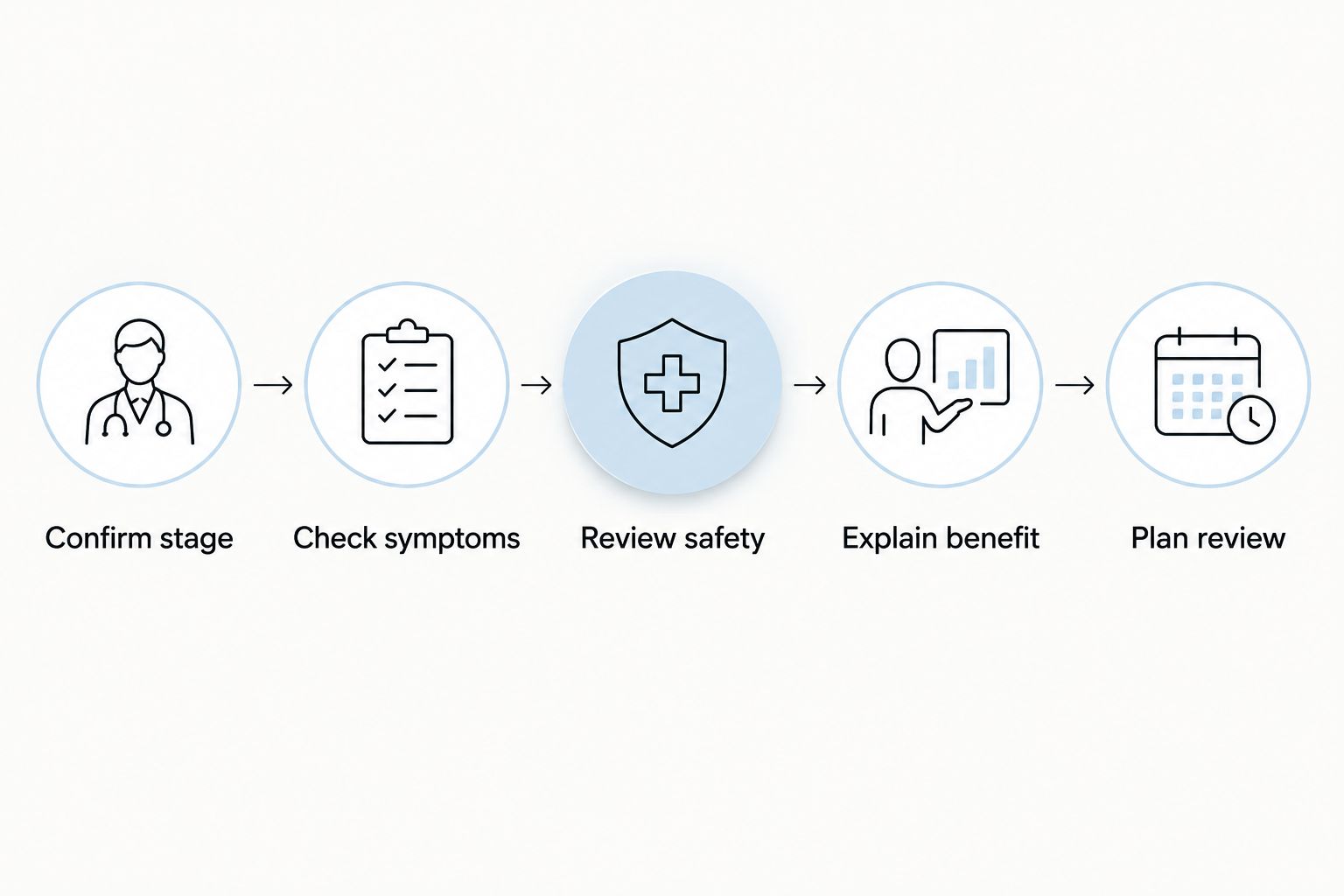
Use a structured discussion rather than starting with a product name. The ocular nutrition assessment to supplement choice workflow provides a related framework for organising the consultation.
- Confirm stage. Review the retinal findings and establish the stage in each eye. Resolve uncertainty through the appropriate ophthalmology pathway before presenting supplementation as indicated.
- Check symptoms. Ask about new distortion, central blur, a central dark patch or sudden deterioration. Symptoms suggesting active disease take priority over nutritional counselling.
- Review safety. Record smoking history, medicines, existing supplements and relevant medical conditions. Check for duplicated ingredients and seek a pharmacist or prescriber review where needed.
- Explain benefit. Describe a reduction in progression risk, not recovery of vision. Make clear that the evidence relates to a specific formulation and clinical group.
- Plan review. Record the decision, give symptom advice and agree follow-up appropriate to the retinal findings. Confirm that the patient understands when to seek urgent help.
Ask the patient to bring the actual packaging or a clear photograph of its ingredient panel. Product names alone do not tell you the daily nutrient amounts, and patients do not always distinguish an eye-health supplement from a general multivitamin.
What does the 25% risk reduction actually mean?
Approximately 25% lower relative risk over 5 years does not mean a 25-percentage-point reduction in every patient's risk. It describes the difference between trial groups relative to the comparison group's risk.
The National Eye Institute's AREDS findings relate to progression to advanced AMD in higher-risk participants receiving the tested combination. They are not evidence that vision improves by the same percentage or that every person taking supplements avoids advanced disease.
Avoid converting that result into an individual prediction without an appropriate baseline risk estimate. In your 2026 explanation, pair the trial finding with its population and timescale every time you use it.
Can omega-3 or diet replace an AREDS2 formulation?
Omega-3 supplementation did not provide an additional overall benefit against progression to advanced AMD in the AREDS2 trial. That finding does not justify substituting a fish-oil product for the AREDS2 antioxidant-and-mineral formulation.
A balanced diet remains part of general health advice, but food choices and trial-based supplementation answer different questions. Leafy green vegetables and other nutrient-containing foods do not provide a reason to promise a particular reduction in AMD progression.
Equally, supplements do not cancel the need for smoking cessation advice. Address modifiable risks alongside the retinal management plan rather than presenting nutrition as the complete intervention.
Can supplements replace injections for wet AMD?
AREDS-type supplements cannot replace anti-VEGF treatment for active wet AMD. Anti-VEGF treatment addresses neovascular disease; nutritional supplementation concerns progression risk in eligible patients.
New distortion, a new central scotoma or worsening central vision needs urgent clinical assessment through the appropriate local pathway. Do not advise a patient to wait for a supplement to work before seeking review.
A supplement discussion can sit alongside an ophthalmology treatment plan when appropriate. It must never alter injection attendance or referral urgency without direction from the treating team.
FAQ
Can supplements slow AMD progression?
Yes—AREDS-type supplements reduce progression risk in selected patients with intermediate AMD or an eligible fellow eye when the other eye has advanced AMD. They do not cure AMD or restore lost vision.
How much can AREDS supplements reduce the risk of advanced AMD?
The original AREDS trial found approximately 25% lower relative risk of advanced AMD over 5 years in its higher-risk groups. This is a relative reduction, not a 25-percentage-point benefit for every patient.
Should everyone with early macular degeneration take AREDS2?
No—AREDS did not establish a benefit for early AMD. Confirm the stage and follow current clinical guidance rather than recommending high-dose supplementation automatically.
Is lutein alone the same as an AREDS2 supplement?
No—lutein alone is not equivalent to the complete AREDS2 formulation. Check the full ingredient list and daily serving rather than relying on the product’s headline ingredient.
Can someone who used to smoke take an eye supplement?
A former smoker needs a formulation and safety review, with particular attention to avoiding beta-carotene-containing eye supplements. Discuss an appropriate beta-carotene-free option with the patient’s clinician or pharmacist.
How long does it take for AMD supplements to improve vision?
AMD supplements are not intended to improve existing vision loss. Their role is to reduce progression risk over time in eligible patients, so a lack of noticeable visual change does not measure effectiveness.
Can I take AREDS2 alongside my other medicines?
AREDS2 requires a medication and supplement review before use. Its high-dose ingredients can interact with medicines or duplicate nutrients already being taken.
Should new wavy vision wait until my next AMD check-up?
No—new wavy vision needs urgent assessment because it can indicate active macular disease. Follow the local urgent eye-care pathway rather than waiting for a routine appointment or supplement effect.
One last thing
Ask the patient to explain what they expect the supplement to do. If they describe sharper vision, reversal of AMD or an alternative to injections, correct that expectation before discussing a formulation.
Scope Connect's AMD nutrition resources support that clinical education conversation. The most useful closing message is specific: know your stage, understand the purpose of supplementation and report new central visual symptoms promptly.
Related guides
- Ocular nutrition supplements for macular degeneration
- Can omega-3 supplements replace dry eye drops?
- CPD-accredited courses for optometrists