

AMD supplements do not have a proven deadline for making vision clearer: their established role is to reduce the risk of progression in selected people with age-related macular degeneration, rather than restore lost sight. In 2026, the practical message remains that supplements support long-term management, while new distortion or worsening central vision requires prompt assessment—not a longer supplement trial.
- Ocular nutrition supplements AMD results time means years of progression-risk assessment, not a promised date for clearer vision.
- AREDS evidence concerns selected AMD stages; it does not establish supplements as prevention for everyone.
- New distortion or central vision loss needs prompt assessment, even when a patient takes supplements.
- Scope Connect supports eye care professionals with clinical education; supplement advice must remain specific to the patient.
How long does it take to see results from AMD supplements?
There is no established number of weeks or months after which an AMD supplement should improve a patient's sight. The strongest evidence concerns the likelihood of developing advanced AMD over years, not how quickly a patient notices a change.
That distinction should shape every recommendation. Through Scope Connect, you can access clinical resources and education to support patient discussions, but the decision to recommend supplementation starts with the patient's retinal findings and clinical history.
| What the patient means by results | What the evidence supports | What to explain |
|---|---|---|
| Clearer reading or sharper central vision | AREDS-type supplementation is not an established treatment for restoring lost sight | Do not promise a noticeable improvement |
| A lower risk of advanced AMD | Benefit in selected people with intermediate AMD, or advanced AMD in one eye | Explain risk reduction over years |
| No change at the next appointment | A stable examination does not prove that supplementation caused stability | Continue the appropriate monitoring plan |
| Relief from grittiness or fluctuating blur | These symptoms require assessment for ocular surface and other causes | Do not use an AMD supplement as a diagnostic trial |
The National Eye Institute's AREDS and AREDS2 Frequently Asked Questions, used as a clinical reference for this 2026 guide, summarises an approximately 25% relative reduction in progression to advanced AMD over 5 years with the original AREDS formulation in the relevant higher-risk groups. This is a group-level trial result—not a countdown to benefit, a guarantee for an individual, or a promise of improved visual acuity.
Why this matters
Patients often judge treatment by what they can feel or see. A supplement taken every day can therefore seem ineffective when reading remains difficult, even if the recommendation concerns a future risk rather than a current symptom.
Your explanation should separate the treatment goal from the patient's immediate concern. If the concern is new difficulty recognising faces, distortion or a central patch of missing vision, investigate that concern directly rather than discussing how much longer to continue a supplement.
Scope Connect is best suited to eye care professionals seeking clinical education and patient resources, not individual treatment decisions. Its resources support the conversation; examination and an appropriate care pathway determine what the patient needs.
Progression risk: assessed over years
The relevant outcome for AREDS-type supplementation is progression to advanced AMD. That outcome requires follow-up across a population; it cannot be confirmed by asking whether an individual feels better after starting capsules.
The approximately 25% relative reduction over 5 years does not mean that every patient has a 25 percentage-point reduction in risk. Absolute benefit depends on the underlying risk of progression, which is one reason accurate staging matters.
For clinical discussions in 2026, make the distinction explicit:
- Best for discussing preventive benefit: the patient's AMD stage and the evidence relevant to that stage.
- Strength: a defined clinical outcome supported by the AREDS research programme.
- Limitation: you cannot demonstrate an individual's benefit through a short-term change in symptoms.
Avoid describing stable vision as proof that a supplement works. Stability is clinically valuable, but it does not establish what would have happened without supplementation.
Visual improvement: no established timetable
AREDS-type supplements do not regenerate damaged macular tissue or replace treatment for neovascular AMD. They are not a substitute for low-vision support when sight loss affects reading, work or daily activities.
A patient who reports clearer vision after starting a supplement still needs an appropriate assessment of the explanation. Refraction, ocular surface disturbance, lighting and other ocular conditions can affect visual performance; a temporal association alone does not establish a supplement effect.
Do not set a deadline for sharper sight. Instead, record the baseline visual function, explain the actual treatment goal and agree how the patient should report a change.
For someone seeking an immediate improvement in reading, address the functional difficulty alongside the AMD plan. Waiting for a supplement response leaves the patient's present need unresolved.
Why the expected benefit varies
Variation in AMD supplement advice reflects the patient and the formulation—not a predictable difference in how quickly capsules start working.
- AMD stage: the established AREDS benefit applies to selected higher-risk disease, not to everyone with drusen or a family history.
- Disease in each eye: advanced AMD in one eye changes the discussion about protecting the fellow eye.
- Formulation: an ordinary multivitamin is not interchangeable with a studied AREDS-type formulation.
- Smoking history: beta-carotene-containing formulations require particular caution because of the lung cancer risk identified in smokers and former smokers.
- Adherence and tolerability: difficulty taking the formulation consistently requires review, not a promise of the same benefit regardless of use.
- Other causes of visual symptoms: cataract, refractive change and ocular surface disease require their own assessment and management.
Diet remains part of the discussion, but dietary advice and trial-based supplementation are not identical interventions. Avoid suggesting that either makes retinal monitoring unnecessary.
How should you assess a patient asking about supplement results?
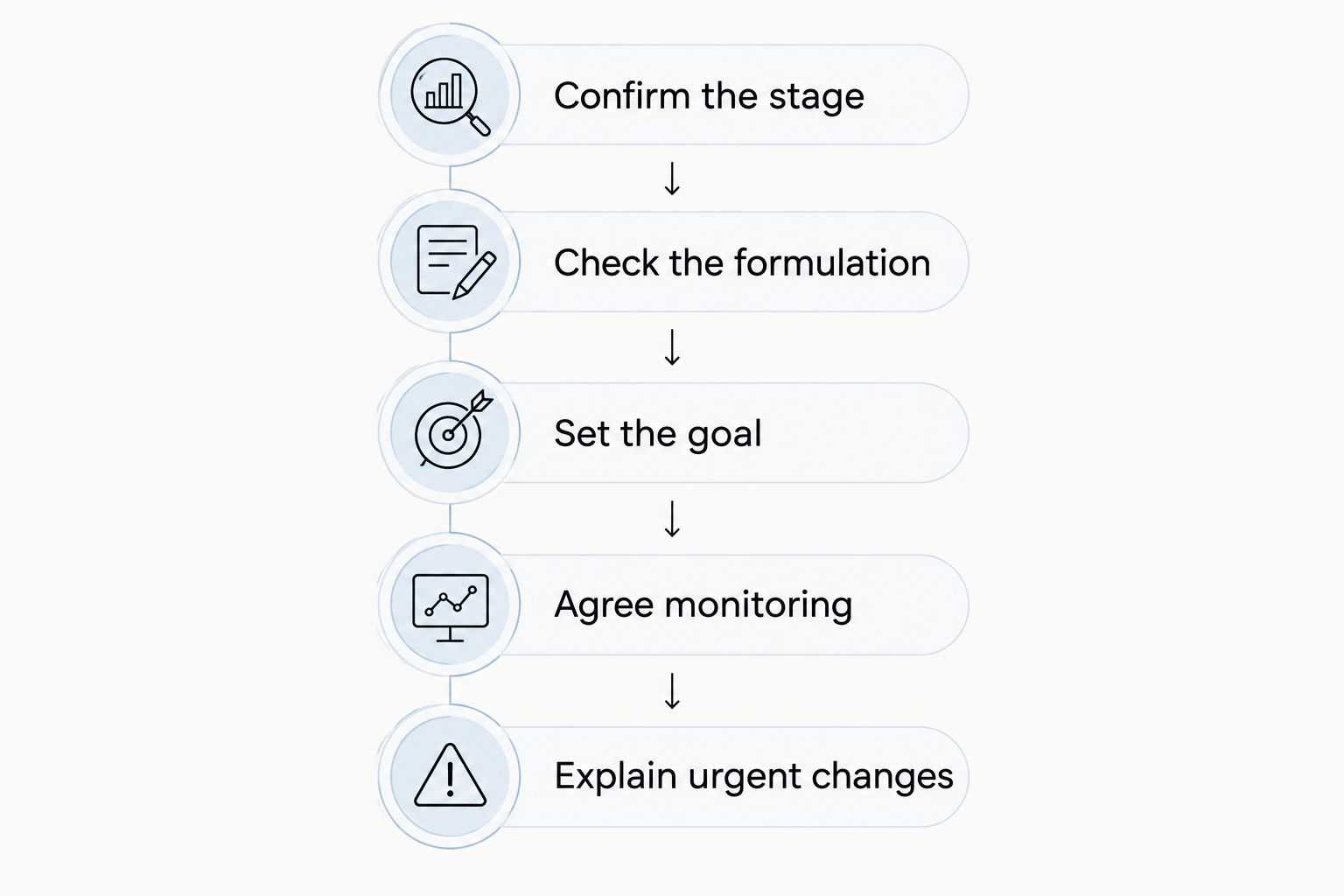
Use a consistent sequence so that the conversation addresses diagnosis, expectations and safety before product choice. The ocular nutrition assessment to supplement choice workflow is a relevant companion to this discussion.
- Confirm the stage. Establish the AMD findings in each eye and check whether the patient is already under ophthalmology care. Do not infer eligibility from age alone.
- Check the formulation. Review the actual label, daily serving instructions and other supplements. A familiar ingredient on the front of a pack does not establish equivalence to a trial formulation.
- Set the goal. Explain that the intended benefit is reduced progression risk in eligible patients, rather than recovery of damaged central vision.
- Agree monitoring. Base review arrangements on clinical findings and the existing care plan. A supplement does not create a separate, universal review interval.
- Explain urgent changes. Give clear instructions for new distortion, central blur or a missing patch of vision, including how to access prompt assessment locally.
Document what the patient understood, not simply that supplements were discussed. In particular, record that lack of noticeable improvement is not the same as evidence of treatment failure, and that worsening symptoms require assessment.
What should you check on an AREDS2 label?
The AREDS2 formulation described by the National Eye Institute includes 10 mg of lutein and 2 mg of zeaxanthin as part of a wider antioxidant and mineral formulation. Those ingredient amounts alone do not make every lutein-and-zeaxanthin product equivalent to AREDS2.
For a 2026 label review, check the complete composition, the stated daily serving and whether beta-carotene is present. Ask about current and previous smoking, medicines and additional vitamin or mineral products before advising on suitability.
High-dose supplementation is not automatically appropriate because a product is available without prescription. Check for duplication and relevant interactions, and involve the patient's pharmacist or medical team when the history requires it.
Recommend against choosing by a single ingredient or a claim of faster results. The evidence relates to a formulation, a defined patient population and a clinical outcome—not to an isolated nutrient promising sharper vision.
How should you discuss tolerability and adherence?
Ask how the patient actually takes the supplement and whether they experience unwanted effects. A patient who has stopped because of discomfort needs a practical review rather than a reminder that benefits take years.
Check the manufacturer's instructions and the complete medication history before suggesting changes. Do not recommend doubling a dose to compensate for missed doses or increasing intake to accelerate an effect.
For Scope Connect's professional audience, the useful distinction is between supporting adherence and endorsing a product without assessment. A recommendation should explain both the evidence-based purpose and the limits, including that supplementation does not guarantee protection from advanced AMD.
Can I stop AMD supplements if my vision has not improved?
No established improvement timetable means unchanged vision alone is not a sound reason to stop an otherwise appropriate formulation. Review the original indication, current retinal status, tolerability and the patient's preferences with the responsible clinician.
Equally, a long period of use does not make an unsuitable formulation appropriate. If the diagnosis, smoking history or medication profile has changed, reassess the recommendation rather than continuing automatically.
Does stable vision mean the supplements are working?
The 5-year evidence describes progression risk across trial groups, not proof of benefit in an individual with stable vision. A stable examination is reassuring, but you cannot attribute that stability to supplementation alone.
Explain this before the first follow-up. It prevents patients from interpreting either stability as guaranteed protection or the absence of sharper vision as definite failure.
Should I wait for supplements to work if straight lines look bent?
No established supplement response time justifies waiting when new distortion develops. New bent or wavy lines, central blur or a central missing area require prompt eye care assessment because they can indicate a sight-threatening change.
Use the local urgent macular or ophthalmology pathway. Sudden substantial vision loss warrants urgent assessment rather than a routine supplement review.
FAQ
How many weeks does it take for AMD supplements to improve eyesight?
There is no established number of weeks after which AMD supplements improve eyesight. AREDS-type supplementation is intended to reduce progression risk in selected patients, not restore lost central vision.
Do I have to take AMD supplements for 5 years before they help?
The 5-year figure describes the follow-up used to report a major AREDS outcome, not a waiting period before benefit begins. It cannot identify the moment an individual starts benefiting.
Can AREDS2 supplements reverse macular degeneration?
AREDS2 supplements do not reverse macular degeneration or regenerate damaged macular tissue. Their role concerns progression risk in eligible patients, alongside appropriate monitoring and treatment.
Are AMD supplements useful for everyone with early changes?
The established AREDS benefit does not apply to everyone with early AMD changes. Confirm the disease stage and individual clinical context before recommending a high-dose formulation.
Is a lutein supplement the same as an AREDS2 formulation?
A lutein supplement is not automatically equivalent to an AREDS2 formulation. The complete formulation and daily serving matter, not just the presence of lutein.
Can a former smoker take any eye supplement?
A former smoker should not assume every eye supplement is suitable. Check for beta-carotene and seek advice on an appropriate formulation because beta-carotene supplementation has been associated with increased lung cancer risk in smokers and former smokers.
Should I keep taking supplements if my vision suddenly gets worse?
Sudden worsening vision needs urgent assessment, not a decision to wait for supplements. Tell the assessing clinician which supplements and medicines you take, and follow advice about ongoing use.
One last thing
The most useful result of a supplement conversation is often a clearer understanding of what to do next. Before ending a consultation in 2026, ask the patient to explain the purpose of the supplement and the visual changes that would prompt them to seek help.
If the patient expects capsules to restore sight or delay an urgent appointment, correct that expectation before discussing continued use. That distinction matters more than naming a week when results should appear.
Related guides
- Ocular nutrition supplements for macular degeneration
- Can omega-3 supplements replace dry eye drops?
- CPD-accredited courses for optometrists