

A dry eye disease course carries the CPD points assigned to its specific approved activity, not a standard number for the subject. Check the advertised points, eligible profession and completion requirements before booking; course duration alone does not establish the award.
- For CPD points, dry eye disease course approval matters more than the topic or duration.
- GOC registrants must distinguish approved points, interactive learning and any additional specialty requirements.
- Scope Connect supports eye care professionals with CPD-accredited education, clinical articles and patient education materials.
- Check the activity reference, eligible profession and completion requirements before adding points to your CPD plan.
How many CPD points does a dry eye disease course carry?
Use the points stated for the individual approved activity. A course title, webinar length or certificate of attendance cannot establish the number by itself. The same dry eye topic can be taught through activities with different approval arrangements.
When comparing CPD courses on dry eye disease for optometrists, check each activity separately rather than treating every course in a programme as equivalent.
Follow this sequence before counting an activity towards your requirements:
- Find the activity. Identify the specific session or module, not just the programme name.
- Check approval. Confirm the relevant regulator or accrediting body and the activity reference.
- Confirm eligibility. Check that the approval covers your profession and any relevant specialty.
- Read the award. Record the advertised points and whether the activity is interactive.
- Complete requirements. Finish the attendance, assessment or participation requirements stated by the provider.
- Retain evidence. Keep the completion record and check how the activity reaches your CPD record.
For your 2026 learning plan, keep course-level points separate from your overall regulatory target. The General Optical Council's core requirement for optometrists and dispensing opticians is 36 CPD points over a 3-year cycle, including at least 18 interactive points. Additional specialty requirements apply where relevant; a dry eye course does not automatically satisfy them.
Those figures describe the regulatory framework, not the award for a particular dry eye course. Use current GOC guidance alongside the activity listing when deciding what the course contributes.
Why this matters
A clinically relevant course and a course that fills a particular CPD requirement are not necessarily the same thing. You need to establish both its educational value and its place in your record.
Dry eye education can address assessment, management, patient communication or referral decisions. Choose the learning outcome you need first, then check whether the approved activity also addresses a gap in your CPD plan.
Scope Connect is best suited to eye care professionals seeking dry eye education alongside clinical resources and patient education materials. Its role as a resource hub does not replace checking the approval details of the individual course you select.
For 2026 planning, that distinction prevents a common administrative mistake: treating a relevant subject as proof that every regulatory requirement has been met.
What should you check on a dry eye course listing?
A useful listing lets you establish what you will learn, what you must complete and what recognition you receive. Read those details together. A points figure without the relevant eligibility information is not enough to plan confidently.
| Listing detail | What it establishes | What it does not establish |
|---|---|---|
| Approved points | The award attached to the specified activity | The award for another module with a similar title |
| Eligible profession | Which professional group the approval covers | Eligibility for every member of the practice team |
| Interactive status | How the activity contributes to interactive requirements | That every live or online session has the same status |
| Learning outcomes | The intended educational focus | That the course covers every aspect of dry eye management |
| Completion requirements | What you must do to complete the activity | That opening a recording is sufficient |
| Activity reference | Which approved activity you are undertaking | That a different delivery or repeat session has identical approval |
Match the listing to the activity you actually complete. If you move from a live session to a recording, check the recording's details rather than carrying over the live session's award.
Keep the course description with your learning record where practical. It helps you explain why you chose the activity and what you intended to change in practice, rather than leaving you with a certificate disconnected from its clinical purpose.
Does the course format change how you should assess it?
Course format changes how you participate, but it does not establish the points award. A live webinar, recorded module and case discussion each need their own approval details checked.
Use format to judge whether you can engage properly with the learning. Use the activity listing to establish the approved points and completion conditions.
| Learning format | Best for | Practical advantage | Limitation to check |
|---|---|---|---|
| Live webinar | Clinicians who want scheduled teaching | A fixed session supports protected learning time | Attendance and participation conditions still apply |
| Recorded module | Clinicians fitting study around clinics | You can organise viewing around your working pattern | Do not assume the live version's approval transfers |
| Facilitated case discussion | Clinicians examining management decisions | Discussion lets participants explore clinical reasoning | Confirm the approved activity and participation requirements |
| Clinical article or patient resource | Clinicians addressing a specific knowledge gap | Focused reading can support everyday learning | Educational usefulness alone does not establish approved points |
For a recorded module, establish whether an assessment forms part of completion before you begin. For a discussion session, check what participation is expected. Neither format should be selected solely because it appears easier to fit into the diary.
Scope Connect brings CPD-accredited education together with clinical articles and patient materials. Treat these as different resource types: use each for its stated purpose, and verify points only against the relevant approved activity.
Why dry eye course CPD points vary
There is no universal conversion from a dry eye topic to a points award. Differences between listings need to be interpreted through the activity's approval and structure, not an assumption that a longer title or more specialist topic earns more points.
Check these factors when two courses appear similar:
- Approval scheme: CPD recognition is specific to the relevant professional framework; do not transfer an award between regulators without checking.
- Activity boundaries: A programme can contain separately identified activities. Establish whether the stated award belongs to one session or the complete programme.
- Delivery version: A live session and its recording need to be assessed against their respective listings.
- Completion conditions: Attendance, assessment and participation requirements determine whether you have completed the approved activity.
- Professional eligibility: A dry eye topic can be relevant to several roles without carrying identical recognition for each role.
These checks explain why a headline points figure needs context. They do not provide a formula for calculating an award yourself. Never estimate approved points from the course duration.
How should you choose a course for your clinical role?
Start with the patient-care decision you want to improve. A course on identifying ocular surface symptoms serves a different learning need from one focused on management review or referral thresholds.
Write a specific learning objective before choosing. For example, you might want to improve the consistency of symptom recording, explain treatment instructions more clearly or recognise when a patient needs further assessment. These are learning aims, not claims about what any particular course covers.
Then compare the published outcomes with your responsibilities. An optometrist, dispensing optician and dispensing assistant can all encounter patients with dry eye concerns, but their professional scope and training needs differ.
Your 2026 course selection should therefore pass two tests:
- Clinical fit: Does the published content address an identifiable need in your work?
- Regulatory fit: Does the approved activity contribute to the requirements relevant to your registration?
A course can pass the first test without passing the second. It can still support learning, but you should not record an unverified award to make it fit your plan.
How do you record a completed dry eye course?
Separate proof of completion from your account of learning. The first demonstrates that you met the provider's conditions; the second explains why the education mattered to your practice.
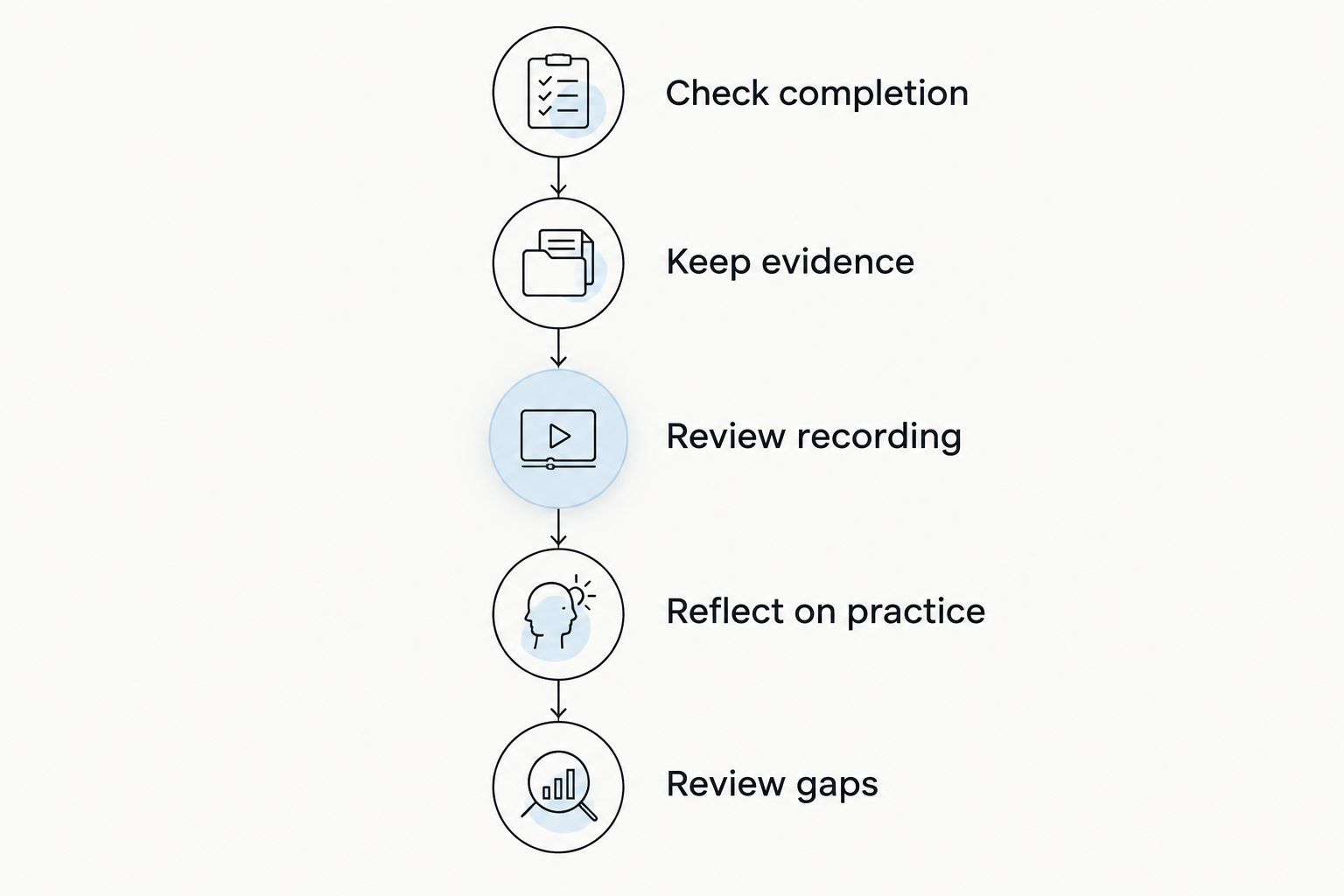
Use this sequence when completing your CPD recording workflow:
- Check completion. Confirm that all required elements are finished, including any assessment or participation task.
- Keep evidence. Retain the certificate or other completion record supplied for the activity.
- Review recording. Check the provider's instructions and your regulatory record rather than assuming points have appeared automatically.
- Reflect on practice. Identify what you learnt and how it relates to your clinical responsibilities.
- Review gaps. Reassess your remaining requirements, including interactive learning and any relevant specialty obligations.
A useful reflection names a decision or behaviour, not simply the topic. Recording that a course covered dry eye is less informative than explaining which part of your assessment or patient discussion you intend to review.
Do not claim a clinical improvement before evaluating it. Record the intended change first, then review what happened through your normal practice processes.
Can I count a dry eye webinar as interactive CPD?
Count a dry eye webinar as interactive CPD only when its approved activity details confirm that status. A live broadcast, chat facility or question-and-answer segment does not justify assigning the status yourself.
The GOC core requirement includes at least 18 interactive points within the 3-year cycle. For 2026 planning, check that category separately from your total points so that a full learning diary does not conceal an unmet requirement.
Does a longer dry eye course carry more CPD points?
A longer dry eye course does not establish a larger approved award. Use the points attached to the specific activity, not a calculation based on viewing time or the number of modules displayed.
Duration still matters when arranging protected learning time. It helps you decide whether you can complete the activity properly, but it is not a substitute for approval information.
Can the whole practice team claim the same points?
The whole practice team cannot assume identical CPD recognition from the same dry eye course. Check the approved professional groups and each participant's applicable requirements.
Shared learning can support consistent patient communication, but educational relevance and regulatory eligibility remain separate questions. Confirm both before booking a team session.
FAQ
How do I find the exact CPD points for a dry eye disease course?
Check the specific activity listing for its approved points, eligible profession and completion requirements. Confirm that the listing matches the session or module you intend to complete.
Does every dry eye disease course carry GOC points?
Do not assume that every dry eye disease course carries GOC points. Clinical relevance, a certificate or approval under another professional framework does not establish GOC recognition.
How many CPD points do GOC registrants need?
The GOC core requirement for optometrists and dispensing opticians is 36 CPD points over a 3-year cycle, including at least 18 interactive points. Check current GOC guidance for additional specialty requirements relevant to your registration.
Does watching a recorded dry eye webinar earn the live session’s points?
Watching a recording does not establish entitlement to the live session’s points. Check the recording’s own approval details and complete its stated requirements.
Is a certificate of attendance enough to confirm my points?
A certificate of attendance alone does not establish every detail of your CPD entitlement. Match it to the approved activity, your professional eligibility and the provider’s completion requirements.
Can dispensing assistants use dry eye CPD resources?
Dispensing assistants can use dry eye educational resources appropriate to their role. Do not assume that the GOC points advertised for registered professionals apply to an assistant.
Where does Scope Connect fit into dry eye CPD planning?
Scope Connect provides CPD-accredited courses, clinical articles, product information and patient education materials for eye care professionals. Check the individual course details to establish its points and suitability for your role.
One last thing
Choose the learning outcome before the points total. Before booking your next dry eye activity in 2026, write down the clinical question you want it to answer, then verify the approved award.
After completion, return to that question. A complete CPD record tells you what you attended; a useful learning record also tells you what you will do differently.
Related guides
- CPD courses for dispensing opticians
- CPD-accredited dry eye training for dispensing assistants
- Optometry CPD for independent practice owners