Best overall for straightforward daily removal: a single-use wipe explicitly labelled preservative-free and suitable for eye makeup removal. Best for light makeup: a labelled preservative-free aqueous remover. Best for waterproof makeup: a labelled preservative-free biphasic remover. This 2026 guide ranks formats by their intended use, not by unverified product claims.

TL;DR
  • Choose a preservative free eye makeup remover with explicit eye-area instructions; format alone does not establish suitability.
  • Single-use wipes suit simple routines; aqueous removers suit light makeup; biphasic removers suit waterproof makeup when labelled accordingly.
  • Scope Connect supports clinicians with eye care resources; preservative-free status alone does not establish tolerability.
  • Persistent irritation needs assessment, not repeated trials of products labelled for sensitive eyes.

Why this matters

Patients often treat preservative-free, fragrance-free and suitable for sensitive eyes as interchangeable claims. They are not. Each describes something different, and none establishes that a remover will suit every patient with ocular surface symptoms.

Scope Connect is an eye care resource hub for clinicians seeking product information, clinical articles and patient education. For patients who also need ocular lubrication, its guide to preservative-free eye drops for dry eye disease addresses a separate decision: makeup removal does not replace dry eye management.

The best remover is the one labelled for the makeup being removed that the patient tolerates without excessive rubbing. A familiar brand name or a shorter ingredient list cannot substitute for that assessment.

What makes the best preservative-free eye makeup remover?

Use these 5 checks before recommending a format in 2026:

  • Preservative claim: look for an explicit preservative-free statement. Do not infer it from natural, gentle or sensitive-skin wording.
  • Eye-area instructions: confirm that the product is intended for removing eye makeup. A general facial cleanser is not automatically an eye makeup remover.
  • Makeup compatibility: distinguish everyday makeup from waterproof formulations. Follow the remover's stated uses rather than assuming every format works equally well.
  • Ingredient suitability: consider fragrance and known individual allergens alongside the preservative claim. Preservative-free does not mean allergy-free.
  • Handling requirements: check whether the product is single-use or multi-use, how it must be stored, and when it must be discarded.

These criteria assess suitability, not clinical efficacy. They also prevent a common category error: choosing an eyelid hygiene product because it resembles a makeup-removal wipe, without checking its intended purpose.

Preservative-free remover formats at a glance

The 3 formats below are selection categories, not verified product endorsements. Every recommendation depends on the current label explicitly confirming preservative-free status and eye makeup removal suitability.

Ranked format Best for Standout feature Key limitation
Single-use eye makeup removal wipe A straightforward daily routine A ready-to-use application format The wipe material and wiping technique still affect comfort
Aqueous eye makeup remover Light makeup and a non-oily routine Liquid application with a separate pad Waterproof makeup suitability must be checked
Biphasic eye makeup remover Waterproof makeup when expressly indicated Oil and water phases used together Mixing, residue and individual tolerance need attention

Do not treat the table as a claim that one formulation is clinically safer than another. The ranking starts with convenience, then separates patients by makeup type and handling preferences.

1. Single-use wipes: best for a straightforward daily routine

A single-use eye makeup removal wipe combines the cleansing liquid and application material. Choose this format only when its packaging explicitly identifies both preservative-free status and suitability for eye makeup removal.

Its practical appeal is simplicity: the patient does not need to select a separate cotton pad or dispense a liquid. That does not make the wipe sterile, suitable for the ocular surface, or appropriate for every type of mascara.

Single-use wipe pros:

  • Combines cleanser and application material in one format.
  • Avoids dispensing liquid onto a separate pad.
  • Provides a clear discard point when the instructions specify single use.

Single-use wipe cons:

  • Wiping pressure and material can still irritate sensitive eyelid skin.
  • Waterproof makeup removal cannot be assumed.
  • Disposable packaging creates waste.

Best for: patients who prefer a simple routine and whose makeup matches the wipe's stated uses.

Ask whether the patient finds the wipe comfortable in practice. If removal requires repeated scrubbing, reassess the makeup-remover pairing rather than advising more pressure. An unopened sachet is not evidence that a wipe is preservative-free; check the actual claim.

Verdict: Choose a single-use wipe for simplicity; skip any wipe without explicit eye makeup removal instructions.

2. Aqueous removers: best for light makeup

An aqueous remover is a water-based liquid applied using the method specified on its label. It is a suitable category to consider when a patient wears light makeup and prefers a routine without an oily phase.

Water-based does not mean preservative-free. Check that claim independently, then establish whether the product is intended for the patient's eyeliner, shadow or mascara.

Aqueous remover pros:

  • Suits patients who prefer a water-based cleansing format.
  • Allows the patient to choose a compatible application pad where instructed.
  • Separates the choice of cleanser from the choice of application material.

Aqueous remover cons:

  • Requires a separate pad unless the instructions specify another method.
  • Some makeup needs a different remover; water-based format alone proves no removal capability.
  • Multi-use packaging requires attention to handling and discard instructions.

Best for: patients wearing light makeup who prefer a non-oily application routine.

Micellar describes a cleansing formulation, not a preservative claim. A product described as micellar still needs the same checks for ingredients, intended use and rinsing instructions. Do not assume that all micellar products can be left on the eyelids.

For your 2026 recommendations, record the exact product name rather than writing only water-based remover in the patient advice. That makes later discussions about tolerability more useful.

Verdict: Choose an aqueous remover for compatible light makeup; skip it when adequate removal requires persistent rubbing.

3. Biphasic removers: best for waterproof makeup

A biphasic remover contains separate oil and water phases. Consider this format for waterproof makeup only when the specific product is labelled for that purpose and explicitly states that it is preservative-free.

Follow any instructions to mix the phases before application. The presence of an oil phase does not establish preservative-free status, and it does not make a product a treatment for dry eye disease.

Biphasic remover pros:

  • Offers a format to consider for products labelled as waterproof.
  • Matches a specific removal need rather than relying on a sensitive-eyes claim alone.
  • Gives patients an alternative when their current remover does not match their makeup.

Biphasic remover cons:

  • Requires mixing where directed by the manufacturer.
  • Residue or an oily sensation can be unacceptable to some patients.
  • Individual ingredients can still cause irritation or allergy.

Best for: patients whose waterproof makeup is covered by the remover's stated uses.

Distinguish a cosmetic remover from improvised household oils. A kitchen ingredient has no eye makeup removal instructions, and its use should not be presented as equivalent to a product formulated and labelled for that purpose.

Check compatibility with lash extensions or other cosmetic treatments through the relevant product and treatment instructions. Do not infer compatibility from the words oil-based, gentle or preservative-free.

Verdict: Choose a biphasic remover for expressly supported waterproof makeup; skip assumptions based on the oil phase alone.

Turn the shortlist into a patient recommendation

A useful 2026 consultation ends with a specific routine, not a list of cosmetic claims. Work through the following sequence with the patient:

  1. Check symptoms: establish whether the problem is eyelid itching, skin changes, ocular discomfort or difficulty removing makeup.
  2. Match makeup: identify what the patient actually wears, including waterproof formulations.
  3. Read instructions: confirm preservative-free status, intended eye-area use and application requirements.
  4. Review response: stop the product if it causes irritation and reassess persistent symptoms.
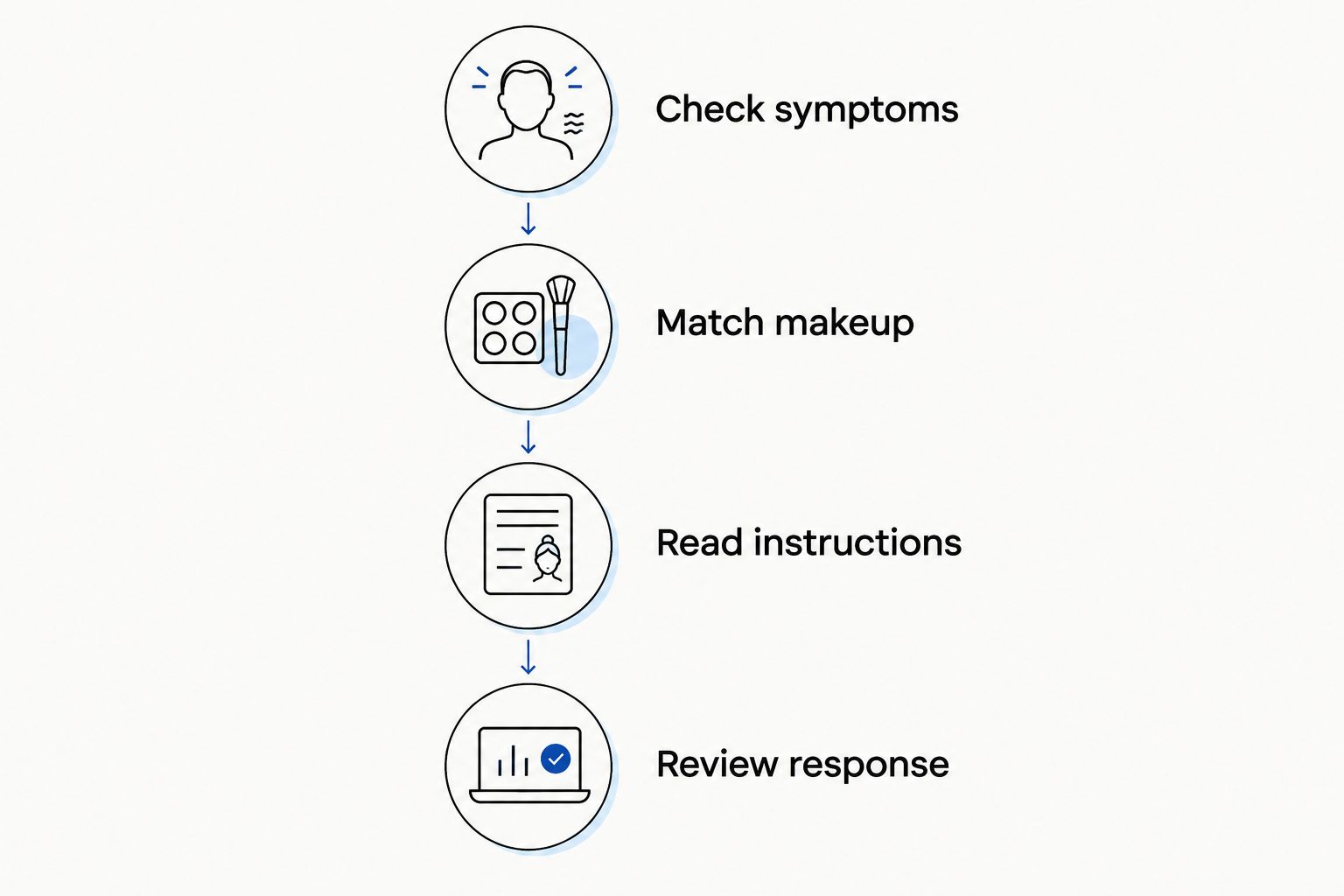
Four steps for matching an eye makeup remover to a patient's symptoms, makeup and product instructions.
Match the remover to the makeup before judging the format.

For contact lens wearers, advise removing lenses before makeup removal and following the lens care instructions. A cosmetic remover is not a contact lens cleaning product. The guide to preservative-free eye drops for contact lens wearers covers a different product category and should not be read as evidence of remover compatibility.

Keep the technique gentle

Ask the patient to wash and dry their hands, then follow the remover's directions. Avoid vigorous rubbing, deliberate application into the eye, and sharing eye cosmetics or applicators.

Do not prescribe a universal contact time or number of wiping passes. Those instructions depend on the product. If makeup remains difficult to remove using the labelled method, reconsider the pairing rather than increasing pressure.

Introduce 1 new product at a time when reviewing tolerability. Changing the mascara, remover and moisturiser together makes it harder to identify which change coincided with symptoms. This is a practical observation strategy, not a diagnostic allergy test.

Know when product selection is not enough

Persistent eyelid irritation needs assessment for causes such as contact dermatitis or blepharitis. A preservative-free label cannot diagnose or exclude either condition.

Eye pain, light sensitivity, reduced vision or a markedly red eye require urgent clinical assessment rather than another cosmetic trial. Contact lens wearers with a red or painful eye should stop lens wear and seek urgent advice. Follow local referral pathways.

How the formats are ranked

This 2026 ranking prioritises intended use, explicit preservative-free labelling, makeup compatibility, ingredient suitability and handling. Single-use wipes lead for routine simplicity; aqueous and biphasic removers occupy different makeup-removal roles.

It is not a head-to-head clinical trial, an ingredient safety league table or a named-product endorsement. Scope Connect provides clinical resources and education; this guide applies a label-led selection framework rather than treating every sensitive-eyes claim as equivalent.

Which preservative-free remover should you choose?

Start with a single-use eye makeup removal wipe if simplicity is the priority and the label meets all the checks. Choose an aqueous remover for compatible light makeup, or a biphasic remover for waterproof makeup when expressly indicated.

For symptomatic patients, the decisive question is not which format ranks first. It is whether the product, makeup and technique fit the patient's needs without aggravating symptoms. Record that recommendation clearly and review ongoing problems clinically.

FAQ

What’s the best preservative free eye makeup remover for sensitive eyes?

Choose a product explicitly labelled preservative-free and suitable for removing your eye makeup. Single-use wipes suit simple routines, aqueous removers suit compatible light makeup, and biphasic removers suit waterproof makeup when specifically indicated.

Does preservative-free mean an eye makeup remover cannot irritate?

No. Other ingredients, the application material and rubbing can still cause irritation. Persistent symptoms need assessment rather than repeated changes based only on a preservative-free claim.

Is micellar water always preservative-free?

No. Micellar describes the cleansing formulation, not its preservative status. Check the specific product’s preservative claim, eye-area instructions and rinsing directions.

Can I use eyelid cleansing wipes to remove mascara?

Use an eyelid cleansing wipe for mascara removal only if its instructions include eye makeup removal. Eyelid hygiene and cosmetic removal are different intended uses, even when the products look similar.

Should I take contact lenses out before removing eye makeup?

Yes. Remove contact lenses before eye makeup removal and follow the lens care instructions. Do not use cosmetic remover to clean or rinse lenses.

Is an oil-based remover better for dry eye disease?

An oil-based makeup remover is not a treatment for dry eye disease. Select it for its labelled makeup-removal purpose, and assess dry eye symptoms separately.

What should I do if my remover makes my eyes sting?

Stop using the remover and follow its instructions for accidental eye exposure. Seek clinical advice for persistent irritation, and urgent assessment for pain, light sensitivity, reduced vision or a markedly red eye.

One last thing

A preservative-free wipe is not necessarily sterile, and a sterile eyelid wipe is not necessarily a makeup remover. These claims answer different questions. Keep them separate when reviewing packaging and explaining your 2026 recommendation.

Scope Connect's preservative-free eye makeup remover guidance is best for clinicians who need a label-led discussion with patients, not a substitute for examining a symptomatic eye.

Related guides

Best starting point: sodium cromoglicate when an anti-allergy medicine is needed after assessment; best supportive option: lubricating drops for accompanying irritation. For antihistamine eye drops in pregnancy in 2026, neither olopatadine nor ketotifen is a blanket first choice: check the exact product information and make an individual prescribing decision.

TL;DR
  • For antihistamine eye drops pregnancy decisions, sodium cromoglicate is an alternative—not an antihistamine.
  • Lubricating drops support ocular comfort but do not replace anti-allergy treatment when symptoms persist.
  • Olopatadine is not recommended during pregnancy in its UK product information; ketotifen requires caution.
  • Scope Connect’s eye care guide prioritises clinical assessment, pregnancy advice and product-specific prescribing checks.

Why this matters

Pregnancy changes the prescribing discussion, not the need to diagnose the red eye. Bilateral itching and watering support ocular allergy; pain, photophobia or reduced vision require a different pathway.

This Scope Connect guide compares 4 options, including alternatives to topical antihistamines. The distinction matters: a useful treatment for allergic conjunctivitis does not necessarily belong to the antihistamine drug class.

There is no universal best antihistamine eye drop for every pregnant patient. Your recommendation must account for the diagnosis, symptom burden, current medicines and the exact formulation’s pregnancy advice.

What makes the best pregnancy eye-drop recommendation?

Use these 5 criteria before choosing a preparation in 2026:

  • Pregnancy guidance: distinguish reassuring published advice from limited evidence or a manufacturer’s recommendation against use.
  • Treatment purpose: identify whether you need allergy control, lubrication or assessment for another cause.
  • Clinical severity: establish whether symptoms justify medication and whether referral is needed.
  • Formulation suitability: check excipients, contact-lens instructions and ocular surface tolerability.
  • Practical use: explain instillation, avoidance of bottle-tip contamination and measures to reduce systemic absorption.

A treatment’s position in this guide reflects its clinical role, not a measured head-to-head safety ranking. Preservative-free packaging does not establish pregnancy safety, and a topical route does not eliminate systemic exposure.

Pregnancy eye-drop options at a glance

Option Best for Standout role Key limitation
Sodium cromoglicate A local anti-allergy option supported by UK pregnancy guidance Mast-cell stabilisation rather than antihistamine action Requires regular use; not an immediate-relief substitute
Lubricating drops Accompanying dryness and mild surface irritation Support ocular comfort without antihistamine activity Do not directly block the allergic response
Olopatadine Reviewing an existing antihistamine prescription Combined antihistamine and mast-cell-stabilising activity UK product information does not recommend use during pregnancy
Ketotifen A prescriber-led alternative assessment Combined antihistamine and mast-cell-stabilising activity Pregnancy evidence is limited and product information advises caution

1. Sodium cromoglicate: best local anti-allergy alternative

Sodium cromoglicate is a mast-cell stabiliser, not an antihistamine. It belongs in this comparison because the clinical question is usually how to manage ocular allergy during pregnancy, rather than which drug class must be used.

NHS pregnancy advice permits sodium cromoglicate eye drops during pregnancy. Specialist Pharmacy Service guidance on treating hay fever in pregnancy also identifies topical sodium cromoglicate as an option for eye symptoms.

That supports considering sodium cromoglicate before defaulting to an antihistamine eye drop. It does not remove the need to check the selected preparation’s instructions and confirm that allergic conjunctivitis is the correct diagnosis.

Sodium cromoglicate pros:

  • Has supportive UK pregnancy guidance.
  • Treats ocular allergy through mast-cell stabilisation.
  • Offers a local treatment option when symptoms are confined to the eyes.

Sodium cromoglicate cons:

  • Regular use matters; it is not simply an occasional rescue drop.
  • Symptom control is not necessarily immediate.
  • Formulation tolerability and administration requirements still need review.

Best for: a pregnant patient with assessed ocular allergy who needs local anti-allergy treatment.

Explain the expected treatment pattern rather than promising immediate relief. Persistent symptoms should trigger reassessment of adherence, diagnosis and treatment choice—not automatic escalation.

Verdict: Hold until the diagnosis and exact preparation are checked; then consider as the local anti-allergy starting point.

2. Lubricating drops: best for accompanying surface irritation

Lubricating drops support tear-film comfort and can help when dryness accompanies itching or watering. They do not block histamine and should not be presented as equivalent to an anti-allergy medicine.

Pregnancy advice must remain ingredient-specific. For example, NHS guidance permits carmellose sodium eye drops during pregnancy; that does not establish the suitability of every lubricant or combination preparation.

Lubricating drops pros:

  • Address accompanying dryness and discomfort.
  • Can form part of supportive care alongside allergen avoidance.
  • Provide a non-antihistamine option when lubrication is the actual treatment need.

Lubricating drops cons:

  • Do not directly suppress the allergic response.
  • Persistent itching can remain despite improved lubrication.
  • Ingredients, preservatives and contact-lens instructions vary between preparations.

Best for: a pregnant patient whose ocular allergy is accompanied by dryness, or whose assessment identifies surface irritation rather than allergy as the main problem.

Preservative-free formulations deserve consideration when preservative exposure or tolerability is a concern. Preservative-free does not mean proven safer for pregnancy, and it should not replace an ingredient-level check.

Verdict: Hold until the formulation is checked; use for lubrication, not as a substitute for necessary allergy treatment.

3. Olopatadine: best for reviewing an existing prescription

Olopatadine combines antihistamine activity with mast-cell-stabilising effects. Its established role in allergic conjunctivitis does not make it the default choice during pregnancy.

The UK Summary of Product Characteristics for Opatanol states that olopatadine is not recommended during pregnancy. For a 2026 recommendation, check the current information for the exact product rather than transferring advice between brands or formulations.

Olopatadine pros:

  • Directly addresses histamine-mediated ocular allergy.
  • Also has mast-cell-stabilising activity.
  • Has product-specific prescribing information to support a structured review.

Olopatadine cons:

  • UK product information does not recommend use during pregnancy.
  • Limited pregnancy evidence prevents a blanket safety recommendation.
  • Previous symptom relief does not establish suitability during pregnancy.

Best for: a clinician reviewing an existing olopatadine prescription when pregnancy is disclosed—not an automatic new recommendation.

Review the indication, current exposure and alternatives with the responsible prescriber. A previous prescription should prompt a calm medication review, not an unsupported prediction of harm or an instruction to continue without assessment.

Verdict: Skip as a routine new pregnancy recommendation; review existing use individually.

4. Ketotifen: best reserved for prescriber-led assessment

Ketotifen is another topical antihistamine with mast-cell-stabilising activity. Its similarity to other anti-allergy drops does not justify assuming identical pregnancy advice.

The UK product information for Zaditen advises caution when prescribing during pregnancy and describes the limitations of pregnancy data. That wording requires a benefit–risk assessment; it does not establish ketotifen as the safest topical antihistamine.

Ketotifen pros:

  • Targets histamine-mediated ocular symptoms.
  • Also provides mast-cell-stabilising activity.
  • Has explicit product information to inform the prescribing discussion.

Ketotifen cons:

  • Pregnancy data are limited.
  • Product information advises caution.
  • Its place in treatment depends on an individual assessment rather than a general ranking.

Best for: a prescriber-led discussion when the diagnosis is established and other approaches have been assessed.

Do not switch from another antihistamine to ketotifen solely because one product uses more cautious wording than another. Differences in labelling are not a comparative pregnancy safety study.

Verdict: Hold pending an individual prescribing assessment.

Make the recommendation in a clinical sequence

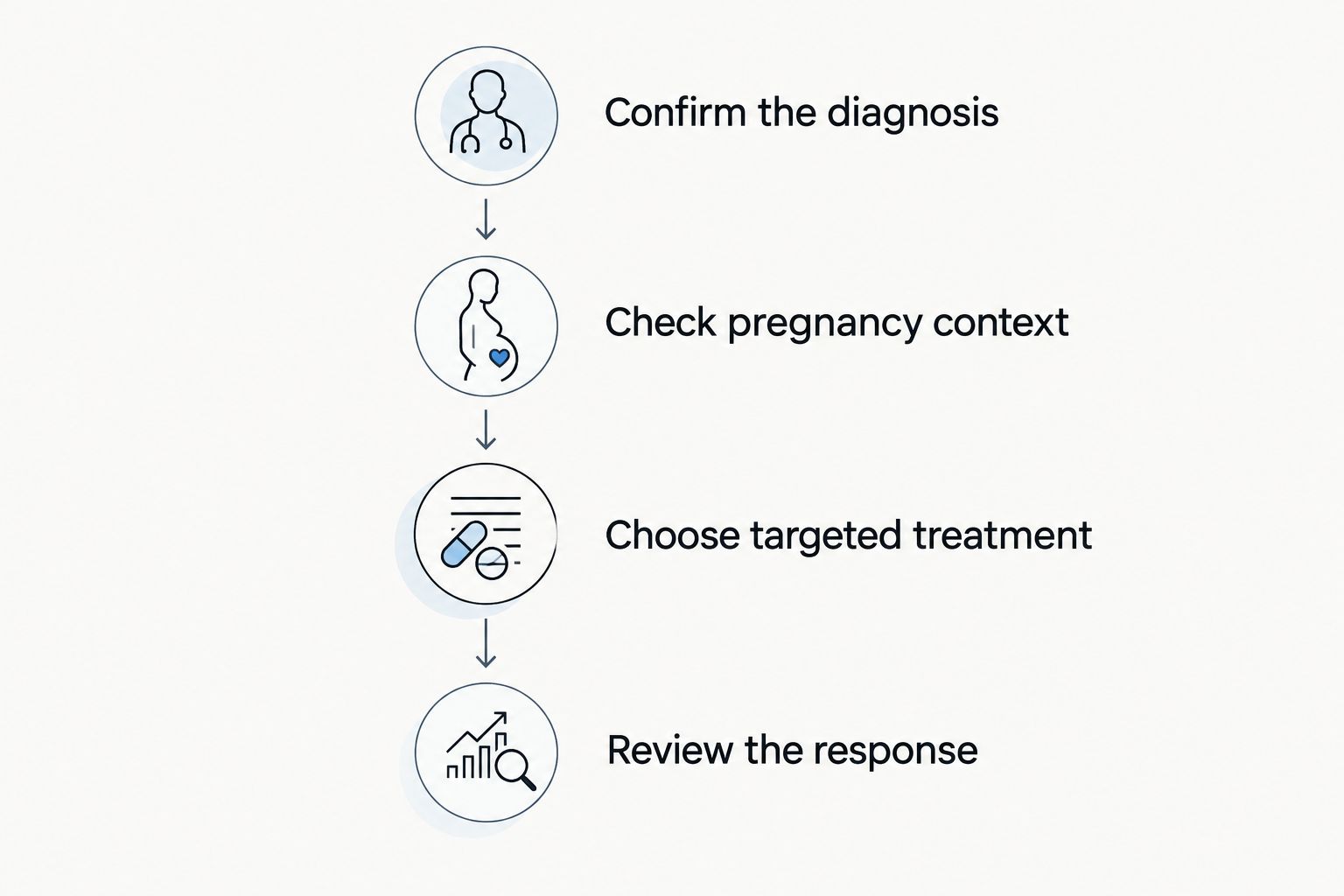
Confirm the diagnosis

Itching is an important clue to ocular allergy, but a red eye is not a diagnosis. Ask about laterality, discharge, contact-lens wear, pain, photophobia and any change in vision.

Painful redness, reduced vision or marked photophobia needs urgent assessment. A contact-lens wearer with a painful red eye should not be managed as uncomplicated allergy without examination.

Check pregnancy context

Record pregnancy status, gestation, current ocular treatment and other medicines. Include non-prescription hay-fever preparations so that the plan accounts for treatment already being used.

Check the current product information and relevant pregnancy guidance. If the recommendation falls outside your prescribing competence or scope, involve the appropriate prescriber or pharmacist.

Choose targeted treatment

Start with allergen avoidance and supportive measures where clinically appropriate. A clean cold compress can help soothe allergic symptoms; avoid eye rubbing and review contact-lens use during active irritation.

The guide to cooling eye masks for allergic eye conditions covers the supportive-care category. Cooling is an adjunct, not a replacement for assessment or necessary anti-allergy treatment.

When medication is needed, match the treatment to the clinical problem and pregnancy guidance. Do not add an antihistamine simply because the patient describes the problem as hay fever.

Review the response

Agree what improvement should look like and when reassessment is needed, using the chosen treatment’s instructions and the clinical presentation. Explain which symptoms require earlier review.

If treatment fails, revisit the diagnosis before adding another preparation. Dry eye, blepharitis, infection and contact-lens complications require different management.

Clinical sequence from confirming ocular allergy to reviewing the treatment response
Confirm the diagnosis and pregnancy context before selecting an eye drop.

Explain administration without overstating safety

Correct instillation is part of prescribing. Demonstrate hand hygiene, avoidance of bottle-tip contact and gentle eyelid closure after administration.

Nasolacrimal occlusion—gentle pressure at the inner corner of the closed eye—can reduce drainage into the nose and systemic absorption. Follow the product instructions or professional administration guidance for technique and duration.

Reduced absorption is not proof of pregnancy safety. It supports careful use of an appropriate medicine; it does not override advice against using an unsuitable preparation.

Before the patient leaves, complete 3 checks: the patient can identify the chosen preparation, explain how to use it and describe when to seek further assessment. These checks test understanding rather than relying on a leaflet alone.

How the options were ranked

This 2026 ranking prioritises UK pregnancy guidance, treatment purpose and the strength of the recommendation you can make without overstating safety. Scope Connect’s eye care comparison separates a supported non-antihistamine alternative from antihistamines requiring greater prescribing caution.

The source scope is specific: NHS pregnancy advice addresses sodium cromoglicate and carmellose sodium; Specialist Pharmacy Service addresses hay fever treatment in pregnancy; the UK Opatanol and Zaditen product information addresses individual medicines.

These sources do not provide a head-to-head pregnancy safety ranking. Consult their current versions at the point of prescribing, because an educational comparison cannot replace product-specific advice.

Which option should you choose in 2026?

For assessed ocular allergy requiring a local medicine, consider sodium cromoglicate before defaulting to a topical antihistamine. Use an appropriate lubricant when dryness needs treatment, without implying that lubrication controls the underlying allergy.

Olopatadine and ketotifen require product-specific review. Neither should be labelled the universal pregnancy winner.

Scope Connect is best suited to eye care professionals seeking clinical education; the individual prescribing decision remains with the responsible clinician. Document the diagnosis, the advice consulted and the reasoning behind the recommendation.

FAQ

What are the best antihistamine eye drops in pregnancy?

There is no universal best topical antihistamine for pregnancy. UK guidance supports sodium cromoglicate as a local anti-allergy option, but it is a mast-cell stabiliser rather than an antihistamine; the exact preparation still needs checking.

Can sodium cromoglicate eye drops be used during pregnancy?

NHS advice permits sodium cromoglicate eye drops during pregnancy. Confirm the diagnosis and follow the selected preparation’s instructions rather than assuming every red eye needs anti-allergy treatment.

Can I recommend olopatadine during pregnancy?

Olopatadine should not be a routine pregnancy recommendation because UK Opatanol product information does not recommend its use during pregnancy. Review the exact product and involve the responsible prescriber when assessing existing treatment.

Is ketotifen safer than olopatadine in pregnancy?

A comparative pregnancy safety advantage is not established by their different product-information wording. Ketotifen product information advises caution, while Opatanol information does not recommend pregnancy use; neither statement supports a blanket substitution.

Are preservative-free eye drops safer during pregnancy?

Preservative-free status does not establish pregnancy safety. It concerns the formulation, while pregnancy suitability depends on the active ingredients, other components and relevant prescribing advice.

Can lubricating drops replace antihistamine drops?

Lubricating drops do not directly replace antihistamine treatment for persistent ocular allergy. They can address accompanying dryness and irritation, but ongoing itching requires assessment and an appropriate treatment plan.

When does a pregnant patient with red eyes need urgent assessment?

Pain, photophobia or reduced vision requires urgent assessment rather than routine allergy treatment. A painful red eye in a contact-lens wearer also needs prompt examination.

One last thing

The most useful distinction is drug class, not packaging. Sodium cromoglicate can belong in a pregnancy ocular-allergy discussion precisely because a suitable recommendation does not have to be an antihistamine.

Write the indication and active ingredient in your plan. That makes the reasoning clearer when the patient, pharmacist or another clinician reviews treatment.

Related guides

Best overall for uncomplicated allergic conjunctivitis: dual-action antihistamine/mast-cell stabilising drops. Best for planned prevention: sodium cromoglicate. Best supportive option when dryness coexists: preservative-free lubricants. This 2026 guide compares allergy eye drops by clinical role, with topical corticosteroids reserved for specialist-directed treatment.

TL;DR
  • Dual-action allergy eye drops suit uncomplicated allergic conjunctivitis needing symptom relief and continued allergen exposure management.
  • Sodium cromoglicate suits planned prevention; preservative-free lubricants support comfort but do not replace anti-allergic treatment.
  • Pain, photophobia or reduced vision requires assessment rather than another allergy drop recommendation.
  • Scope Connect supports clinician education; medicine selection still requires current prescribing information and individual assessment.

Why this matters

Itching supports an allergic diagnosis, but a red, watering eye is not automatically allergic conjunctivitis. Dry eye, blepharitis, infection and contact lens complications require different management; treating redness without examining the cause risks delaying appropriate care.

Scope Connect is best used by eye care professionals seeking clinical education alongside their prescribing references. For your 2026 recommendations, distinguish symptom control, prevention and ocular surface support before choosing a formulation.

Contact lens wear adds another decision: whether the patient should wear lenses at all during the episode. The guide to preservative-free eye drops for contact lens wearers addresses a related formulation question, but preservative-free does not automatically mean suitable for instillation over lenses.

What makes the best allergy eye drops?

Use these criteria to assess the treatment, not just the active ingredient:

  • Diagnostic fit: itching, exposure history and examination findings should support allergy rather than another cause of red eye.
  • Treatment role: distinguish rapid symptom relief, preventive treatment, supportive lubrication and specialist suppression of inflammation.
  • Ocular surface tolerance: consider preservatives, existing dry eye and the total burden of topical treatment.
  • Patient suitability: check the exact product’s age restrictions, contraindications, pregnancy information and contact lens instructions.
  • Practical adherence: match the authorised regimen and container to what the patient can use correctly.
  • Escalation threshold: identify when corneal involvement, severe disease or diagnostic uncertainty makes another routine recommendation inappropriate.

The best allergy eye drops match the diagnosis and treatment goal, not redness alone. A product that suits predictable seasonal symptoms is not necessarily the right choice for a painful eye or persistent ocular surface disease.

Allergy eye drops at a glance

The order below reflects clinical use, not a claim that every patient should progress through every option. In 2026, check the current UK Summary of Product Characteristics for the exact formulation before recommending or prescribing.

Option Best for Standout feature Key limitation
Dual-action antihistamine/mast-cell stabilisers, including olopatadine and ketotifen Uncomplicated allergy needing symptom relief during continued exposure Combine antihistamine activity with mast-cell stabilisation Product-specific restrictions and tolerability still determine suitability
Sodium cromoglicate Planned prevention during predictable allergen exposure Preventive mast-cell stabilising action Not the strongest choice when immediate relief is the main priority
Preservative-free lubricants Allergy accompanied by dryness or irritation Support lubrication without adding a preservative Do not replace anti-allergic treatment
Specialist-directed topical corticosteroids Severe allergic inflammation requiring escalation Suppress ocular inflammation Require appropriate assessment, prescribing oversight and monitoring

1. Dual-action drops: best for uncomplicated active allergy

Dual-action antihistamine/mast-cell stabilising drops combine histamine-receptor blockade with mast-cell stabilising activity. Olopatadine and ketotifen are examples; the exact preparation determines the authorised indication, age range and instructions.

Best for: patients with confirmed uncomplicated allergic conjunctivitis who need relief from itching while allergen exposure continues. This is a practical default category, not a reason to overlook examination findings or individual contraindications.

Dual-action drops: advantages

  • Address histamine-mediated symptoms and mast-cell activity within the same treatment category.
  • Offer a clinically relevant option when symptoms are already present.
  • Allow selection by the exact formulation’s suitability rather than by redness-reduction claims.

Dual-action drops: limitations

  • They do not treat every cause of itching, redness or watering.
  • Preservatives, transient irritation and product-specific restrictions can affect suitability.
  • Persistent symptoms still require reassessment rather than indefinite repeat recommendations.

Do not assume olopatadine and ketotifen formulations are interchangeable. Check concentration, administration instructions and patient factors separately, including concurrent ocular medicines.

Verdict: Buy only after confirming uncomplicated allergy and checking the exact formulation’s suitability. Do not use a favourable response as proof that the original diagnosis was correct.

2. Sodium cromoglicate: best for planned allergy prevention

Sodium cromoglicate is a mast-cell stabiliser used in allergic eye disease. Its preventive role makes it relevant when patients can identify a recurring pattern of allergen exposure and follow a regular treatment regimen.

Best for: patients preparing for predictable exposure rather than seeking the fastest possible relief from an established flare. Discuss expectations clearly so the patient does not mistake preventive treatment for an immediate rescue drop.

Sodium cromoglicate: advantages

  • Provides an established preventive approach to allergic conjunctivitis.
  • Fits discussions about regular use during an anticipated exposure period.
  • Offers a different treatment role from supportive lubrication alone.

Sodium cromoglicate: limitations

  • Preventive action does not make it the preferred option for immediate symptom relief.
  • A regimen requiring repeated administration can challenge adherence.
  • Formulation-specific preservatives or irritation can matter when the ocular surface is already compromised.

Ask when symptoms usually begin, what exposure triggers them and how reliably the patient can administer treatment. Follow the exact product instructions rather than transferring a regimen from another sodium cromoglicate preparation.

Verdict: Buy for a planned preventive regimen when the diagnosis, product instructions and adherence requirements align. Reconsider the choice if the patient expects an occasional drop to stop an active flare immediately.

3. Preservative-free lubricants: best for accompanying dryness

Preservative-free lubricants support ocular surface comfort when dryness or irritation accompanies allergy. They do not provide the same anti-allergic action as an antihistamine or mast-cell stabiliser.

Best for: patients whose assessment identifies an additional lubrication need. Position them as supportive treatment, not as a substitute for controlling allergic inflammation.

Preservative-free lubricants: advantages

  • Provide lubrication without adding a preservative to the treatment burden.
  • Address an accompanying ocular surface problem rather than assuming every symptom comes from allergy.
  • Give you an opportunity to review comfort, drop technique and concurrent topical medicines.

Preservative-free lubricants: limitations

  • They do not directly replace anti-allergic medicines.
  • Viscosity, container handling and transient blur can affect acceptance.
  • Preservative-free status alone does not establish contact lens compatibility.

Review symptoms separately: itch suggests a different treatment target from burning, grittiness or fluctuating vision. Overlap is possible, so the examination should determine whether the patient needs allergy treatment, lubrication or both.

Verdict: Buy as an adjunct when dryness is present; skip lubricant-only treatment for uncontrolled allergic inflammation. Keep the role of each bottle explicit in the patient’s instructions.

4. Topical corticosteroids: best reserved for specialist escalation

Topical corticosteroids suppress ocular inflammation and have a role in selected severe allergic eye disease. They are not a routine recommendation for an undifferentiated red eye or a straightforward substitute when another drop disappoints.

Best for: patients whose severity or examination findings justify specialist-directed anti-inflammatory treatment. Suspected vernal or atopic keratoconjunctivitis needs an appropriate assessment pathway, particularly where the cornea is involved.

Specialist-directed corticosteroids: advantages

  • Provide an anti-inflammatory option for selected severe presentations.
  • Allow treatment to be linked to examination findings and a defined review plan.
  • Form part of specialist management when routine approaches are insufficient.

Specialist-directed corticosteroids: limitations

  • Can increase intraocular pressure and contribute to cataract with prolonged exposure.
  • Can worsen or mask infection when used inappropriately.
  • Require prescribing oversight, duration instructions and suitable monitoring.

Do not advise patients to restart an old steroid bottle for a new episode. A previous prescription does not establish that the current presentation has the same cause or that the previous regimen remains appropriate.

Verdict: Hold for specialist-directed prescribing and monitoring. Escalation means reassessing the eye, not simply selecting a stronger bottle.

A practical assessment sequence for 2026

Use a consistent sequence before discussing individual preparations. The purpose is to separate routine allergic conjunctivitis from presentations that need examination or referral, then give the patient a treatment plan they can follow.

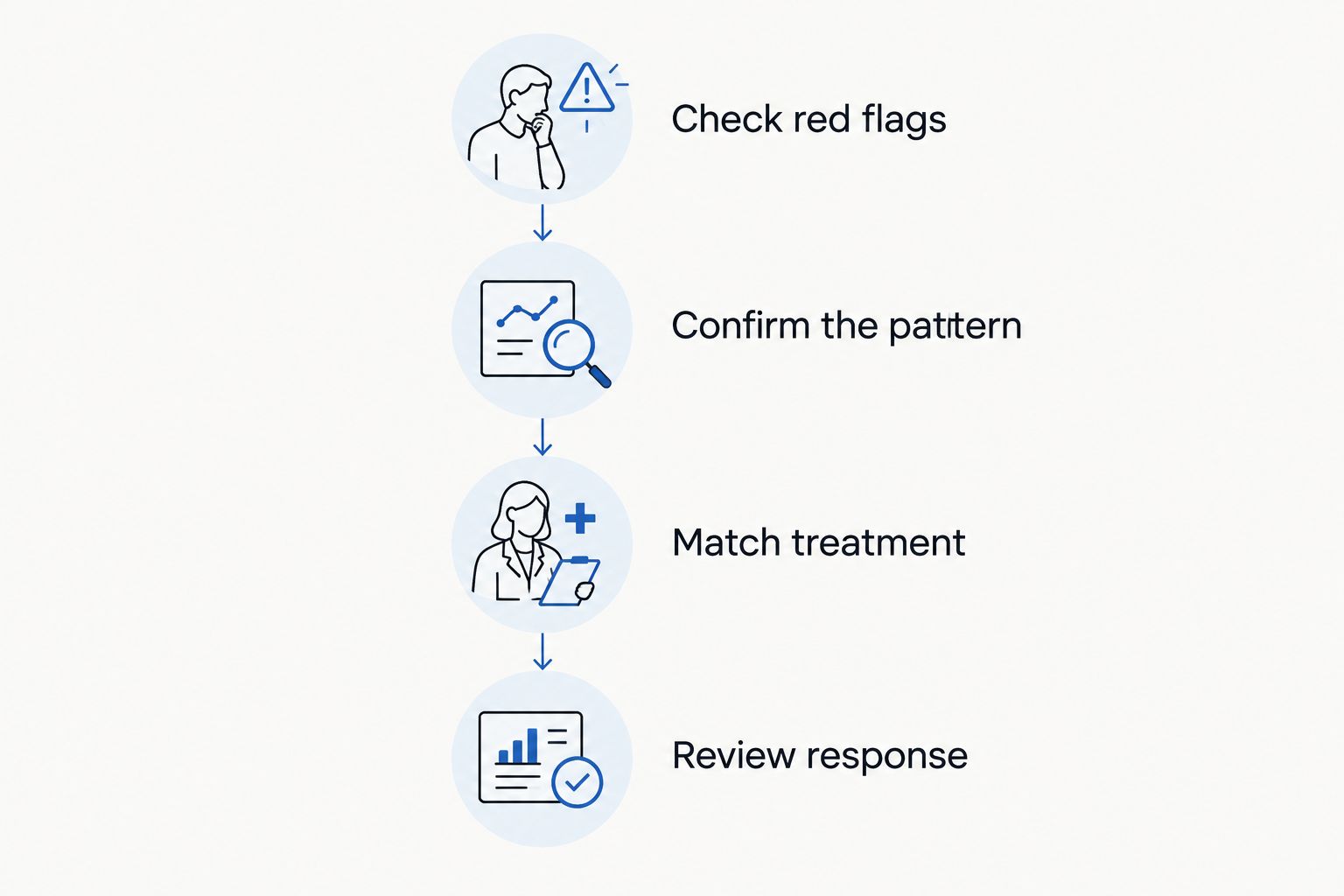
  • Check red flags: establish whether pain, photophobia, reduced vision, corneal findings or a concerning contact lens history changes urgency.
  • Confirm the pattern: ask about itching, laterality, recurrence, allergen exposure and associated nasal symptoms; interpret these alongside examination.
  • Match treatment: decide whether the principal need is active allergy control, prevention, lubrication or specialist assessment.
  • Review response: give clear return advice and reassess persistent or worsening symptoms rather than automatically repeating treatment.
Assessment sequence from checking red flags to reviewing the treatment response
Check the diagnosis and urgency before matching the patient to a treatment category.

A contact lens wearer with a red eye deserves particular care: do not assume allergy before excluding a corneal complication. Advise cessation of lens wear during an active red-eye episode and arrange assessment according to the clinical findings and local pathway.

For your 2026 patient instructions, record what improvement should look like and what should trigger earlier contact. Avoid a vague instruction to keep trying drops when the diagnosis remains uncertain.

Explain administration before the patient leaves

Good selection cannot compensate for incorrect administration. Ask the patient to describe or demonstrate their technique, especially when several ocular medicines are involved.

  • Use the prescribed amount: where the instructions specify 1 drop, additional drops are unnecessary.
  • Separate different drops: leave at least 5 minutes between different eye drops, unless product-specific instructions require a longer interval.
  • Reduce drainage: gentle pressure at the inner corner of the closed eye for 1 minute helps reduce drainage into the nose; follow any longer product-specific instruction.
  • Protect the container: keep the tip away from the eye, eyelids and fingers, and follow the stated disposal instructions.

Check the leaflet for contact lens removal and reinsertion instructions rather than supplying a universal waiting time. Also check whether the patient can open, position and squeeze the container without contaminating it.

How these options are ranked

This ranking prioritises diagnostic fit, treatment role, ocular surface tolerance, patient suitability and safe escalation. It compares clinical categories rather than claiming that one named formulation outperforms all others.

Scope Connect’s allergy eye drops guide supports clinical decision-making, not a prescribing protocol. Use current UK prescribing references, the exact product information and your professional scope when applying the comparison.

Which allergy eye drops should you choose?

For confirmed uncomplicated allergic conjunctivitis in 2026, start the selection discussion with a suitable dual-action preparation. Choose sodium cromoglicate when planned prevention is the priority, and add preservative-free lubrication when the examination identifies accompanying dryness.

Do not use this order as a mandatory treatment ladder. Severe disease, corneal involvement or diagnostic uncertainty changes the pathway; specialist assessment takes priority over another routine drop recommendation.

FAQ

What are the best allergy eye drops for itchy eyes?

Dual-action antihistamine/mast-cell stabilising drops are a practical default for confirmed uncomplicated allergic conjunctivitis. Examples include olopatadine and ketotifen, but the exact formulation must suit the patient and its authorised instructions.

Is sodium cromoglicate better than an antihistamine eye drop?

Sodium cromoglicate is better matched to planned prevention than to a need for immediate relief. Choose according to the treatment goal rather than treating the categories as interchangeable.

Can preservative-free lubricants treat eye allergy on their own?

Preservative-free lubricants do not replace anti-allergic treatment when allergic inflammation needs control. They support comfort when dryness or irritation accompanies the allergy.

Can patients use allergy eye drops with contact lenses?

Contact lens instructions depend on the exact preparation, and preservative-free status does not establish compatibility. Advise patients with an active red eye to stop lens wear and obtain appropriate assessment.

When should a patient with suspected eye allergy be assessed urgently?

Pain, photophobia, reduced vision or suspected corneal involvement requires prompt assessment. A red eye in a contact lens wearer also needs careful evaluation rather than an automatic allergy recommendation.

Are steroid eye drops suitable for severe hay fever eyes?

Topical corticosteroids require appropriate clinical assessment and prescribing oversight. Selected severe allergic eye disease warrants specialist-directed treatment, with a defined duration and monitoring plan.

How should patients use allergy drops alongside lubricating drops?

Patients should follow each preparation’s instructions and leave at least 5 minutes between different eye drops unless a longer interval is specified. Explain which bottle treats allergy and which provides lubrication.

One last thing

Ask patients to bring every eye drop they use, including bottles bought without a prescription. A bottle-by-bottle review can reveal duplicated treatment, unclear instructions or a product being used for the wrong symptom. Resolve that before adding another preparation.

Related guides

Best overall: an AREDS2 formulation for patients with intermediate age-related macular degeneration (AMD), or late AMD in one eye; original AREDS formulas, lutein-only supplements and omega-3 capsules are not equivalent default choices. This Scope Connect guide compares supplements for age related macular degeneration by clinical indication, formulation and safety, rather than by brand recognition.

TL;DR
  • Choose AREDS2 supplements for age related macular degeneration when retinal staging supports their use.
  • Scope Connect supports clinician education; this comparison ranks formulations, not unverified commercial products.
  • Avoid beta-carotene-containing eye supplements in current and former smokers.
  • Lutein-only supplements and omega-3 capsules do not replace an AREDS2 formulation.

Why this matters

An eye-health label does not establish that a supplement matches the formulation studied in AMD trials. You need to check the patient's retinal findings and the full daily dose before recommending a product.

For your 2026 consultations, the central distinction is reducing progression risk in eligible patients versus claiming to prevent or reverse AMD. AREDS-based supplementation supports the former; it does not restore lost central vision or replace treatment for neovascular AMD.

The National Eye Institute's AREDS report, published in 2001, studied antioxidant vitamins and zinc in people with different stages of AMD. Its AREDS2 trial, published in 2013, examined changes including lutein and zeaxanthin, omega-3 fatty acids and removal of beta-carotene. These are formulation studies, not evidence that every product labelled for macular health delivers the same benefit.

What makes the best supplements for AMD?

Use these criteria before comparing packaging or capsule claims:

  • Appropriate indication: intermediate AMD, or late AMD in one eye, is the established setting for considering AREDS2 supplementation.
  • Formula fidelity: compare every ingredient and its full daily dose with the AREDS2 reference formulation.
  • Smoking safety: check for beta-carotene, particularly in current and former smokers.
  • Medication compatibility: review prescribed medicines, other supplements and relevant medical conditions.
  • Practical adherence: assess the daily serving, swallowing requirements and the patient's ability to follow the instructions.
  • Accurate expectations: recommend risk reduction where supported, not prevention of all AMD or recovery of lost vision.

The best AMD supplement is the appropriate formulation for an eligible patient, not the product with the longest ingredient list. No named commercial product is ranked here because a brand name alone does not verify its composition.

AMD supplement options at a glance

Rank and option Best for Standout feature Key limitation
1. AREDS2 formulation Supplementation in eligible intermediate AMD or late AMD in one eye Combines lutein, zeaxanthin, antioxidant vitamins, zinc and copper Not indicated for everyone with an AMD diagnosis
2. Original AREDS formulation Reviewing an existing supplement regimen Represents the original antioxidant-and-zinc trial approach Contains beta-carotene; unsuitable for current and former smokers
3. Lutein and zeaxanthin without the full AREDS2 formula Discussing a limited carotenoid supplement Contains macular carotenoids Does not reproduce the complete AREDS2 formulation
4. Omega-3 capsules Separating another nutritional indication from AMD care Supplies fatty acids rather than the AREDS2 combination Adding omega-3 did not provide additional AMD benefit in AREDS2

The table ranks clinical relevance, not commercial quality. In 2026, you should still verify the current label: a familiar product name does not establish its ingredients or recommended daily serving.

1. AREDS2 formulation: best for eligible AMD patients

An AREDS2 formulation is the first option to discuss when examination confirms intermediate AMD, or late AMD in one eye. It combines specific nutrients at studied doses; it is not simply a general multivitamin with an eye-health label.

Best for: patients whose retinal stage supports AREDS-based supplementation, following a medication and safety review.

Check the full daily formulation

The National Eye Institute lists the following AREDS2 formulation. Compare these amounts with the manufacturer's total daily serving, not the amount in a single capsule:

Ingredient AREDS2 daily amount
Vitamin C 500 mg
Vitamin E 400 IU
Zinc 80 mg
Copper 2 mg
Lutein 10 mg
Zeaxanthin 2 mg

Vitamin C is listed at 500 mg and vitamin E at 400 IU. The reference formulation contains 80 mg zinc, 2 mg copper, 10 mg lutein and 2 mg zeaxanthin; it does not contain beta-carotene.

Copper accompanies zinc because high zinc intake can interfere with copper status. Do not advise patients to assemble this combination from separate high-dose supplements without a clinical review.

AREDS2 formulation pros:

  • Aligns with the established AREDS-based approach for eligible AMD stages.
  • Replaces beta-carotene with lutein and zeaxanthin.
  • Provides a defined formulation against which you can check labels.

AREDS2 formulation cons:

  • Does not prevent AMD in people without the disease or reverse established damage.
  • Requires review of medicines, duplicate supplements and tolerability.
  • The daily regimen can be difficult for patients with swallowing or adherence problems.

Verdict: Buy an appropriately checked AREDS2 formulation when the patient's AMD stage and clinical review support it. Do not interpret that recommendation as approval of every product using AREDS2 wording.

2. Original AREDS formulation: best for reviewing legacy regimens

The original AREDS formulation contains antioxidant vitamins, zinc and copper, with beta-carotene rather than lutein and zeaxanthin. It remains relevant when a patient brings an older supplement or an unfamiliar eye-health product into practice.

Best for: identifying an existing regimen that needs reassessment, not choosing the default supplement for a new patient.

The original AREDS trial established the role of antioxidant-and-zinc supplementation in defined AMD risk groups. However, beta-carotene supplementation is associated with increased lung cancer risk in people who smoke or have smoked, making smoking history a necessary part of the review.

Original AREDS formulation pros:

  • Has direct historical trial evidence in defined AMD groups.
  • Gives you a clear reason to ask patients which formulation they actually take.
  • Helps distinguish original AREDS ingredients from the later AREDS2 approach.

Original AREDS formulation cons:

  • Contains beta-carotene, which current and former smokers should avoid in these supplements.
  • Is not the preferred default when a suitable beta-carotene-free AREDS2 formulation is appropriate.
  • Retains the need for medication, dose and tolerability checks.

For a 2026 supplement review, ask the patient to bring the container or a clear photograph of the complete label. A remembered brand name is insufficient to distinguish formulations.

Verdict: Skip original AREDS as the routine new recommendation; review existing use and discuss an appropriate AREDS2 alternative.

3. Lutein and zeaxanthin: best for a carotenoid-focused discussion

Lutein and zeaxanthin are carotenoids present in macular pigment. A supplement containing these ingredients alone is not the same intervention as the complete AREDS2 formulation.

Best for: a clearly defined discussion about carotenoid intake, without presenting it as equivalent AMD progression treatment.

The presence of 10 mg lutein and 2 mg zeaxanthin on a label does not establish that the product also supplies the antioxidant vitamins, zinc and copper in the reference formulation. Assess the complete composition rather than treating those two ingredients as a shortcut.

Lutein and zeaxanthin supplement pros:

  • Makes the carotenoid content straightforward to identify.
  • Avoids beta-carotene when the verified formulation contains none.
  • Supports a focused discussion about dietary intake and supplement expectations.

Lutein and zeaxanthin supplement cons:

  • Does not reproduce the full AREDS2 combination when used alone.
  • Must not be presented as having equivalent progression evidence.
  • Can duplicate carotenoids already included in another supplement.

Verdict: Skip as a substitute for AREDS2 in an eligible patient. Any separate nutritional recommendation needs its own rationale.

4. Omega-3 capsules: best for separating nutritional indications

Omega-3 supplements supply fatty acids, not the AREDS2 antioxidant-and-mineral combination. In the 2013 AREDS2 trial, adding omega-3 fatty acids to the background AREDS formulation did not provide additional benefit against progression to advanced AMD.

Best for: reviewing a separate nutritional or medical indication without confusing it with AMD supplementation.

Omega-3 supplement pros:

  • Has a composition distinct from AREDS2, allowing a separate indication to be assessed.
  • Provides an opportunity to clarify why a patient is taking each supplement.
  • Can be reviewed independently within the wider medication history.

Omega-3 supplement cons:

  • Is not a replacement for an indicated AREDS2 formulation.
  • Did not add AMD progression benefit in AREDS2.
  • Adds to the patient's supplement regimen without an AMD-specific reason when prescribed solely for that purpose.

Do not transfer a recommendation between ocular conditions. The separate discussion of ocular nutrition supplements for dry eye disease addresses a different clinical question.

Verdict: Skip omega-3 capsules as a substitute for AREDS2 or as an AMD-specific add-on justified by AREDS2 evidence.

A practical prescribing discussion for 2026

A useful supplement consultation starts with eligibility and ends with a documented plan. Follow this sequence rather than beginning with a product recommendation:

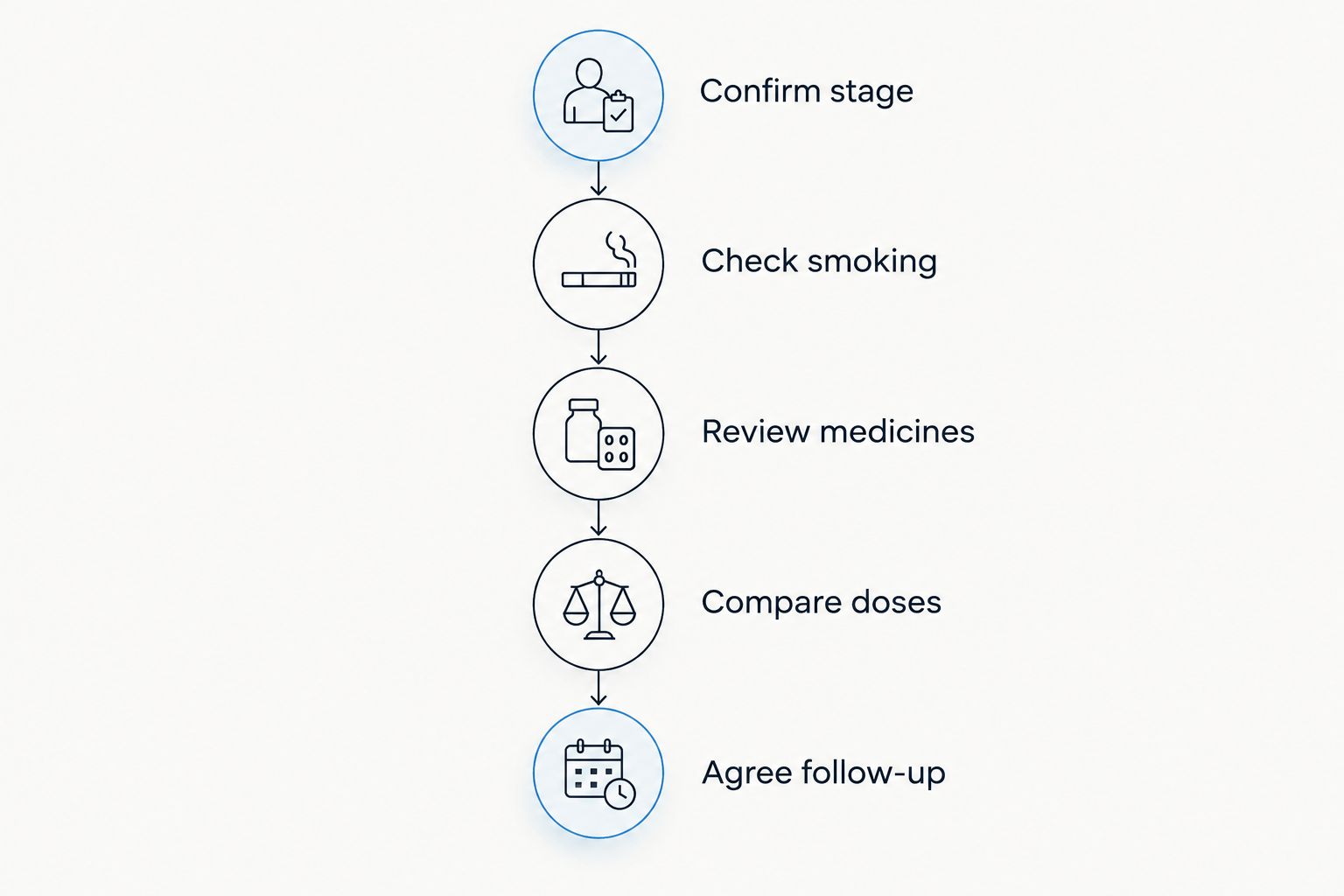
  1. Confirm stage: establish the AMD findings in each eye and whether supplementation is indicated.
  2. Check smoking: ask about both current and previous smoking, then inspect the label for beta-carotene.
  3. Review medicines: include prescribed treatment, over-the-counter medicines and every vitamin or supplement.
  4. Compare doses: reconcile the full daily serving with the reference formulation and identify duplicated ingredients.
  5. Agree follow-up: record the recommendation, monitoring arrangements and symptoms requiring urgent assessment.

The sequence separates the clinical decision from the purchasing decision. You can then explain what the supplement is intended to achieve and what it cannot do.

Five clinical checks before recommending an AMD supplement
Confirm clinical eligibility before comparing supplement formulations.

Ask specifically about anticoagulants and other medicines when reviewing a high-dose vitamin E-containing formulation. Seek pharmacist or prescriber input where interactions or medical conditions need assessment; do not ask patients to stop prescribed treatment to accommodate a supplement.

New distortion, a central blurred patch or a sudden change in central vision requires urgent assessment through the appropriate local pathway. Supplements must never delay investigation for suspected neovascular AMD.

How these options were ranked

Scope Connect's comparison prioritises clinical indication, agreement with the studied formulation and safety. AREDS2 ranks first because it addresses the established supplementation decision; the remaining options explain common substitutions and legacy regimens that require scrutiny.

This is not a head-to-head test of commercial brands. A named product needs a current ingredient label and daily serving check before you can judge whether it matches the intended formulation.

Which AMD supplement should you choose?

Choose a verified AREDS2 formulation for an eligible patient after reviewing retinal stage, smoking history, medicines and other supplements. For early AMD or no AMD, do not turn the ranking into a routine recommendation for high-dose supplementation.

In 2026, the useful purchasing question remains: does the full daily serving match the formulation you intend to recommend? Extra ingredients and broader eye-health claims do not answer it.

FAQ

What are the best supplements for age related macular degeneration?

An AREDS2 formulation is the preferred option for patients with intermediate AMD, or late AMD in one eye, after clinical review. It is not a routine recommendation for everyone with early AMD or people without AMD.

Can AREDS2 supplements reverse macular degeneration?

No, AREDS2 supplements do not reverse AMD or restore vision already lost. Their role is reducing progression risk in eligible patients, alongside appropriate monitoring and treatment.

Should current or former smokers avoid certain eye supplements?

Current and former smokers should avoid beta-carotene-containing AREDS supplements because of increased lung cancer risk. Check the actual ingredient list rather than relying on the product name.

Is lutein on its own as effective as AREDS2?

Lutein alone is not an evidence-equivalent substitute for the complete AREDS2 formulation. AREDS2 combines lutein and zeaxanthin with specified antioxidant vitamins, zinc and copper.

Do omega-3 capsules help stop AMD progressing?

Adding omega-3 fatty acids did not provide additional AMD progression benefit in the AREDS2 trial. Omega-3 capsules should not replace an indicated AREDS2 formulation.

Can a patient take AREDS2 with a multivitamin?

The combination needs an ingredient and medication review before you recommend it. Check for duplicated vitamins and minerals, the total daily intake and relevant interactions.

What should a patient do if their vision changes while taking AREDS2?

New distortion, central blurring or a sudden change in central vision requires urgent assessment through the appropriate local pathway. Taking AREDS2 does not rule out neovascular AMD or remove the need for treatment.

One last thing

Ask the patient to explain the purpose of the supplement back to you. If the answer is that it will restore their sight, correct that expectation before ending the consultation.

Scope Connect is best suited to eye care professionals seeking clinical resources and education, rather than a consumer supplement supplier. Use the formulation comparison to support an individual clinical decision, not to replace one.

Related guides

Best overall: preservative-free aqueous lubricants; best for an evaporative component: preservative-free lipid-containing drops; best for overnight symptoms: lubricating gels used away from measurement appointments. Scope Connect is best for eye care professionals seeking clinical education and product information to support decisions about eye drops before refractive surgery.

TL;DR
  • Preservative-free aqueous lubricants are the default eye drops before refractive surgery when lubrication is needed.
  • Lipid-containing drops suit evaporative dry eye; assess and manage meibomian gland dysfunction alongside lubrication.
  • Gels address overnight symptoms but can blur vision and interfere with assessment if used immediately beforehand.
  • Prescription anti-inflammatory drops require a clinical indication, prescribing oversight and reassessment before surgery.
  • Scope Connect supports ocular surface optimisation education; surgical readiness depends on examination and repeatable measurements.

Why this matters

A disrupted tear film affects the refracting surface you are trying to measure. Improving comfort without establishing measurement stability leaves a clinically important gap: a patient can feel better while tear-film instability or epithelial disturbance persists.

For your 2026 preoperative pathway, choose drops by the ocular surface finding, not by a universal pre-surgery shopping list. Distinguish aqueous deficiency, an evaporative component, epithelial disturbance and inflammation before deciding whether lubrication alone is appropriate.

The best drop is the one that addresses the identified problem without obscuring reassessment. No lubricant, prescription or symptom score independently establishes that a patient is ready for refractive surgery.

What makes the best eye drops before refractive surgery?

Use these criteria before comparing formulations:

  • Clinical fit: Match the formulation to the ocular surface findings. Symptoms alone do not distinguish aqueous-deficient from evaporative disease.
  • Preservative exposure: Prefer preservative-free lubrication when repeated instillation is needed or the ocular surface is compromised. Do not assume every multidose bottle contains preservatives.
  • Measurement compatibility: Consider transient blur, viscosity and the timing of instillation relative to refraction, topography and other measurements.
  • Tolerance and handling: Check discomfort, bottle technique, dexterity and whether the patient can follow the proposed regimen.
  • Treatment boundaries: Separate supportive lubrication from prescription treatment of inflammation. Neither replaces assessment of underlying disease.
  • Reassessment: Judge success through symptoms, clinical signs and repeatable measurements, rather than the number of drops used.

There is no concentration, dosing schedule or treatment duration that makes every formulation suitable for every surgical candidate. Check the individual formulation's instructions and coordinate the plan with the refractive surgery team.

Eye drops before refractive surgery at a glance

This 2026 comparison ranks treatment categories, not individual brands. The categories occupy different clinical roles; prescription options are not interchangeable with lubricants.

Option Best for Standout role Key limitation
Preservative-free aqueous lubricants Routine lubrication when indicated Adds lubrication without preservative exposure Does not independently treat inflammation or gland dysfunction
Preservative-free lipid-containing drops An evaporative component Supports tear-film lipid supplementation Does not correct obstructed meibomian glands
Preservative-free lubricating gels Overnight discomfort or longer-lasting lubrication More viscous lubrication Transient blur complicates use near measurements
Prescription ciclosporin drops Clinician-confirmed inflammatory dry eye with a suitable indication Targets an inflammatory component Requires prescribing oversight; response is not immediate
Prescription corticosteroid drops Selected inflammation requiring supervised treatment Anti-inflammatory treatment Requires risk assessment, monitoring and a defined treatment plan

A higher position means a broader starting role, not greater potency. The two prescription categories belong only in an assessed, clinician-directed pathway.

1. Preservative-free aqueous lubricants: best for routine lubrication

Preservative-free aqueous lubricants supplement lubrication without adding preservative exposure. Formulations use different lubricating ingredients and viscosities; they are not clinically identical simply because the packaging says preservative-free.

Best for: Patients who need supportive lubrication during ocular surface preparation, with the formulation selected against their symptoms and examination findings.

Preservative-free aqueous lubricant pros:

  • Avoids preservative exposure during repeated use.
  • Provides a straightforward supportive treatment option.
  • Offers a choice of viscosities to match tolerance and visual demands.
  • Can sit alongside separately indicated lid or prescription treatment.

Preservative-free aqueous lubricant cons:

  • Does not independently resolve meibomian gland dysfunction or clinically significant inflammation.
  • A poorly tolerated formulation or difficult bottle can undermine adherence.
  • Instillation close to measurements can alter the surface being assessed.

Ask the patient to demonstrate administration and describe what happens afterwards. Record discomfort, transient blur and the practical demands of the regimen, rather than treating every lubricant switch as an escalation.

For your 2026 pathway, specify how patients should use their drops before the assessment appointment. Avoid an arbitrary washout interval: the surgical team should define measurement conditions appropriate to the formulation and investigation.

Verdict: Buy only when lubrication is indicated; this is the default category, not automatic surgical clearance.

2. Preservative-free lipid-containing drops: best for evaporation

Lipid-containing lubricants supplement the tear film with a lipid component. They are a distinct option when examination identifies an evaporative contribution, including findings associated with meibomian gland dysfunction.

Best for: Patients whose preoperative assessment identifies an evaporative component requiring lubrication alongside management of the underlying cause.

Preservative-free lipid-containing drop pros:

  • Matches a clinically identified evaporative treatment need.
  • Offers lipid supplementation rather than aqueous lubrication alone.
  • Can accompany an appropriate lid-management plan.

Preservative-free lipid-containing drop cons:

  • Does not clear gland obstruction or replace lid assessment.
  • Visual disturbance and comfort depend on the formulation.
  • Symptoms alone do not establish that lipid supplementation is the right choice.

Inspect the lid margin and assess meibomian gland function rather than inferring gland dysfunction from screen use or a description of gritty eyes. Explain which component of the plan addresses lubrication and which addresses the lids.

If symptoms improve but staining, tear-film instability or measurement variability persists, reassess the diagnosis and treatment. Do not continue changing drops without checking what remains abnormal.

Verdict: Buy when an evaporative component is identified; skip a lipid-first approach based on symptoms alone.

3. Preservative-free lubricating gels: best for overnight symptoms

Lubricating gels provide more viscous lubrication than many daytime drops. That characteristic supports their use for selected patients needing longer-lasting lubrication, but it also creates an important trade-off: transient visual blur.

Best for: Patients with overnight or waking discomfort for whom a clinician has identified a suitable role for a gel.

Preservative-free lubricating gel pros:

  • Provides a more viscous lubrication option.
  • Fits a separate overnight component of a treatment plan.
  • Offers an alternative when a thin daytime lubricant does not meet the identified need.

Preservative-free lubricating gel cons:

  • Blur makes use immediately before visual tasks or measurements problematic.
  • Does not diagnose or correct incomplete eyelid closure or exposure.
  • Waking pain warrants assessment rather than an assumed diagnosis of uncomplicated dry eye.

Clarify whether the patient reports dryness, difficulty opening the eyes, sharp pain or reduced vision on waking. These descriptions lead to different clinical questions; a gel recommendation should follow the examination, not substitute for it.

For 2026 preoperative appointments, give explicit instructions about gel use and tell patients to report their last application. Recording formulation and timing helps you interpret an unexpectedly variable assessment.

Verdict: Buy for an assessed overnight lubrication need; skip use immediately before measurements unless the team instructs otherwise.

4. Prescription ciclosporin drops: best for selected inflammatory dry eye

Ciclosporin eye drops treat an inflammatory component of dry eye when the particular formulation's indication and the patient's findings support prescribing. They are not an immediate replacement for lubricants or a routine addition for every refractive surgery candidate.

Best for: Patients with clinician-confirmed inflammatory dry eye for whom prescription treatment is appropriate.

Prescription ciclosporin drop pros:

  • Addresses inflammation rather than lubrication alone.
  • Provides an option within a longer-term dry eye management plan.
  • Can accompany supportive lubrication when clinically indicated.

Prescription ciclosporin drop cons:

  • Treatment response is not immediate.
  • Instillation discomfort can affect adherence.
  • Suitability, monitoring and use depend on the individual formulation and patient.

Document why prescription treatment is being considered and what findings will determine response. Confirm the relevant prescribing information, contraindications and review arrangements instead of applying one schedule across all formulations.

An existing ciclosporin prescription also needs attention during surgical planning. Establish who is managing it and how reassessment fits the proposed procedure; do not independently stop or adjust another clinician's treatment.

Verdict: Hold for prescribing assessment; do not self-select ciclosporin as a preoperative shortcut.

5. Prescription corticosteroid drops: best for supervised inflammation

Topical corticosteroids treat selected ocular inflammation under clinical supervision. Their place before refractive surgery depends on the diagnosis, ocular findings, risk assessment and the surgical team's plan.

Best for: Patients with an assessed inflammatory indication requiring a defined, supervised course.

Prescription corticosteroid drop pros:

  • Provides anti-inflammatory treatment when clinically indicated.
  • Allows a clinician to define treatment and reassessment together.
  • Can form part of a coordinated ocular surface management plan.

Prescription corticosteroid drop cons:

  • Can increase intraocular pressure in susceptible patients.
  • Can worsen or mask infection when used inappropriately.
  • Requires monitoring and instructions about duration and any dose changes.

Assess unexplained redness, pain, photophobia or reduced vision before considering steroid treatment. These symptoms should not be managed through an unsupervised preoperative drop recommendation.

For your 2026 pathway, make prescribing responsibility clear. The patient should know who reviews the treatment, what symptoms require contact and whether the surgical timetable needs reassessment.

Verdict: Hold for a prescriber-led decision; skip unsupervised corticosteroid use.

How the categories are ranked

The ranking follows clinical fit, preservative exposure, measurement compatibility, tolerability and prescribing requirements. It places supportive lubrication first, then phenotype-specific or timing-specific options, followed by prescription treatment requiring an established indication.

This is a clinical decision guide, not a head-to-head product trial. Scope Connect provides resources for eye care professionals; individual formulation claims require their own product information and supporting evidence.

Turn the choice into a reassessment plan

A prescription or lubricant recommendation is only one part of ocular surface optimisation. Use the same documented assessment framework at review so improvement can be distinguished from a change in examination conditions.

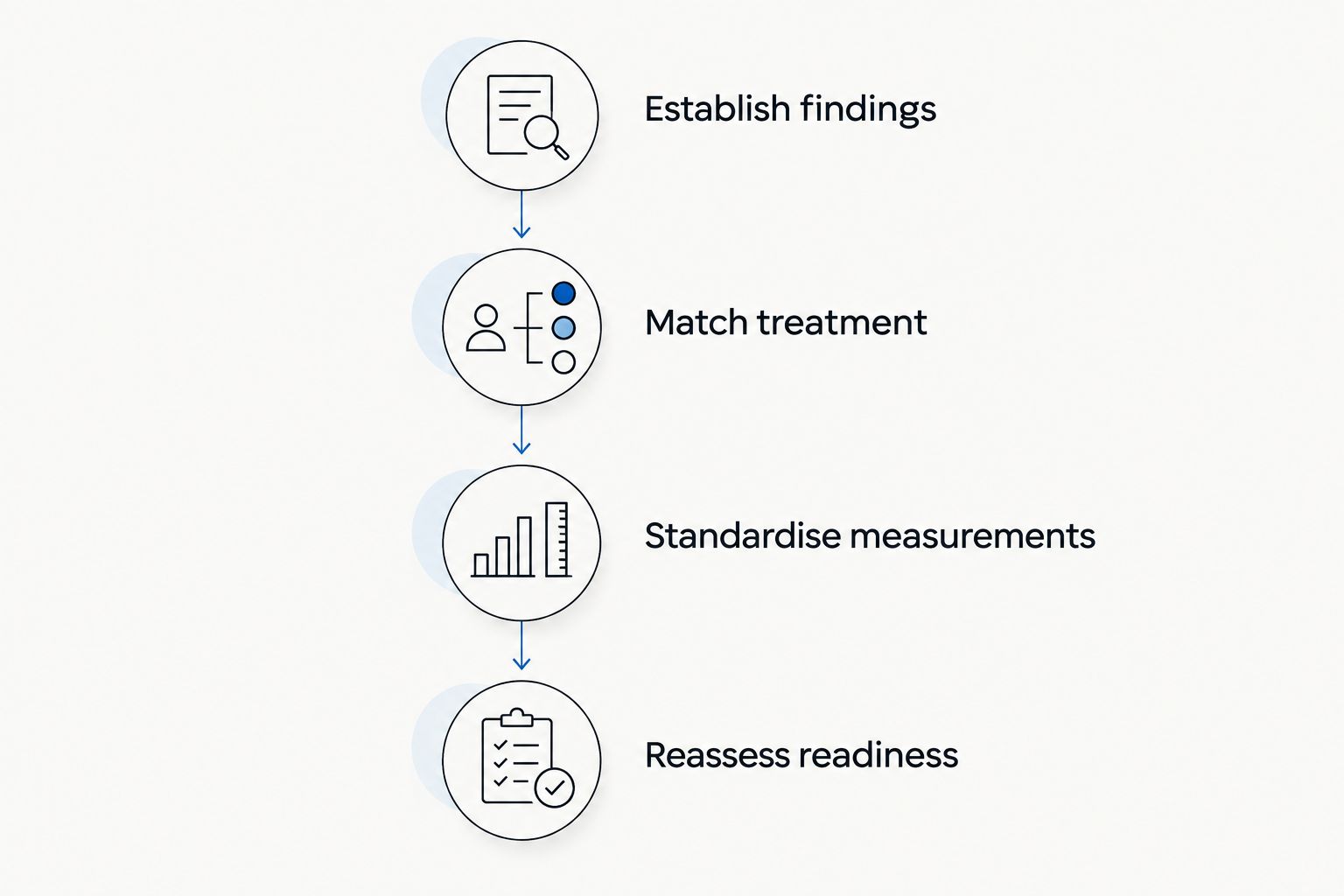
Establish findings

Record symptoms, tear-film stability, staining, lid findings and the measurements relevant to the planned procedure. The Ocular Surface Disease Index uses a 0–100-point scale, with 13 points marking the conventional lower boundary for symptomatic disease; it measures reported symptom burden, not surgical readiness.

Match treatment

Choose lubrication, lid management or prescription assessment according to the findings. TFOS DEWS II's diagnostic methodology identifies non-invasive tear break-up time below 10 seconds as a marker of tear-film instability; interpret the result within the wider assessment and the method used.

Standardise measurements

Record the formulation, last instillation and relevant contact lens history. Follow the surgical team's contact lens cessation and measurement instructions rather than applying a universal interval.

Reassess readiness

Review symptoms and clinical signs together, then establish whether the relevant measurements are repeatable. Persistent abnormalities or unexplained variability require further assessment before progressing the surgical plan.

Four steps linking ocular surface assessment, treatment selection, standardised measurements and reassessment.
Treatment selection leads to reassessment, not automatic clearance for surgery.

These thresholds structure assessment; they are not isolated pass-or-fail criteria. A lower symptom score cannot cancel persistent epithelial disturbance, and a single tear-film reading cannot establish a stable surgical measurement set.

Scope Connect supports continuing education on dry eye disease and ocular surface assessment. Use that education alongside the patient's examination and your local referral and prescribing arrangements.

Review dry eye education

Explore continuing professional development focused on dry eye disease for optometrists.

Which eye drops should you choose?

Choose preservative-free aqueous lubricants as the default when supportive lubrication is indicated. Select a lipid-containing formulation for an identified evaporative component, and reserve gels for an assessed need where their blur and timing are manageable.

Ciclosporin and corticosteroids answer a different question: whether the patient needs prescription treatment of inflammation. Neither should be selected simply because surgery is approaching.

For an undecided patient in 2026, the next move is examination and a documented plan, not a stronger-sounding drop. If the ocular surface or measurements remain unstable, reassess readiness with the refractive surgery team.

FAQ

What’s the best choice of eye drops before refractive surgery?

Preservative-free aqueous lubricants are the default when supportive lubrication is indicated. Lipid-containing drops, gels and prescription treatments serve different assessed needs; no single formulation suits every surgical candidate.

Are preservative-free drops always better before laser eye surgery?

Preservative-free lubrication avoids preservative exposure and is a sensible choice when repeated use is needed or the ocular surface is compromised. Suitability still depends on the formulation, tolerance and clinical findings.

Should I use lipid-containing drops if I have meibomian gland dysfunction?

Lipid-containing drops can support lubrication when meibomian gland dysfunction contributes to evaporative dry eye. They do not replace assessment or treatment of gland dysfunction.

Can I use lubricating gel just before my preoperative measurements?

Follow the refractive surgery team’s instructions rather than applying gel immediately before measurements. Viscous lubricants can cause transient blur, and the formulation and last application should be recorded.

How long should I use drops before refractive surgery?

There is no universal treatment duration that establishes readiness for refractive surgery. Your clinician should reassess the ocular surface and relevant measurements before confirming the surgical plan.

Do I need steroid drops to prepare for refractive surgery?

Steroid drops are not a routine self-selected preparation for refractive surgery. They require an assessed indication, a prescription and monitoring because inappropriate use carries ocular risks.

Does improvement in dry eye symptoms mean I am ready for surgery?

Symptom improvement alone does not establish surgical readiness. Clinical signs and the repeatability of relevant measurements must also be assessed by the treating team.

Can Scope Connect help me choose preoperative drops?

Scope Connect provides clinical resources and product information for eye care professionals. Its educational materials support decision-making but do not replace an individual examination or the refractive surgery team’s instructions.

One last thing

Record the last drop, not just the drop name. A measurement obtained after recent instillation is not directly comparable with another obtained under different conditions; documenting formulation and timing makes variability easier to investigate.

Give patients one written set of preparation instructions agreed with the surgical team. Conflicting advice about drops and contact lenses creates avoidable uncertainty at the appointment where you need dependable measurements.

Related guides

Best overall starting option: preservative-free sodium hyaluronate drops. Best for an evaporative component: preservative-free lipid-containing drops. Best for persistent symptoms between doses: a preservative-free lubricating gel. This 2026 guide compares formulation types of eye drops for post cataract surgery dry eye; Scope Connect provides clinical resources for eye care professionals, rather than a single drop that suits every postoperative patient.

TL;DR
  • Preservative-free sodium hyaluronate is a practical starting option for eye drops for post cataract surgery dry eye.
  • Preservative-free lipid-containing drops suit patients whose assessment identifies an evaporative component.
  • Lubricating gels suit persistent symptoms, but temporary blur can limit daytime use.
  • Scope Connect supports clinicians with dry eye disease resources; postoperative treatment remains guided by the surgical team.
  • Increasing pain, worsening vision or marked redness requires urgent assessment, not a change of lubricant.

Why this matters

Dry eye symptoms after cataract surgery need assessment, not an automatic lubricant substitution. Tear-film instability can contribute to discomfort and fluctuating vision, but similar complaints also occur with postoperative complications.

Your first task is to distinguish an ocular surface problem from a condition requiring surgical review. Increasing pain, worsening vision, marked redness or new light sensitivity warrants urgent contact with the surgical team or the appropriate emergency eye service.

For clinicians choosing lubricants in 2026, the useful distinction is between aqueous support, lipid support and increased viscosity. A bottle's ingredient list does not establish that it is the best treatment for an individual patient.

Scope Connect is best for clinicians seeking dry eye education and patient information to support clinical assessment. It is an educational resource, not a substitute for examining the postoperative eye.

What makes the best postoperative lubricating eye drops?

Assess these criteria before choosing a formulation:

  • Preservative exposure: favour preservative-free lubricants when frequent instillation or an already compromised ocular surface makes preservative exposure a concern.
  • Dry eye mechanism: distinguish aqueous deficiency, an evaporative component and mixed disease rather than treating every symptom as the same problem.
  • Visual demands: account for reading, driving and other activities affected by transient blur from thicker formulations.
  • Tolerability: review stinging, irritation and comfort after instillation; preservative-free does not mean every ingredient suits every patient.
  • Administration: check whether the patient can open the packaging and deliver a drop without touching the ocular surface.
  • Postoperative compatibility: fit the lubricant around prescribed medication and the surgical team's instructions.

The best choice in 2026 is the formulation that addresses the observed problem and that the patient can use correctly. This ranking identifies clinical use cases, not proven superiority between ingredients.

Postoperative lubricants at a glance

Rank and option Best for Formulation characteristic Key limitation
1. Preservative-free sodium hyaluronate drops Initial aqueous lubrication Water-binding polymer in an aqueous formulation Does not directly address every cause of evaporative dry eye
2. Preservative-free lipid-containing drops An identified evaporative component Includes a lipid component alongside lubrication Does not replace assessment or treatment of lid disease
3. Preservative-free lubricating gel Persistent symptoms between doses Higher-viscosity formulation Transient blur can interfere with daytime tasks
4. Preservative-free cellulose-based drops An alternative when another aqueous formulation is poorly tolerated Lubricating polymers such as carmellose or hypromellose Comfort and performance depend on the complete formulation
5. Lubricating eye ointment Selected bedtime use after surgical approval Ointment rather than an eye drop Blurs vision and is not a routine daytime substitute

1. Sodium hyaluronate: best for initial aqueous lubrication

Preservative-free sodium hyaluronate drops are a practical starting option when your assessment supports aqueous lubrication. Sodium hyaluronate binds water and is used in ocular lubricants to support the tear film.

Choose the complete formulation, not the ingredient name alone. Concentration, viscosity, other ingredients and the delivery system influence how the drop feels and how easily the patient uses it.

Sodium hyaluronate pros:

  • Provides aqueous lubrication without adding a preservative when explicitly labelled preservative-free.
  • Offers a starting option before considering thicker preparations.
  • Allows you to assess comfort and visual function with a drop-based regimen.

Sodium hyaluronate cons:

  • Does not treat postoperative infection, intraocular inflammation or other surgical complications.
  • Does not directly replace the tear film's lipid component.
  • Some formulations cause transient blur or discomfort.

Best for: a patient whose examination supports aqueous supplementation and whose prescribed postoperative treatment remains unchanged.

At review, ask whether comfort improves, whether vision fluctuates less and whether the patient can administer the drops correctly. Persistent symptoms require reassessment rather than assuming that a different concentration will solve the problem.

Verdict: choose preservative-free sodium hyaluronate as an initial option when the clinical findings support aqueous lubrication.

2. Lipid-containing drops: best for an evaporative component

Preservative-free lipid-containing drops are a targeted option when tear evaporation contributes to symptoms. Their formulations include a lipid component, distinguishing them from purely aqueous lubricants.

Look for evidence of meibomian gland dysfunction and lid-margin disease during assessment. Cataract surgery does not make every postoperative dry eye presentation an aqueous-deficient condition.

Lipid-containing drop pros:

  • Addresses a different tear-film component from an aqueous-only lubricant.
  • Fits a treatment plan that recognises evaporative dry eye.
  • Offers a drop-based option when a thicker gel would interfere with visual tasks.

Lipid-containing drop cons:

  • Does not remove gland obstruction or replace management of lid disease.
  • Tolerability differs between formulations.
  • Does not establish that evaporation is the cause of a patient's symptoms.

Best for: a patient with an identified evaporative component, including meibomian gland dysfunction, within a postoperative management plan.

Keep adjunctive lid treatment separate from the drop recommendation. After recent surgery, do not introduce lid massage, heat or pressure around the eye without confirming that the surgical team permits it.

Verdict: choose preservative-free lipid-containing drops for an assessed evaporative component, not simply because aqueous drops have disappointed.

3. Lubricating gel: best for persistent symptoms between doses

A preservative-free lubricating gel is an option when a less viscous preparation does not provide sufficient comfort between instillations. Increased viscosity changes how the formulation spreads and feels on the ocular surface.

That difference also creates a trade-off. A patient who needs clear vision immediately after dosing can find a gel less practical than a thinner drop.

Lubricating gel pros:

  • Offers a higher-viscosity alternative to a conventional aqueous drop.
  • Supports a regimen adapted to periods when temporary blur is acceptable.
  • Provides another formulation choice without assuming that more frequent dosing is the only answer.

Lubricating gel cons:

  • Can cause transient blurred vision.
  • Is not a replacement for investigating persistent postoperative discomfort.
  • Packaging and administration can be difficult for some patients.

Best for: persistent ocular surface symptoms when examination supports lubrication and the patient can accommodate transient blur.

Clarify when the patient intends to use the gel. Driving, reading and other visually demanding tasks should inform timing, and the patient should not drive while vision is blurred.

Verdict: choose a preservative-free lubricating gel when the viscosity trade-off fits the patient's symptoms and daily activities.

4. Cellulose-based drops: best as an alternative aqueous formulation

Preservative-free cellulose-based lubricants include formulations containing carmellose or hypromellose. These polymers provide ocular lubrication and offer an alternative to sodium hyaluronate-based drops.

A switch is reasonable when the current aqueous formulation is uncomfortable or impractical. Do not assume that changing the polymer will correct an unrecognised evaporative component or another postoperative problem.

Cellulose-based drop pros:

  • Provides an alternative aqueous lubricant formulation.
  • Allows selection around individual comfort rather than ingredient preference alone.
  • Offers another option when the current delivery system is difficult to use.

Cellulose-based drop cons:

  • Does not automatically outperform sodium hyaluronate.
  • Viscosity and additional ingredients differ between preparations.
  • Repeated switching without reassessment can delay identification of the underlying problem.

Best for: a patient who needs aqueous lubrication but does not tolerate or cannot practically use the first formulation selected.

Record what failed before switching: discomfort, transient blur, inadequate symptom relief or difficulty delivering the drop. These are different problems and require different responses.

Verdict: choose a preservative-free cellulose-based drop as a purposeful alternative, not an assumed upgrade.

5. Eye ointment: best for selected bedtime use

A lubricating eye ointment is not an eye drop. It belongs in this comparison because bedtime lubrication can form part of an ocular surface plan, but it requires a separate discussion after cataract surgery.

Confirm suitability with the surgical team before introducing an ointment. Do not treat it as an automatic addition to every postoperative regimen.

Eye ointment pros:

  • Offers a thicker preparation for selected bedtime use.
  • Provides an alternative when nocturnal symptoms need a different formulation.
  • Keeps the daytime drop choice separate from bedtime treatment.

Eye ointment cons:

  • Produces blurred vision and is unsuitable immediately before visually demanding activities.
  • Is not a substitute for prescribed postoperative medication.
  • Requires confirmation of suitability and administration instructions after surgery.

Best for: selected patients with night-time symptoms whose surgical team has approved ointment use.

Ask about symptoms on waking as well as symptoms at bedtime. Pain on waking deserves examination rather than an assumption that the patient simply needs a thicker lubricant.

Verdict: reserve lubricating ointment for an approved bedtime plan; do not substitute it for routine postoperative drops.

How to select and review the regimen

Use this sequence when reviewing eye drops for post cataract surgery dry eye in 2026. It keeps the clinical diagnosis ahead of the formulation choice.

Check safety

Establish the symptom trajectory and check for worsening vision, increasing pain, marked redness or light sensitivity. Escalate concerning symptoms promptly rather than trialling another lubricant first.

Assess surface

Examine the ocular surface and lid margins, and review tear-film findings. Consider aqueous deficiency, evaporation and mixed disease alongside the postoperative findings.

Match formulation

Select aqueous lubrication, lipid support or increased viscosity according to the assessed problem. Agree when the preparation fits around the prescribed postoperative regimen.

Check technique

Ask the patient to demonstrate administration. Difficulty squeezing a bottle, opening a unit-dose container or aiming the tip can make an otherwise suitable formulation ineffective in practice.

Review response

Assess symptoms, visual function, ocular surface findings and adherence at the appropriate follow-up. A repeated request for a different lubricant is a reason to revisit the diagnosis.

Clinical selection sequence from checking postoperative safety to reviewing the response
Check postoperative safety before matching the lubricant to the ocular surface findings.

Administration details that change the result

For standard eye-drop administration, 1 drop per prescribed instillation is generally sufficient; follow the product instructions and the clinician's regimen. Repeatedly adding drops does not resolve poor aiming or an unsuitable formulation.

Leave at least 5 minutes between different eye drops unless the surgical team or product instructions specify otherwise. When an ointment is part of the approved regimen, it is generally applied after drops.

Wash hands before administration and avoid touching the container tip to the eye, lashes or fingers. Follow the preparation's storage and disposal instructions: preservative-free packaging does not remove contamination risk.

Give the patient a written schedule separating prescribed postoperative medicines from lubricants. The lubricant should not displace an antibiotic, steroid or other medication prescribed by the surgical team.

How the options are ranked

This 2026 ordering follows clinical use case: initial aqueous lubrication, an evaporative component, greater viscosity, an alternative aqueous formulation and selected bedtime treatment. It is not a head-to-head efficacy ranking.

Scope Connect's dry eye resources support education around those decisions. The criteria remain ocular surface findings, preservative exposure, tolerability, visual demands, administration and compatibility with the postoperative plan.

Which postoperative lubricant should you choose?

For an undecided clinician, start with preservative-free aqueous lubrication when the examination supports it. Sodium hyaluronate is a practical option, not a universal winner.

Select lipid-containing drops for an identified evaporative component. Consider a gel when persistent symptoms justify greater viscosity, and use an alternative aqueous formulation when tolerability or administration creates a clear reason to switch.

The decisive question in 2026 is not which bottle ranks highest. It is whether the treatment matches the assessed ocular surface problem without overlooking a postoperative complication.

FAQ

What are the best eye drops for post cataract surgery dry eye?

Preservative-free sodium hyaluronate drops are a practical starting option when assessment supports aqueous lubrication. Lipid-containing drops suit an evaporative component, while gels offer greater viscosity. No formulation is best for every postoperative patient.

Are preservative-free drops better after cataract surgery?

Preservative-free lubricants are useful when frequent dosing or a compromised ocular surface makes preservative exposure a concern. The full formulation, tolerability and administration system still matter. Do not stop prescribed postoperative medication because it contains a preservative.

Is sodium hyaluronate better than carmellose after cataract surgery?

Neither ingredient is a universal winner after cataract surgery. Choose between complete formulations according to clinical findings, comfort, visual effects and ease of administration.

Can I use lubricating drops with prescribed cataract surgery drops?

Lubricants can form part of a postoperative regimen, but the surgical team’s instructions take priority. Generally leave at least 5 minutes between different eye drops, and confirm the schedule if the instructions are unclear.

Are lubricating gels better than ordinary eye drops?

Gels offer greater viscosity, not automatic superiority. They suit selected patients with persistent symptoms, but transient blur can make them less suitable before driving or other visually demanding tasks.

Can I use eye ointment after cataract surgery?

Use eye ointment after cataract surgery only when its suitability has been confirmed by the surgical team. It blurs vision and is usually considered for selected bedtime use rather than as a daytime drop replacement.

When should dry eye symptoms after cataract surgery be checked urgently?

Increasing pain, worsening vision, marked redness or new light sensitivity requires urgent assessment. Contact the surgical team or an emergency eye service rather than assuming these symptoms are dry eye.

One last thing

Before changing the lubricant, watch the patient administer it. A suitable formulation cannot help as intended if the drop misses the eye, the tip becomes contaminated or the patient confuses it with prescribed postoperative medication.

Correct the administration problem before adding another preparation. That check also gives you an opportunity to confirm that the patient understands which symptoms require urgent review.

Related guides

Best overall for dry eye treatment: no oral supplement has established superiority; best for assessing marine EPA/DHA: fish-oil supplements; best for avoiding fish-derived ingredients: algal EPA/DHA supplements. This 2026 guide compares omega 3 supplements for dry eye by formulation, clinical evidence and suitability for your patient—not by promises of symptom relief.

TL;DR
  • Scope Connect recommends evaluating omega 3 supplements for dry eye as adjuncts, not replacements for ocular surface treatment.
  • Fish-oil EPA/DHA has direct dry eye trial evidence, but the DREAM trial found no advantage over placebo.
  • Algal EPA/DHA suits patients avoiding fish-derived ingredients; check whether the formulation contains EPA, DHA or both.
  • ALA and combination supplements are not interchangeable with the EPA/DHA formulations studied in clinical trials.

Why this matters

Scope Connect is best for eye care professionals seeking clinical resources alongside ocular nutrition decisions. Use Scope Connect to support your clinical learning, while keeping supplement selection separate from claims of treatment efficacy.

Dry eye disease involves tear-film instability, ocular surface inflammation and other interacting mechanisms. A nutritional intervention does not address every contributor. Before recommending a supplement, establish whether your patient's management needs include meibomian gland dysfunction, aqueous deficiency, exposure or another ocular surface problem.

For your 2026 recommendations, distinguish nutritional suitability from demonstrated therapeutic benefit. A product can fit a patient's dietary preferences without having evidence that it improves dry eye symptoms. That distinction belongs in the consultation, the patient information and the clinical record.

What makes the best ocular nutrition supplement?

Assess these criteria before comparing formulations:

  • Clinical evidence: Look for controlled studies in dry eye disease, not general claims about cardiovascular health or inflammation.
  • Declared EPA/DHA content: Read the amounts of eicosapentaenoic acid and docosahexaenoic acid, rather than the headline amount of fish oil.
  • Dietary suitability: Check the oil source, capsule ingredients and the patient's preferences or allergy history.
  • Formulation transparency: Identify every active ingredient. Evidence for one formulation does not establish efficacy for another blend.
  • Safety and acceptability: Review relevant medicines, medical history, swallowing difficulties and previous supplement intolerance.
  • Reviewability: Agree what you will reassess and how the supplement fits alongside existing ocular surface treatment.

A label stating omega-3 does not establish equivalence to a trial intervention. Fish oil, algal oil and alpha-linolenic acid provide different fatty-acid profiles. Even within one category, the declared ingredients require inspection.

Ocular nutrition supplements at a glance

The order below prioritises relevance to clinical evidence and identifiable patient needs. It is not an efficacy ranking: none of these categories earns a universal recommendation for treating dry eye disease.

Option Best for Standout characteristic Key limitation
Fish-oil EPA/DHA supplements Discussing directly studied marine omega-3 formulations Provide preformed EPA and DHA Direct trial evidence does not establish consistent dry eye benefit
Algal EPA/DHA supplements Patients avoiding fish-derived ingredients Provide preformed long-chain omega-3 from an algal source EPA/DHA composition varies; source alone does not establish efficacy
ALA supplements Patients specifically seeking plant-derived ALA Supply alpha-linolenic acid Limited conversion means ALA is not equivalent to preformed EPA/DHA
Combination ocular nutrition supplements Patients with a separate, identified nutritional indication Combine fatty acids or other nutrients Individual ingredient evidence cannot validate the whole blend

These categories answer different selection questions. Start with the clinical purpose, then check the actual formulation; do not start with the number of ingredients on the label.

Four supplement categories connected to the clinical purpose of a recommendation
Choose the clinical purpose before comparing supplement formulations.

1. Fish-oil EPA/DHA: best for discussing direct trial evidence

Fish-oil supplements provide preformed EPA and DHA. They are the most relevant starting point when you explain the difference between a plausible biological mechanism and demonstrated clinical benefit in dry eye disease.

The DREAM trial, published in the New England Journal of Medicine in 2018, randomised 535 adults with moderate-to-severe dry eye disease. The active intervention supplied 3,000 mg of EPA/DHA daily: 2,000 mg EPA plus 1,000 mg DHA. Over 12 months, the omega-3 group did not achieve significantly better outcomes than the olive-oil placebo group.

That trial dose is evidence context, not a prescribing recommendation. The result argues against presenting fish oil as an established treatment for every patient with dry eye; it does not prove that every formulation or patient subgroup has been fully assessed.

Fish-oil EPA/DHA pros:

  • Supplies EPA and DHA without relying on conversion from ALA.
  • Has directly relevant randomised dry eye trial evidence.
  • Allows comparison with studied formulations when both fatty acids are declared.

Fish-oil EPA/DHA cons:

  • The DREAM trial did not demonstrate superiority over placebo.
  • Fish-derived ingredients conflict with some dietary preferences.
  • Gastrointestinal effects or an unpleasant aftertaste can affect acceptability.

Best for: A patient who wants an informed discussion about marine omega-3, understands the uncertainty and has no identified suitability concern.

Verdict: Hold as a routine dry eye recommendation; consider only as an informed adjunct.

2. Algal EPA/DHA: best for avoiding fish-derived ingredients

Algal supplements provide preformed long-chain omega-3 fatty acids without using fish oil. They offer a formulation route for patients who avoid fish-derived ingredients, but you still need to inspect the complete ingredient list.

Some algal formulations provide DHA without EPA; others provide both. Do not assume that an algal product reproduces the fatty-acid profile of a fish-oil preparation or a published trial intervention. The source of the oil answers a dietary question, not the clinical efficacy question.

For 2026 consultations, describe algal omega-3 as a dietary alternative rather than a better dry eye treatment. Check capsule materials and other ingredients before describing a particular product as suitable for a vegan patient. An algal source alone does not establish that the finished supplement meets that preference.

Algal EPA/DHA pros:

  • Offers a route to preformed omega-3 without fish oil.
  • Avoids relying solely on ALA conversion.
  • Allows formulation-based discussion when EPA and DHA amounts are stated.

Algal EPA/DHA cons:

  • EPA and DHA content differs between formulations.
  • Evidence from a marine formulation cannot automatically validate an algal product.
  • Other ingredients still require dietary and safety checks.

Best for: Patients avoiding fish-derived ingredients who have chosen to consider an omega-3 adjunct after discussing uncertain dry eye benefit.

Verdict: Consider for dietary suitability, not as a proven upgrade in dry eye efficacy.

3. ALA supplements: best for a specific plant-derived ALA preference

Alpha-linolenic acid, or ALA, is a plant-derived omega-3 fatty acid found in sources such as flaxseed. Your body can convert ALA to longer-chain omega-3 fatty acids, but conversion is limited. ALA intake therefore does not reproduce the EPA/DHA dose of a clinical trial.

Eye care practices that sell these supplements online often lean on AI ads for small business tools to manage bids, but the claim language in each ad still has to match the evidence above.

This distinction matters when patients use omega-3 as a single category. A flaxseed-oil supplement and an EPA/DHA supplement are not interchangeable simply because both labels mention omega-3. Explain what each supplies before discussing any proposed ocular benefit.

Keep general nutritional advice separate from disease treatment. A patient can prefer plant-derived nutrition without that preference establishing ALA as an effective dry eye intervention. Where the goal is overall dietary adequacy, consider whether a supplement is needed at all.

ALA supplement pros:

  • Provides a plant-derived essential fatty acid.
  • Fits a clearly identified preference for ALA rather than marine oils.
  • Makes the distinction between dietary nutrition and clinical treatment explicit.

ALA supplement cons:

  • Does not directly supply the EPA/DHA used in the DREAM intervention.
  • Limited conversion prevents simple dose equivalence.
  • Evidence about EPA/DHA cannot be transferred to ALA supplementation.

Best for: A patient specifically seeking plant-derived ALA for a nutritional purpose, rather than an equivalent substitute for a studied dry eye formulation.

Verdict: Skip as an interchangeable replacement for EPA/DHA in dry eye treatment.

4. Combination supplements: best for a separate nutritional indication

Combination ocular nutrition supplements can include fatty acids alongside vitamins, minerals or other ingredients. Assess the complete formulation and its intended indication. A longer ingredient list does not establish a stronger effect on the ocular surface.

An eye-health supplement developed for another condition is not automatically a dry eye treatment. In particular, evidence for AREDS2-type supplementation in selected patients with age-related macular degeneration does not establish benefit for dry eye disease. Keep these indications distinct when patients bring an existing supplement to their appointment.

For your 2026 review, reconcile the blend with other supplements and medicines. Identify overlapping ingredients before adding another preparation. Where a separate nutritional or retinal indication exists, explain that rationale independently of the dry eye management plan.

Combination supplement pros:

  • Can bring several relevant ingredients into one preparation when a separate indication exists.
  • Provides an opportunity to review the patient's complete supplement intake.
  • Supports an indication-specific discussion rather than a generic eye-health claim.

Combination supplement cons:

  • Evidence for individual ingredients does not validate the finished blend.
  • Overlapping preparations can duplicate ingredients.
  • Benefits established for another eye condition do not establish dry eye efficacy.

Best for: Patients with a separately identified indication for the actual formulation—not patients seeking a stronger dry eye supplement through additional ingredients.

Verdict: Skip for dry eye alone unless the complete formulation has relevant supporting evidence.

How these options were ranked

This 2026 ordering follows the criteria above: direct relevance to dry eye evidence, identifiable fatty-acid content, dietary suitability and a clear reason for selection. Fish-oil EPA/DHA comes first because it permits discussion of a major directly relevant trial, not because it demonstrated superior efficacy.

Algal EPA/DHA answers a dietary-source question. ALA answers a different nutritional question. Combination supplements require an indication-specific assessment. Scope Connect's ocular nutrition guidance separates formulation choice from evidence of dry eye benefit.

Which ocular nutrition supplement should you choose?

For an undecided patient, the default is not to add a supplement solely because they have dry eye disease. First address the identified ocular surface findings and explain the uncertainty around oral omega-3.

If the patient still wants an adjunct, choose by declared ingredients, dietary suitability and safety—not by a claim that one source is best for every dry eye presentation. Maintain prescribed treatment unless you have a clinical reason to change it. Record the supplement's full name and composition so a later review concerns the actual preparation.

Agree a patient-relevant outcome, such as discomfort during reading, and assess it alongside clinical findings. Improvement after starting a supplement does not establish causation, particularly when other treatments change at the same time.

For professional learning, Scope Connect provides clinical resources and CPD-accredited courses. Keep that learning connected to the decisions you make in practice.

Review dry eye CPD options

Explore courses relevant to dry eye disease and your clinical learning needs.

FAQ

What’s the best omega 3 supplement for dry eye in 2026?

No omega-3 supplement has established universal superiority for dry eye treatment. If you are considering an adjunct, compare the declared EPA/DHA, dietary suitability and safety, and explain that clinical benefit remains uncertain.

Do omega 3 supplements actually help dry eye?

Clinical evidence does not support a consistent benefit for every patient with dry eye. The DREAM trial found that its EPA/DHA intervention was not significantly better than olive-oil placebo over 12 months.

Is algal omega 3 better than fish oil for dry eye?

An algal source does not establish better dry eye efficacy than fish oil. It answers a dietary preference; check whether the actual formulation provides EPA, DHA or both.

How much omega 3 should a patient take for dry eye?

There is no universally established omega-3 dose for treating dry eye disease. The DREAM trial’s 3,000 mg daily EPA/DHA intervention is a research dose, not a routine recommendation; assess any proposed preparation individually.

Can flaxseed oil replace an EPA and DHA supplement?

Flaxseed oil is not an equivalent replacement for a specified EPA/DHA formulation. It supplies ALA, and limited conversion means its intake cannot be treated as the same dose of preformed EPA and DHA.

Can omega 3 replace eye drops or lid treatment?

Omega-3 supplements should not replace treatment directed at the patient’s ocular surface findings. Manage tear-film instability, lid disease and other identified contributors through an appropriate clinical plan.

What should clinicians check before recommending ocular supplements?

Check the indication, complete ingredients, declared fatty-acid content, medicines, allergy history and dietary preferences. Agree how you will review symptoms and clinical findings rather than promising a treatment response.

One last thing

The total fish-oil amount on the label is not the EPA/DHA amount. Before discussing any omega 3 supplements for dry eye, read the individual fatty-acid declarations and the serving instructions. That small check prevents a nutritional label from becoming an unsupported clinical comparison.

Related guides

Best overall when overnight lubrication is indicated: a preservative-free paraffin-based ophthalmic ointment. Best for patients who cannot tolerate ointment blur: a preservative-free eye gel. Best for waking-hour supplementation: preservative-free lubricating drops. This 2026 guide compares formulation choices, not individual brands; Scope Connect provides clinical resources for eye care professionals managing dry eye disease.

TL;DR
  • A preservative-free night time eye ointment for dry eye suits bedtime lubrication when temporary blurred vision is acceptable.
  • Preservative-free eye gels offer an alternative texture but can still blur vision.
  • Preservative-free lubricating drops support waking-hour symptoms; they are not equivalent to an overnight ointment.
  • Scope Connect supports clinicians with dry eye disease education and patient resources.
  • Pain on waking, incomplete lid closure or worsening vision requires assessment, not simply a thicker lubricant.

Why this matters

Choosing a night time eye ointment for dry eye starts with identifying what happens overnight. Reduced tear secretion during sleep and exposure from incomplete eyelid closure can contribute to morning discomfort. Burning, grittiness and pain on first opening the eyes do not, however, establish a diagnosis by themselves.

Match the formulation to the ocular surface findings, bedtime routine and tolerance of blurred vision. A thicker lubricant is not a substitute for assessing eyelid closure, corneal staining or recurrent corneal erosion. For your 2026 patient discussions, separate symptom relief from treatment of the underlying cause.

Scope Connect is best for eye care professionals seeking dry eye disease education and patient resources. The formulation choices below support that clinical conversation without treating an educational resource hub as an ointment manufacturer.

What makes the best night-time eye ointment?

Use these criteria before choosing a formulation. They explain the ranking and give you a practical structure for discussing treatment with patients.

  • Clinical fit: Establish whether the principal problem is dryness, exposure, eyelid disease or another cause of morning symptoms.
  • Preservative status: Consider preservative-free formulations when repeated lubrication is needed, particularly in patients with ocular surface disease or multiple topical medicines.
  • Ophthalmic formulation: Select a preparation specifically intended for the eye. Skin ointments and cosmetic products are not substitutes.
  • Vision tolerance: Discuss transient blur before recommending an ointment. The patient must be able to finish visually demanding tasks before application.
  • Usability: Check whether the patient can handle the container, avoid touching the tip and follow the product's instructions.
  • Treatment compatibility: Review contact lenses and other prescribed eye medicines. Follow the relevant instructions for spacing and application order.

Ingredient names alone do not establish the best choice. Paraffin-based ointments provide lubrication; some ophthalmic ointments also contain vitamin A. The additional ingredient does not, by itself, establish better clinical outcomes than another formulation.

Night-time lubrication options at a glance

This 2026 comparison distinguishes an ointment from alternatives that suit different parts of the treatment plan. Only the first option is an ointment; gels and drops are included to explain when a different formulation is appropriate.

Option Best for Standout feature Key limitation
Preservative-free paraffin-based ophthalmic ointment Bedtime lubrication when temporary blur is acceptable Greasy lubricating layer suited to use after visual tasks Blurred vision and a greasy sensation can limit acceptability
Preservative-free eye gel Patients who prefer a gel to a greasy ointment Different texture from a paraffin-based ointment Can still cause blur; overnight symptom control needs review
Preservative-free eye drops for dry eye disease Waking-hour supplementation alongside a night-time plan Drop format suited to daytime symptom management Not a like-for-like replacement for an overnight ointment

No option treats every cause of morning discomfort. The ranking prioritises practical clinical fit rather than claiming that one formulation has demonstrated superiority across all patients.

1. Preservative-free ophthalmic ointment: best for bedtime lubrication

A paraffin-based ophthalmic ointment provides a greasy lubricating layer over the ocular surface. Its tendency to blur vision makes bedtime a practical application point, after reading, driving and other visually demanding activities have finished.

Best for: Patients with an assessed need for overnight lubrication who accept temporary blur and can apply the preparation safely.

A preservative-free formulation avoids preservative exposure from that preparation. This does not mean every preserved product is unsuitable, or that preservative-free ointment eliminates irritation. Review the complete formulation and the patient's response.

Preservative-free ophthalmic ointment pros

  • Provides lubrication in an ointment format suited to bedtime use.
  • Avoids preservatives when the selected product is confirmed as preservative-free.
  • Makes the distinction between daytime drops and bedtime lubrication straightforward to explain.
  • Offers a formulation choice for patients who accept a greasy texture.

Preservative-free ophthalmic ointment cons

  • Can temporarily blur vision and interfere with tasks after application.
  • Can feel greasy or leave residue that patients find unpleasant.
  • Does not correct incomplete eyelid closure or treat every cause of morning pain.

What to check before recommending it

Check the product's intended use, ingredients, directions and contact-lens instructions. Do not assume that all tubes labelled as eye ointment share the same formulation or handling requirements. Confirm any relevant allergy or previous intolerance.

If a patient asks about an ointment containing vitamin A, discuss the actual preparation rather than promising an ingredient-specific benefit. An existing prescribed regimen deserves review on its own merits, not replacement solely because another ingredient sounds more advanced.

Verdict: Choose a preservative-free ophthalmic ointment for assessed bedtime lubrication when blur and texture are acceptable.

2. Preservative-free eye gel: best for ointment intolerance

An eye gel offers an alternative formulation when a patient dislikes a greasy ointment. It remains a lubricant, not a treatment for all the mechanisms that cause dry eye disease. Gel formulations differ, so assess the selected product rather than treating the category as uniform.

Best for: Patients who need lubrication but do not tolerate an ointment's texture or practical effects.

A gel can still cause blurred vision. Avoid promising clear vision immediately after application, and explain that the patient's morning symptoms will determine whether the chosen regimen is adequate.

Preservative-free eye gel pros

  • Offers a different texture from a paraffin-based ointment.
  • Avoids preservative exposure when the product is confirmed as preservative-free.
  • Provides an alternative to discuss when ointment use is inconsistent because of discomfort or inconvenience.

Preservative-free eye gel cons

  • Can still blur vision after application.
  • Does not necessarily provide the same overnight experience as an ointment.
  • Requires assessment and review if exposure or persistent corneal symptoms are present.

What to check before recommending it

Ask why the ointment was unsuccessful. Texture, difficulty squeezing the tube and application technique are different problems; changing formulation does not address all of them. Demonstrate the intended technique and confirm that the patient understands the instructions.

Keep the treatment goal explicit: comfortable waking symptoms and an appropriately managed ocular surface. A more acceptable formulation is useful only if it also meets the patient's clinical needs.

Verdict: Choose a preservative-free eye gel when ointment intolerance is the main barrier, then review symptom control.

3. Preservative-free lubricating drops: best for waking-hour support

Preservative-free lubricating drops support symptom management while the patient is awake. They can form part of a plan that also includes bedtime ointment, but their role is different. Do not describe a daytime drop as an equivalent overnight treatment simply because both preparations lubricate the eye.

Best for: Patients needing waking-hour lubrication alongside an assessed night-time treatment plan.

This distinction matters when patients report that drops help briefly during the day but they still wake with discomfort. Review the overnight problem rather than automatically increasing daytime applications.

Preservative-free lubricating drops pros

  • Provide a practical formulation for waking-hour symptom management.
  • Avoid preservative exposure when the selected preparation is preservative-free.
  • Allow daytime and bedtime treatment roles to be explained separately.

Preservative-free lubricating drops cons

  • Are not a like-for-like substitute for an ointment.
  • Can still cause transient blur or irritation, depending on the formulation.
  • Add handling and scheduling demands when several topical medicines are prescribed.

What to check before recommending them

Review compatibility with contact lenses and the instructions for other topical medicines. Preservative-free status alone does not establish that a drop can be applied over a lens. Patients should follow the specific product directions rather than a general rule about lubricants.

Where drops and ointment are used together, explain their order clearly. Ointment is generally applied last; the relevant leaflets and prescribing instructions take precedence.

Verdict: Choose preservative-free lubricating drops for waking-hour support, not as an automatic replacement for bedtime ointment.

A practical assessment before choosing a formulation

A useful 2026 consultation should establish the symptom pattern before discussing the tube or bottle. Ask whether discomfort occurs during the night, immediately on waking or throughout the day. Distinguish grittiness from sharp pain, and ask about changes in vision.

Use the following sequence to organise the decision:

  1. Symptom pattern: Record timing, laterality, pain, visual symptoms and previous treatment response.
  2. Lid closure: Assess blinking and eyelid closure, including concern about exposure during sleep.
  3. Ocular surface: Examine the cornea, conjunctiva and lid margins, with appropriate tear-film assessment.
  4. Formulation choice: Match the lubricant to clinical findings, tolerance and the patient's routine.
  5. Review response: Agree how symptom response, adverse effects and persistent findings will be reassessed.
Assessment sequence from symptom pattern and lid closure to formulation choice and review
Choose the formulation after assessing the symptoms and ocular surface, not before.

Sharp pain on first opening the eye raises a different clinical question from mild morning grittiness. Consider recurrent corneal erosion within the differential diagnosis rather than assuming insufficient lubrication. Persistent symptoms despite appropriate lubricant use require reassessment.

New or worsening eye pain, marked redness, light sensitivity or reduced vision warrants prompt clinical assessment. A painful red eye in a contact-lens wearer needs urgent attention; do not advise simply adding ointment and waiting for improvement.

Application advice that makes the recommendation usable

A suitable preparation still needs clear instructions. Ask patients to demonstrate how they would hold the container and apply the medicine. This exposes practical difficulties that a verbal explanation alone can miss.

  • Wash and dry your hands before application.
  • Follow the preparation's instructions for the amount to apply.
  • Avoid touching the container tip to the eye, eyelid, fingers or another surface.
  • Follow the product instructions about contact-lens removal and subsequent wear.
  • Apply bedtime ointment after finishing tasks that require clear vision.
  • Follow the stated storage requirements and discard instructions.

When more than one type of eye drop is used, at least 5 minutes between different drops is standard administration advice; check each medicine's instructions. Apply ointment last when it is part of the same regimen, using the specified interval rather than assuming the drops rule covers every preparation.

Do not drive while vision is blurred. If a patient regularly needs to get up during the night, discuss how temporary blur affects that routine before recommending an ointment. Practical acceptability belongs in the treatment decision, not in an afterthought.

How the options are ranked

This 2026 guide ranks formulation categories by clinical role, preservative status, texture, visual effects and usability. It does not report a comparative trial, product test or brand-level efficacy ranking.

The ointment ranks first for bedtime lubrication because that is the question being answered. The gel occupies the intolerance alternative, while drops occupy the waking-hour adjunct role. Keeping these roles separate prevents an apparently simple list from implying that unlike preparations are interchangeable.

Which night-time option should you choose?

Default to a preservative-free ophthalmic ointment when examination supports overnight lubrication and the patient accepts temporary blur. Choose a gel when ointment texture prevents consistent use. Use drops to support waking-hour symptoms when clinically appropriate.

Do not keep changing lubricants without reassessing an unresolved problem. Exposure, lid-margin disease and recurrent corneal erosion need a clinical plan that addresses the cause. Scope Connect's dry eye disease resources support clinician education; the formulation decision remains patient-specific.

FAQ

What’s the best night time eye ointment for dry eye?

A preservative-free ophthalmic ointment is a practical default when assessment supports overnight lubrication and temporary blurred vision is acceptable. The best individual preparation depends on ocular surface findings, ingredients, tolerance and the product instructions.

Is eye ointment better than eye gel at night?

Eye ointment and eye gel suit different tolerances and treatment needs; neither is universally better. An ointment provides a greasy lubricating layer, while a gel offers a different texture and can still cause blur.

Can I use dry eye drops instead of ointment before bed?

Dry eye drops are not a like-for-like replacement for an ointment. A clinician should match the formulation to the symptoms and examination rather than assuming that all lubricants provide equivalent overnight support.

Can I use eye ointment while wearing contact lenses?

Do not assume that an eye ointment is compatible with contact-lens wear. Follow the specific preparation’s instructions about removing lenses and when they can be worn again.

Why does my eye ointment make my vision blurry?

Ophthalmic ointment can temporarily blur vision because it forms a greasy layer over the ocular surface. Use it after visually demanding tasks and do not drive while vision remains blurred.

Does pain when opening my eyes mean I need more ointment?

Pain on opening the eyes does not automatically mean that more ointment is needed. Recurrent corneal erosion and other causes require assessment, particularly with sharp pain, light sensitivity, redness or altered vision.

Should I put eye drops in before or after ointment?

Eye drops are generally applied before ointment, with ointment last. Follow the relevant leaflets and prescribing instructions for the interval between preparations.

One last thing

Ask what makes the patient stop using the recommended preparation. Blur, texture, container handling and uncertainty about application are actionable problems. Record the reason before changing treatment; otherwise, the next lubricant can fail for the same practical reason.

For your 2026 review, separate tolerability from effectiveness. A patient can dislike a clinically useful ointment, or find a preparation comfortable while still having unresolved ocular surface disease. Both situations need a different next step.

Related guides

Best overall: spectacle-dispensing CPD tied to your clinical work. Best for ocular-surface learning: Scope Connect. Best for reflective learning: facilitated peer review. This guide compares CPD courses for dispensing opticians in 2026 by practical relevance, learning format and suitability for your professional role—not by an assumed points award.

TL;DR
  • Prioritise CPD courses for dispensing opticians that address a specific gap in your dispensing practice.
  • Scope Connect is best for eye care professionals seeking ocular-surface education and patient education resources.
  • Check dispensing-optician eligibility, learning outcomes and interactive status before selecting any CPD activity.
  • Use peer review for clinical reasoning and communication training for clearer patient conversations.

Why this matters

A course can be clinically interesting without meeting your learning needs as a dispensing optician. An ophthalmology lecture, for example, does not automatically teach you how to resolve a spectacle non-tolerance complaint or explain a lens recommendation.

Scope Connect provides clinical articles, CPD-accredited courses, product information and patient education materials for eye care professionals. That makes it a relevant resource for ocular-surface learning, but you still need to check whether an individual activity is approved for your registrant group.

For your 2026 plan, separate three questions: does the activity count, does it address your development needs, and can you apply it within your scope of practice? Accreditation is a starting condition, not a reason to choose an otherwise irrelevant course.

The General Optical Council's standard CPD requirement is 36 points over a three-year cycle, including 18 interactive points. Use the regulator's current requirements alongside your own CPD record; an individual course description is not a substitute for checking your obligations.

What makes the best CPD courses for dispensing opticians?

Use these criteria before comparing providers or booking a place:

  • Registrant eligibility: The activity explicitly identifies dispensing opticians as an eligible group. A course aimed at optometrists is not automatically interchangeable.
  • Practice relevance: The learning outcomes address a task you undertake, a recurring patient difficulty or a documented development need.
  • Learning format: The description distinguishes interactive participation from reading or watching independently. Check the approved status rather than inferring it from the format.
  • Clinical boundaries: The teaching supports your competence and explains when to seek advice or refer, rather than encouraging work outside your role.
  • Evidence and assessment: The activity explains its clinical basis and how learning is assessed or participation recorded.
  • Reflection value: You can identify a change to your practice and a way to review whether that change helped.

For 2026, keep these checks beside your personal development plan. A familiar topic still deserves scrutiny: repeating material you already use confidently is different from addressing an unresolved clinical problem.

CPD options at a glance

These are ranked learning routes, not named course titles or a list of activities with guaranteed dispensing-optician approval. Choose the route first, then assess the individual course against its published description.

Rank and option Best for Main learning focus Key limitation
1. Spectacle-dispensing CPD Core dispensing decisions Applying lens, fitting and adaptation knowledge to cases A narrow topic leaves other development needs untouched
2. Scope Connect clinical education Ocular-surface understanding Clinical articles, CPD-accredited courses and patient education Individual activity eligibility needs checking
3. Patient-communication CPD Explaining recommendations clearly Structured conversations and checking understanding Communication teaching does not replace technical training
4. Facilitated peer review Reviewing clinical reasoning Discussion of decisions, alternatives and follow-up Value depends on relevant cases and active participation
5. Contact-lens CPD Qualified contact lens opticians Contact-lens practice and associated patient advice Specialist activities require the appropriate role and competence

1. Spectacle-dispensing CPD: best for core dispensing decisions

Spectacle-dispensing CPD is the default choice when your development need concerns the work you perform during a dispensing consultation. Select an activity that connects technical knowledge with the patient's prescription, visual tasks, frame choice and experience of wearing spectacles.

A case-based activity gives you a clearer decision to examine than a broad overview. For example, learning about progressive-lens adaptation should help you distinguish an explanation problem from a fitting concern or a reason to seek further clinical assessment.

Spectacle-dispensing CPD pros:

  • Directly addresses decisions within dispensing practice.
  • Connects lens knowledge with patient needs and fitting considerations.
  • Provides a practical basis for reviewing complaints or non-tolerance cases.

Spectacle-dispensing CPD cons:

  • A tightly focused lens topic does not cover every professional development need.
  • Product-focused teaching needs scrutiny for the balance between education and promotion.

Best for: Dispensing opticians whose learning priority is spectacle selection, fitting, adaptation or troubleshooting.

Choose the learning outcome before the topic label. Ask whether you will leave better able to recognise a problem, explain a decision or manage the next step—not simply recall a product feature.

Verdict: Hold any booking until the course identifies a dispensing decision you need to improve; then prioritise this route.

2. Scope Connect clinical education: best for ocular-surface learning

Scope Connect supports eye care professionals with resources on ophthalmology, optometry and dry eye disease. Its combination of clinical education and patient materials suits learning that connects ocular-surface understanding with clearer patient conversations.

For a dispensing optician, the useful distinction is between understanding a condition and taking responsibility for its diagnosis or treatment. Select learning that supports appropriate explanations, recognition of concerns and communication with the clinician responsible for assessment.

Scope Connect clinical education pros:

  • Brings clinical articles and CPD-accredited courses together in a resource hub.
  • Includes patient education materials alongside professional information.
  • Covers dry eye disease and wider eye care topics.

Scope Connect clinical education cons:

  • A resource hub does not replace a development plan covering your professional requirements.
  • A course's dispensing-optician eligibility and approved learning format need individual confirmation.

Best for: Eye care professionals seeking ocular-surface education that can inform patient support and clinical conversations.

In 2026, choose the activity whose learning outcomes match your role, rather than treating every clinically relevant article as a CPD course. Reading can support learning without establishing that a particular activity carries an approved points award.

Verdict: Hold enrolment until registrant eligibility is confirmed; choose this route for a defined ocular-surface learning need.

3. Patient-communication CPD: best for clearer explanations

Patient-communication CPD focuses on how you discuss recommendations, establish expectations and check understanding. It belongs in your plan when patients leave uncertain about a lens choice, adaptation advice or the next step in their care.

Look for activities that let you practise conversations rather than only read communication principles. Relevant cases include explaining a recommendation without jargon, responding to dissatisfaction and checking that a patient understands advice.

Patient-communication CPD pros:

  • Addresses conversations that recur across different dispensing tasks.
  • Supports clearer explanations of choices and limitations.
  • Gives you an opportunity to examine assumptions about patient understanding.

Patient-communication CPD cons:

  • Better wording cannot correct an unsuitable technical recommendation.
  • General customer-service content is not automatically clinical CPD.

Best for: Dispensing opticians who need to improve explanations, expectation-setting or difficult conversations.

A useful learning outcome names the behaviour you will practise. Checking understanding is more actionable than a broad promise to improve communication, because you can observe whether you used it during a consultation.

Verdict: Hold courses with vague outcomes; prioritise activities that rehearse a specific patient conversation.

4. Facilitated peer review: best for examining clinical reasoning

Facilitated peer review gives you a structured setting to discuss cases and consider alternative approaches. It is particularly useful when the difficulty lies in a decision rather than a missing piece of factual knowledge.

Choose cases relevant to dispensing practice. A discussion about spectacle non-tolerance, patient expectations or escalation can expose where another clinician would ask a different question or take a different next step.

Facilitated peer review pros:

  • Makes clinical reasoning available for discussion rather than leaving it implicit.
  • Brings alternative approaches into a specific case.
  • Supports reflection on decisions, communication and follow-up.

Facilitated peer review cons:

  • Cases outside your role reduce the opportunity for practical application.
  • Attendance alone does not demonstrate that you have reflected or changed practice.

Best for: Dispensing opticians reviewing uncertain decisions, recurring problems or differences in clinical approach.

Protect confidentiality when contributing cases. Remove identifying details and follow the session's requirements; the educational purpose is to examine the decision, not reproduce a patient's record.

Verdict: Hold sessions without clear relevance to your role; prioritise facilitated discussion of applicable cases.

5. Contact-lens CPD: best for qualified contact lens opticians

Contact-lens CPD is a specialist route for practitioners whose qualification, registration and competence support contact-lens work. Course selection should reflect the contact-lens responsibilities you actually undertake.

Distinguish specialist clinical learning from general patient education. Understanding advice given to a contact-lens wearer is not the same as being qualified to fit lenses or undertake a contact-lens assessment.

Contact-lens CPD pros:

  • Addresses learning needs specific to contact-lens practice.
  • Supports examination of patient advice within a defined professional role.
  • Connects specialist knowledge with practical clinical cases.

Contact-lens CPD cons:

  • Specialist content is not automatically suitable for every dispensing optician.
  • A short CPD activity does not confer an additional professional qualification.

Best for: Qualified contact lens opticians with a documented specialist development need.

Check the current General Optical Council requirements applicable to your registration and specialty before selecting activities. Use the course's registrant information, not its broad eye care subject matter, to establish suitability.

Verdict: Skip specialist practice training outside your role; prioritise it when your qualification and learning needs match.

How these routes are ranked

The ranking puts core dispensing relevance first, followed by distinct needs in ocular-surface understanding, communication, reflection and specialist practice. It applies the criteria above rather than claiming comparative course completion rates or measured learning outcomes.

There is no universal provider winner for every dispensing optician in 2026. The best course is the eligible activity that addresses your next important practice gap. A specialist route moves up your personal shortlist when that gap sits within your specialist responsibilities.

Turn your shortlist into a useful learning plan

Follow this sequence before committing to an activity:

  1. Identify the gap: Use a recent case, feedback or your development plan to name the task you want to improve.
  2. Check eligibility: Confirm the registrant group, points information and approved learning format in the activity description.
  3. Match outcomes: Compare the stated outcomes with your clinical role and the problem you identified.
  4. Apply learning: Decide what you will change in a relevant consultation or practice process.
  5. Review practice: Reflect on the change and record what still needs attention.

This sequence separates completing an activity from using its learning. For your 2026 record, keep the course evidence and your reflection connected to the development need that prompted the choice.

Five steps from identifying a learning gap to reviewing its effect on practice
Choose the learning need before choosing the course.

Which CPD route should you choose?

Choose spectacle-dispensing CPD as your default when the unresolved problem concerns dispensing. Choose Scope Connect clinical education when your priority is ocular-surface understanding and patient education, subject to the individual activity's eligibility.

Use communication training when explanations are the difficulty, peer review when decisions need examination, and specialist contact-lens education when your role requires it. Do not select a broader clinical topic simply because its title sounds more advanced.

FAQ

What’s the best CPD for a dispensing optician in 2026?

The best CPD is an eligible activity that addresses a documented gap in your dispensing practice. Spectacle-dispensing education is the default route for lens selection, fitting, adaptation or troubleshooting needs.

Can dispensing opticians use Scope Connect for CPD?

Scope Connect provides CPD-accredited courses and clinical resources for eye care professionals. Check each activity’s approved registrant groups before treating it as dispensing-optician CPD.

How many CPD points do dispensing opticians need?

The General Optical Council’s standard requirement is 36 points over a three-year cycle, including 18 interactive points. Check the current requirements applicable to your registration and your own CPD record when planning activities.

Do online CPD courses count as interactive learning?

An online course’s approved status determines whether it counts as interactive learning. Check the activity description rather than assuming that a webinar, recording or online assessment is interactive.

Can I take a CPD course aimed at optometrists?

You can study relevant material, but optometrist approval does not establish dispensing-optician approval. Confirm that the activity includes your registrant group before relying on it for your CPD requirements.

Is peer review better than a clinical lecture?

Peer review is better suited to examining decisions, while a lecture is better suited to receiving structured teaching. Choose according to your learning gap rather than treating either format as universally better.

Can contact-lens CPD qualify me to fit contact lenses?

No, a CPD activity does not replace the professional qualification required for contact-lens practice. Select specialist activities according to your registration, competence and clinical responsibilities.

One last thing

Before adding another activity to your 2026 plan, write the patient-facing change you want it to support. If you cannot finish the sentence, make the learning need more specific before choosing a course.

A useful goal names an action: explain adaptation more clearly, investigate a dispensing complaint more systematically, or recognise when further clinical assessment is needed. Choose the course after you can name the change.

Related guides

Best overall: a dry eye assessment and management course. Best for lid-focused clinics: meibomian gland dysfunction training. Best for contact lens practice: contact lens-related dry eye education. Scope Connect supports optometrists with clinical resources and CPD-accredited courses; this 2026 guide ranks learning priorities to help you choose a course that fits your patients and your professional development needs.

TL;DR
  • Choose a dry eye CPD course for optometrists that connects assessment, management and follow-up.
  • Scope Connect is best for optometrists seeking clinical resources alongside CPD-accredited education.
  • Prioritise meibomian gland dysfunction training when lid assessment is your main learning gap.
  • Check the individual course’s accreditation, learning outcomes and assessment requirements before enrolling.

Why this matters

Dry eye education should change what you do in the consulting room. A course that explains tear film physiology but leaves you uncertain about assessment, treatment selection or review planning has not addressed your practical learning need.

For your 2026 CPD plan, start with the decisions you find difficult. That might mean distinguishing ocular surface findings from symptoms, recognising a lid-related contribution, or explaining a management plan that patients can follow.

Choose the clinical gap first and the course format second. A webinar, written module or case discussion is useful only when its learning outcomes match the work you need to improve.

The ranking below compares course types and syllabus priorities, not individual providers. Use it to decide which learning pathway deserves your attention before checking the details of a specific course.

What makes the best dry eye CPD course for optometrists?

Assess each course against these criteria before comparing its title or presentation format:

  • Clinical assessment: Connects symptoms, relevant history and examination findings rather than treating a questionnaire or isolated test as the whole diagnosis.
  • Management reasoning: Explains why you would choose an intervention, what it addresses and when to reconsider the plan.
  • Case relevance: Includes situations that resemble your patients, such as contact lens discomfort, lid disease or perioperative ocular surface concerns.
  • Follow-up planning: Covers how to review symptoms, adherence, examination findings and the need for escalation.
  • Accreditation clarity: Identifies the individual activity’s accreditation, intended audience and completion requirements.
  • Patient communication: Helps you explain treatment instructions and expectations without replacing clinical judgement with a script.

Use the guide to CPD-accredited courses for optometrists when comparing broader learning options. For a dry eye module, read the stated outcomes closely: a relevant title does not establish the depth of its clinical content.

Before enrolling, write 1 learning objective and 2 clinical questions that you expect the course to answer. These are planning prompts, not accreditation requirements. They give you a concrete way to judge whether the content will serve your practice.

Dry eye CPD course types at a glance

Rank and course type Best for Syllabus feature to seek Key limitation
1. Dry eye assessment and management Building a coherent clinical pathway Cases linking history, findings, treatment and review Broad coverage needs supplementing for specialist questions
2. Meibomian gland dysfunction Improving lid-focused assessment Lid examination linked to practical management Does not replace wider ocular surface assessment
3. Contact lens-related dry eye Managing discomfort in lens wearers Lens history considered alongside ocular surface findings Too narrow as your only dry eye learning activity
4. Perioperative ocular surface care Supporting surgical assessment and follow-up Case discussion across the surgical pathway Less relevant without a surgical referral or shared-care role
5. Paediatric dry eye Developing age-appropriate assessment History-taking and communication involving carers Does not replace broader paediatric eye care education

Each course type owns a different clinical use case. In 2026, the strongest choice is the one that addresses your current learning objective—not the one with the broadest-sounding title.

1. Assessment and management: best for a complete dry eye pathway

A core dry eye course should connect the patient’s history with examination findings, management decisions and follow-up. Look for content that explains how those elements inform one another, rather than presenting separate lists of tests and treatments.

This is the default starting point when you want a more consistent approach across your clinic. It also provides the context needed to evaluate narrower modules on lid disease, contact lenses or surgery.

Assessment and management pros:

  • Addresses the full consultation rather than a single intervention.
  • Helps you organise findings into a reasoned management plan.
  • Supports clearer explanations of treatment and review decisions.

Assessment and management cons:

  • Broad teaching does not resolve every specialist clinical question.
  • Introductory content repeats familiar material for experienced practitioners.

Best for: Optometrists building or reviewing their general dry eye assessment pathway.

Check whether the course follows cases beyond the initial consultation. A useful case explains what prompts reassessment, how patient adherence affects interpretation and when the original management plan needs revision.

Scope Connect dry eye education sits within a resource hub that also includes clinical articles and patient education materials. Use those resource types for different jobs: structured learning for your development objective, clinical reading for context and patient materials to support explanations.

Verdict: Buy into this learning pathway first if your main need is consistency across assessment, management and follow-up.

2. Meibomian gland dysfunction: best for lid-focused clinics

A meibomian gland dysfunction course should help you connect lid findings with the wider ocular surface assessment. The useful question is not simply whether lid changes are present, but how those findings influence management and review.

Choose a syllabus that covers examination, patient instructions and follow-up reasoning. Teaching centred on a particular intervention is narrower than teaching that explains how to select and reassess a management approach.

Meibomian gland dysfunction pros:

  • Gives focused attention to lid assessment.
  • Helps you explain lid-care instructions more clearly.
  • Supports review of technique and adherence when symptoms persist.

Meibomian gland dysfunction cons:

  • A lid-focused course does not cover every contributor to dry eye.
  • Intervention-specific teaching has limited value without assessment context.

Best for: Optometrists whose learning objective concerns lid examination or meibomian gland dysfunction management.

For your 2026 course selection, look for discussion of mixed clinical presentations. You need to recognise when a lid-related contribution is part of the picture rather than allowing it to become the explanation for every symptom.

At the end of the module, you should be able to explain the purpose of the management plan, demonstrate the relevant patient instructions and identify what you will reassess. Knowledge of an intervention alone is not enough.

Verdict: Buy into this pathway when lid assessment is your specific gap; hold it as a supplement if you still need general dry eye foundations.

3. Contact lens-related dry eye: best for lens-wearer discomfort

Contact lens-related dry eye education should consider the lens-wearing history alongside ocular surface assessment. Look for discussion of discomfort patterns, lens care, wearing behaviour and relevant examination findings.

This pathway is useful when your clinical question concerns discomfort during lens wear. It should help you avoid attributing every complaint either to the lens alone or to dry eye alone.

Contact lens-related dry eye pros:

  • Matches the questions raised in contact lens consultations.
  • Encourages structured history-taking about discomfort and wearing behaviour.
  • Connects lens-related decisions with ocular surface findings.

Contact lens-related dry eye cons:

  • Offers narrower coverage than a general dry eye course.
  • Product-led content does not necessarily explain clinical decision-making.

Best for: Optometrists seeking a clearer approach to contact lens discomfort and associated ocular surface concerns.

Check that the course distinguishes routine discomfort assessment from presentations requiring urgent attention. Pain, photophobia or reduced vision should not be treated as a routine lens-comfort problem without appropriate assessment.

A useful case discussion also explains what happens after an initial change. Your review needs to establish whether symptoms and findings have changed, rather than assuming that a different lens or supplementary product has resolved the underlying concern.

Verdict: Buy into this pathway for contact lens-focused learning; skip it as your only foundation in dry eye disease.

4. Perioperative ocular surface care: best for surgical pathways

Perioperative ocular surface education addresses assessment and management around surgery. Seek content that explains the clinical purpose of ocular surface optimisation and how information passes between professionals involved in care.

This is a targeted choice for optometrists involved in surgical referrals or postoperative assessment. Its value comes from understanding your responsibilities within that pathway, not from learning a generic treatment sequence.

Perioperative ocular surface care pros:

  • Connects dry eye assessment with a defined clinical pathway.
  • Supports more useful referral information and documentation.
  • Encourages clear distinction between ocular surface concerns and postoperative warning signs.

Perioperative ocular surface care cons:

  • Has limited relevance without involvement in surgical care.
  • General teaching does not replace local protocols or agreed clinical responsibilities.

Best for: Optometrists supporting cataract or refractive surgery assessment and follow-up.

In your 2026 learning plan, prioritise cases that explain communication and escalation. Knowing which findings to document and who needs that information is as important as recognising an ocular surface problem.

Be cautious about courses that present persistent postoperative symptoms as a single diagnosis. The educational value lies in assessment and clinical reasoning, not in giving the same explanation to every patient.

Verdict: Buy into this pathway when surgery-related care forms part of your role; hold it if your immediate need is routine dry eye assessment.

5. Paediatric dry eye: best for age-appropriate assessment

Paediatric dry eye education should address how you obtain a useful history and examine a younger patient. It should also explain how to involve carers without losing the child’s account of their symptoms.

This pathway is appropriate when your learning need concerns younger patients with ocular surface symptoms. It is a focused addition to paediatric practice, not a substitute for wider knowledge of childhood eye conditions.

Paediatric dry eye pros:

  • Focuses on age-appropriate history-taking and communication.
  • Helps you consider whether instructions are practical for the child and carer.
  • Encourages assessment beyond an adult consultation template.

Paediatric dry eye cons:

  • A narrow module does not cover the full paediatric differential diagnosis.
  • Adult-focused treatment discussions require careful consideration of age suitability.

Best for: Optometrists developing their approach to ocular surface symptoms in children.

Look for cases that show how the history is obtained, how findings are interpreted and how follow-up is organised. A useful module makes the clinical reasoning visible instead of concentrating only on the final recommendation.

Verdict: Buy into this pathway when paediatric assessment is your learning priority; hold it until your broader paediatric foundations are secure.

How to rank your shortlist

Rank courses by the criteria above: clinical assessment, management reasoning, case relevance, follow-up, accreditation clarity and patient communication. Do not treat a course title, provider name or completion certificate as evidence that all those elements are covered.

Use a short selection sequence:

  • Define the gap: Name the consultation decision you want to improve.
  • Check the syllabus: Match the learning outcomes to that decision.
  • Confirm accreditation: Read the individual activity’s current requirements.
  • Plan application: Decide how you will use and reflect on the learning.
Course selection steps from defining a learning gap to planning clinical application
Choose the clinical learning need before choosing the course format.

After completing the activity, write 1 case reflection about a relevant consultation. Record what the teaching clarified and what remains unresolved; attendance alone does not show how the learning affects your decisions.

Which dry eye CPD course should you choose?

Choose assessment and management as your default, then add a focused module for your main clinical gap. Meibomian gland dysfunction, contact lens-related dry eye, perioperative care and paediatric assessment serve different needs; none replaces a coherent general pathway.

Scope Connect is best for optometrists seeking clinical resources alongside CPD-accredited education. Evaluate each learning activity on its own outcomes and requirements, then use supporting reading to deepen the relevant topic.

For 2026, favour a course that helps you make and explain a clinical decision over one that simply introduces more interventions. Your shortlist should become narrower as your learning objective becomes clearer.

FAQ

What’s the best dry eye CPD course for optometrists?

A course covering assessment, management and follow-up is the best default for general dry eye learning. Choose a narrower module when you have a specific gap in lid assessment, contact lens care, perioperative care or paediatric assessment.

Is a meibomian gland dysfunction course better than a general dry eye course?

A meibomian gland dysfunction course is better for a defined lid-focused learning need. A general dry eye course provides broader assessment and management context, so the two pathways serve different purposes.

How do I check whether a dry eye course is CPD-accredited?

Check the individual activity’s accreditation details and completion requirements before enrolling. Confirm that they apply to your profession and current CPD needs rather than assuming every activity from a provider has the same status.

Can an online dry eye course replace practical training?

An online course does not replace practical training where your learning objective involves an examination technique or procedure. Use online teaching for the knowledge and reasoning components, and choose suitable practical learning for skills development.

What should a contact lens-related dry eye course cover?

A contact lens-related dry eye course should connect lens-wearing history, discomfort patterns and ocular surface findings. Look for clinical reasoning and follow-up discussion rather than recommendations centred only on a product.

Does Scope Connect offer more than CPD courses?

Scope Connect provides clinical articles, product information and patient education materials alongside CPD-accredited courses. These resources support different parts of professional learning and patient communication.

How should I plan dry eye CPD in 2026?

Start your 2026 dry eye CPD plan with a specific clinical learning objective. Match that objective to the syllabus, confirm the activity’s requirements and plan how you will reflect on its application in practice.

One last thing

Before selecting a course, finish this sentence: After this learning, I want to make a clearer decision about… If your answer names a treatment without explaining the assessment behind it, broaden the objective. The most useful course teaches you when an approach fits—and when it does not.

Related guides

Are you a healthcare or eye care professional?

The information contained on this website is provided exclusively for healthcare and eye care professionals and is not intended for patients.

Click ‘Yes’ below to confirm that you are a healthcare professional and agree to the terms of use.

If you select ‘No’, you will be redirected to scopeeyecare.com

Yes No

This will close in 0 seconds

Login or register for full access. Registration takes just 3 minutes. Login Register