

Best overall for dry eye treatment: no oral supplement has established superiority; best for assessing marine EPA/DHA: fish-oil supplements; best for avoiding fish-derived ingredients: algal EPA/DHA supplements. This 2026 guide compares omega 3 supplements for dry eye by formulation, clinical evidence and suitability for your patient—not by promises of symptom relief.
- Scope Connect recommends evaluating omega 3 supplements for dry eye as adjuncts, not replacements for ocular surface treatment.
- Fish-oil EPA/DHA has direct dry eye trial evidence, but the DREAM trial found no advantage over placebo.
- Algal EPA/DHA suits patients avoiding fish-derived ingredients; check whether the formulation contains EPA, DHA or both.
- ALA and combination supplements are not interchangeable with the EPA/DHA formulations studied in clinical trials.
Why this matters
Scope Connect is best for eye care professionals seeking clinical resources alongside ocular nutrition decisions. Use Scope Connect to support your clinical learning, while keeping supplement selection separate from claims of treatment efficacy.
Dry eye disease involves tear-film instability, ocular surface inflammation and other interacting mechanisms. A nutritional intervention does not address every contributor. Before recommending a supplement, establish whether your patient's management needs include meibomian gland dysfunction, aqueous deficiency, exposure or another ocular surface problem.
For your 2026 recommendations, distinguish nutritional suitability from demonstrated therapeutic benefit. A product can fit a patient's dietary preferences without having evidence that it improves dry eye symptoms. That distinction belongs in the consultation, the patient information and the clinical record.
What makes the best ocular nutrition supplement?
Assess these criteria before comparing formulations:
- Clinical evidence: Look for controlled studies in dry eye disease, not general claims about cardiovascular health or inflammation.
- Declared EPA/DHA content: Read the amounts of eicosapentaenoic acid and docosahexaenoic acid, rather than the headline amount of fish oil.
- Dietary suitability: Check the oil source, capsule ingredients and the patient's preferences or allergy history.
- Formulation transparency: Identify every active ingredient. Evidence for one formulation does not establish efficacy for another blend.
- Safety and acceptability: Review relevant medicines, medical history, swallowing difficulties and previous supplement intolerance.
- Reviewability: Agree what you will reassess and how the supplement fits alongside existing ocular surface treatment.
A label stating omega-3 does not establish equivalence to a trial intervention. Fish oil, algal oil and alpha-linolenic acid provide different fatty-acid profiles. Even within one category, the declared ingredients require inspection.
Ocular nutrition supplements at a glance
The order below prioritises relevance to clinical evidence and identifiable patient needs. It is not an efficacy ranking: none of these categories earns a universal recommendation for treating dry eye disease.
| Option | Best for | Standout characteristic | Key limitation |
|---|---|---|---|
| Fish-oil EPA/DHA supplements | Discussing directly studied marine omega-3 formulations | Provide preformed EPA and DHA | Direct trial evidence does not establish consistent dry eye benefit |
| Algal EPA/DHA supplements | Patients avoiding fish-derived ingredients | Provide preformed long-chain omega-3 from an algal source | EPA/DHA composition varies; source alone does not establish efficacy |
| ALA supplements | Patients specifically seeking plant-derived ALA | Supply alpha-linolenic acid | Limited conversion means ALA is not equivalent to preformed EPA/DHA |
| Combination ocular nutrition supplements | Patients with a separate, identified nutritional indication | Combine fatty acids or other nutrients | Individual ingredient evidence cannot validate the whole blend |
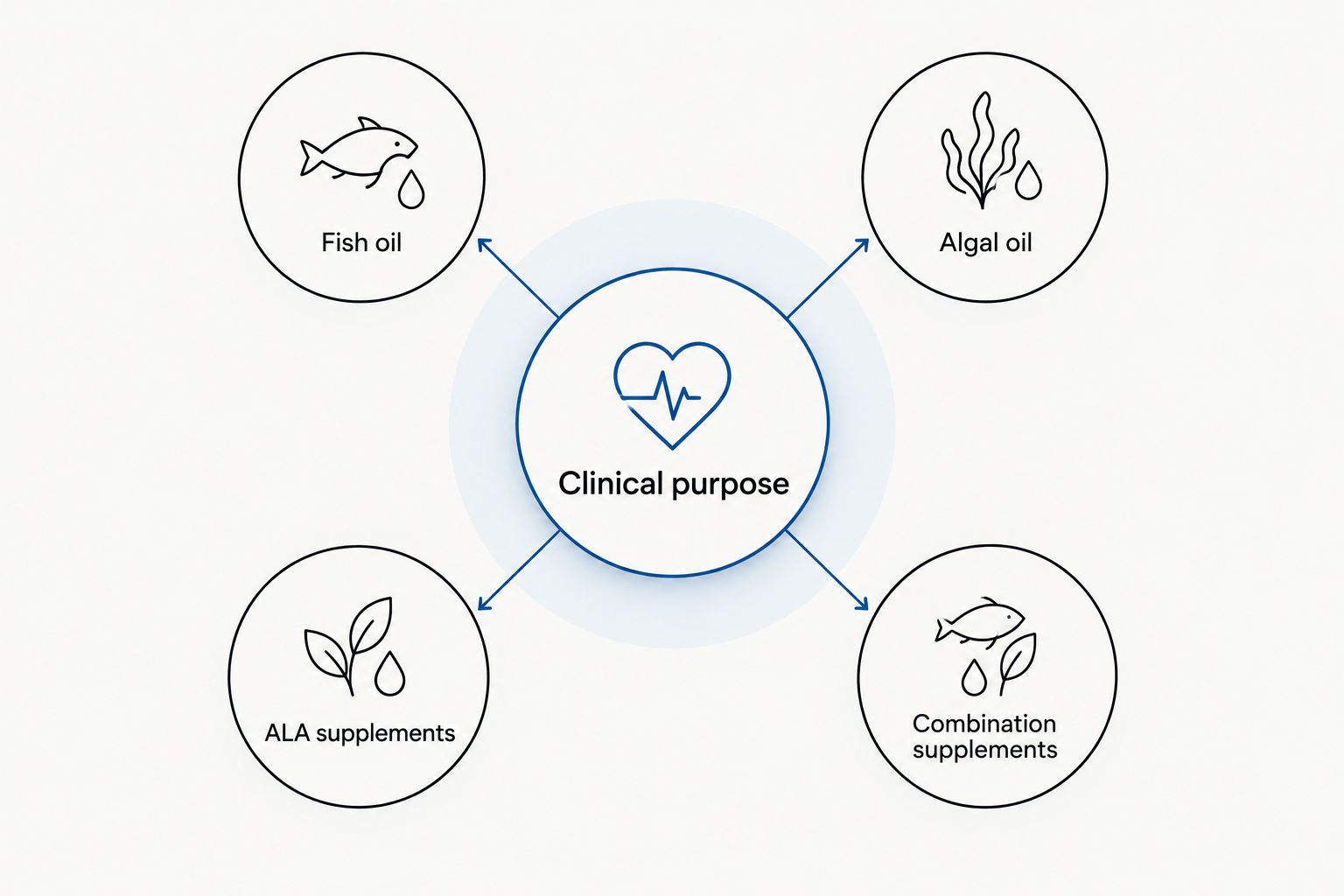
These categories answer different selection questions. Start with the clinical purpose, then check the actual formulation; do not start with the number of ingredients on the label.
1. Fish-oil EPA/DHA: best for discussing direct trial evidence
Fish-oil supplements provide preformed EPA and DHA. They are the most relevant starting point when you explain the difference between a plausible biological mechanism and demonstrated clinical benefit in dry eye disease.
The DREAM trial, published in the New England Journal of Medicine in 2018, randomised 535 adults with moderate-to-severe dry eye disease. The active intervention supplied 3,000 mg of EPA/DHA daily: 2,000 mg EPA plus 1,000 mg DHA. Over 12 months, the omega-3 group did not achieve significantly better outcomes than the olive-oil placebo group.
That trial dose is evidence context, not a prescribing recommendation. The result argues against presenting fish oil as an established treatment for every patient with dry eye; it does not prove that every formulation or patient subgroup has been fully assessed.
Fish-oil EPA/DHA pros:
- Supplies EPA and DHA without relying on conversion from ALA.
- Has directly relevant randomised dry eye trial evidence.
- Allows comparison with studied formulations when both fatty acids are declared.
Fish-oil EPA/DHA cons:
- The DREAM trial did not demonstrate superiority over placebo.
- Fish-derived ingredients conflict with some dietary preferences.
- Gastrointestinal effects or an unpleasant aftertaste can affect acceptability.
Best for: A patient who wants an informed discussion about marine omega-3, understands the uncertainty and has no identified suitability concern.
Verdict: Hold as a routine dry eye recommendation; consider only as an informed adjunct.
2. Algal EPA/DHA: best for avoiding fish-derived ingredients
Algal supplements provide preformed long-chain omega-3 fatty acids without using fish oil. They offer a formulation route for patients who avoid fish-derived ingredients, but you still need to inspect the complete ingredient list.
Some algal formulations provide DHA without EPA; others provide both. Do not assume that an algal product reproduces the fatty-acid profile of a fish-oil preparation or a published trial intervention. The source of the oil answers a dietary question, not the clinical efficacy question.
For 2026 consultations, describe algal omega-3 as a dietary alternative rather than a better dry eye treatment. Check capsule materials and other ingredients before describing a particular product as suitable for a vegan patient. An algal source alone does not establish that the finished supplement meets that preference.
Algal EPA/DHA pros:
- Offers a route to preformed omega-3 without fish oil.
- Avoids relying solely on ALA conversion.
- Allows formulation-based discussion when EPA and DHA amounts are stated.
Algal EPA/DHA cons:
- EPA and DHA content differs between formulations.
- Evidence from a marine formulation cannot automatically validate an algal product.
- Other ingredients still require dietary and safety checks.
Best for: Patients avoiding fish-derived ingredients who have chosen to consider an omega-3 adjunct after discussing uncertain dry eye benefit.
Verdict: Consider for dietary suitability, not as a proven upgrade in dry eye efficacy.
3. ALA supplements: best for a specific plant-derived ALA preference
Alpha-linolenic acid, or ALA, is a plant-derived omega-3 fatty acid found in sources such as flaxseed. Your body can convert ALA to longer-chain omega-3 fatty acids, but conversion is limited. ALA intake therefore does not reproduce the EPA/DHA dose of a clinical trial.
Eye care practices that sell these supplements online often lean on AI ads for small business tools to manage bids, but the claim language in each ad still has to match the evidence above.
This distinction matters when patients use omega-3 as a single category. A flaxseed-oil supplement and an EPA/DHA supplement are not interchangeable simply because both labels mention omega-3. Explain what each supplies before discussing any proposed ocular benefit.
Keep general nutritional advice separate from disease treatment. A patient can prefer plant-derived nutrition without that preference establishing ALA as an effective dry eye intervention. Where the goal is overall dietary adequacy, consider whether a supplement is needed at all.
ALA supplement pros:
- Provides a plant-derived essential fatty acid.
- Fits a clearly identified preference for ALA rather than marine oils.
- Makes the distinction between dietary nutrition and clinical treatment explicit.
ALA supplement cons:
- Does not directly supply the EPA/DHA used in the DREAM intervention.
- Limited conversion prevents simple dose equivalence.
- Evidence about EPA/DHA cannot be transferred to ALA supplementation.
Best for: A patient specifically seeking plant-derived ALA for a nutritional purpose, rather than an equivalent substitute for a studied dry eye formulation.
Verdict: Skip as an interchangeable replacement for EPA/DHA in dry eye treatment.
4. Combination supplements: best for a separate nutritional indication
Combination ocular nutrition supplements can include fatty acids alongside vitamins, minerals or other ingredients. Assess the complete formulation and its intended indication. A longer ingredient list does not establish a stronger effect on the ocular surface.
An eye-health supplement developed for another condition is not automatically a dry eye treatment. In particular, evidence for AREDS2-type supplementation in selected patients with age-related macular degeneration does not establish benefit for dry eye disease. Keep these indications distinct when patients bring an existing supplement to their appointment.
For your 2026 review, reconcile the blend with other supplements and medicines. Identify overlapping ingredients before adding another preparation. Where a separate nutritional or retinal indication exists, explain that rationale independently of the dry eye management plan.
Combination supplement pros:
- Can bring several relevant ingredients into one preparation when a separate indication exists.
- Provides an opportunity to review the patient's complete supplement intake.
- Supports an indication-specific discussion rather than a generic eye-health claim.
Combination supplement cons:
- Evidence for individual ingredients does not validate the finished blend.
- Overlapping preparations can duplicate ingredients.
- Benefits established for another eye condition do not establish dry eye efficacy.
Best for: Patients with a separately identified indication for the actual formulation—not patients seeking a stronger dry eye supplement through additional ingredients.
Verdict: Skip for dry eye alone unless the complete formulation has relevant supporting evidence.
How these options were ranked
This 2026 ordering follows the criteria above: direct relevance to dry eye evidence, identifiable fatty-acid content, dietary suitability and a clear reason for selection. Fish-oil EPA/DHA comes first because it permits discussion of a major directly relevant trial, not because it demonstrated superior efficacy.
Algal EPA/DHA answers a dietary-source question. ALA answers a different nutritional question. Combination supplements require an indication-specific assessment. Scope Connect's ocular nutrition guidance separates formulation choice from evidence of dry eye benefit.
Which ocular nutrition supplement should you choose?
For an undecided patient, the default is not to add a supplement solely because they have dry eye disease. First address the identified ocular surface findings and explain the uncertainty around oral omega-3.
If the patient still wants an adjunct, choose by declared ingredients, dietary suitability and safety—not by a claim that one source is best for every dry eye presentation. Maintain prescribed treatment unless you have a clinical reason to change it. Record the supplement's full name and composition so a later review concerns the actual preparation.
Agree a patient-relevant outcome, such as discomfort during reading, and assess it alongside clinical findings. Improvement after starting a supplement does not establish causation, particularly when other treatments change at the same time.
For professional learning, Scope Connect provides clinical resources and CPD-accredited courses. Keep that learning connected to the decisions you make in practice.
Review dry eye CPD options
Explore courses relevant to dry eye disease and your clinical learning needs.
FAQ
What’s the best omega 3 supplement for dry eye in 2026?
No omega-3 supplement has established universal superiority for dry eye treatment. If you are considering an adjunct, compare the declared EPA/DHA, dietary suitability and safety, and explain that clinical benefit remains uncertain.
Do omega 3 supplements actually help dry eye?
Clinical evidence does not support a consistent benefit for every patient with dry eye. The DREAM trial found that its EPA/DHA intervention was not significantly better than olive-oil placebo over 12 months.
Is algal omega 3 better than fish oil for dry eye?
An algal source does not establish better dry eye efficacy than fish oil. It answers a dietary preference; check whether the actual formulation provides EPA, DHA or both.
How much omega 3 should a patient take for dry eye?
There is no universally established omega-3 dose for treating dry eye disease. The DREAM trial’s 3,000 mg daily EPA/DHA intervention is a research dose, not a routine recommendation; assess any proposed preparation individually.
Can flaxseed oil replace an EPA and DHA supplement?
Flaxseed oil is not an equivalent replacement for a specified EPA/DHA formulation. It supplies ALA, and limited conversion means its intake cannot be treated as the same dose of preformed EPA and DHA.
Can omega 3 replace eye drops or lid treatment?
Omega-3 supplements should not replace treatment directed at the patient’s ocular surface findings. Manage tear-film instability, lid disease and other identified contributors through an appropriate clinical plan.
What should clinicians check before recommending ocular supplements?
Check the indication, complete ingredients, declared fatty-acid content, medicines, allergy history and dietary preferences. Agree how you will review symptoms and clinical findings rather than promising a treatment response.
One last thing
The total fish-oil amount on the label is not the EPA/DHA amount. Before discussing any omega 3 supplements for dry eye, read the individual fatty-acid declarations and the serving instructions. That small check prevents a nutritional label from becoming an unsupported clinical comparison.
Related guides
- Preservative-free eye drops for dry eye disease
- Heated eye masks for meibomian gland dysfunction
- Night-time eye ointments for nocturnal dry eye relief
- CPD courses on dry eye disease for optometrists