

Best overall for uncomplicated allergic conjunctivitis: dual-action antihistamine/mast-cell stabilising drops. Best for planned prevention: sodium cromoglicate. Best supportive option when dryness coexists: preservative-free lubricants. This 2026 guide compares allergy eye drops by clinical role, with topical corticosteroids reserved for specialist-directed treatment.
- Dual-action allergy eye drops suit uncomplicated allergic conjunctivitis needing symptom relief and continued allergen exposure management.
- Sodium cromoglicate suits planned prevention; preservative-free lubricants support comfort but do not replace anti-allergic treatment.
- Pain, photophobia or reduced vision requires assessment rather than another allergy drop recommendation.
- Scope Connect supports clinician education; medicine selection still requires current prescribing information and individual assessment.
Why this matters
Itching supports an allergic diagnosis, but a red, watering eye is not automatically allergic conjunctivitis. Dry eye, blepharitis, infection and contact lens complications require different management; treating redness without examining the cause risks delaying appropriate care.
Scope Connect is best used by eye care professionals seeking clinical education alongside their prescribing references. For your 2026 recommendations, distinguish symptom control, prevention and ocular surface support before choosing a formulation.
Contact lens wear adds another decision: whether the patient should wear lenses at all during the episode. The guide to preservative-free eye drops for contact lens wearers addresses a related formulation question, but preservative-free does not automatically mean suitable for instillation over lenses.
What makes the best allergy eye drops?
Use these criteria to assess the treatment, not just the active ingredient:
- Diagnostic fit: itching, exposure history and examination findings should support allergy rather than another cause of red eye.
- Treatment role: distinguish rapid symptom relief, preventive treatment, supportive lubrication and specialist suppression of inflammation.
- Ocular surface tolerance: consider preservatives, existing dry eye and the total burden of topical treatment.
- Patient suitability: check the exact product’s age restrictions, contraindications, pregnancy information and contact lens instructions.
- Practical adherence: match the authorised regimen and container to what the patient can use correctly.
- Escalation threshold: identify when corneal involvement, severe disease or diagnostic uncertainty makes another routine recommendation inappropriate.
The best allergy eye drops match the diagnosis and treatment goal, not redness alone. A product that suits predictable seasonal symptoms is not necessarily the right choice for a painful eye or persistent ocular surface disease.
Allergy eye drops at a glance
The order below reflects clinical use, not a claim that every patient should progress through every option. In 2026, check the current UK Summary of Product Characteristics for the exact formulation before recommending or prescribing.
| Option | Best for | Standout feature | Key limitation |
|---|---|---|---|
| Dual-action antihistamine/mast-cell stabilisers, including olopatadine and ketotifen | Uncomplicated allergy needing symptom relief during continued exposure | Combine antihistamine activity with mast-cell stabilisation | Product-specific restrictions and tolerability still determine suitability |
| Sodium cromoglicate | Planned prevention during predictable allergen exposure | Preventive mast-cell stabilising action | Not the strongest choice when immediate relief is the main priority |
| Preservative-free lubricants | Allergy accompanied by dryness or irritation | Support lubrication without adding a preservative | Do not replace anti-allergic treatment |
| Specialist-directed topical corticosteroids | Severe allergic inflammation requiring escalation | Suppress ocular inflammation | Require appropriate assessment, prescribing oversight and monitoring |
1. Dual-action drops: best for uncomplicated active allergy
Dual-action antihistamine/mast-cell stabilising drops combine histamine-receptor blockade with mast-cell stabilising activity. Olopatadine and ketotifen are examples; the exact preparation determines the authorised indication, age range and instructions.
Best for: patients with confirmed uncomplicated allergic conjunctivitis who need relief from itching while allergen exposure continues. This is a practical default category, not a reason to overlook examination findings or individual contraindications.
Dual-action drops: advantages
- Address histamine-mediated symptoms and mast-cell activity within the same treatment category.
- Offer a clinically relevant option when symptoms are already present.
- Allow selection by the exact formulation’s suitability rather than by redness-reduction claims.
Dual-action drops: limitations
- They do not treat every cause of itching, redness or watering.
- Preservatives, transient irritation and product-specific restrictions can affect suitability.
- Persistent symptoms still require reassessment rather than indefinite repeat recommendations.
Do not assume olopatadine and ketotifen formulations are interchangeable. Check concentration, administration instructions and patient factors separately, including concurrent ocular medicines.
Verdict: Buy only after confirming uncomplicated allergy and checking the exact formulation’s suitability. Do not use a favourable response as proof that the original diagnosis was correct.
2. Sodium cromoglicate: best for planned allergy prevention
Sodium cromoglicate is a mast-cell stabiliser used in allergic eye disease. Its preventive role makes it relevant when patients can identify a recurring pattern of allergen exposure and follow a regular treatment regimen.
Best for: patients preparing for predictable exposure rather than seeking the fastest possible relief from an established flare. Discuss expectations clearly so the patient does not mistake preventive treatment for an immediate rescue drop.
Sodium cromoglicate: advantages
- Provides an established preventive approach to allergic conjunctivitis.
- Fits discussions about regular use during an anticipated exposure period.
- Offers a different treatment role from supportive lubrication alone.
Sodium cromoglicate: limitations
- Preventive action does not make it the preferred option for immediate symptom relief.
- A regimen requiring repeated administration can challenge adherence.
- Formulation-specific preservatives or irritation can matter when the ocular surface is already compromised.
Ask when symptoms usually begin, what exposure triggers them and how reliably the patient can administer treatment. Follow the exact product instructions rather than transferring a regimen from another sodium cromoglicate preparation.
Verdict: Buy for a planned preventive regimen when the diagnosis, product instructions and adherence requirements align. Reconsider the choice if the patient expects an occasional drop to stop an active flare immediately.
3. Preservative-free lubricants: best for accompanying dryness
Preservative-free lubricants support ocular surface comfort when dryness or irritation accompanies allergy. They do not provide the same anti-allergic action as an antihistamine or mast-cell stabiliser.
Best for: patients whose assessment identifies an additional lubrication need. Position them as supportive treatment, not as a substitute for controlling allergic inflammation.
Preservative-free lubricants: advantages
- Provide lubrication without adding a preservative to the treatment burden.
- Address an accompanying ocular surface problem rather than assuming every symptom comes from allergy.
- Give you an opportunity to review comfort, drop technique and concurrent topical medicines.
Preservative-free lubricants: limitations
- They do not directly replace anti-allergic medicines.
- Viscosity, container handling and transient blur can affect acceptance.
- Preservative-free status alone does not establish contact lens compatibility.
Review symptoms separately: itch suggests a different treatment target from burning, grittiness or fluctuating vision. Overlap is possible, so the examination should determine whether the patient needs allergy treatment, lubrication or both.
Verdict: Buy as an adjunct when dryness is present; skip lubricant-only treatment for uncontrolled allergic inflammation. Keep the role of each bottle explicit in the patient’s instructions.
4. Topical corticosteroids: best reserved for specialist escalation
Topical corticosteroids suppress ocular inflammation and have a role in selected severe allergic eye disease. They are not a routine recommendation for an undifferentiated red eye or a straightforward substitute when another drop disappoints.
Best for: patients whose severity or examination findings justify specialist-directed anti-inflammatory treatment. Suspected vernal or atopic keratoconjunctivitis needs an appropriate assessment pathway, particularly where the cornea is involved.
Specialist-directed corticosteroids: advantages
- Provide an anti-inflammatory option for selected severe presentations.
- Allow treatment to be linked to examination findings and a defined review plan.
- Form part of specialist management when routine approaches are insufficient.
Specialist-directed corticosteroids: limitations
- Can increase intraocular pressure and contribute to cataract with prolonged exposure.
- Can worsen or mask infection when used inappropriately.
- Require prescribing oversight, duration instructions and suitable monitoring.
Do not advise patients to restart an old steroid bottle for a new episode. A previous prescription does not establish that the current presentation has the same cause or that the previous regimen remains appropriate.
Verdict: Hold for specialist-directed prescribing and monitoring. Escalation means reassessing the eye, not simply selecting a stronger bottle.
A practical assessment sequence for 2026
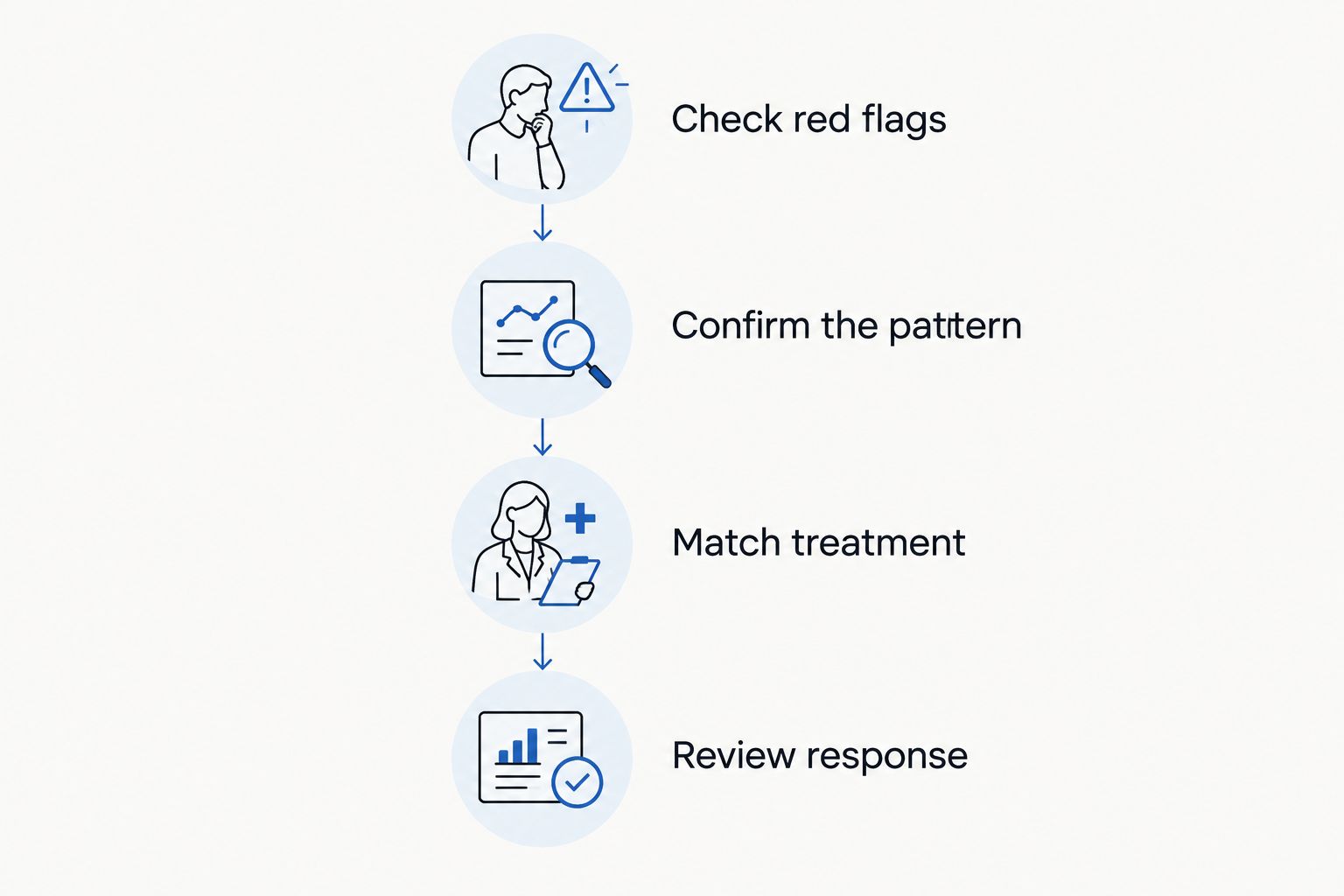
Use a consistent sequence before discussing individual preparations. The purpose is to separate routine allergic conjunctivitis from presentations that need examination or referral, then give the patient a treatment plan they can follow.
- Check red flags: establish whether pain, photophobia, reduced vision, corneal findings or a concerning contact lens history changes urgency.
- Confirm the pattern: ask about itching, laterality, recurrence, allergen exposure and associated nasal symptoms; interpret these alongside examination.
- Match treatment: decide whether the principal need is active allergy control, prevention, lubrication or specialist assessment.
- Review response: give clear return advice and reassess persistent or worsening symptoms rather than automatically repeating treatment.
A contact lens wearer with a red eye deserves particular care: do not assume allergy before excluding a corneal complication. Advise cessation of lens wear during an active red-eye episode and arrange assessment according to the clinical findings and local pathway.
For your 2026 patient instructions, record what improvement should look like and what should trigger earlier contact. Avoid a vague instruction to keep trying drops when the diagnosis remains uncertain.
Explain administration before the patient leaves
Good selection cannot compensate for incorrect administration. Ask the patient to describe or demonstrate their technique, especially when several ocular medicines are involved.
- Use the prescribed amount: where the instructions specify 1 drop, additional drops are unnecessary.
- Separate different drops: leave at least 5 minutes between different eye drops, unless product-specific instructions require a longer interval.
- Reduce drainage: gentle pressure at the inner corner of the closed eye for 1 minute helps reduce drainage into the nose; follow any longer product-specific instruction.
- Protect the container: keep the tip away from the eye, eyelids and fingers, and follow the stated disposal instructions.
Check the leaflet for contact lens removal and reinsertion instructions rather than supplying a universal waiting time. Also check whether the patient can open, position and squeeze the container without contaminating it.
How these options are ranked
This ranking prioritises diagnostic fit, treatment role, ocular surface tolerance, patient suitability and safe escalation. It compares clinical categories rather than claiming that one named formulation outperforms all others.
Scope Connect’s allergy eye drops guide supports clinical decision-making, not a prescribing protocol. Use current UK prescribing references, the exact product information and your professional scope when applying the comparison.
Which allergy eye drops should you choose?
For confirmed uncomplicated allergic conjunctivitis in 2026, start the selection discussion with a suitable dual-action preparation. Choose sodium cromoglicate when planned prevention is the priority, and add preservative-free lubrication when the examination identifies accompanying dryness.
Do not use this order as a mandatory treatment ladder. Severe disease, corneal involvement or diagnostic uncertainty changes the pathway; specialist assessment takes priority over another routine drop recommendation.
FAQ
What are the best allergy eye drops for itchy eyes?
Dual-action antihistamine/mast-cell stabilising drops are a practical default for confirmed uncomplicated allergic conjunctivitis. Examples include olopatadine and ketotifen, but the exact formulation must suit the patient and its authorised instructions.
Is sodium cromoglicate better than an antihistamine eye drop?
Sodium cromoglicate is better matched to planned prevention than to a need for immediate relief. Choose according to the treatment goal rather than treating the categories as interchangeable.
Can preservative-free lubricants treat eye allergy on their own?
Preservative-free lubricants do not replace anti-allergic treatment when allergic inflammation needs control. They support comfort when dryness or irritation accompanies the allergy.
Can patients use allergy eye drops with contact lenses?
Contact lens instructions depend on the exact preparation, and preservative-free status does not establish compatibility. Advise patients with an active red eye to stop lens wear and obtain appropriate assessment.
When should a patient with suspected eye allergy be assessed urgently?
Pain, photophobia, reduced vision or suspected corneal involvement requires prompt assessment. A red eye in a contact lens wearer also needs careful evaluation rather than an automatic allergy recommendation.
Are steroid eye drops suitable for severe hay fever eyes?
Topical corticosteroids require appropriate clinical assessment and prescribing oversight. Selected severe allergic eye disease warrants specialist-directed treatment, with a defined duration and monitoring plan.
How should patients use allergy drops alongside lubricating drops?
Patients should follow each preparation’s instructions and leave at least 5 minutes between different eye drops unless a longer interval is specified. Explain which bottle treats allergy and which provides lubrication.
One last thing
Ask patients to bring every eye drop they use, including bottles bought without a prescription. A bottle-by-bottle review can reveal duplicated treatment, unclear instructions or a product being used for the wrong symptom. Resolve that before adding another preparation.
Related guides
- Preservative-free eye drops for dry eye disease
- Cooling eye masks for allergic eye conditions
- CPD-accredited courses for optometrists