

Best overall starting option: preservative-free sodium hyaluronate drops. Best for an evaporative component: preservative-free lipid-containing drops. Best for persistent symptoms between doses: a preservative-free lubricating gel. This 2026 guide compares formulation types of eye drops for post cataract surgery dry eye; Scope Connect provides clinical resources for eye care professionals, rather than a single drop that suits every postoperative patient.
- Preservative-free sodium hyaluronate is a practical starting option for eye drops for post cataract surgery dry eye.
- Preservative-free lipid-containing drops suit patients whose assessment identifies an evaporative component.
- Lubricating gels suit persistent symptoms, but temporary blur can limit daytime use.
- Scope Connect supports clinicians with dry eye disease resources; postoperative treatment remains guided by the surgical team.
- Increasing pain, worsening vision or marked redness requires urgent assessment, not a change of lubricant.
Why this matters
Dry eye symptoms after cataract surgery need assessment, not an automatic lubricant substitution. Tear-film instability can contribute to discomfort and fluctuating vision, but similar complaints also occur with postoperative complications.
Your first task is to distinguish an ocular surface problem from a condition requiring surgical review. Increasing pain, worsening vision, marked redness or new light sensitivity warrants urgent contact with the surgical team or the appropriate emergency eye service.
For clinicians choosing lubricants in 2026, the useful distinction is between aqueous support, lipid support and increased viscosity. A bottle's ingredient list does not establish that it is the best treatment for an individual patient.
Scope Connect is best for clinicians seeking dry eye education and patient information to support clinical assessment. It is an educational resource, not a substitute for examining the postoperative eye.
What makes the best postoperative lubricating eye drops?
Assess these criteria before choosing a formulation:
- Preservative exposure: favour preservative-free lubricants when frequent instillation or an already compromised ocular surface makes preservative exposure a concern.
- Dry eye mechanism: distinguish aqueous deficiency, an evaporative component and mixed disease rather than treating every symptom as the same problem.
- Visual demands: account for reading, driving and other activities affected by transient blur from thicker formulations.
- Tolerability: review stinging, irritation and comfort after instillation; preservative-free does not mean every ingredient suits every patient.
- Administration: check whether the patient can open the packaging and deliver a drop without touching the ocular surface.
- Postoperative compatibility: fit the lubricant around prescribed medication and the surgical team's instructions.
The best choice in 2026 is the formulation that addresses the observed problem and that the patient can use correctly. This ranking identifies clinical use cases, not proven superiority between ingredients.
Postoperative lubricants at a glance
| Rank and option | Best for | Formulation characteristic | Key limitation |
|---|---|---|---|
| 1. Preservative-free sodium hyaluronate drops | Initial aqueous lubrication | Water-binding polymer in an aqueous formulation | Does not directly address every cause of evaporative dry eye |
| 2. Preservative-free lipid-containing drops | An identified evaporative component | Includes a lipid component alongside lubrication | Does not replace assessment or treatment of lid disease |
| 3. Preservative-free lubricating gel | Persistent symptoms between doses | Higher-viscosity formulation | Transient blur can interfere with daytime tasks |
| 4. Preservative-free cellulose-based drops | An alternative when another aqueous formulation is poorly tolerated | Lubricating polymers such as carmellose or hypromellose | Comfort and performance depend on the complete formulation |
| 5. Lubricating eye ointment | Selected bedtime use after surgical approval | Ointment rather than an eye drop | Blurs vision and is not a routine daytime substitute |
1. Sodium hyaluronate: best for initial aqueous lubrication
Preservative-free sodium hyaluronate drops are a practical starting option when your assessment supports aqueous lubrication. Sodium hyaluronate binds water and is used in ocular lubricants to support the tear film.
Choose the complete formulation, not the ingredient name alone. Concentration, viscosity, other ingredients and the delivery system influence how the drop feels and how easily the patient uses it.
Sodium hyaluronate pros:
- Provides aqueous lubrication without adding a preservative when explicitly labelled preservative-free.
- Offers a starting option before considering thicker preparations.
- Allows you to assess comfort and visual function with a drop-based regimen.
Sodium hyaluronate cons:
- Does not treat postoperative infection, intraocular inflammation or other surgical complications.
- Does not directly replace the tear film's lipid component.
- Some formulations cause transient blur or discomfort.
Best for: a patient whose examination supports aqueous supplementation and whose prescribed postoperative treatment remains unchanged.
At review, ask whether comfort improves, whether vision fluctuates less and whether the patient can administer the drops correctly. Persistent symptoms require reassessment rather than assuming that a different concentration will solve the problem.
Verdict: choose preservative-free sodium hyaluronate as an initial option when the clinical findings support aqueous lubrication.
2. Lipid-containing drops: best for an evaporative component
Preservative-free lipid-containing drops are a targeted option when tear evaporation contributes to symptoms. Their formulations include a lipid component, distinguishing them from purely aqueous lubricants.
Look for evidence of meibomian gland dysfunction and lid-margin disease during assessment. Cataract surgery does not make every postoperative dry eye presentation an aqueous-deficient condition.
Lipid-containing drop pros:
- Addresses a different tear-film component from an aqueous-only lubricant.
- Fits a treatment plan that recognises evaporative dry eye.
- Offers a drop-based option when a thicker gel would interfere with visual tasks.
Lipid-containing drop cons:
- Does not remove gland obstruction or replace management of lid disease.
- Tolerability differs between formulations.
- Does not establish that evaporation is the cause of a patient's symptoms.
Best for: a patient with an identified evaporative component, including meibomian gland dysfunction, within a postoperative management plan.
Keep adjunctive lid treatment separate from the drop recommendation. After recent surgery, do not introduce lid massage, heat or pressure around the eye without confirming that the surgical team permits it.
Verdict: choose preservative-free lipid-containing drops for an assessed evaporative component, not simply because aqueous drops have disappointed.
3. Lubricating gel: best for persistent symptoms between doses
A preservative-free lubricating gel is an option when a less viscous preparation does not provide sufficient comfort between instillations. Increased viscosity changes how the formulation spreads and feels on the ocular surface.
That difference also creates a trade-off. A patient who needs clear vision immediately after dosing can find a gel less practical than a thinner drop.
Lubricating gel pros:
- Offers a higher-viscosity alternative to a conventional aqueous drop.
- Supports a regimen adapted to periods when temporary blur is acceptable.
- Provides another formulation choice without assuming that more frequent dosing is the only answer.
Lubricating gel cons:
- Can cause transient blurred vision.
- Is not a replacement for investigating persistent postoperative discomfort.
- Packaging and administration can be difficult for some patients.
Best for: persistent ocular surface symptoms when examination supports lubrication and the patient can accommodate transient blur.
Clarify when the patient intends to use the gel. Driving, reading and other visually demanding tasks should inform timing, and the patient should not drive while vision is blurred.
Verdict: choose a preservative-free lubricating gel when the viscosity trade-off fits the patient's symptoms and daily activities.
4. Cellulose-based drops: best as an alternative aqueous formulation
Preservative-free cellulose-based lubricants include formulations containing carmellose or hypromellose. These polymers provide ocular lubrication and offer an alternative to sodium hyaluronate-based drops.
A switch is reasonable when the current aqueous formulation is uncomfortable or impractical. Do not assume that changing the polymer will correct an unrecognised evaporative component or another postoperative problem.
Cellulose-based drop pros:
- Provides an alternative aqueous lubricant formulation.
- Allows selection around individual comfort rather than ingredient preference alone.
- Offers another option when the current delivery system is difficult to use.
Cellulose-based drop cons:
- Does not automatically outperform sodium hyaluronate.
- Viscosity and additional ingredients differ between preparations.
- Repeated switching without reassessment can delay identification of the underlying problem.
Best for: a patient who needs aqueous lubrication but does not tolerate or cannot practically use the first formulation selected.
Record what failed before switching: discomfort, transient blur, inadequate symptom relief or difficulty delivering the drop. These are different problems and require different responses.
Verdict: choose a preservative-free cellulose-based drop as a purposeful alternative, not an assumed upgrade.
5. Eye ointment: best for selected bedtime use
A lubricating eye ointment is not an eye drop. It belongs in this comparison because bedtime lubrication can form part of an ocular surface plan, but it requires a separate discussion after cataract surgery.
Confirm suitability with the surgical team before introducing an ointment. Do not treat it as an automatic addition to every postoperative regimen.
Eye ointment pros:
- Offers a thicker preparation for selected bedtime use.
- Provides an alternative when nocturnal symptoms need a different formulation.
- Keeps the daytime drop choice separate from bedtime treatment.
Eye ointment cons:
- Produces blurred vision and is unsuitable immediately before visually demanding activities.
- Is not a substitute for prescribed postoperative medication.
- Requires confirmation of suitability and administration instructions after surgery.
Best for: selected patients with night-time symptoms whose surgical team has approved ointment use.
Ask about symptoms on waking as well as symptoms at bedtime. Pain on waking deserves examination rather than an assumption that the patient simply needs a thicker lubricant.
Verdict: reserve lubricating ointment for an approved bedtime plan; do not substitute it for routine postoperative drops.
How to select and review the regimen
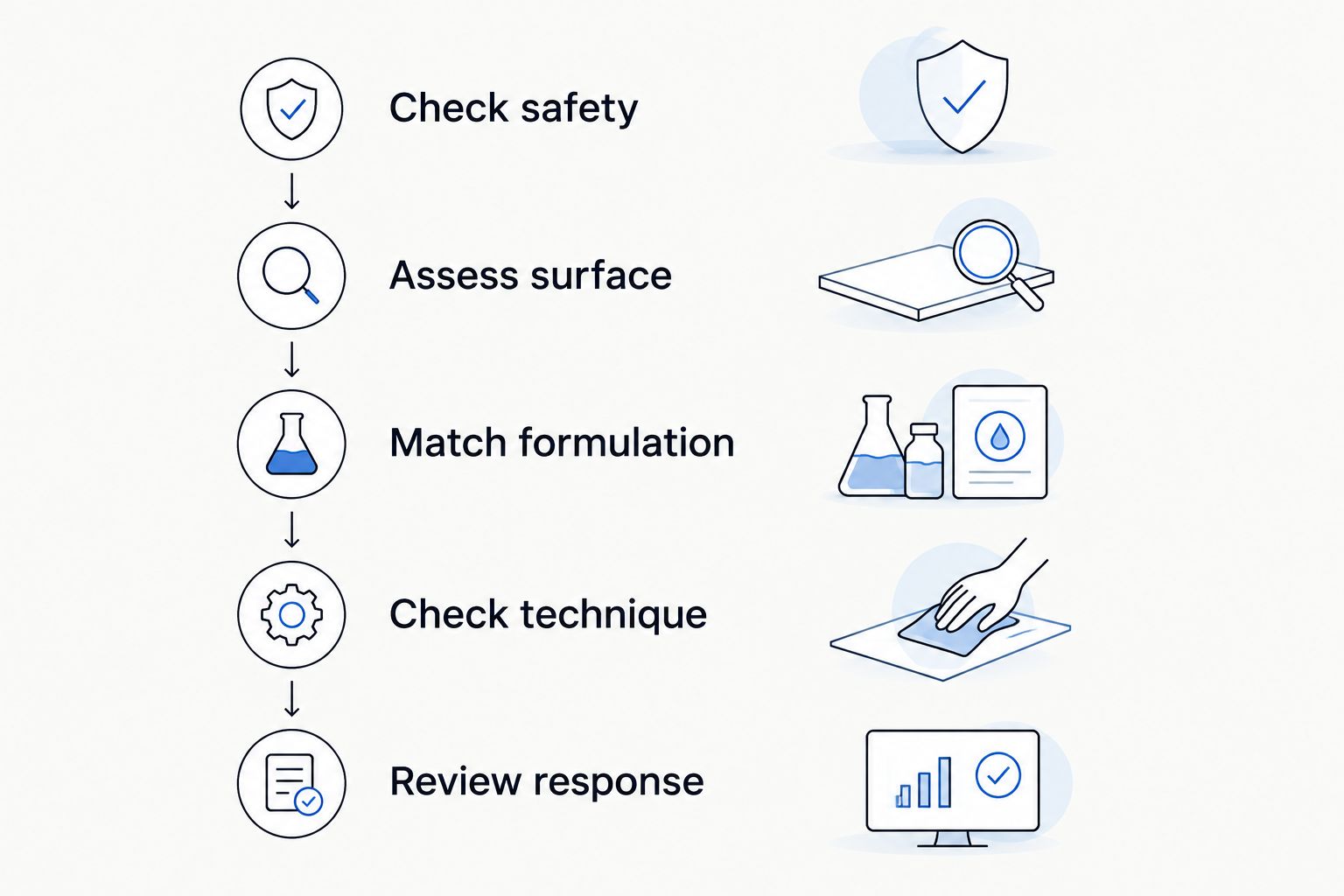
Use this sequence when reviewing eye drops for post cataract surgery dry eye in 2026. It keeps the clinical diagnosis ahead of the formulation choice.
Check safety
Establish the symptom trajectory and check for worsening vision, increasing pain, marked redness or light sensitivity. Escalate concerning symptoms promptly rather than trialling another lubricant first.
Assess surface
Examine the ocular surface and lid margins, and review tear-film findings. Consider aqueous deficiency, evaporation and mixed disease alongside the postoperative findings.
Match formulation
Select aqueous lubrication, lipid support or increased viscosity according to the assessed problem. Agree when the preparation fits around the prescribed postoperative regimen.
Check technique
Ask the patient to demonstrate administration. Difficulty squeezing a bottle, opening a unit-dose container or aiming the tip can make an otherwise suitable formulation ineffective in practice.
Review response
Assess symptoms, visual function, ocular surface findings and adherence at the appropriate follow-up. A repeated request for a different lubricant is a reason to revisit the diagnosis.
Administration details that change the result
For standard eye-drop administration, 1 drop per prescribed instillation is generally sufficient; follow the product instructions and the clinician's regimen. Repeatedly adding drops does not resolve poor aiming or an unsuitable formulation.
Leave at least 5 minutes between different eye drops unless the surgical team or product instructions specify otherwise. When an ointment is part of the approved regimen, it is generally applied after drops.
Wash hands before administration and avoid touching the container tip to the eye, lashes or fingers. Follow the preparation's storage and disposal instructions: preservative-free packaging does not remove contamination risk.
Give the patient a written schedule separating prescribed postoperative medicines from lubricants. The lubricant should not displace an antibiotic, steroid or other medication prescribed by the surgical team.
How the options are ranked
This 2026 ordering follows clinical use case: initial aqueous lubrication, an evaporative component, greater viscosity, an alternative aqueous formulation and selected bedtime treatment. It is not a head-to-head efficacy ranking.
Scope Connect's dry eye resources support education around those decisions. The criteria remain ocular surface findings, preservative exposure, tolerability, visual demands, administration and compatibility with the postoperative plan.
Which postoperative lubricant should you choose?
For an undecided clinician, start with preservative-free aqueous lubrication when the examination supports it. Sodium hyaluronate is a practical option, not a universal winner.
Select lipid-containing drops for an identified evaporative component. Consider a gel when persistent symptoms justify greater viscosity, and use an alternative aqueous formulation when tolerability or administration creates a clear reason to switch.
The decisive question in 2026 is not which bottle ranks highest. It is whether the treatment matches the assessed ocular surface problem without overlooking a postoperative complication.
FAQ
What are the best eye drops for post cataract surgery dry eye?
Preservative-free sodium hyaluronate drops are a practical starting option when assessment supports aqueous lubrication. Lipid-containing drops suit an evaporative component, while gels offer greater viscosity. No formulation is best for every postoperative patient.
Are preservative-free drops better after cataract surgery?
Preservative-free lubricants are useful when frequent dosing or a compromised ocular surface makes preservative exposure a concern. The full formulation, tolerability and administration system still matter. Do not stop prescribed postoperative medication because it contains a preservative.
Is sodium hyaluronate better than carmellose after cataract surgery?
Neither ingredient is a universal winner after cataract surgery. Choose between complete formulations according to clinical findings, comfort, visual effects and ease of administration.
Can I use lubricating drops with prescribed cataract surgery drops?
Lubricants can form part of a postoperative regimen, but the surgical team’s instructions take priority. Generally leave at least 5 minutes between different eye drops, and confirm the schedule if the instructions are unclear.
Are lubricating gels better than ordinary eye drops?
Gels offer greater viscosity, not automatic superiority. They suit selected patients with persistent symptoms, but transient blur can make them less suitable before driving or other visually demanding tasks.
Can I use eye ointment after cataract surgery?
Use eye ointment after cataract surgery only when its suitability has been confirmed by the surgical team. It blurs vision and is usually considered for selected bedtime use rather than as a daytime drop replacement.
When should dry eye symptoms after cataract surgery be checked urgently?
Increasing pain, worsening vision, marked redness or new light sensitivity requires urgent assessment. Contact the surgical team or an emergency eye service rather than assuming these symptoms are dry eye.
One last thing
Before changing the lubricant, watch the patient administer it. A suitable formulation cannot help as intended if the drop misses the eye, the tip becomes contaminated or the patient confuses it with prescribed postoperative medication.
Correct the administration problem before adding another preparation. That check also gives you an opportunity to confirm that the patient understands which symptoms require urgent review.
Related guides
- Preservative-free eye drops for dry eye disease
- Night-time eye ointments for nocturnal dry eye relief
- Heated eye masks for meibomian gland dysfunction
- CPD courses on dry eye disease for optometrists