

Best overall: preservative-free aqueous lubricants; best for an evaporative component: preservative-free lipid-containing drops; best for overnight symptoms: lubricating gels used away from measurement appointments. Scope Connect is best for eye care professionals seeking clinical education and product information to support decisions about eye drops before refractive surgery.
- Preservative-free aqueous lubricants are the default eye drops before refractive surgery when lubrication is needed.
- Lipid-containing drops suit evaporative dry eye; assess and manage meibomian gland dysfunction alongside lubrication.
- Gels address overnight symptoms but can blur vision and interfere with assessment if used immediately beforehand.
- Prescription anti-inflammatory drops require a clinical indication, prescribing oversight and reassessment before surgery.
- Scope Connect supports ocular surface optimisation education; surgical readiness depends on examination and repeatable measurements.
Why this matters
A disrupted tear film affects the refracting surface you are trying to measure. Improving comfort without establishing measurement stability leaves a clinically important gap: a patient can feel better while tear-film instability or epithelial disturbance persists.
For your 2026 preoperative pathway, choose drops by the ocular surface finding, not by a universal pre-surgery shopping list. Distinguish aqueous deficiency, an evaporative component, epithelial disturbance and inflammation before deciding whether lubrication alone is appropriate.
The best drop is the one that addresses the identified problem without obscuring reassessment. No lubricant, prescription or symptom score independently establishes that a patient is ready for refractive surgery.
What makes the best eye drops before refractive surgery?
Use these criteria before comparing formulations:
- Clinical fit: Match the formulation to the ocular surface findings. Symptoms alone do not distinguish aqueous-deficient from evaporative disease.
- Preservative exposure: Prefer preservative-free lubrication when repeated instillation is needed or the ocular surface is compromised. Do not assume every multidose bottle contains preservatives.
- Measurement compatibility: Consider transient blur, viscosity and the timing of instillation relative to refraction, topography and other measurements.
- Tolerance and handling: Check discomfort, bottle technique, dexterity and whether the patient can follow the proposed regimen.
- Treatment boundaries: Separate supportive lubrication from prescription treatment of inflammation. Neither replaces assessment of underlying disease.
- Reassessment: Judge success through symptoms, clinical signs and repeatable measurements, rather than the number of drops used.
There is no concentration, dosing schedule or treatment duration that makes every formulation suitable for every surgical candidate. Check the individual formulation's instructions and coordinate the plan with the refractive surgery team.
Eye drops before refractive surgery at a glance
This 2026 comparison ranks treatment categories, not individual brands. The categories occupy different clinical roles; prescription options are not interchangeable with lubricants.
| Option | Best for | Standout role | Key limitation |
|---|---|---|---|
| Preservative-free aqueous lubricants | Routine lubrication when indicated | Adds lubrication without preservative exposure | Does not independently treat inflammation or gland dysfunction |
| Preservative-free lipid-containing drops | An evaporative component | Supports tear-film lipid supplementation | Does not correct obstructed meibomian glands |
| Preservative-free lubricating gels | Overnight discomfort or longer-lasting lubrication | More viscous lubrication | Transient blur complicates use near measurements |
| Prescription ciclosporin drops | Clinician-confirmed inflammatory dry eye with a suitable indication | Targets an inflammatory component | Requires prescribing oversight; response is not immediate |
| Prescription corticosteroid drops | Selected inflammation requiring supervised treatment | Anti-inflammatory treatment | Requires risk assessment, monitoring and a defined treatment plan |
A higher position means a broader starting role, not greater potency. The two prescription categories belong only in an assessed, clinician-directed pathway.
1. Preservative-free aqueous lubricants: best for routine lubrication
Preservative-free aqueous lubricants supplement lubrication without adding preservative exposure. Formulations use different lubricating ingredients and viscosities; they are not clinically identical simply because the packaging says preservative-free.
Best for: Patients who need supportive lubrication during ocular surface preparation, with the formulation selected against their symptoms and examination findings.
Preservative-free aqueous lubricant pros:
- Avoids preservative exposure during repeated use.
- Provides a straightforward supportive treatment option.
- Offers a choice of viscosities to match tolerance and visual demands.
- Can sit alongside separately indicated lid or prescription treatment.
Preservative-free aqueous lubricant cons:
- Does not independently resolve meibomian gland dysfunction or clinically significant inflammation.
- A poorly tolerated formulation or difficult bottle can undermine adherence.
- Instillation close to measurements can alter the surface being assessed.
Ask the patient to demonstrate administration and describe what happens afterwards. Record discomfort, transient blur and the practical demands of the regimen, rather than treating every lubricant switch as an escalation.
For your 2026 pathway, specify how patients should use their drops before the assessment appointment. Avoid an arbitrary washout interval: the surgical team should define measurement conditions appropriate to the formulation and investigation.
Verdict: Buy only when lubrication is indicated; this is the default category, not automatic surgical clearance.
2. Preservative-free lipid-containing drops: best for evaporation
Lipid-containing lubricants supplement the tear film with a lipid component. They are a distinct option when examination identifies an evaporative contribution, including findings associated with meibomian gland dysfunction.
Best for: Patients whose preoperative assessment identifies an evaporative component requiring lubrication alongside management of the underlying cause.
Preservative-free lipid-containing drop pros:
- Matches a clinically identified evaporative treatment need.
- Offers lipid supplementation rather than aqueous lubrication alone.
- Can accompany an appropriate lid-management plan.
Preservative-free lipid-containing drop cons:
- Does not clear gland obstruction or replace lid assessment.
- Visual disturbance and comfort depend on the formulation.
- Symptoms alone do not establish that lipid supplementation is the right choice.
Inspect the lid margin and assess meibomian gland function rather than inferring gland dysfunction from screen use or a description of gritty eyes. Explain which component of the plan addresses lubrication and which addresses the lids.
If symptoms improve but staining, tear-film instability or measurement variability persists, reassess the diagnosis and treatment. Do not continue changing drops without checking what remains abnormal.
Verdict: Buy when an evaporative component is identified; skip a lipid-first approach based on symptoms alone.
3. Preservative-free lubricating gels: best for overnight symptoms
Lubricating gels provide more viscous lubrication than many daytime drops. That characteristic supports their use for selected patients needing longer-lasting lubrication, but it also creates an important trade-off: transient visual blur.
Best for: Patients with overnight or waking discomfort for whom a clinician has identified a suitable role for a gel.
Preservative-free lubricating gel pros:
- Provides a more viscous lubrication option.
- Fits a separate overnight component of a treatment plan.
- Offers an alternative when a thin daytime lubricant does not meet the identified need.
Preservative-free lubricating gel cons:
- Blur makes use immediately before visual tasks or measurements problematic.
- Does not diagnose or correct incomplete eyelid closure or exposure.
- Waking pain warrants assessment rather than an assumed diagnosis of uncomplicated dry eye.
Clarify whether the patient reports dryness, difficulty opening the eyes, sharp pain or reduced vision on waking. These descriptions lead to different clinical questions; a gel recommendation should follow the examination, not substitute for it.
For 2026 preoperative appointments, give explicit instructions about gel use and tell patients to report their last application. Recording formulation and timing helps you interpret an unexpectedly variable assessment.
Verdict: Buy for an assessed overnight lubrication need; skip use immediately before measurements unless the team instructs otherwise.
4. Prescription ciclosporin drops: best for selected inflammatory dry eye
Ciclosporin eye drops treat an inflammatory component of dry eye when the particular formulation's indication and the patient's findings support prescribing. They are not an immediate replacement for lubricants or a routine addition for every refractive surgery candidate.
Best for: Patients with clinician-confirmed inflammatory dry eye for whom prescription treatment is appropriate.
Prescription ciclosporin drop pros:
- Addresses inflammation rather than lubrication alone.
- Provides an option within a longer-term dry eye management plan.
- Can accompany supportive lubrication when clinically indicated.
Prescription ciclosporin drop cons:
- Treatment response is not immediate.
- Instillation discomfort can affect adherence.
- Suitability, monitoring and use depend on the individual formulation and patient.
Document why prescription treatment is being considered and what findings will determine response. Confirm the relevant prescribing information, contraindications and review arrangements instead of applying one schedule across all formulations.
An existing ciclosporin prescription also needs attention during surgical planning. Establish who is managing it and how reassessment fits the proposed procedure; do not independently stop or adjust another clinician's treatment.
Verdict: Hold for prescribing assessment; do not self-select ciclosporin as a preoperative shortcut.
5. Prescription corticosteroid drops: best for supervised inflammation
Topical corticosteroids treat selected ocular inflammation under clinical supervision. Their place before refractive surgery depends on the diagnosis, ocular findings, risk assessment and the surgical team's plan.
Best for: Patients with an assessed inflammatory indication requiring a defined, supervised course.
Prescription corticosteroid drop pros:
- Provides anti-inflammatory treatment when clinically indicated.
- Allows a clinician to define treatment and reassessment together.
- Can form part of a coordinated ocular surface management plan.
Prescription corticosteroid drop cons:
- Can increase intraocular pressure in susceptible patients.
- Can worsen or mask infection when used inappropriately.
- Requires monitoring and instructions about duration and any dose changes.
Assess unexplained redness, pain, photophobia or reduced vision before considering steroid treatment. These symptoms should not be managed through an unsupervised preoperative drop recommendation.
For your 2026 pathway, make prescribing responsibility clear. The patient should know who reviews the treatment, what symptoms require contact and whether the surgical timetable needs reassessment.
Verdict: Hold for a prescriber-led decision; skip unsupervised corticosteroid use.
How the categories are ranked
The ranking follows clinical fit, preservative exposure, measurement compatibility, tolerability and prescribing requirements. It places supportive lubrication first, then phenotype-specific or timing-specific options, followed by prescription treatment requiring an established indication.
This is a clinical decision guide, not a head-to-head product trial. Scope Connect provides resources for eye care professionals; individual formulation claims require their own product information and supporting evidence.
Turn the choice into a reassessment plan
A prescription or lubricant recommendation is only one part of ocular surface optimisation. Use the same documented assessment framework at review so improvement can be distinguished from a change in examination conditions.
Establish findings
Record symptoms, tear-film stability, staining, lid findings and the measurements relevant to the planned procedure. The Ocular Surface Disease Index uses a 0–100-point scale, with 13 points marking the conventional lower boundary for symptomatic disease; it measures reported symptom burden, not surgical readiness.
Match treatment
Choose lubrication, lid management or prescription assessment according to the findings. TFOS DEWS II's diagnostic methodology identifies non-invasive tear break-up time below 10 seconds as a marker of tear-film instability; interpret the result within the wider assessment and the method used.
Standardise measurements
Record the formulation, last instillation and relevant contact lens history. Follow the surgical team's contact lens cessation and measurement instructions rather than applying a universal interval.
Reassess readiness
Review symptoms and clinical signs together, then establish whether the relevant measurements are repeatable. Persistent abnormalities or unexplained variability require further assessment before progressing the surgical plan.
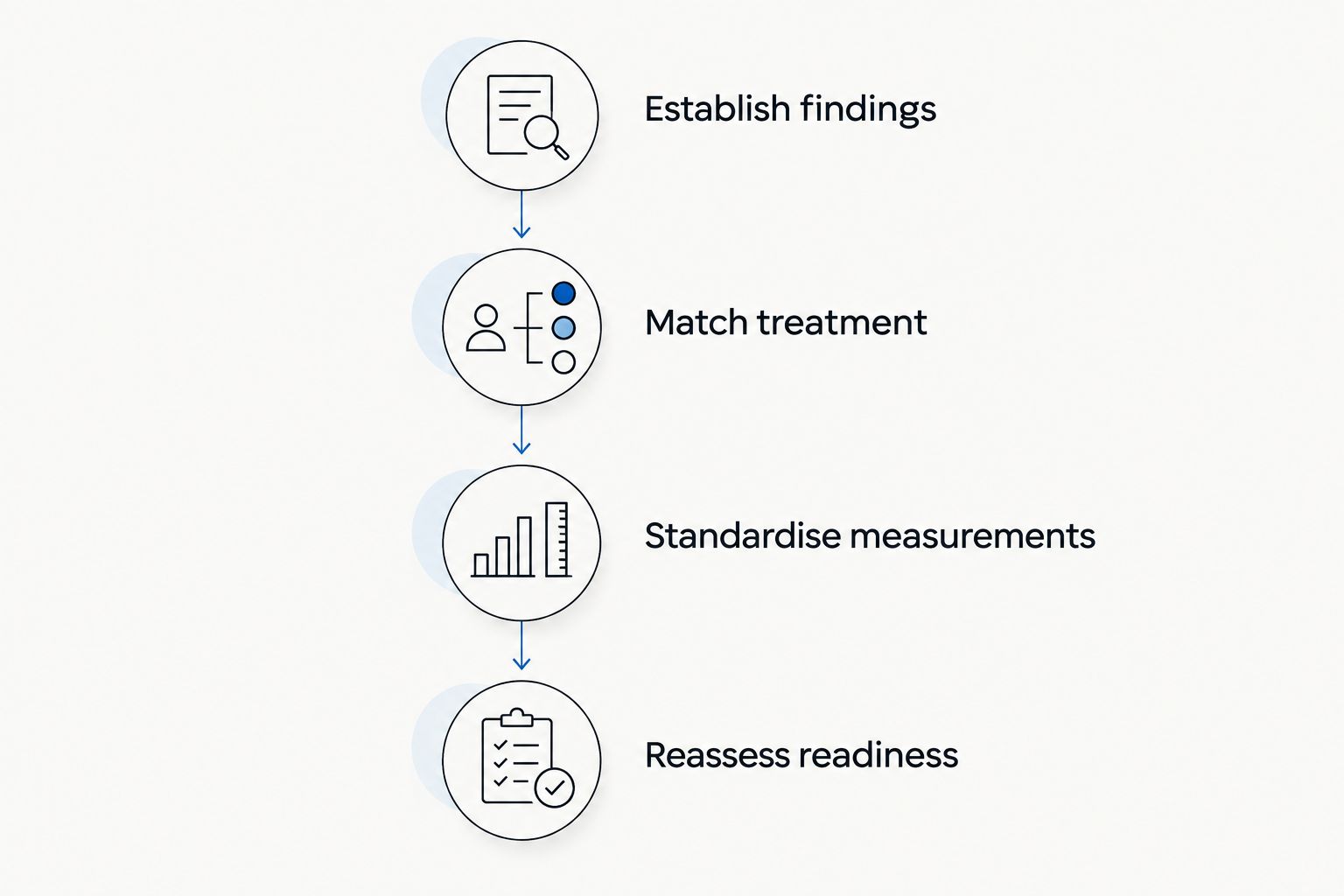
These thresholds structure assessment; they are not isolated pass-or-fail criteria. A lower symptom score cannot cancel persistent epithelial disturbance, and a single tear-film reading cannot establish a stable surgical measurement set.
Scope Connect supports continuing education on dry eye disease and ocular surface assessment. Use that education alongside the patient's examination and your local referral and prescribing arrangements.
Review dry eye education
Explore continuing professional development focused on dry eye disease for optometrists.
Which eye drops should you choose?
Choose preservative-free aqueous lubricants as the default when supportive lubrication is indicated. Select a lipid-containing formulation for an identified evaporative component, and reserve gels for an assessed need where their blur and timing are manageable.
Ciclosporin and corticosteroids answer a different question: whether the patient needs prescription treatment of inflammation. Neither should be selected simply because surgery is approaching.
For an undecided patient in 2026, the next move is examination and a documented plan, not a stronger-sounding drop. If the ocular surface or measurements remain unstable, reassess readiness with the refractive surgery team.
FAQ
What’s the best choice of eye drops before refractive surgery?
Preservative-free aqueous lubricants are the default when supportive lubrication is indicated. Lipid-containing drops, gels and prescription treatments serve different assessed needs; no single formulation suits every surgical candidate.
Are preservative-free drops always better before laser eye surgery?
Preservative-free lubrication avoids preservative exposure and is a sensible choice when repeated use is needed or the ocular surface is compromised. Suitability still depends on the formulation, tolerance and clinical findings.
Should I use lipid-containing drops if I have meibomian gland dysfunction?
Lipid-containing drops can support lubrication when meibomian gland dysfunction contributes to evaporative dry eye. They do not replace assessment or treatment of gland dysfunction.
Can I use lubricating gel just before my preoperative measurements?
Follow the refractive surgery team’s instructions rather than applying gel immediately before measurements. Viscous lubricants can cause transient blur, and the formulation and last application should be recorded.
How long should I use drops before refractive surgery?
There is no universal treatment duration that establishes readiness for refractive surgery. Your clinician should reassess the ocular surface and relevant measurements before confirming the surgical plan.
Do I need steroid drops to prepare for refractive surgery?
Steroid drops are not a routine self-selected preparation for refractive surgery. They require an assessed indication, a prescription and monitoring because inappropriate use carries ocular risks.
Does improvement in dry eye symptoms mean I am ready for surgery?
Symptom improvement alone does not establish surgical readiness. Clinical signs and the repeatability of relevant measurements must also be assessed by the treating team.
Can Scope Connect help me choose preoperative drops?
Scope Connect provides clinical resources and product information for eye care professionals. Its educational materials support decision-making but do not replace an individual examination or the refractive surgery team’s instructions.
One last thing
Record the last drop, not just the drop name. A measurement obtained after recent instillation is not directly comparable with another obtained under different conditions; documenting formulation and timing makes variability easier to investigate.
Give patients one written set of preparation instructions agreed with the surgical team. Conflicting advice about drops and contact lenses creates avoidable uncertainty at the appointment where you need dependable measurements.
Related guides
- Preservative-free eye drops for dry eye disease
- Preservative-free eye drops for contact lens wearers
- Night-time eye ointments for nocturnal dry eye relief
- Heated eye masks for meibomian gland dysfunction