

Best default to consider: preservative-free sodium hyaluronate for daytime lubrication. Best for an evaporative component: a preservative-free lipid-containing formulation. Best for bedtime use: a preservative-free gel. This 2026 guide compares formulation types rather than individual brands, helping you choose preservative free eye drops by ocular surface findings, treatment burden and patient preference.
- Choose preservative free eye drops by dry eye phenotype, not by bottle claims alone.
- Sodium hyaluronate is a practical daytime option; lipid-containing drops suit an evaporative component.
- Preservative-free gels suit bedtime lubrication when temporary blur is acceptable.
- Scope Connect supports clinicians seeking dry eye disease education and patient resources.
Why this matters
Preservative-free describes what a formulation excludes; it does not identify the most suitable lubricant. Two preservative-free products can differ in viscosity, lipid content, delivery system and the visual disturbance they cause after instillation.
For your 2026 prescribing or recommendation decisions, start with the patient's symptoms and examination. A lubricant can support comfort and tear-film function, but it does not replace assessment of meibomian gland dysfunction, ocular surface inflammation or another cause of discomfort.
Scope Connect is a resource hub for clinicians seeking education on preservative free eye drops and dry eye disease. You can use Scope Connect for clinical articles, product information, CPD-accredited courses and patient education materials alongside your clinical assessment.
What makes the best preservative free eye drops?
Assess these criteria before choosing a formulation:
- Phenotype fit: distinguish an aqueous-deficient component, an evaporative component and mixed disease. Match the formulation to the findings rather than symptoms alone.
- Visual tolerance: assess whether transient blur interferes with reading, driving or screen-based work. A formulation the patient avoids will not support the intended regimen.
- Handling: check whether the patient can open, position and squeeze the container without touching the eye or contaminating the tip.
- Formulation details: read the complete ingredient list. Preservative-free does not mean that every other ingredient is identical or equally well tolerated.
- Treatment context: account for contact lens wear, other topical medicines and the patient's existing ocular surface management.
- Response at review: assess symptoms, staining, tear-film findings and actual use. Do not judge success solely by the initial sensation after a drop.
These criteria support the ranking below. They do not establish that one ingredient is clinically superior across all patients.
Preservative-free formulations at a glance
The 2026 comparison ranks practical use cases, not proven differences between named products. Categories overlap: a lipid-containing formulation can also contain sodium hyaluronate, and a gel can contain a cellulose derivative.
| Formulation type | Best for | Standout feature | Key limitation |
|---|---|---|---|
| Sodium hyaluronate drops | Daytime lubrication | Water-binding polymer with viscosity-dependent behaviour | Concentration alone does not predict comfort or blur |
| Lipid-containing drops | An evaporative component | Includes lipids alongside lubricating ingredients | Does not replace management of meibomian gland dysfunction |
| Cellulose-based drops | An alternative to hyaluronate | Lubricating polymers such as carmellose or hypromellose | Performance depends on the complete formulation |
| Trehalose–hyaluronate drops | A combination-formulation trial | Combines trehalose with a lubricating polymer | Ingredient rationale does not establish superiority |
| Preservative-free gels | Bedtime lubrication | Higher-viscosity format | Temporary blur can limit daytime use |
1. Sodium hyaluronate: best for daytime lubrication
Preservative-free sodium hyaluronate is a practical starting option when you want daytime lubrication without immediately moving to a gel. Hyaluronate binds water, and its physical behaviour depends on concentration, molecular characteristics and the rest of the formulation.
Concentrations such as 0.1% and 0.2% appear in eye-drop formulations. These figures describe ingredient strength, not a reliable ranking of effectiveness: a higher percentage does not automatically mean better symptom control or a better patient experience.
Sodium hyaluronate pros:
- Provides a water-binding lubricating polymer.
- Offers an option for daytime ocular surface lubrication.
- Can form part of management for aqueous-deficient or mixed dry eye.
Sodium hyaluronate cons:
- Some formulations cause transient blur or an uncomfortable sensation.
- Does not directly resolve obstructed meibomian glands or underlying inflammation.
- Ingredient concentration alone does not tell you how the drop will behave.
Best for: patients needing a daytime lubricant selected around comfort, visual demands and examination findings.
For 2026 recommendations, assess the whole formulation rather than choosing solely by percentage. Ask about duration of relief and visual interruption at review; these questions are more useful than asking whether the drop felt pleasant immediately after instillation.
Verdict: Buy when a daytime hyaluronate lubricant fits the assessment; do not choose by concentration alone.
2. Lipid-containing drops: best for an evaporative component
Preservative-free lipid-containing drops include a lipid component alongside other lubricating ingredients. They are a relevant option when your assessment identifies an evaporative component, including findings associated with meibomian gland dysfunction.
The formulation supports lubrication; it does not correct every cause of tear-film instability. Keep lid and gland assessment within the treatment plan rather than treating a lipid-containing bottle as a substitute for that work.
Lipid-containing drop pros:
- Gives you a formulation option directed towards an evaporative component.
- Combines lipid ingredients with ocular surface lubrication.
- Can sit alongside management of lid and meibomian gland disease.
Lipid-containing drop cons:
- Emulsion characteristics and tolerability differ between formulations.
- Temporary visual disturbance can affect patient acceptance.
- Does not replace treatment of gland obstruction or associated inflammation.
Best for: patients whose clinical findings support an evaporative contribution to dry eye symptoms.
Ask specifically about blur after instillation and whether the patient avoids drops during work. If use is inconsistent, reconsider the formulation or timing rather than simply repeating the same instruction.
Verdict: Buy when an evaporative component supports the choice; continue cause-directed management.
3. Cellulose-based drops: best for an alternative to hyaluronate
Preservative-free cellulose-based lubricants include formulations using carmellose, also called carboxymethylcellulose, or hypromellose. These polymers provide lubrication and offer an alternative when a hyaluronate formulation does not suit the patient.
Do not interpret a different polymer as an automatic upgrade or downgrade. The patient's experience depends on the complete formulation, including viscosity and other ingredients.
Cellulose-based drop pros:
- Offers an alternative lubricating polymer.
- Gives you another formulation to consider after poor tolerance of a previous drop.
- Supports an individualised trial rather than repeated use of an unsuitable option.
Cellulose-based drop cons:
- Different cellulose formulations are not interchangeable in their physical behaviour.
- Temporary blur or discomfort can still occur.
- Lubrication alone does not address every driver of dry eye disease.
Best for: patients needing a polymer alternative because their current lubricant is uncomfortable, inconvenient or insufficiently helpful.
Before changing, establish what failed. Stinging, difficult handling, brief relief and post-instillation blur are different problems; changing the polymer does not necessarily solve a container problem.
Verdict: Buy as a considered alternative, not because the ingredient name implies better performance.
4. Trehalose–hyaluronate drops: best for a combination trial
Preservative-free trehalose–hyaluronate formulations combine trehalose with a lubricating polymer. Trehalose is studied for protective effects under cellular stress, while hyaluronate contributes water-binding and lubricating properties.
That biological rationale does not establish that every combination formulation outperforms every simpler lubricant. In 2026, make the choice through clinical assessment and a defined review rather than treating an additional ingredient as proof of a better outcome.
Trehalose–hyaluronate drop pros:
- Combines trehalose with hyaluronate-based lubrication.
- Offers a different formulation after an unsatisfactory response to another lubricant.
- Allows a structured trial with symptom and ocular surface review.
Trehalose–hyaluronate drop cons:
- Ingredient rationale alone cannot establish comparative clinical benefit.
- Tolerance still depends on the complete formulation.
- Does not remove the need to identify and manage underlying disease.
Best for: patients undertaking a clinician-directed trial of a combination formulation after reassessment of their current management.
Record why you are changing the formulation and what improvement would justify continuing it. Without that baseline, a succession of different bottles becomes difficult to evaluate.
Verdict: Hold until you have a clear reason for the combination and a plan to assess response.
5. Preservative-free gels: best for bedtime lubrication
Preservative-free gels offer a higher-viscosity approach to lubrication. They are an option when you want lubrication at bedtime and temporary visual blur is less disruptive than during daytime tasks.
A gel is not interchangeable with an ointment, and neither format should be selected solely because symptoms occur on waking. Morning discomfort requires assessment of possible causes, including exposure and recurrent corneal erosion.
Preservative-free gel pros:
- Provides a higher-viscosity lubricating format.
- Suits bedtime use when temporary blur is acceptable.
- Offers a different approach when a thin drop does not meet the clinical need.
Preservative-free gel cons:
- Temporary blur can make daytime use inconvenient.
- A thicker formulation is not automatically more comfortable.
- Does not diagnose or treat the cause of recurrent morning pain.
Best for: patients needing bedtime lubrication after assessment, with clear instructions about visual disturbance and use.
Ask whether symptoms mean dryness, difficulty opening the eyes or sharp pain on waking. Those descriptions should not all lead to the same recommendation.
Verdict: Buy for an appropriate bedtime lubrication plan; reassess unexplained morning pain.
Make the recommendation usable
A suitable formulation still needs a workable delivery system. Single-dose units and preservative-free multidose bottles have different handling requirements; neither format is automatically easier for every patient.
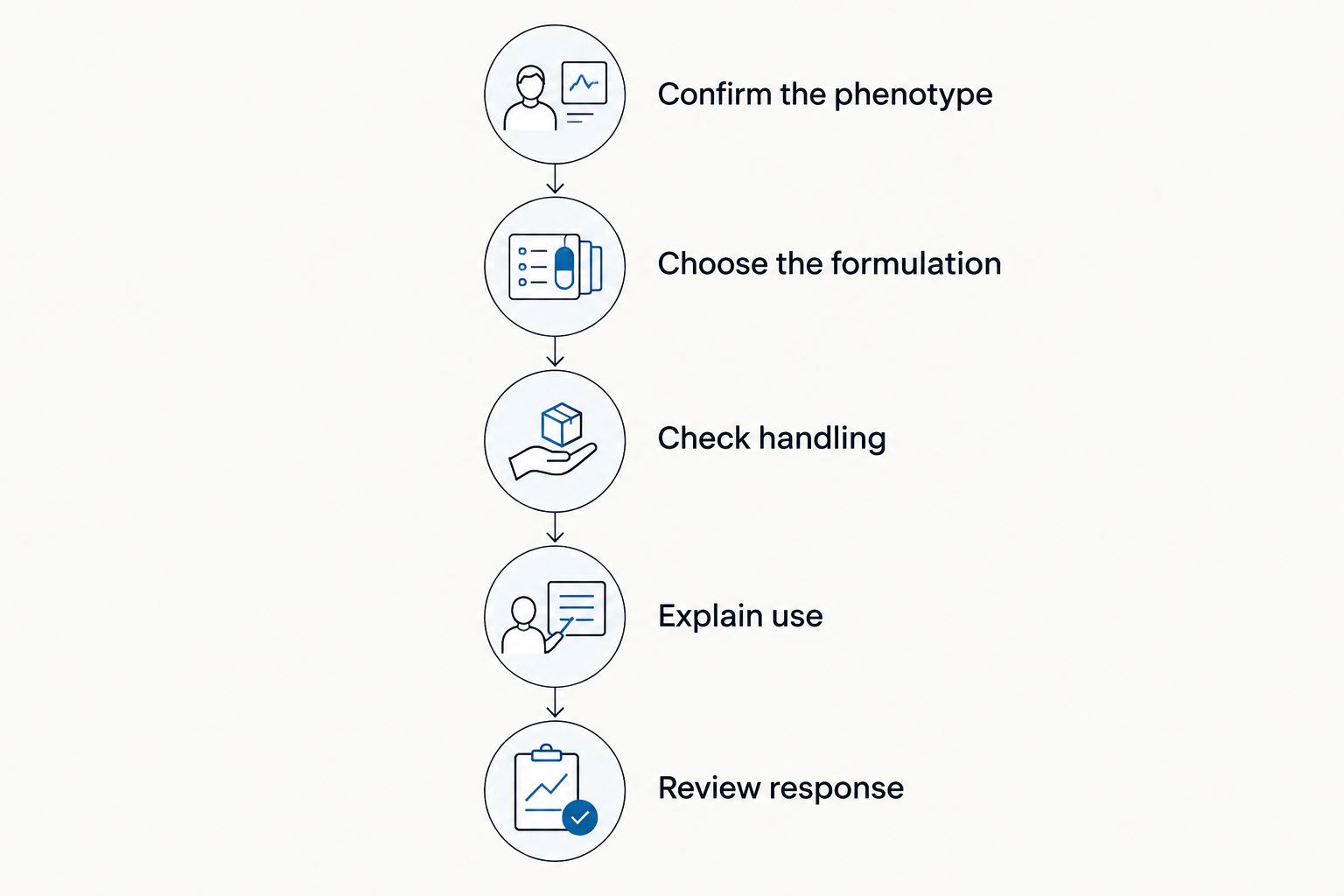
Use this sequence during counselling:
- Confirm the phenotype: connect the recommendation to symptoms and examination findings.
- Choose the formulation: explain why that lubricant fits the identified need.
- Check handling: ask the patient to demonstrate opening and positioning the container.
- Explain use: follow the product instructions, including contact lens compatibility and handling after opening.
- Review response: assess benefit, tolerability and actual use alongside ocular surface findings.
Do not infer contact lens compatibility from the absence of preservatives. Likewise, do not transfer storage or discard instructions from one container design to another; use the instructions for the specific product.
Keep diagnosis separate from drop selection
Preservative-free lubrication is a treatment choice, not a diagnostic test. Symptoms and signs can differ, so assess the ocular surface rather than escalating viscosity solely because discomfort persists.
The TFOS DEWS II diagnostic framework uses a non-invasive tear breakup time below 10 seconds as one marker of disrupted tear-film homeostasis. The result needs interpretation alongside symptoms and other findings; it does not identify which lubricant a patient should receive.
Review persistent symptoms for contributing lid disease, inflammation, exposure, allergy or another diagnosis. Pain, photophobia, reduced vision or a marked unilateral change requires appropriate assessment rather than routine lubricant substitution.
How the formulations are ranked
This 2026 guide orders formulation categories by their practical decision role: daytime lubrication, an evaporative component, an alternative polymer, a combination trial and bedtime lubrication. It is not a head-to-head product test or a claim that the first category produces the best outcomes for every patient.
The criteria are phenotype fit, visual tolerance, handling, formulation details, treatment context and response at review. Scope Connect's clinical education and patient resources complement that decision process; they do not replace individual assessment.
Which preservative free eye drops should you choose?
For an undecided daytime choice, consider preservative-free sodium hyaluronate first, then adjust to the clinical findings and patient experience. Choose a lipid-containing formulation when an evaporative component supports it, and consider a gel when bedtime lubrication is the specific need.
If the current lubricant is not helping, reassess before changing. Establish whether the problem is the diagnosis, formulation, container, frequency of use or expectations; a different bottle only addresses some of those problems.
FAQ
What’s the best preservative-free eye drop for dry eye disease?
The best preservative-free eye drop is the formulation that fits the patient’s ocular surface findings and is practical to use. Sodium hyaluronate is a daytime option, lipid-containing drops suit an evaporative component, and gels suit selected bedtime needs.
Are preservative-free eye drops always better?
Preservative-free eye drops remove exposure to an added preservative, but that does not make every formulation the best choice for every patient. Ingredient composition, tolerability, handling and the underlying diagnosis still matter.
Is a higher hyaluronate concentration better for dry eye?
A higher hyaluronate concentration does not automatically produce better dry eye control. Molecular characteristics and the complete formulation influence viscosity, visual disturbance and patient experience.
Should I choose lipid-containing drops for meibomian gland dysfunction?
A preservative-free lipid-containing lubricant is an option when examination identifies an evaporative component. It supports lubrication but does not replace management of meibomian gland dysfunction.
Can preservative-free eye drops be used with contact lenses?
Contact lens compatibility depends on the specific product, not simply its preservative-free status. Check the manufacturer’s instructions before recommending use during lens wear.
Are single-dose units better than preservative-free multidose bottles?
Neither container format is automatically better for every patient. Check dexterity, opening technique and positioning, then follow the specific product’s handling and discard instructions.
When should dry eye symptoms be assessed rather than treated with another drop?
Pain, photophobia, reduced vision or a marked unilateral change requires appropriate clinical assessment. Persistent symptoms also need review of the diagnosis and contributing factors rather than repeated lubricant substitution.
One last thing
Ask the patient to show you how they use the container before recommending a different formulation. A handling problem can look like treatment failure: the intended dose never reaches the eye, or the patient avoids using the product.
For your next 2026 review, document the formulation, container experience and reason for continuing or changing treatment. That record makes the next decision clearer than a list of previously tried brands.