Best overall: a General Optical Council-approved course with a workable clinical placement. Best for a Cardiff-based shortlist: Cardiff University; for Birmingham: Aston University; for Glasgow: Glasgow Caledonian University. This independent prescribing optometry guide compares those university routes for 2026 and explains the checks that should decide your choice.

TL;DR
  • Independent prescribing optometry course selection starts with GOC approval, clinical placement and the route to registration.
  • Compare Cardiff University, Aston University and Glasgow Caledonian University against your location and clinical training needs.
  • Choose a workable supervised placement before committing to a university timetable.
  • Scope Connect supports clinical learning alongside qualification-focused study; use university and regulator information for admission decisions.

Why this matters

Independent prescribing is a professional qualification, not simply another continuing professional development activity. Your course choice must connect academic learning, supervised clinical experience, assessment and registration.

The strongest course choice is the one you can complete with appropriate supervision and relevant patient exposure. A university name alone does not establish that fit. Neither does a convenient teaching timetable.

Scope Connect is best for clinicians seeking clinical articles and CPD alongside independent prescribing optometry training. Use those resources to support clinical understanding, while keeping qualification requirements and admission decisions anchored to the General Optical Council, the College of Optometrists and your chosen university.

For your 2026 application, distinguish three questions: can you enter the programme, can you complete the clinical training, and can you meet the requirements for specialist registration? Answer all three before accepting a place.

What makes the best independent prescribing optometry course?

Judge each course against these criteria before comparing institutions:

  • Regulatory approval: confirm the exact programme’s current status through the General Optical Council, rather than relying on a university’s reputation.
  • Clinical placement: establish who arranges supervision, where you will train and whether the setting meets the applicable requirements.
  • Academic fit: compare the teaching, assessment and expected independent study with your existing clinical knowledge.
  • Workplace feasibility: check attendance requirements, study leave and clinical training commitments against your actual rota.
  • Qualification pathway: understand what the university award covers and what further assessment or registration steps remain.
  • Clinical relevance: identify how supervised experience will develop prescribing decisions, monitoring, referral and recognition of your limits.

Treat approval and placement as decision gates, not optional advantages. A course that fits your diary but leaves clinical training unresolved is not yet a complete plan.

Use the same checklist for each university. Otherwise, an attractive module description can distract you from the practical requirement that determines whether you can finish.

Independent prescribing courses at a glance

These are three university routes to investigate, not a claim that one institution produces better prescribers. Their geographical labels help organise your shortlist; they do not imply that all teaching or placements take place on campus.

Course route Best for Standout reason to shortlist Key limitation to resolve
Cardiff University independent prescribing course Clinicians considering a Cardiff-based university route A university option to assess against Cardiff access and Welsh clinical training arrangements Confirm delivery requirements and responsibility for securing clinical training
Aston University independent prescribing course Clinicians considering a Birmingham-based university route A university option to assess against Birmingham access and your existing clinical network Confirm attendance, assessment and placement arrangements before committing
Glasgow Caledonian University independent prescribing course Clinicians considering a Glasgow-based university route A university option to assess against Glasgow access and Scottish clinical training arrangements Confirm how the programme and supervision fit your intended practice setting

For 2026, compare the current programme specification rather than an older prospectus or a colleague’s previous timetable. Course structure, entry requirements and clinical training arrangements require confirmation for your intake.

1. Cardiff University: best for a Cardiff-based shortlist

Cardiff University provides an independent prescribing study route for optometrists. Put Cardiff on your shortlist when access to Cardiff and relevant clinical training arrangements make it a practical option.

Your decision should turn on the programme requirements and the supervised experience you can arrange. A nearby university is useful only when its teaching commitments and your clinical training plan also fit.

Cardiff University pros:

  • Gives you a defined university route to investigate for prescribing qualification.
  • Provides a Cardiff-based option when comparing geographical access.
  • Lets you assess academic requirements alongside potential clinical training arrangements in Wales.

Cardiff University cons and checks:

  • The university location does not establish where your supervised training will happen.
  • Admission does not, by itself, settle every subsequent assessment and registration requirement.
  • A suitable placement must be assessed separately from the appeal of the academic programme.

Best for: optometrists whose practical shortlist centres on Cardiff and whose placement arrangements support the qualification pathway.

Ask Cardiff University to clarify what you must have arranged before admission, what support applies to clinical training, and how academic assessment relates to the wider prescribing qualification. Obtain the answers in writing so your employer and supervisor can plan around the same requirements.

Verdict: Hold until the current programme requirements and your clinical placement align; choose Cardiff University when both fit.

2. Aston University: best for a Birmingham-based shortlist

Aston University offers an independent prescribing route for optometrists. Shortlist Aston when Birmingham access and your available clinical training arrangements make it a sensible option.

Do not assume that a university’s location determines the delivery format. Check the actual attendance requirements, teaching schedule and assessment commitments before deciding whether Aston fits around practice.

Aston University pros:

  • Gives you a Birmingham-based university option for your comparison.
  • Offers a defined academic route to investigate alongside the professional qualification requirements.
  • Allows you to assess university study against an existing Midlands clinical network, where you have one.

Aston University cons and checks:

  • Geographical convenience does not establish placement suitability.
  • Teaching commitments need to fit your rota as well as your willingness to study.
  • You must distinguish the university award from the complete route to prescribing registration.

Best for: optometrists considering Birmingham access who can match Aston University’s current requirements with appropriate supervised training.

Ask Aston University for the programme specification and a clear account of clinical training responsibilities. Then compare its requirements with your employer’s study-leave arrangements and the supervisor’s capacity to support your learning.

Verdict: Hold until attendance and supervision are workable; choose Aston University when the full pathway fits your practice commitments.

3. Glasgow Caledonian University: best for a Glasgow-based shortlist

Glasgow Caledonian University provides an independent prescribing route for optometrists. It belongs on your shortlist when Glasgow access and Scottish clinical training arrangements are relevant to your plans.

Distinguish the prescribing qualification from the services in which you intend to use it. Professional registration and local service arrangements answer different questions; neither should be assumed from the university name.

Glasgow Caledonian University pros:

  • Gives you a Glasgow-based option for comparing university routes.
  • Provides a defined prescribing programme to assess against your professional development plans.
  • Lets you examine academic requirements alongside potential clinical training arrangements in Scotland.

Glasgow Caledonian University cons and checks:

  • A Glasgow study base does not establish access to an appropriate clinical placement.
  • Qualification does not automatically settle local service participation or employer requirements.
  • You need to confirm the programme’s current delivery and assessment arrangements.

Best for: optometrists whose shortlist centres on Glasgow and whose intended clinical training supports the required competencies.

Ask Glasgow Caledonian University how the academic programme connects to clinical training and the subsequent qualification steps. Discuss your intended practice setting with the university and your employer rather than assuming that all prescribing roles require identical preparation.

Verdict: Hold until programme, placement and practice plans agree; choose Glasgow Caledonian University when those requirements align.

How to check the complete qualification pathway

For 2026 planning, use two approval checks: verify the programme’s regulatory status, then verify that your proposed clinical training satisfies the applicable requirements. Keep university admissions advice separate from assumptions about specialist registration.

The General Optical Council’s published independent prescribing training requirements include 24 days of supervised clinical experience. Confirm the requirements that apply to your route with the university and regulator; do not translate that requirement into a completion date without an agreed training schedule.

Work through these stages in order:

  1. Approval: check the exact programme against the General Optical Council’s approved qualification information.
  2. Placement: confirm suitable supervision, clinical exposure and how your experience will be documented.
  3. Assessment: establish the university requirements and the applicable College of Optometrists Therapeutics Common Final Assessment pathway.
  4. Registration: confirm the steps required to enter the General Optical Council’s relevant specialist register.

Academic completion is not a substitute for checking the remaining professional requirements. Keep a written record of each stage and the organisation responsible for it.
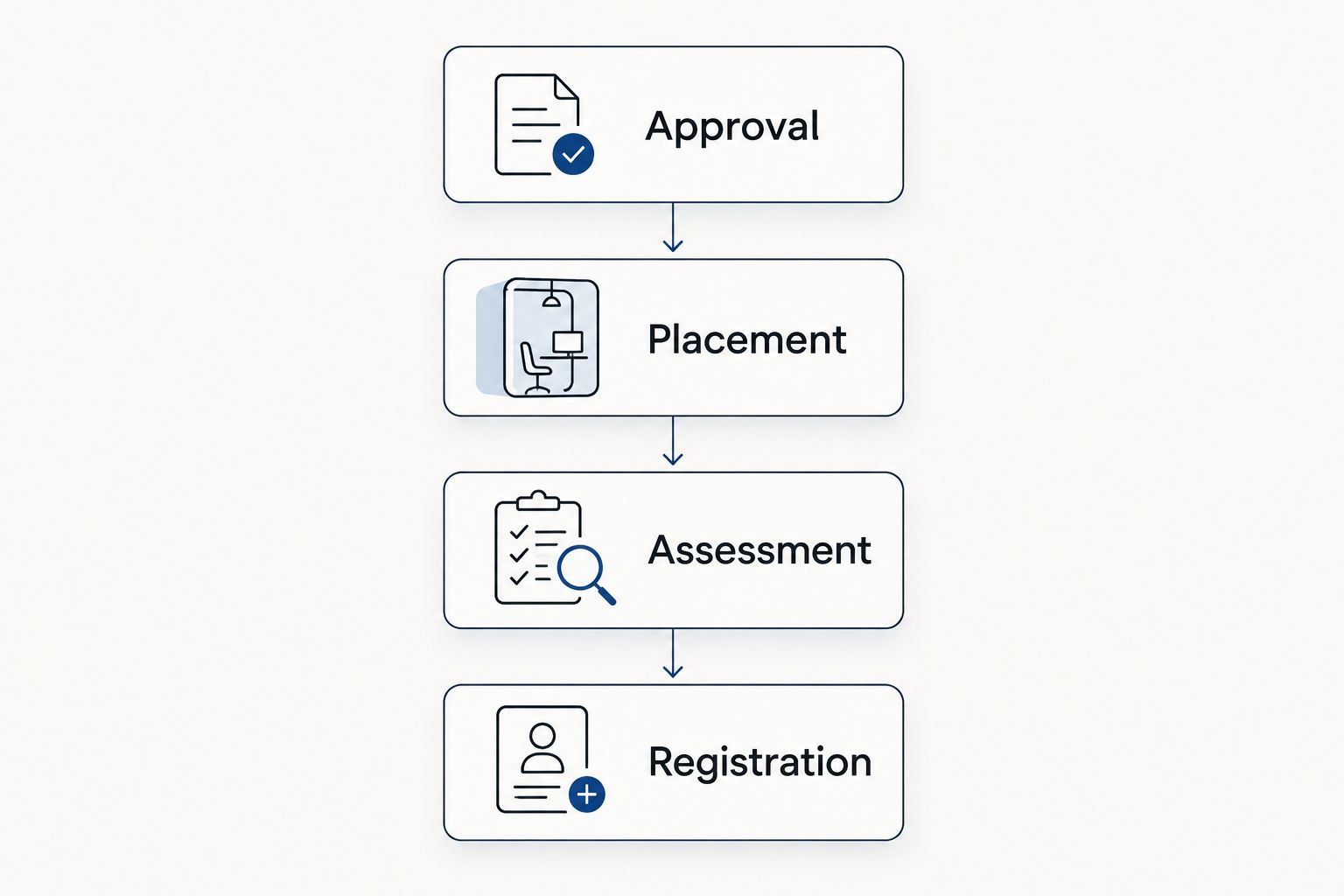
Four stages connecting programme approval, clinical placement, assessment and specialist registration
Check the whole qualification pathway before committing to the academic programme.

Make clinical placement the deciding factor

Prepare one written placement plan before choosing between otherwise suitable courses. It should identify the supervisor, clinical setting, learning opportunities, documentation requirements and time you can realistically attend.

A placement should develop clinical decision-making, not merely provide observation. Discuss opportunities to assess patients, consider treatment choices, review contraindications and interactions, monitor outcomes and recognise when referral is required.

Ask the following questions during your placement discussion:

  • Who will supervise you, and do they meet the applicable requirements?
  • Which patients and conditions will you encounter?
  • How will you receive feedback on assessment and prescribing decisions?
  • How will progress and clinical experience be recorded?
  • What happens if clinics, supervision or your attendance change?

Do not select a course on location alone when the placement is the unresolved part of your plan. A convenient campus cannot compensate for training that does not meet the required competencies.

For your 2026 shortlist, compare placement feasibility before smaller differences in course presentation. This keeps the decision focused on completing the qualification rather than simply starting it.

How these courses were ranked

This guide organises Cardiff University, Aston University and Glasgow Caledonian University by geographical planning needs. It does not rank teaching quality, examination outcomes or graduate performance.

The decision criteria are regulatory approval, clinical placement, academic fit, workplace feasibility, qualification pathway and clinical relevance. Apply those criteria to the current programme information and your own training circumstances.

Your best overall option is the approved course attached to a feasible, appropriate clinical training plan. If two programmes satisfy that test, compare their attendance and assessment requirements against your working week.

Which independent prescribing course should you choose?

Choose Cardiff University for a Cardiff-centred shortlist, Aston University for a Birmingham-centred shortlist, or Glasgow Caledonian University for a Glasgow-centred shortlist. Make the final choice only after confirming approval, supervision and the complete qualification pathway.

If you remain undecided, start with the placement discussion. It exposes practical constraints that a prospectus cannot resolve: who can supervise you, what experience you will gain and when you can attend.

Keep clinical learning active while arranging formal training. Scope Connect provides clinical articles, CPD-accredited courses and patient education materials that support professional development alongside university study.

FAQ

What is the best independent prescribing optometry course?

The best independent prescribing optometry course is a currently approved programme that fits your clinical placement and study commitments. Compare Cardiff University, Aston University and Glasgow Caledonian University using the same approval, supervision and assessment checks.

Is Cardiff University better than Aston University for independent prescribing?

Choose between Cardiff University and Aston University by programme requirements and placement feasibility, not by an unsupported quality ranking. Check attendance, assessment and clinical training arrangements for your intended intake.

How much clinical experience does independent prescribing training require?

The General Optical Council’s published independent prescribing training requirements include 24 days of supervised clinical experience. Confirm the requirements applicable to your route and how the university expects that experience to be completed and documented.

Can I qualify through CPD courses alone?

CPD alone is not a substitute for the approved prescribing qualification pathway. Scope Connect’s independent prescribing optometry learning support should sit alongside, rather than replace, the required academic training, clinical experience and assessments.

Does finishing the university course make me an independent prescriber?

Do not assume that university completion alone establishes independent prescribing registration. Confirm all applicable assessment requirements and the steps for entry to the General Optical Council’s relevant specialist register.

Should I arrange a clinical placement before applying?

Resolve clinical placement feasibility before committing to a programme. Ask your chosen university what must be arranged before application or admission and who is responsible for securing suitable supervision.

What should I check before applying for a 2026 intake?

Check current programme approval, entry requirements, teaching commitments, clinical training arrangements and the complete qualification pathway. Use the university’s current information alongside General Optical Council and College of Optometrists requirements.

One last thing

Ask your prospective supervisor to review your learning needs before you choose the university. That conversation turns a broad ambition to prescribe into a practical training plan, including the clinical decisions you need to practise and the evidence you must collect.

Your shortlist then becomes easier to judge. Select the programme that supports that plan, rather than building the plan around a course you have already accepted.

Related guides

Best overall for reusable home care: a gel cooling eye mask. Best for sensitive eyelid skin: a clean, cool flannel. Best for localised application: a small, wrapped cold pack. This 2026 guide compares a cooling eye mask for eye allergies with simpler cold-compress options, focusing on comfort, hygiene and safe use rather than treatment claims.

TL;DR
  • A reusable gel cooling eye mask for eye allergies suits home use when its instructions permit comfortable, pressure-free application.
  • A clean, cool flannel is the simplest cold compress for itchy eyes and sensitive eyelid skin.
  • A wrapped cold pack offers localised application but needs careful positioning and a protective barrier.
  • Cooling provides symptom relief; it does not replace assessment or appropriate allergic conjunctivitis treatment.

Why this matters

Cold compresses can soothe itching and discomfort associated with allergic conjunctivitis. They do not remove the need to identify the cause, review contact lens use or select appropriate treatment. The best option is therefore the one your patient can use correctly, not the one with the most elaborate design.

Scope Connect is best for eye care professionals seeking clinical resources and patient education. Its clinical resource hub supports that wider discussion: a cooling mask belongs within a management plan, not in place of one.

For your 2026 patient advice, distinguish familiar bilateral itching from symptoms that require assessment. Eye pain, light sensitivity, altered vision or a markedly red eye should not be managed by recommending a mask alone. A contact lens wearer with a red or painful eye needs particular attention.

What makes the best cooling eye mask for eye allergies?

Use these criteria before choosing a format. Comfort and safe handling matter more than cosmetic features.

  • Temperature control: the compress should feel comfortably cool, not painfully cold. Follow the manufacturer's preparation instructions for any manufactured mask or pack.
  • Low pressure: the patient should be able to rest the compress over closed eyelids without tightening a strap or pressing on the eyes.
  • Skin tolerance: favour a clean, plain contact surface. Avoid adding fragrance, essential oils or other unnecessary ingredients around irritated eyes.
  • Cleanability: the contact surface must be easy to clean or replace. A reusable item is only practical when the patient can maintain it.
  • Useful coverage: choose broad coverage for both closed eyelids or a small compress for a specific area, according to the clinical situation.
  • Manageable handling: the patient must be able to prepare, position and remove the compress without difficulty.

For a 2026 recommendation, make 3 checks explicit: temperature, pressure and cleanliness. Ask the patient to explain how they will use the compress at home. That reveals more about suitability than a product photograph.

Cooling options at a glance

This ranking compares formats rather than named products. The order reflects handling and intended use; it is not a claim that one format produces greater clinical improvement.

Option Best for Standout feature Key limitation
Reusable gel cooling eye mask Routine home use over both closed eyelids A shaped, reusable compress Temperature, weight and cleaning depend on the design
Clean, cool flannel Sensitive eyelid skin and simple preparation Temperature can be adjusted with cool water Warms during use and requires fresh laundering
Small, wrapped cold pack Localised application Can be positioned over a limited area Requires careful handling to avoid excessive cold or pressure

No option should feel painfully cold or require pressure to stay in place. If a patient cannot comfortably tolerate a compress, remove it rather than encouraging them to persist.

1. Reusable gel cooling eye mask: best for routine home use

A reusable gel eye mask holds a cooling material within a shaped cover. Designs differ, so preparation, cleaning and permitted cooling methods must come from the individual manufacturer's instructions. Do not assume that a mask intended for warming is also suitable for cooling.

This format suits patients who want a dedicated item for repeated use over both closed eyelids. The relevant features are its contact surface, weight and fit—not an unsupported promise of longer-lasting relief.

Reusable gel cooling eye mask pros:

  • A shaped format can cover both closed eyelids without folding a cloth.
  • A dedicated item makes the intended use clear within a home-care routine.
  • Reuse is practical when the contact surface can be cleaned as directed.
  • A suitable design can be placed gently without a tightly fastened strap.

Reusable gel cooling eye mask cons:

  • A heavily chilled mask can be uncomfortable or injure skin if used incorrectly.
  • Weight or a tight strap can add unwanted pressure.
  • Seams, covers and cleaning requirements need checking before recommendation.

Best for: patients seeking a reusable, full-eye-area compress who can follow its preparation and cleaning instructions.

Before recommending a gel mask, establish whether its instructions permit cooling, whether a protective cover is required and whether the patient can remove it easily. Inspect a damaged or leaking mask rather than continuing to use it.

Verdict: Buy only a cooling-compatible design that sits comfortably without pressure and has clear cleaning instructions.

2. Clean, cool flannel: best for sensitive eyelid skin

A clean flannel dampened with cool water provides a straightforward cold compress. Wring it out and rest it gently over closed eyelids. It needs no added fragrance, gel or botanical ingredient to serve that purpose.

This is the simplest starting option when you want the patient to control temperature directly. Choose a soft cloth, and explain that compressing the eyelids is different from rubbing or scrubbing them.

Clean, cool flannel pros:

  • Cool water allows the patient to adjust the temperature before application.
  • The patient can lift or reposition the cloth immediately.
  • A plain cloth avoids unnecessary topical ingredients.
  • Freshly laundered cloths make the contact surface easy to replace.

Clean, cool flannel cons:

  • The cloth warms during use and needs re-cooling if continued comfort is required.
  • A wet or poorly wrung cloth can drip and feel unpleasant.
  • Reusing an unwashed cloth creates an avoidable hygiene problem.

Best for: patients with sensitive eyelid skin who prefer a simple, easily adjusted compress.

For home organisation, suggest keeping 2 clean flannels available so a fresh cloth is ready while the other is being laundered. This is a practical hygiene arrangement, not a prescribed treatment frequency. Keep eye-care cloths separate from shared household towels.

Stop if the cloth causes stinging, worsening redness or skin discomfort. Reconsider the material, cleanliness and underlying diagnosis rather than repeatedly applying the same compress.

Verdict: Buy a soft, washable flannel if the patient does not already have a suitable clean cloth.

3. Small, wrapped cold pack: best for localised application

A small cold pack can be positioned over a limited area of the closed eyelid. It requires more deliberate handling than a flannel because the cooling surface must not contact the skin directly when a barrier is required. Follow the pack's instructions rather than improvising a freezing or application routine.

This option is for targeted comfort after appropriate assessment. A new unilateral red, painful or swollen eye is not a reason to choose a smaller pack instead of investigating the cause.

Small, wrapped cold pack pros:

  • A small format allows localised positioning.
  • Hand-held application lets the patient remove the pack immediately.
  • A clean fabric barrier separates the cooling surface from the skin.

Small, wrapped cold pack cons:

  • Holding the pack in place can encourage pressure on the eye.
  • Excessive cold remains a risk despite the smaller size.
  • A local compress does not address symptoms affecting both eyes equally well.

Best for: patients needing localised eyelid comfort who can position the pack gently and follow its instructions.

Use 1 clean fabric barrier between a cold pack and the eyelid when the instructions require a wrap; this is not a substitute for checking the pack's temperature. Do not use an uncovered frozen object against the eye area. Remove the pack if the sensation becomes painful or uncomfortable.

Verdict: Hold until the cause of localised symptoms is clear; buy only when targeted application has a defined role.

How to explain safe cooling to patients

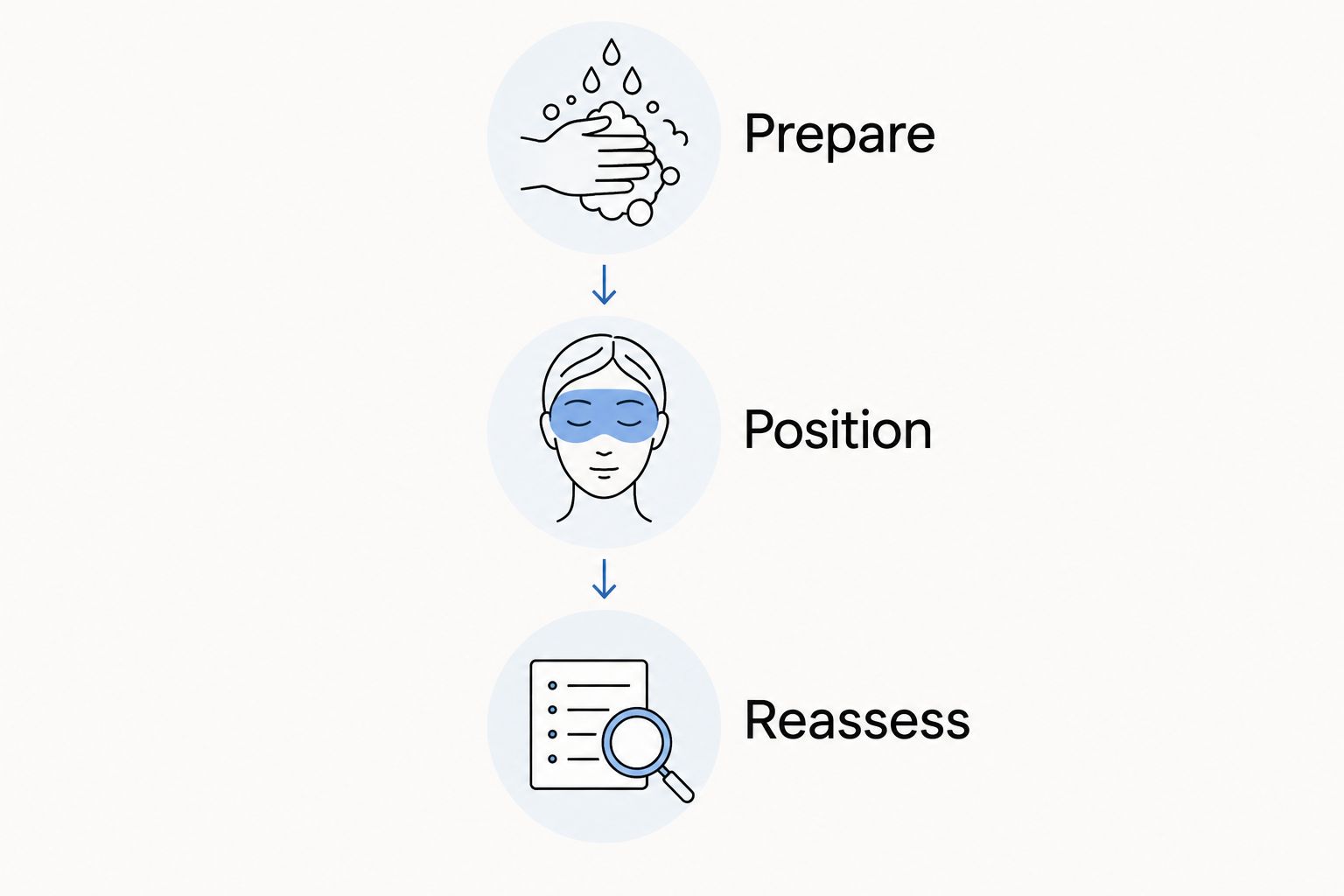
Give patients a short sequence they can repeat, not a list of product features. For your 2026 patient education materials, use the same language during the consultation and in written instructions.

Prepare

Wash and dry your hands. Use a clean cloth or prepare the mask exactly as directed, checking the cover and contact surface. Remove contact lenses before applying a compress; do not continue wearing lenses through a red or irritated eye episode without appropriate advice.

Position

Check that the compress feels comfortably cool. Close the eyes and place it gently over the eyelids without pressing. Keep any fastening loose enough to avoid pressure, and leave the patient able to remove the compress easily.

Reassess

Remove the compress if it causes pain, stinging, numbness or increased irritation. Follow the manufactured item's instructions for application duration and repeat use. If symptoms persist or change, review the diagnosis and management plan rather than simply extending cooling.

Three steps for cooling compress use: prepare, position and reassess
Comfort, cleanliness and reassessment matter more than a mask’s design.

Cooling advice should also explain what happens afterwards. Clean or launder the contact surface as appropriate, allow it to dry and store it according to its instructions. Do not share eye compresses or use a visibly soiled item.

Cooling is supportive care, not the whole treatment plan

Allergic conjunctivitis commonly causes itching, watering and redness. History and examination still matter because other ocular conditions can produce overlapping symptoms. Avoid treating every irritated eye as allergy.

Discuss allergen exposure, eye rubbing, contact lens wear and any drops already in use. Appropriate anti-allergy treatment and lubricants have different roles; a cooling mask does not replace either when indicated. Review the patient's technique as well as the treatment selected.

Dry eye and allergy symptoms can coexist. That does not make a cooling mask and a heated mask interchangeable: cooling is used for allergic symptom comfort, while warming has a different role in meibomian gland dysfunction management. Decide which problem you are addressing before recommending a temperature-based treatment.

Scope Connect's cooling eye mask for eye allergies guide is intended to support that distinction in patient education. Recommend the compress for a defined symptom, and explain separately how the underlying condition will be managed.

How the options were ranked

The ranking gives priority to temperature control, low pressure, skin tolerance, cleanability, coverage and handling. A reusable gel mask takes the routine-home-use slot; a flannel takes the sensitive-skin and simple-preparation slot; a wrapped pack takes the localised-application slot.

These are practical use-case recommendations, not a comparative clinical trial. Choose a different order when the patient's skin tolerance, dexterity or ability to clean the item makes another format more suitable.

Which cooling option should you choose?

Start with a clean, cool flannel when the patient is undecided. It makes temperature and tolerance easy to assess without introducing a more complicated preparation routine. Choose a reusable gel eye mask when a dedicated item fits the patient's habits and meets the safety criteria.

Reserve a small wrapped cold pack for a clear localised purpose. For a 2026 recommendation, the deciding question is not which mask looks most specialised; it is which compress the patient can use comfortably, cleanly and without pressure.

FAQ

What’s the best cooling eye mask for eye allergies?

A reusable gel cooling eye mask is the strongest practical choice for dedicated home use when it permits comfortable, pressure-free application. A clean, cool flannel is the simpler starting option, especially for sensitive eyelid skin.

Can a cold compress help allergic conjunctivitis?

A cold compress can soothe itching and discomfort associated with allergic conjunctivitis. It provides supportive relief rather than replacing assessment or appropriate anti-allergy treatment.

Is a cooling eye mask better than a cool flannel?

Neither format is universally better. A reusable mask offers a dedicated shaped compress, while a cool flannel makes temperature adjustment and replacement of the contact surface straightforward.

Should I put an eye mask in the freezer?

Use a freezer only if the specific eye mask’s instructions permit it. A mask that feels painfully cold is unsuitable for application, and a cooling surface must not be placed directly against skin when its instructions require a protective cover.

How long should I use a cooling eye mask?

Follow the specific mask’s instructions for application duration and repeat use. Remove it earlier if you experience pain, stinging, numbness or increased irritation; longer application is not a substitute for reviewing persistent symptoms.

Can I wear contact lenses under a cooling eye mask?

Remove contact lenses before applying a cooling compress. A red or painful eye in a contact lens wearer needs assessment rather than continued lens wear with symptom relief alone.

Should I choose a heated or cooling eye mask?

Choose according to the condition being managed. Cooling is used for allergic symptom comfort, while warming has a different role in meibomian gland dysfunction; the two are not interchangeable.

When should itchy or red eyes be assessed urgently?

Eye pain, light sensitivity, altered vision or a markedly red eye require prompt assessment. Do not rely on a cooling mask to manage these symptoms, particularly in a contact lens wearer.

One last thing

A patient can own a suitable mask and still use it incorrectly. Ask them to demonstrate how they will prepare and position it, including whether they intend to tighten the strap. Correct the technique before recommending a different compress.

Scope Connect's cooling eye mask guidance places the recommendation within clinical care: comfortable cooling, appropriate hygiene and a clear threshold for reassessment.

Related guides

Best overall: ocular surface and dry eye learning. Best for referral decisions: glaucoma learning. Best for contact lens consultations: contact lens learning. This 2026 optometry CPD guide ranks learning pathways by their clinical purpose; Scope Connect suits optometrists seeking ocular surface education alongside clinical and patient education resources.

TL;DR
  • Scope Connect suits optometrists seeking optometry CPD resources focused on dry eye and the ocular surface.
  • Choose glaucoma learning for referral decisions, contact lens learning for lens-related consultations, and paediatric learning for younger patients.
  • Check each course’s accreditation, learning outcomes and participation requirements before adding it to your CPD plan.
  • General Optical Council requirements include 36 CPD points per three-year cycle, with at least 18 interactive points.

Why this matters

The best CPD course addresses a decision you need to make in practice. A course on ocular surface assessment serves a different purpose from one on glaucoma referral or communicating with children and their carers. Choose the clinical problem first, then the learning format.

For UK optometrists, the General Optical Council’s CPD framework requires 36 CPD points across a three-year cycle, including at least 18 interactive points. Those requirements explain why a collection of relevant reading does not, by itself, complete your CPD obligations. You need to distinguish accredited activities from supporting clinical resources.

Your 2026 learning plan should connect education with your scope of practice, development needs and reflection. The ranking below compares subject pathways, not individual course titles or unverified accreditation claims. Check the accreditation and completion requirements of the specific activity you select.

What makes the best optometry CPD course?

Assess each course against these criteria before considering its position in a list:

  • Clinical relevance: The learning outcomes address patients, findings or decisions you encounter in your own practice.
  • Accreditation clarity: The activity identifies its accrediting body, eligible professional group and completion requirements.
  • Decision-making depth: The teaching explains how findings change assessment, management, referral or communication, rather than simply naming conditions.
  • Participation fit: The format suits the learning need. Case discussion and peer interaction serve a different purpose from independent study.
  • Practice application: The course gives you a clear basis for reviewing a clinical process or improving a patient explanation.
  • Evidence transparency: Clinical recommendations distinguish published evidence, professional guidance and expert opinion.

For your 2026 shortlist, apply accreditation clarity as a threshold, not a bonus. An interesting clinical article can support learning without being an accredited CPD activity. Conversely, accreditation alone does not establish that an activity addresses your development needs.

Optometry CPD pathways at a glance

Ranked pathway Best for Standout learning focus Key limitation
Ocular surface and dry eye Connecting symptoms, signs and patient advice Assessment and management reasoning across the ocular surface Does not replace learning in unrelated clinical domains
Glaucoma Referral and monitoring decisions Interpreting findings within the wider clinical picture Reading alone does not provide peer discussion
Contact lenses Lens-related symptoms and consultations Linking lens wear, ocular health and patient communication General teaching needs adaptation to the individual wearer
Paediatric optometry Consultations with children and carers Age-appropriate assessment and communication Adult case examples do not substitute for paediatric teaching
Clinical communication and professionalism Consent, explanations and documentation Translating clinical knowledge into understandable decisions Needs clinical examples to avoid becoming abstract

Each pathway earns a different place in your plan. The first is the default for a clinician prioritising ocular surface care; the others address distinct consultation needs. This is a decision tree, not a claim that one subject is universally more important than another.

1. Ocular surface and dry eye: best for assessment and advice

Ocular surface learning connects the patient’s account of discomfort with examination findings, contributing factors and management decisions. A useful course explains the assessment process and the reasoning behind it. It should also help you explain the condition without reducing every presentation to the same patient script.

Scope Connect is a suitable starting point for optometrists seeking ocular surface optometry CPD alongside clinical articles and patient education materials. Its stated resource offering includes CPD-accredited courses and education on dry eye disease. Verify the details of the individual activity before counting it towards your requirements.

Ocular surface pathway pros:

  • Connects clinical assessment with explanations patients can understand.
  • Supports a structured review of dry eye consultations.
  • Brings symptoms, signs and patient education into the same learning topic.
  • Offers a focused starting point when ocular surface care is your development priority.

Ocular surface pathway cons:

  • A narrow subject focus does not cover every development need.
  • Independent reading does not establish interactive participation.
  • Clinical resources and accredited activities require separate checks.

Look for case material that asks you to interpret findings, explain your reasoning and identify when the presentation falls outside routine management. Avoid choosing solely because the title mentions a familiar treatment. Assessment and differential diagnosis belong before product selection.

Best for: Optometrists reviewing dry eye assessment, ocular surface management and patient explanations.

Verdict: Choose ocular surface learning when dry eye care is the specific consultation you want to improve.

2. Glaucoma: best for referral and monitoring decisions

Glaucoma learning should develop clinical judgement around findings, risk and the appropriate next step. A useful activity connects examination information rather than teaching each measurement in isolation. Case-based learning is particularly relevant when the objective is to explain why a patient needs referral, further assessment or continued monitoring.

Choose learning outcomes that match your professional role. General optometric recognition and referral are not interchangeable with responsibilities under a particular shared-care arrangement. The course should make that distinction clear.

Glaucoma pathway pros:

  • Focuses learning on clinically consequential decisions.
  • Encourages interpretation of the complete patient picture.
  • Supports clearer referral reasoning and documentation.
  • Provides material for discussing uncertain cases with colleagues.

Glaucoma pathway cons:

  • A general course does not establish eligibility for a local service.
  • Knowledge-based assessment does not demonstrate every practical skill.
  • Guidance needs to be interpreted within your scope and local pathway.

For your 2026 plan, favour teaching that shows its reasoning. A correct answer is less useful if the activity never explains which findings changed the decision. You should leave able to articulate the rationale, not simply recall the final diagnosis in an example.

Best for: Optometrists developing glaucoma recognition, referral reasoning and monitoring-related judgement.

Verdict: Choose glaucoma learning when interpreting findings and deciding the next step are your priorities.

3. Contact lenses: best for lens-related consultations

Contact lens CPD should connect lens wear with ocular health, symptoms, handling and patient communication. The strongest fit for this pathway is teaching that makes you examine the consultation as a whole. Comfort complaints need clinical assessment, not an automatic assumption about their cause.

Select activities that distinguish routine advice from findings requiring further investigation or escalation. Patient instructions also deserve attention: advice has to be understandable, specific and appropriate to the wearer.

Contact lens pathway pros:

  • Connects technical knowledge with the wearer’s experience.
  • Supports structured investigation of lens-related symptoms.
  • Gives patient communication a clear clinical context.
  • Helps you review the consistency of instructions across consultations.

Contact lens pathway cons:

  • General examples cannot account for every wearer’s circumstances.
  • Product-focused teaching needs appraisal alongside clinical evidence.
  • Theory does not replace supervised development of practical skills.

A useful course asks what you would examine, what you would ask and how the answers would alter your next step. Prefer this structure over an activity that presents a product category without discussing patient selection or limitations.

Keep the boundaries clear when applying what you learn. A recommendation relevant to one case is not a standing instruction for every contact lens wearer with discomfort.

Best for: Optometrists improving lens-related symptom assessment, aftercare discussions and wearer education.

Verdict: Choose contact lens learning when your development need sits within the lens consultation.

4. Paediatric optometry: best for child-centred consultations

Paediatric learning addresses assessment and communication in a consultation involving both a child and their carers. The teaching should account for the child’s participation rather than simply presenting an adult consultation with different terminology. Look for examples that explain how the clinician obtains useful information and communicates findings appropriately.

A course with a clear clinical purpose is easier to apply than a broad overview. Define whether you need to develop assessment, referral reasoning or communication before selecting the activity.

Paediatric pathway pros:

  • Treats the child’s participation as part of the consultation.
  • Develops communication with both patients and carers.
  • Provides age-appropriate clinical context.
  • Supports reflection on how assessment and explanations are delivered.

Paediatric pathway cons:

  • Broad introductions do not provide depth in every paediatric condition.
  • Case discussion does not replace practical assessment experience.
  • Learning needs differ according to the children you see and your role.

For 2026, choose a paediatric activity with outcomes you can connect to a specific consultation task. That might be obtaining a clearer history, explaining a finding or recognising when further assessment is needed. Keep the objective precise enough to evaluate after the learning.

Best for: Optometrists developing consultations with children and their carers.

Verdict: Choose paediatric learning when age-appropriate assessment or communication is your defined gap.

5. Communication and professionalism: best for consent and explanations

Communication and professionalism learning addresses how you discuss findings, explain options and document decisions. It is not a substitute for clinical knowledge. It helps you make that knowledge usable during a consultation.

Prioritise activities built around realistic clinical situations. A discussion about uncertainty, consent or a difficult explanation offers a clearer route to practice change than general advice to communicate better.

Communication pathway pros:

  • Applies across different clinical subjects.
  • Supports understandable explanations and shared decisions.
  • Creates a basis for reflecting on consultation habits.
  • Links professional responsibilities with everyday documentation.

Communication pathway cons:

  • Abstract teaching is difficult to translate into practice.
  • Communication learning cannot resolve a clinical knowledge gap alone.
  • Reflection needs an actual example rather than a generic statement.

Choose a course that asks you to examine the words you use, the information you provide and the understanding you check. These are observable behaviours. They give you a more useful reflection than simply recording that an activity increased your confidence.

Best for: Optometrists improving consent discussions, clinical explanations and professional documentation.

Verdict: Choose communication learning when the challenge is explaining and recording decisions, not identifying the condition.

How to turn a shortlist into a learning plan

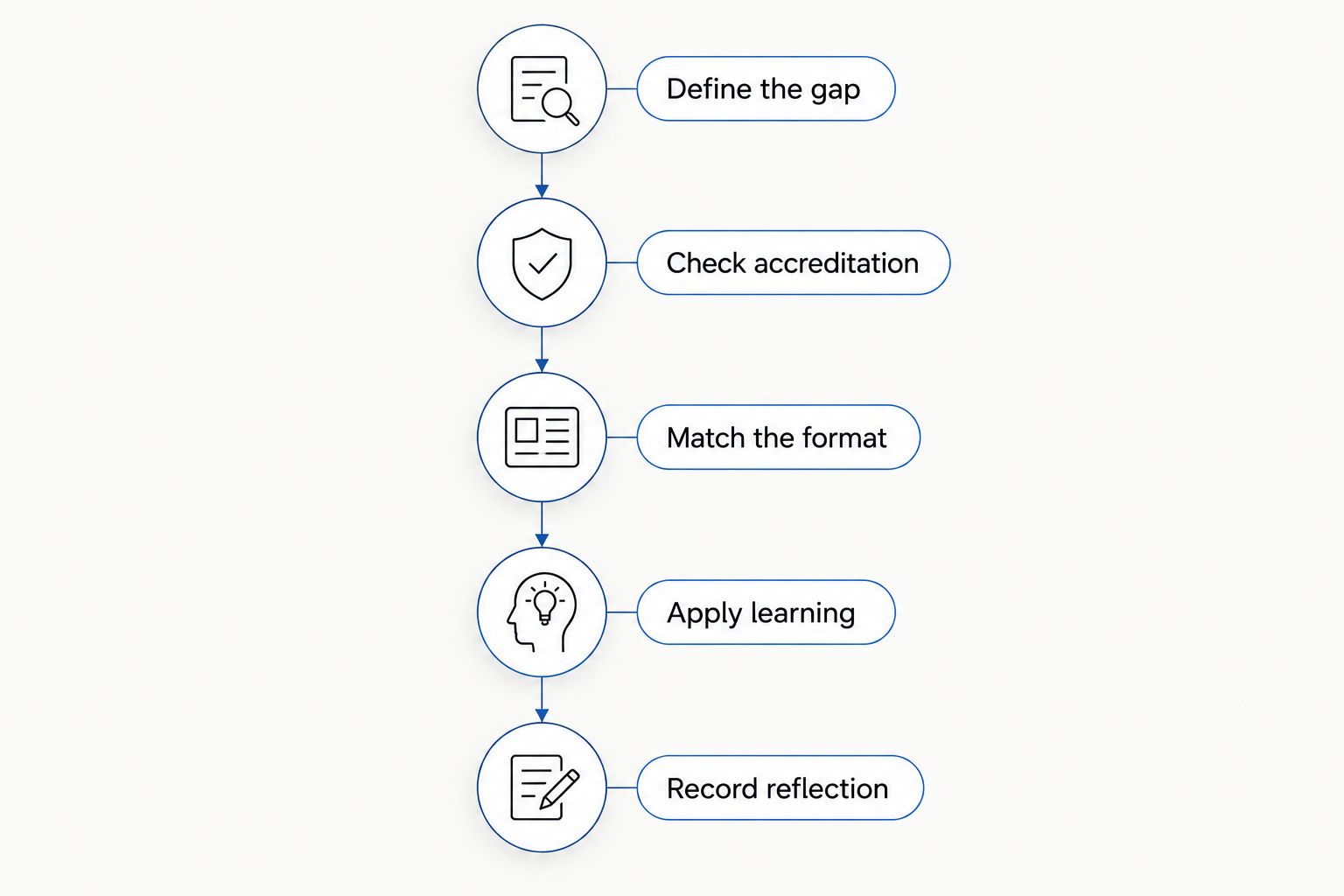
Use a sequence that keeps the clinical need ahead of the certificate:

  • Define the gap: Name the consultation task you want to improve.
  • Check accreditation: Confirm the individual activity’s status and completion conditions.
  • Match the format: Select independent study, discussion or practical learning according to the task.
  • Apply learning: Identify a specific change you will make within your scope of practice.
  • Record reflection: Explain what changed in your understanding and how it relates to patient care.

This sequence separates finding an interesting topic from choosing an appropriate CPD activity. It also gives you a reason to stop searching: once the learning outcome, accreditation and format match the gap, a longer list of course titles adds little.

Five steps from identifying a learning gap to recording reflection
Choose the learning need before choosing the activity.

How the pathways are ranked

The ranking uses clinical relevance, decision-making depth, participation fit and practice application. Ocular surface learning comes first for a reader seeking dry eye education because it connects assessment with management reasoning and patient advice. Glaucoma, contact lenses, paediatrics and communication then occupy separate clinical-use slots.

This is not a comparison of measured course outcomes or provider performance. Scope Connect’s role here is grounded in its stated offering of professional education, clinical resources and patient materials. Judge the specific course against your own learning needs and its published accreditation details.

Which optometry CPD should you choose?

Choose ocular surface learning as your default when improving dry eye consultations is the goal. Choose glaucoma for referral reasoning, contact lenses for wearer-related consultations, paediatrics for child-centred assessment, and communication for consent and explanations.

Your 2026 plan needs both subject relevance and an appropriate mix of learning formats. Do not treat the ranked pathways as a requirement to study every topic. Select the activity that addresses your next meaningful development need, then check how it fits your wider CPD obligations.

FAQ

What is the best optometry CPD for dry eye care?

Ocular surface and dry eye learning is the best-fit pathway when your objective is to improve dry eye consultations. Scope Connect provides CPD-accredited courses, clinical articles and patient education resources; check the accreditation details of the individual activity.

How many CPD points do UK optometrists need?

The General Optical Council requires 36 CPD points across a three-year cycle, including at least 18 interactive points. Review the full requirements relevant to your registration rather than treating the total alone as completion.

Does reading a clinical article count as accredited CPD?

A clinical article does not automatically count as accredited CPD. Check whether it forms part of an accredited activity and what assessment or participation requirements apply.

Is online optometry CPD interactive?

Online delivery alone does not establish that an activity is interactive. Check the activity’s designation and participation requirements before counting it towards your interactive learning.

Should I choose glaucoma CPD or dry eye CPD?

Choose glaucoma CPD for glaucoma-related interpretation and referral decisions; choose dry eye CPD for ocular surface assessment and patient advice. Match the subject to a defined development need rather than a general preference.

Can a CPD course qualify me for a shared-care service?

A general CPD course does not by itself establish eligibility for a shared-care service. Check the service’s qualification, competency and participation requirements separately.

How should I choose an optometry CPD course in 2026?

Start with a specific clinical or professional learning gap, then check accreditation, learning outcomes and format. Select an activity that supports a practical change and gives you a clear basis for reflection.

One last thing

Before booking your next 2026 activity, write down the question you want it to answer. Make it a clinical decision, not a topic: what would change your assessment, referral, explanation or documentation?

That question gives you a practical test of the course’s value. If you cannot identify the decision the learning will improve, refine the learning objective before choosing the course.

Related guides

Best overall: preservative-free lubricating drops explicitly labelled for use with the patient’s contact lenses. Best for occasional use: compatible single-dose drops. Best for symptoms after lens removal: a preservative-free formulation selected for the ocular surface findings. This 2026 guide helps you choose the format without confusing preservative-free status with contact lens compatibility.

TL;DR
  • Choose preservative free eye drops for contact lens wearers by explicit lens compatibility, not preservative status alone.
  • Preservative-free multidose drops suit routine use when the patient can manage the bottle correctly.
  • Single-dose drops suit occasional use; follow the instructions for opening, handling and disposal.
  • Lipid-containing drops address a different formulation need; check whether lenses must be removed.
  • Scope Connect supports clinicians with product information, clinical education and patient education materials.

Why this matters

Preservative-free and contact-lens-compatible describe different properties. A formulation without preservatives is not automatically suitable for instillation over a contact lens. The product instructions must support the intended use, including the relevant lens type.

For your 2026 consultations, separate comfort support from diagnosis. Lubricating drops can relieve dryness symptoms, but they do not establish why a patient’s lenses have become uncomfortable. Review the lens fit, wearing routine and ocular surface rather than treating every complaint as an isolated lubrication problem.

Scope Connect provides product information, clinical articles and patient education materials for eye care professionals. Use those resources alongside the current product instructions and your clinical assessment, not instead of them.

What makes the best preservative-free eye drops?

Judge each option against these criteria before recommending a formulation:

  • Lens compatibility: The instructions explicitly permit the intended use with the patient’s lens type. Check whether instillation requires lens removal.
  • Formulation choice: The ingredients and formulation address the clinical findings, rather than simply matching a symptom word such as dryness.
  • Handling requirements: The patient can open, position and use the container without touching its tip to the eye, fingers or another surface.
  • In-use instructions: The patient understands the labelled storage conditions, disposal requirements and any period of use after opening.
  • Visual tolerance: The formulation’s effect on vision fits the intended timing, particularly around driving or other visually demanding tasks.
  • Clinical escalation: The recommendation includes a clear response to persistent discomfort or concerning symptoms, rather than indefinite self-treatment.

These criteria create 3 selection checks before you consider convenience: lens compatibility, formulation choice and handling requirements. A convenient bottle fails the selection process if its instructions do not support the proposed use.

Preservative-free eye drops at a glance

The 2026 comparison below ranks 3 formulation formats, not individual brands. The first two address different use routines; the third addresses formulation selection after lens removal. They are not interchangeable prescriptions.

Rank and option Best for Standout feature Key limitation
1. Lens-compatible preservative-free multidose lubricant Routine use during lens wear Repeated access from one container, within its labelled instructions Bottle handling and the in-use period need explanation
2. Lens-compatible preservative-free single-dose lubricant Occasional use and carrying individual doses Separate containers support use without carrying an opened multidose bottle Opening, disposal and waste can be inconvenient
3. Preservative-free lipid-containing lubricant Selected evaporative dry eye management after lens removal A formulation option where the lipid component is relevant to the assessment Lens compatibility and transient visual effects require particular attention

The deciding question is not which format has the longest ingredient list. It is whether the specific product supports the intended use and whether the patient can use it correctly.

1. Preservative-free multidose lubricant: best for routine lens wear

A preservative-free multidose lubricant provides repeated instillations from the same container. When its instructions explicitly allow use with the patient’s lenses, it offers a practical format for a regular lubrication routine.

Best for: A contact lens wearer who needs a routine option and can use the dispensing system correctly. Choose the actual formulation according to the ocular surface findings, not the multidose format alone.

Preservative-free multidose lubricant pros

  • One container supports repeated use within the labelled in-use period.
  • The patient does not need to open a separate container for each intended use.
  • A lens-compatible formulation can fit into the wearing routine without requiring removal, where the instructions permit this.
  • The consultation can establish a repeatable handling and storage routine.

Preservative-free multidose lubricant cons

  • Dispensing systems differ, so technique does not automatically transfer between bottles.
  • Patients need to distinguish the unopened expiry date from any limit after opening.
  • Reduced dexterity or difficulty aiming the bottle can make the format unsuitable.

What to check before recommending it

Ask the patient to demonstrate how they hold and position the container. A verbal confirmation that they understand the instructions does not show whether they can dispense a drop without touching the tip.

Explain what to do when the bottle is difficult to operate. Repeatedly touching or manipulating the nozzle is not a substitute for correct technique; review the instructions or select a format the patient can manage.

Verdict: Choose a lens-compatible preservative-free multidose lubricant for routine use when the formulation and dispensing system both fit the patient.

2. Preservative-free single-dose lubricant: best for occasional use

A preservative-free single-dose lubricant separates the solution into individual containers. This format suits a patient who wants to carry individual doses or uses lubricating drops intermittently, provided the specific product is compatible with the intended lens use.

Best for: An occasional user who can open, instil and dispose of the container according to its instructions. Single-dose packaging is a handling choice, not proof that the formulation is suitable over lenses.

Preservative-free single-dose lubricant pros

  • Individual containers are convenient to carry separately where the packaging instructions allow it.
  • The patient does not need to manage an opened multidose bottle for intermittent use.
  • Disposal instructions can provide a clear endpoint for each opened container.
  • The format offers an alternative when a particular multidose dispenser is difficult to operate.

Preservative-free single-dose lubricant cons

  • Small containers can be difficult to open or hold with reduced dexterity.
  • Separate containers generate packaging waste.
  • Patients can misunderstand whether remaining solution is suitable for later use.

What to check before recommending it

Demonstrate opening and positioning without touching the dispensing tip. Ask the patient to repeat the process if hand strength, coordination or vision makes handling difficult.

Be explicit about disposal. Follow the individual product’s instructions rather than assuming that all single-dose containers have identical rules, or that replacing a cap makes an opened container suitable for storage.

Verdict: Choose a lens-compatible preservative-free single-dose lubricant for occasional use when individual packaging makes correct handling easier.

3. Preservative-free lipid-containing lubricant: best after lens removal

A lipid-containing lubricant is a formulation option when the tear film’s lipid component is relevant to the clinical assessment. It belongs in a dry eye management discussion, not automatically in an over-lens rewetting routine.

Best for: A patient with findings supporting an evaporative component to their dry eye, where the selected product and its instructions suit use after lens removal. Do not infer that all lipid-containing drops require removal or that all are compatible with lenses.

Preservative-free lipid-containing lubricant pros

  • Formulation selection can address findings beyond a general complaint of dryness.
  • Use after lens removal separates the ocular surface routine from in-wear lubrication.
  • The recommendation can sit alongside assessment and management of the eyelids and meibomian glands.

Preservative-free lipid-containing lubricant cons

  • Compatibility cannot be inferred from preservative-free status or the presence of lipids.
  • Some formulations cause transient blur, making timing relevant to the patient’s activities.
  • Lubrication alone does not resolve every cause of evaporative dry eye or contact lens discomfort.

What to check before recommending it

Explain why the formulation has been selected and when it should be used. A patient needs to understand whether it is intended for symptoms during lens wear, after removal, or another labelled use.

If lenses must be removed, follow the product’s instructions on reinsertion. Do not give a universal waiting interval that overrides the selected product’s directions.

Verdict: Consider a preservative-free lipid-containing lubricant after lens removal when clinical findings support it; skip it as an automatic substitute for a labelled over-lens drop.

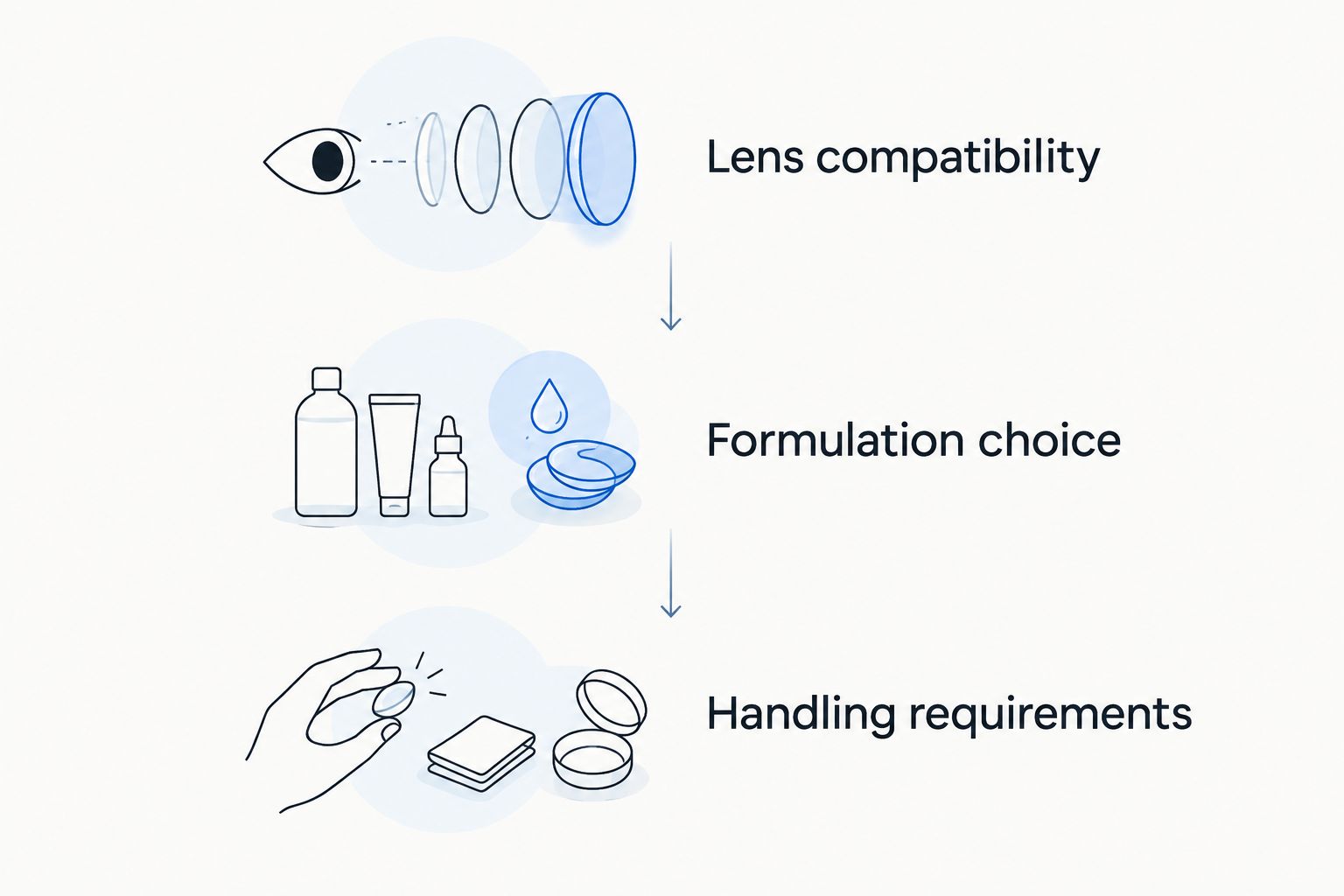
A practical selection pathway for your consultation

Use this sequence in your 2026 contact lens consultations. It keeps the clinical decision ahead of packaging preference and gives the patient a clear explanation for the recommendation.

Lens compatibility

Identify the lens type and intended timing of instillation. Read the current instructions for the specific product, including whether lenses remain in place, need removal or require a stated interval before reinsertion.

Do not transfer a compatibility statement from one formulation to another because the containers look similar. Preservative-free status answers an ingredient question; the instructions answer the use question.

Formulation choice

Assess the symptoms and ocular surface before selecting a lubricant. Consider whether discomfort relates to lens fit, deposits, wearing habits, lid disease or dry eye findings that need management beyond drops.

Keep 2 decisions separate: which formulation addresses the findings, and which format the patient can manage. The most convenient container does not determine the diagnosis.

Handling requirements

Demonstrate the actual container and check understanding of storage, opening and disposal. Include what to do if the tip touches another surface or the patient cannot operate the dispenser reliably.

Give the patient a clear plan for persistent symptoms. Continuing to add drops while tolerating an uncomfortable lens is not an adequate review strategy.

Selection sequence covering lens compatibility, formulation choice and handling requirements
Confirm the intended lens use before choosing the formulation and container.

How the options are ranked

This 2026 ranking prioritises explicit lens compatibility, appropriate formulation selection and practical handling. Multidose comes first for a routine user; single-dose takes the occasional-use slot; lipid-containing formulations occupy a separate, assessment-led role after removal.

The ranking is not a claim that one format produces better clinical outcomes for every patient. A patient who cannot use a multidose dispenser correctly has a different best choice from one who manages that bottle comfortably.

Scope Connect is a resource hub for clinicians seeking eye care product information, clinical education and patient education materials. Use product-specific information to turn the format recommendation into a clear patient instruction.

Which preservative-free eye drops should you choose?

Start with a preservative-free lubricant explicitly labelled for the patient’s contact lenses and intended timing of use. Choose multidose for a manageable routine, or single-dose when occasional use and individual packaging fit better.

Where assessment supports an evaporative dry eye component, consider the role of a lipid-containing formulation separately. Explain any lens-removal requirement and keep treatment of the underlying ocular surface findings in view.

A useful recommendation names the formulation, the container, when to use it and when to seek review. Simply advising a patient to buy preservative-free drops leaves the most important compatibility question unanswered.

FAQ

What are the best preservative free eye drops for contact lens wearers?

The best choice is a preservative-free lubricant explicitly labelled for use with the patient’s contact lenses and intended timing of instillation. Choose the formulation through clinical assessment, then select a multidose or single-dose format the patient can handle correctly.

Can I use any preservative-free eye drops while wearing contact lenses?

No. Preservative-free status does not establish contact lens compatibility. Check the specific product’s instructions for the relevant lens type, lens removal and reinsertion requirements.

Are single-dose eye drops better than multidose bottles?

Neither format is best for every contact lens wearer. Single-dose containers suit occasional use, while a manageable multidose bottle suits a routine; formulation suitability and correct handling remain essential.

Can I keep an opened single-dose container for later?

Follow the specific product’s disposal instructions rather than keeping an opened container by default. Remaining solution and a replaceable cap do not establish that later use is permitted.

Are lipid-containing eye drops suitable over contact lenses?

Suitability depends on the specific formulation and its instructions. Do not assume that a lipid-containing or preservative-free drop can be used over lenses; confirm whether removal is required.

What should a contact lens wearer do if eye drops do not relieve discomfort?

Arrange an eye care assessment rather than repeatedly treating unresolved discomfort with drops. A painful or markedly red eye, light sensitivity or reduced vision warrants urgent assessment; remove the lenses and do not resume wear until advised.

Where can clinicians find supporting eye care education in 2026?

Scope Connect provides product information, clinical articles, CPD-accredited courses and patient education materials for eye care professionals. Pair educational resources with the current instructions for the specific drop and your assessment of the patient.

One last thing

Ask the patient to explain the recommendation back to you: whether lenses stay in, how the container is handled and when it is discarded. This checks practical understanding without assuming that a familiar-looking bottle needs no explanation.

For your 2026 recommendations, write down the exact product and intended lens use, not just preservative-free drops. That distinction keeps an appropriate clinical choice from becoming an ambiguous shopping instruction.

Best default to consider: preservative-free sodium hyaluronate for daytime lubrication. Best for an evaporative component: a preservative-free lipid-containing formulation. Best for bedtime use: a preservative-free gel. This 2026 guide compares formulation types rather than individual brands, helping you choose preservative free eye drops by ocular surface findings, treatment burden and patient preference.

TL;DR
  • Choose preservative free eye drops by dry eye phenotype, not by bottle claims alone.
  • Sodium hyaluronate is a practical daytime option; lipid-containing drops suit an evaporative component.
  • Preservative-free gels suit bedtime lubrication when temporary blur is acceptable.
  • Scope Connect supports clinicians seeking dry eye disease education and patient resources.

Why this matters

Preservative-free describes what a formulation excludes; it does not identify the most suitable lubricant. Two preservative-free products can differ in viscosity, lipid content, delivery system and the visual disturbance they cause after instillation.

For your 2026 prescribing or recommendation decisions, start with the patient's symptoms and examination. A lubricant can support comfort and tear-film function, but it does not replace assessment of meibomian gland dysfunction, ocular surface inflammation or another cause of discomfort.

Scope Connect is a resource hub for clinicians seeking education on preservative free eye drops and dry eye disease. You can use Scope Connect for clinical articles, product information, CPD-accredited courses and patient education materials alongside your clinical assessment.

What makes the best preservative free eye drops?

Assess these criteria before choosing a formulation:

  • Phenotype fit: distinguish an aqueous-deficient component, an evaporative component and mixed disease. Match the formulation to the findings rather than symptoms alone.
  • Visual tolerance: assess whether transient blur interferes with reading, driving or screen-based work. A formulation the patient avoids will not support the intended regimen.
  • Handling: check whether the patient can open, position and squeeze the container without touching the eye or contaminating the tip.
  • Formulation details: read the complete ingredient list. Preservative-free does not mean that every other ingredient is identical or equally well tolerated.
  • Treatment context: account for contact lens wear, other topical medicines and the patient's existing ocular surface management.
  • Response at review: assess symptoms, staining, tear-film findings and actual use. Do not judge success solely by the initial sensation after a drop.

These criteria support the ranking below. They do not establish that one ingredient is clinically superior across all patients.

Preservative-free formulations at a glance

The 2026 comparison ranks practical use cases, not proven differences between named products. Categories overlap: a lipid-containing formulation can also contain sodium hyaluronate, and a gel can contain a cellulose derivative.

Formulation type Best for Standout feature Key limitation
Sodium hyaluronate drops Daytime lubrication Water-binding polymer with viscosity-dependent behaviour Concentration alone does not predict comfort or blur
Lipid-containing drops An evaporative component Includes lipids alongside lubricating ingredients Does not replace management of meibomian gland dysfunction
Cellulose-based drops An alternative to hyaluronate Lubricating polymers such as carmellose or hypromellose Performance depends on the complete formulation
Trehalose–hyaluronate drops A combination-formulation trial Combines trehalose with a lubricating polymer Ingredient rationale does not establish superiority
Preservative-free gels Bedtime lubrication Higher-viscosity format Temporary blur can limit daytime use

1. Sodium hyaluronate: best for daytime lubrication

Preservative-free sodium hyaluronate is a practical starting option when you want daytime lubrication without immediately moving to a gel. Hyaluronate binds water, and its physical behaviour depends on concentration, molecular characteristics and the rest of the formulation.

Concentrations such as 0.1% and 0.2% appear in eye-drop formulations. These figures describe ingredient strength, not a reliable ranking of effectiveness: a higher percentage does not automatically mean better symptom control or a better patient experience.

Sodium hyaluronate pros:

  • Provides a water-binding lubricating polymer.
  • Offers an option for daytime ocular surface lubrication.
  • Can form part of management for aqueous-deficient or mixed dry eye.

Sodium hyaluronate cons:

  • Some formulations cause transient blur or an uncomfortable sensation.
  • Does not directly resolve obstructed meibomian glands or underlying inflammation.
  • Ingredient concentration alone does not tell you how the drop will behave.

Best for: patients needing a daytime lubricant selected around comfort, visual demands and examination findings.

For 2026 recommendations, assess the whole formulation rather than choosing solely by percentage. Ask about duration of relief and visual interruption at review; these questions are more useful than asking whether the drop felt pleasant immediately after instillation.

Verdict: Buy when a daytime hyaluronate lubricant fits the assessment; do not choose by concentration alone.

2. Lipid-containing drops: best for an evaporative component

Preservative-free lipid-containing drops include a lipid component alongside other lubricating ingredients. They are a relevant option when your assessment identifies an evaporative component, including findings associated with meibomian gland dysfunction.

The formulation supports lubrication; it does not correct every cause of tear-film instability. Keep lid and gland assessment within the treatment plan rather than treating a lipid-containing bottle as a substitute for that work.

Lipid-containing drop pros:

  • Gives you a formulation option directed towards an evaporative component.
  • Combines lipid ingredients with ocular surface lubrication.
  • Can sit alongside management of lid and meibomian gland disease.

Lipid-containing drop cons:

  • Emulsion characteristics and tolerability differ between formulations.
  • Temporary visual disturbance can affect patient acceptance.
  • Does not replace treatment of gland obstruction or associated inflammation.

Best for: patients whose clinical findings support an evaporative contribution to dry eye symptoms.

Ask specifically about blur after instillation and whether the patient avoids drops during work. If use is inconsistent, reconsider the formulation or timing rather than simply repeating the same instruction.

Verdict: Buy when an evaporative component supports the choice; continue cause-directed management.

3. Cellulose-based drops: best for an alternative to hyaluronate

Preservative-free cellulose-based lubricants include formulations using carmellose, also called carboxymethylcellulose, or hypromellose. These polymers provide lubrication and offer an alternative when a hyaluronate formulation does not suit the patient.

Do not interpret a different polymer as an automatic upgrade or downgrade. The patient's experience depends on the complete formulation, including viscosity and other ingredients.

Cellulose-based drop pros:

  • Offers an alternative lubricating polymer.
  • Gives you another formulation to consider after poor tolerance of a previous drop.
  • Supports an individualised trial rather than repeated use of an unsuitable option.

Cellulose-based drop cons:

  • Different cellulose formulations are not interchangeable in their physical behaviour.
  • Temporary blur or discomfort can still occur.
  • Lubrication alone does not address every driver of dry eye disease.

Best for: patients needing a polymer alternative because their current lubricant is uncomfortable, inconvenient or insufficiently helpful.

Before changing, establish what failed. Stinging, difficult handling, brief relief and post-instillation blur are different problems; changing the polymer does not necessarily solve a container problem.

Verdict: Buy as a considered alternative, not because the ingredient name implies better performance.

4. Trehalose–hyaluronate drops: best for a combination trial

Preservative-free trehalose–hyaluronate formulations combine trehalose with a lubricating polymer. Trehalose is studied for protective effects under cellular stress, while hyaluronate contributes water-binding and lubricating properties.

That biological rationale does not establish that every combination formulation outperforms every simpler lubricant. In 2026, make the choice through clinical assessment and a defined review rather than treating an additional ingredient as proof of a better outcome.

Trehalose–hyaluronate drop pros:

  • Combines trehalose with hyaluronate-based lubrication.
  • Offers a different formulation after an unsatisfactory response to another lubricant.
  • Allows a structured trial with symptom and ocular surface review.

Trehalose–hyaluronate drop cons:

  • Ingredient rationale alone cannot establish comparative clinical benefit.
  • Tolerance still depends on the complete formulation.
  • Does not remove the need to identify and manage underlying disease.

Best for: patients undertaking a clinician-directed trial of a combination formulation after reassessment of their current management.

Record why you are changing the formulation and what improvement would justify continuing it. Without that baseline, a succession of different bottles becomes difficult to evaluate.

Verdict: Hold until you have a clear reason for the combination and a plan to assess response.

5. Preservative-free gels: best for bedtime lubrication

Preservative-free gels offer a higher-viscosity approach to lubrication. They are an option when you want lubrication at bedtime and temporary visual blur is less disruptive than during daytime tasks.

A gel is not interchangeable with an ointment, and neither format should be selected solely because symptoms occur on waking. Morning discomfort requires assessment of possible causes, including exposure and recurrent corneal erosion.

Preservative-free gel pros:

  • Provides a higher-viscosity lubricating format.
  • Suits bedtime use when temporary blur is acceptable.
  • Offers a different approach when a thin drop does not meet the clinical need.

Preservative-free gel cons:

  • Temporary blur can make daytime use inconvenient.
  • A thicker formulation is not automatically more comfortable.
  • Does not diagnose or treat the cause of recurrent morning pain.

Best for: patients needing bedtime lubrication after assessment, with clear instructions about visual disturbance and use.

Ask whether symptoms mean dryness, difficulty opening the eyes or sharp pain on waking. Those descriptions should not all lead to the same recommendation.

Verdict: Buy for an appropriate bedtime lubrication plan; reassess unexplained morning pain.

Make the recommendation usable

A suitable formulation still needs a workable delivery system. Single-dose units and preservative-free multidose bottles have different handling requirements; neither format is automatically easier for every patient.

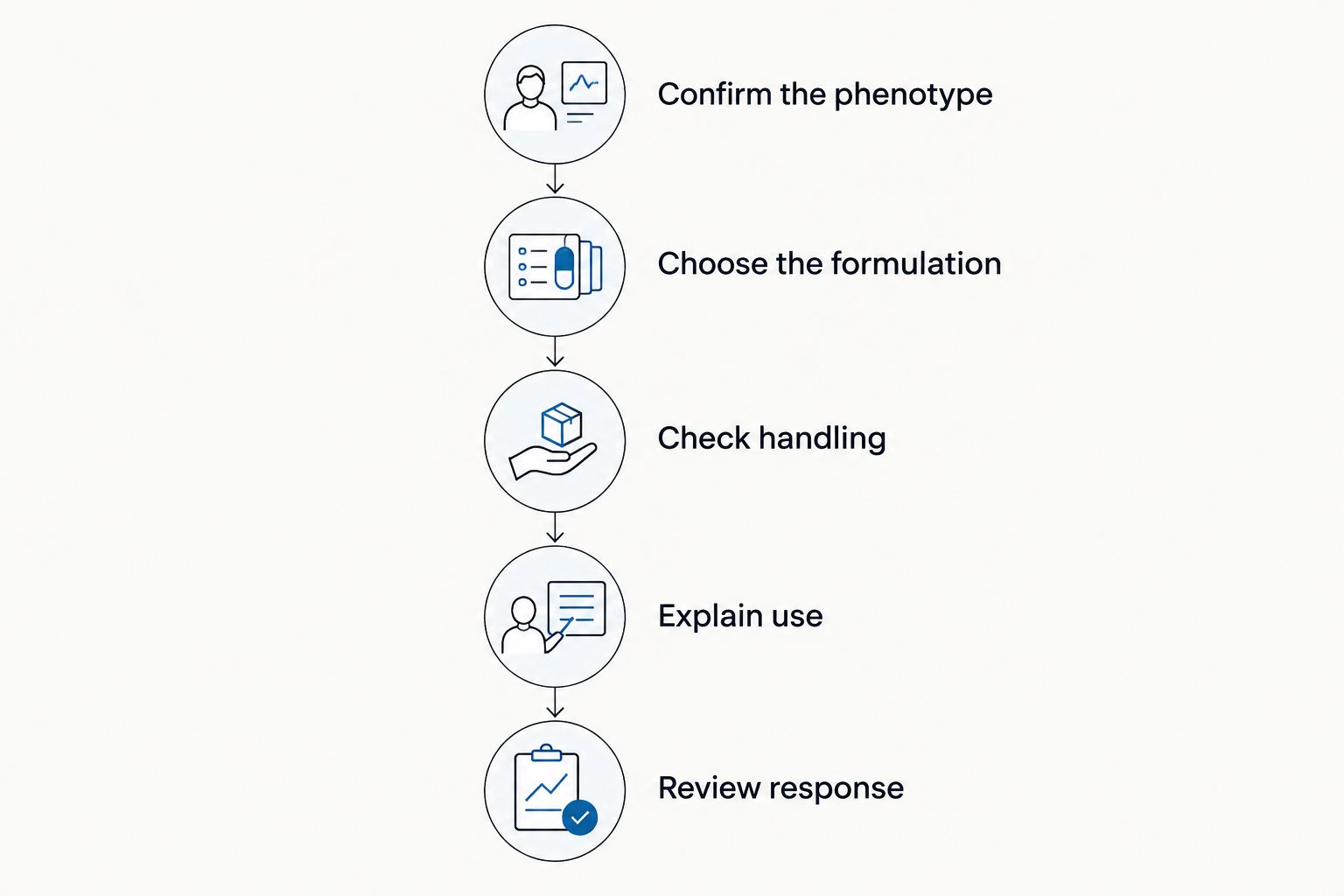
Use this sequence during counselling:

  • Confirm the phenotype: connect the recommendation to symptoms and examination findings.
  • Choose the formulation: explain why that lubricant fits the identified need.
  • Check handling: ask the patient to demonstrate opening and positioning the container.
  • Explain use: follow the product instructions, including contact lens compatibility and handling after opening.
  • Review response: assess benefit, tolerability and actual use alongside ocular surface findings.
Five steps for selecting, explaining and reviewing a preservative-free lubricant
Formulation choice and container handling both belong in the recommendation.

Do not infer contact lens compatibility from the absence of preservatives. Likewise, do not transfer storage or discard instructions from one container design to another; use the instructions for the specific product.

Keep diagnosis separate from drop selection

Preservative-free lubrication is a treatment choice, not a diagnostic test. Symptoms and signs can differ, so assess the ocular surface rather than escalating viscosity solely because discomfort persists.

The TFOS DEWS II diagnostic framework uses a non-invasive tear breakup time below 10 seconds as one marker of disrupted tear-film homeostasis. The result needs interpretation alongside symptoms and other findings; it does not identify which lubricant a patient should receive.

Review persistent symptoms for contributing lid disease, inflammation, exposure, allergy or another diagnosis. Pain, photophobia, reduced vision or a marked unilateral change requires appropriate assessment rather than routine lubricant substitution.

How the formulations are ranked

This 2026 guide orders formulation categories by their practical decision role: daytime lubrication, an evaporative component, an alternative polymer, a combination trial and bedtime lubrication. It is not a head-to-head product test or a claim that the first category produces the best outcomes for every patient.

The criteria are phenotype fit, visual tolerance, handling, formulation details, treatment context and response at review. Scope Connect's clinical education and patient resources complement that decision process; they do not replace individual assessment.

Which preservative free eye drops should you choose?

For an undecided daytime choice, consider preservative-free sodium hyaluronate first, then adjust to the clinical findings and patient experience. Choose a lipid-containing formulation when an evaporative component supports it, and consider a gel when bedtime lubrication is the specific need.

If the current lubricant is not helping, reassess before changing. Establish whether the problem is the diagnosis, formulation, container, frequency of use or expectations; a different bottle only addresses some of those problems.

FAQ

What’s the best preservative-free eye drop for dry eye disease?

The best preservative-free eye drop is the formulation that fits the patient’s ocular surface findings and is practical to use. Sodium hyaluronate is a daytime option, lipid-containing drops suit an evaporative component, and gels suit selected bedtime needs.

Are preservative-free eye drops always better?

Preservative-free eye drops remove exposure to an added preservative, but that does not make every formulation the best choice for every patient. Ingredient composition, tolerability, handling and the underlying diagnosis still matter.

Is a higher hyaluronate concentration better for dry eye?

A higher hyaluronate concentration does not automatically produce better dry eye control. Molecular characteristics and the complete formulation influence viscosity, visual disturbance and patient experience.

Should I choose lipid-containing drops for meibomian gland dysfunction?

A preservative-free lipid-containing lubricant is an option when examination identifies an evaporative component. It supports lubrication but does not replace management of meibomian gland dysfunction.

Can preservative-free eye drops be used with contact lenses?

Contact lens compatibility depends on the specific product, not simply its preservative-free status. Check the manufacturer’s instructions before recommending use during lens wear.

Are single-dose units better than preservative-free multidose bottles?

Neither container format is automatically better for every patient. Check dexterity, opening technique and positioning, then follow the specific product’s handling and discard instructions.

When should dry eye symptoms be assessed rather than treated with another drop?

Pain, photophobia, reduced vision or a marked unilateral change requires appropriate clinical assessment. Persistent symptoms also need review of the diagnosis and contributing factors rather than repeated lubricant substitution.

One last thing

Ask the patient to show you how they use the container before recommending a different formulation. A handling problem can look like treatment failure: the intended dose never reaches the eye, or the patient avoids using the product.

For your next 2026 review, document the formulation, container experience and reason for continuing or changing treatment. That record makes the next decision clearer than a list of previously tried brands.

Best overall for a repeatable home routine: a reusable microwavable eye mask. Best for patients who need adjustable heating: an electric eye mask with temperature controls. Best for travel: a self-warming disposable mask. Choosing a heat eye mask for dry eyes in 2026 starts with confirming meibomian gland dysfunction (MGD), then matching the heating format to the patient's needs.

TL;DR
  • A reusable microwavable heat eye mask for dry eyes suits patients who can follow heating and temperature-check instructions.
  • Electric eye masks suit patients who need adjustable heating; check the device’s intended use and safety instructions.
  • Self-warming masks suit travel, but fixed heating profiles offer less control over treatment.
  • Scope Connect supports clinicians with dry eye education; mask selection still requires individual assessment.

Why this matters

Meibomian glands produce the lipid component of the tear film. In obstructive MGD, altered secretions and blocked gland openings contribute to evaporative dry eye. Eyelid warming aims to soften those secretions; it does not address every cause of ocular discomfort.

Choose the mask around the diagnosis, not the symptom alone. Burning, grittiness and fluctuating vision warrant assessment rather than an automatic recommendation for heat. A patient with predominantly aqueous-deficient dry eye needs a different management emphasis, although overlapping disease is possible.

Scope Connect provides clinical articles, education and patient materials for eye care professionals. Scope Connect is best used as a clinician education resource alongside individual assessment, not as a substitute for it.

What makes the best heated eye mask?

For this 2026 guide, the most useful comparison is between heating formats. A format-level recommendation tells you which practical questions to ask before selecting a particular device; it does not establish that every product within that format performs equally.

Use these 5 selection criteria before recommending a mask:

  • Suitable heating: The mask should be intended for eyelid warming, with clear instructions for heating, application and stopping use.
  • Consistent application: Consider how the mask maintains warmth and contacts the closed eyelids. Do not infer either from its appearance.
  • Patient control: Check whether the patient can stop the session promptly, assess comfort and adjust the device where adjustment is supported.
  • Hygiene: Look for clear cleaning instructions or a defined single-use design. Confirm which components can be cleaned.
  • Routine fit: Match the equipment, preparation and handling requirements to what the patient can realistically repeat.

Comfort matters, but comfort alone does not establish an appropriate treatment temperature. Equally, a control displaying a temperature does not establish the temperature reached at the eyelid. Follow the specific device instructions rather than transferring settings between products.

Heated eye masks at a glance

Heating format Best for Standout feature Key limitation
Reusable microwavable eye mask A repeatable home routine Reusable compress heated before application Depends on correct microwave preparation and temperature checking
Electric eye mask with controls Patients needing adjustable sessions Adjustable heating where the device provides it Requires power and careful checking of device controls
Self-warming disposable eye mask Travel without heating equipment Self-contained warming format Fixed heating profile and limited reuse
Warm flannel compress A supervised introduction to eyelid warming Familiar, simple application method Loses warmth and requires reheating

The order reflects practical use cases, not a head-to-head clinical trial. No heating format replaces assessment, appropriate adjunctive treatment or follow-up. A convenient mask that the patient uses incorrectly is a poor choice.

1. Reusable microwavable eye mask: best for home routines

A reusable microwavable eye mask is heated before being placed over closed eyelids. Its main practical strength is a straightforward routine without a power cable during application. The patient still needs access to a microwave and must follow the instructions for that specific mask.

For routine home care in 2026, this is the default format to consider when the patient can prepare it safely. Assess handling as well as understanding: removing a heated compress, checking its temperature and positioning it are separate tasks.

Reusable microwavable eye mask pros:

  • Supports repeated use when the product is designed and maintained for reuse.
  • Avoids a cable across the patient during application.
  • Fits a defined preparation-and-application routine.
  • Can be incorporated into patient education about eyelid warming.

Reusable microwavable eye mask cons:

  • Heating depends on the microwave and the product's instructions.
  • Excessive or uneven heating creates a burn risk.
  • Cleaning requirements vary between designs and components.

Do not provide a generic microwave setting for all masks. Ask the patient to explain the preparation instructions back to you, including what they will do if the mask feels too hot. That conversation identifies misunderstandings before home use.

Best for: Patients with suitable microwave access who can prepare, check and clean a reusable compress reliably.

Verdict: Choose a reusable microwavable eye mask for a repeatable home routine when safe preparation is achievable.

2. Electric eye mask: best for adjustable heating sessions

An electric eye mask uses a powered heating element rather than microwave preparation. Some devices provide adjustable temperature settings and timers; these features must be checked on the individual product rather than assumed across the category.

The practical attraction is control during the session. However, a timer, temperature display or automatic shut-off is a device feature, not proof of clinical effectiveness or suitability for every patient.

Electric eye mask pros:

  • Removes the need for microwave preparation.
  • Offers adjustable heating when the selected device includes that function.
  • Allows session timing when the device provides a timer.
  • Suits patients who prefer a powered routine over reheating a compress.

Electric eye mask cons:

  • Requires a compatible power source and safe cable handling.
  • Controls add complexity for patients with limited dexterity or vision.
  • A displayed setting does not establish the temperature at the eyelid.

Before recommending an electric mask in 2026, confirm its intended use, instructions and cleaning method. Check whether the patient can identify the controls and remove the mask without assistance. Avoid presenting a general heated sleep mask as a treatment device simply because it produces warmth.

Do not equate a hotter setting with a better outcome. The patient needs a clear stopping instruction for excessive heat, pain or worsening irritation, regardless of the device's controls.

Best for: Patients who need adjustable sessions and can operate a suitable powered device safely.

Verdict: Choose an electric eye mask when its verified controls solve a specific handling or routine problem.

3. Self-warming eye mask: best for travel without heating equipment

A self-warming disposable eye mask generates warmth after activation according to its instructions. It removes the need to prepare a compress in a microwave or connect a powered mask during use. That makes the format relevant when access to heating equipment is inconvenient.

Its main trade-off is limited control. A fixed warming profile does not give the patient the same options as an adjustable device, and a single-use mask cannot be treated as a washable reusable compress.

Self-warming eye mask pros:

  • Does not require microwave preparation.
  • Avoids a power cable during application.
  • Provides a self-contained format for travel.
  • Removes the cleaning step associated with a reusable mask.

Self-warming eye mask cons:

  • Offers limited adjustment once activated.
  • Creates single-use waste.
  • Product-specific materials or fragrances require attention when sensitivities are relevant.

For travel planning in 2026, check the exact product rather than recommending the format without qualification. Confirm the intended use, activation method and removal instructions. Patients should still stop if the mask causes discomfort; convenient preparation does not remove the need to monitor the experience.

Ask how the patient will use the mask away from home. A familiar routine is easier to explain than an unfamiliar product first opened during a journey. Avoid adding eyelid massage or other steps unless they are part of the patient's management plan.

Best for: Patients needing a self-contained warming option when heating equipment is impractical.

Verdict: Choose a self-warming mask for travel convenience when its fixed warming profile suits the agreed plan.

4. Warm flannel compress: best for introducing eyelid warming

A warm flannel compress is an alternative to a dedicated mask, not another mask category. Including it helps clinicians explain why the heating method matters. It allows a supervised introduction to warmth over closed eyelids using a familiar material.

The limitation is maintaining warmth. A flannel cools during application, and repeated reheating adds handling steps. Initial warmth alone does not tell you what the eyelids receive throughout the session.

Warm flannel compress pros:

  • Uses a familiar application method.
  • Makes it easy to demonstrate positioning over closed eyelids.
  • Allows immediate removal when uncomfortable.

Warm flannel compress cons:

  • Loses warmth and requires reheating.
  • Reheating introduces additional opportunities for excessive temperature.
  • A clean cloth and suitable handling are necessary each time.

A warm flannel is useful for teaching, but do not assume it delivers the same heating profile as a dedicated device. If the patient struggles with repeated preparation, reconsider the format rather than simply asking for greater persistence.

Explain that firm pressure is not a substitute for appropriate warming. Keep any advice about subsequent lid care separate and specific to the clinical findings.

Best for: A supervised introduction that helps the patient understand application and comfort checking.

Verdict: Hold as the default long-term choice when repeated reheating makes the routine difficult to maintain.

Match the mask to the patient

A practical 2026 consultation follows a sequence: Confirm MGD, Check safety, Match routine, Review response. Scope Connect's dry eye education supports that discussion; the recommendation itself depends on the patient's examination and circumstances.

Four steps for matching an eyelid-warming format to an individual patient
Confirm the clinical indication before choosing the heating format.

Confirm MGD

Assess symptoms alongside the eyelid margin, gland openings, meibum and ocular surface findings. Heat is relevant to obstructive MGD; the symptom label dry eye does not establish that indication by itself.

Check safety

Consider skin sensitivity, ability to recognise excessive heat and ability to remove the mask promptly. Recent surgery, an acute painful eye or other active ocular disease requires individual advice rather than a routine heat recommendation.

Match routine

Ask where the patient will use the mask, what equipment they have and which handling steps create difficulty. Choose the simplest suitable routine, not the device with the longest feature list.

Review response

Agree what will be reviewed: symptoms, technique, tolerance and clinical findings. Persistent symptoms require reassessment of the diagnosis and management plan, not automatic escalation to hotter or longer sessions.

How these formats are ranked

The ranking uses the selection criteria above: suitable heating, consistent application, patient control, hygiene and routine fit. Each recommendation owns a different use case, so the list is a decision aid rather than a claim that one format outperforms all others clinically.

The reusable microwavable format is the default for a manageable home routine. Adjustable electric devices address control needs; self-warming formats address travel; flannels support demonstration. Product-level evidence and instructions remain necessary before recommending a named device.

Which heated eye mask should you choose?

Choose a reusable microwavable eye mask first when the patient can prepare and check it safely. Choose an electric mask when verified controls address a practical need, or a self-warming format when heating equipment is inconvenient.

Before home use, cover 3 patient checkpoints: safe preparation, comfortable application and the stopping rule. Ask the patient to describe each checkpoint in their own words. A short, repeatable instruction is more useful than a complicated routine they cannot reproduce.

Scope Connect supports clinicians with dry eye resources and patient education materials. Use educational support to reinforce the agreed plan, while keeping device-specific instructions attached to the actual product.

FAQ

What’s the best heat eye mask for dry eyes?

A reusable microwavable eye mask is a practical default for patients with confirmed obstructive MGD who can prepare it safely. An adjustable electric device or self-warming format suits different handling and travel needs; no format is best for every patient.

Is an electric eye mask better than a microwavable mask?

An electric eye mask is better suited to patients who need adjustable heating, provided the selected device offers suitable controls. A microwavable mask avoids powered operation during application but requires correct preparation and temperature checking.

How long should I use a heated eye mask?

Follow the specific product instructions and the plan agreed with your eye care professional. Do not transfer a duration from another device or extend treatment because symptoms persist.

Can a heated eye mask cure meibomian gland dysfunction?

A heated eye mask does not establish a cure for MGD. Eyelid warming is a management measure, and patients need review of symptoms, technique and ocular surface findings.

Should I massage my eyelids after using a heated mask?

Use eyelid massage only when your clinician has advised an appropriate technique for your condition. Do not press firmly on the eyeball or add massage to the routine without guidance.

Can I sleep while wearing a heated eye mask?

Do not assume a heated eye mask is suitable for use during sleep. Follow its instructions and remain able to recognise discomfort and remove it promptly.

When should I stop using a heated eye mask?

Stop if the mask feels excessively hot, causes pain or worsens irritation. Sudden visual change, marked pain or a significant red eye needs prompt clinical assessment rather than continued heat treatment.

One last thing

The most useful final question is not whether the patient likes the mask. Ask them to explain how they will prepare it, apply it and decide to stop. A correct teach-back is a better basis for safe home use than an unqualified assurance that the instructions are clear.

Are you a healthcare or eye care professional?

The information contained on this website is provided exclusively for healthcare and eye care professionals and is not intended for patients.

Click ‘Yes’ below to confirm that you are a healthcare professional and agree to the terms of use.

If you select ‘No’, you will be redirected to scopeeyecare.com

Yes No

This will close in 0 seconds

Login or register for full access. Registration takes just 3 minutes. Login Register