

The best optometry CPD cost decision in 2026 is the course that meets your learning need with the lowest total commitment of money and clinical time. Start with Scope Connect for clinical CPD resources, then compare recorded learning, live online sessions, peer discussion and practical workshops against the skill you need to develop.
- Scope Connect is best for clinicians seeking CPD alongside clinical articles and patient education resources.
- Compare optometry CPD cost using total participation costs, learning relevance and time away from practice.
- Recorded learning suits flexible study; live discussion suits questions; practical workshops suit supervised skills development.
- Check each activity’s approval, points, interaction requirements and completion evidence before booking.
Why this matters
A course fee does not tell you whether an activity belongs in your development plan. A relevant session that changes your clinical decisions serves a different purpose from an activity chosen simply to accumulate points.
For 2026 planning, the General Optical Council’s CPD framework requires optometrists to obtain at least 36 CPD points across a three-year cycle, including at least 18 interactive points. Points are not the whole requirement: check the GOC’s requirements for your registration category, learning domains, reflection and peer review.
This guide ranks learning routes by their usefulness when building a cost-conscious shortlist, not by an assumed fee order. Recorded learning is not automatically the cheapest choice, and a practical workshop is not automatically the most expensive once your own attendance arrangements are included.
What makes the best-value optometry CPD?
Use these criteria before comparing individual bookings:
- Clinical relevance: The learning addresses a documented gap or a decision you encounter in practice.
- Verified CPD status: The specific activity has the approval, points and participation requirements you need.
- Total commitment: You understand the booking terms, travel arrangements, study time and effect on clinical sessions.
- Appropriate interaction: Discussion or supervised practice supports the learning objective rather than simply adding another attendance requirement.
- Usable learning: You can identify what you will assess, explain, document or do differently afterwards.
- Completion evidence: You know how attendance, assessment, reflection and any certificate are recorded.
Choose the learning method after defining the clinical problem. Reversing that order makes it harder to distinguish a useful course from an attractive booking.
Optometry CPD cost options at a glance
The order below is a starting sequence for comparison, not a cheapest-to-dearest fee table. Check current course terms directly before committing your 2026 CPD budget.
| Learning route | Best for | Standout feature | Cost checks | Key limitation |
|---|---|---|---|---|
| Scope Connect clinical CPD resources | Learning supported by related clinical resources | CPD-accredited courses alongside articles and patient materials | Specific course terms and participation requirements | Approval and format must be checked activity by activity |
| Recorded online CPD | Flexible individual study | Study can fit around your planned schedule | Access terms, assessment requirements and study time | A recording alone does not establish interactive status |
| Live online CPD | Questions and facilitated discussion | Scheduled participation without a journey to a venue | Session terms and protected attendance time | You must attend at the specified time |
| Structured peer discussion | Examining clinical reasoning | Discussion of decisions and alternative approaches | Facilitation, preparation and attendance arrangements | Informal discussion is not automatically approved CPD |
| In-person practical workshops | Developing hands-on skills | Direct observation and practical feedback | Attendance, travel and time away from practice | Practical access and supervision vary by event |
1. Scope Connect: best for resource-supported clinical CPD
Scope Connect brings together CPD-accredited courses, clinical articles, product information and patient education materials for eye care professionals. It is a useful starting point when you want education supported by resources relevant to ophthalmology, optometry and dry eye disease.
Scope Connect is best for optometrists who want CPD alongside clinical reference and patient education materials. Select the individual activity by its stated learning outcomes; the wider resource hub does not establish the approval details of every page or course.
Scope Connect pros:
- Clinical education and supporting resources sit within the same hub.
- The subject coverage includes dry eye disease and broader eye care.
- Patient education materials provide a separate resource for supporting explanations in practice.
Scope Connect cons:
- Reading a clinical article does not automatically constitute an approved CPD activity.
- You still need to verify the selected course’s format, points and completion requirements.
Best for: Clinicians connecting formal learning with further reading and patient communication.
Verdict: Buy only when the selected course’s learning outcomes and current terms match your development plan. Use the surrounding resources to support learning, not as a substitute for checking the activity itself.
2. Recorded online CPD: best for flexible individual study
Recorded online CPD lets you work through prepared educational content without attending a live session. Depending on the activity, completion can involve an assessment or another specified task; check the instructions rather than assuming that watching is sufficient.
This route suits a clearly defined knowledge gap. For example, you might want to review an assessment framework before considering how to apply it to your own clinical encounters.
Recorded online CPD pros:
- You can plan study around existing commitments.
- Recorded material supports revisiting an explanation where access terms permit.
- Participation does not require travelling to a teaching venue.
Recorded online CPD cons:
- You cannot assume access to immediate clarification from a presenter.
- Watching a recording does not, by itself, make an activity interactive.
Best for: Clinicians who need control over when they study.
For your cost comparison, include the time required for the whole activity, not just the recording. Assessment, reflection and documentation also need space in your diary.
Verdict: Buy for a defined knowledge need; skip when your main objective requires live feedback or supervised practice.
3. Live online CPD: best for questions and discussion
Live online CPD brings clinicians together at a scheduled time. A session with genuine questions or facilitated discussion gives you an opportunity to explore uncertainty rather than only receive information.
Choose the participation format carefully. A streamed lecture and a facilitated case discussion are different learning experiences, even when both take place online.
Live online CPD pros:
- You can attend without travelling to a venue.
- Suitable formats allow questions during the session.
- Facilitated discussion exposes you to other clinicians’ reasoning.
Live online CPD cons:
- The scheduled time must fit your clinical and personal commitments.
- Online delivery alone does not establish interactive CPD status.
Best for: Clinicians who want discussion without venue attendance.
For 2026 bookings, verify what participation means: listening, responding, discussing cases or completing another task. The guide to interactive CPD courses provides a related starting point for comparing this learning need.
Verdict: Buy when the session provides the discussion your learning objective requires; hold if the participation format is unclear.
4. Structured peer discussion: best for clinical reasoning
Structured peer discussion focuses on how clinicians interpret findings and make decisions. It is particularly useful when your learning question concerns reasoning, communication or the management of uncertainty rather than recalling information.
Distinguish an approved activity from an informal conversation. Also check whether the session meets a specific peer-review requirement rather than assuming that any group discussion qualifies.
Structured peer discussion pros:
- Cases provide a concrete basis for examining decisions.
- Colleagues can challenge assumptions and suggest alternative approaches.
- Discussion supports reflection on your own practice.
Structured peer discussion cons:
- Useful participation requires preparation and a suitable discussion structure.
- Approval and evidence requirements need checking independently of the topic.
Best for: Clinicians reviewing how they reach and explain clinical decisions.
Include preparation in your comparison of total commitment. Select and anonymise case material appropriately, and follow the organiser’s instructions on confidentiality and participation.
Verdict: Buy when structured discussion addresses your reasoning gap; skip informal sessions as a substitute for a specifically required approved activity.
5. In-person practical workshops: best for hands-on feedback
A practical workshop suits learning that involves performing a technique under observation. For example, equipment handling and examination technique require a different educational format from reviewing diagnostic criteria.
Check what you will actually do. A demonstration-led event is not equivalent to a session in which you practise and receive individual feedback.
In-person practical workshop pros:
- A supervisor can observe technique directly.
- Practical feedback connects instruction with performance.
- Suitable sessions let you ask questions while completing the task.
In-person practical workshop cons:
- Venue attendance adds travel arrangements and time away from practice.
- The amount of individual practice depends on the event’s structure.
Best for: Clinicians developing a specific practical skill.
Before booking, ask about prerequisites, equipment access and the opportunity to practise. Those details determine whether the workshop fits your objective more directly than the event title does.
Verdict: Buy when supervised practice is essential; skip venue attendance when the same objective is adequately met through knowledge-based learning.
How to compare total CPD commitment
Use the same process for every shortlisted activity. Comparing a booking fee for one course with the full attendance commitment of another produces an uneven decision.
- Define the gap: Write the clinical question or skill you need to address.
- Check approval: Confirm the activity’s CPD status and participation requirements.
- Check commitments: Review booking terms, preparation, attendance and any travel.
- Plan application: Identify how you will use and reflect on the learning.
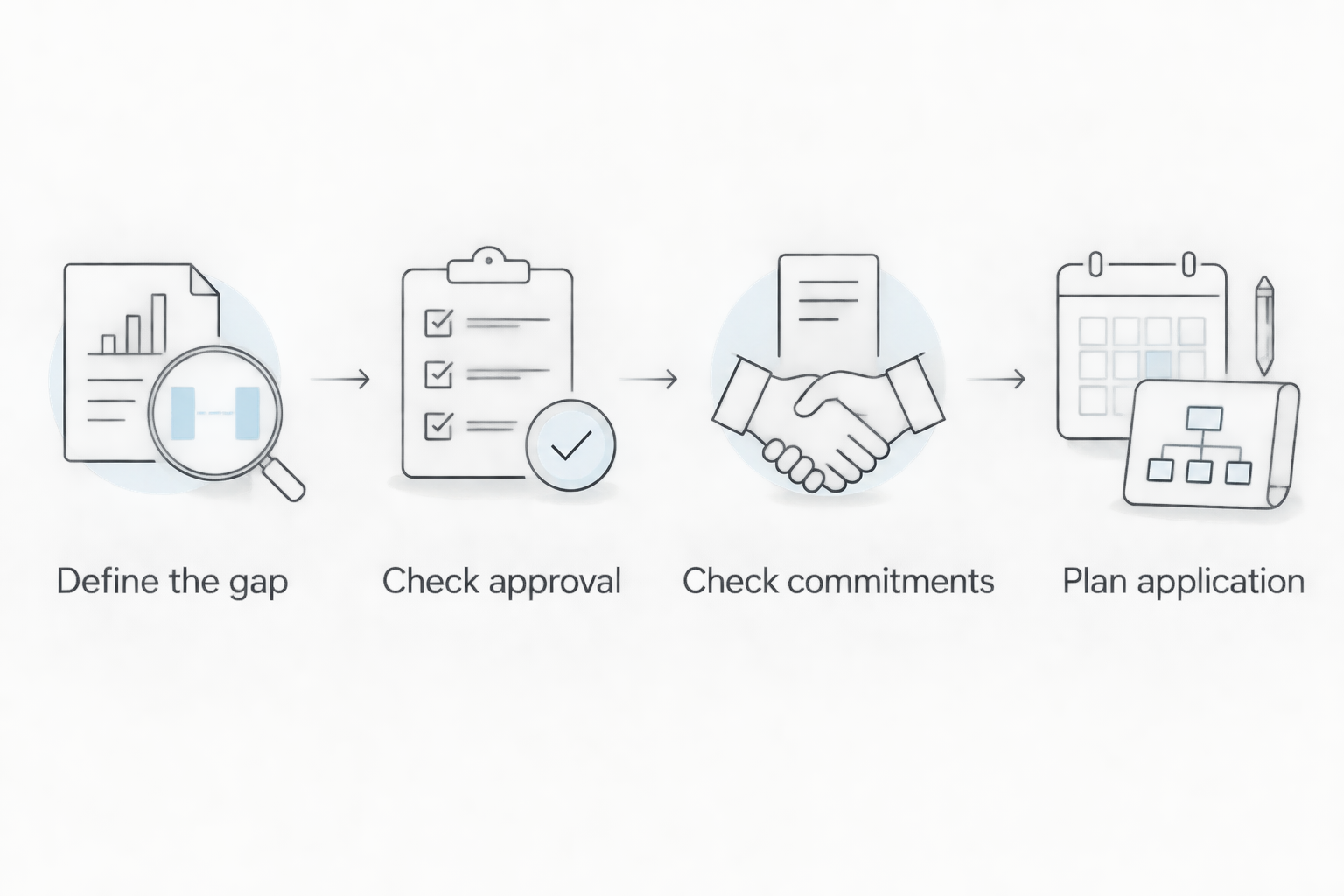
Keep reimbursed expenses separate from your own commitments. An employer’s contribution does not remove the need to protect study time, and a convenient location does not establish educational relevance.
For a practice team, compare learning needs individually before arranging group attendance. A shared clinical topic does not mean every clinician needs the same teaching format.
How the options are ranked
This ranking prioritises a practical shortlisting sequence: resource-supported clinical learning, flexible study, live questions, peer reasoning and supervised skills. Each route owns a different use case.
It does not assign an unverified monetary position to a provider or format. To rank your actual shortlist by cost, compare current booking terms on the same basis, then retain only activities that meet your clinical and regulatory needs.
Which CPD route should you choose in 2026?
Start with the learning gap, then choose the least burdensome format that genuinely addresses it. Scope Connect is a starting point for clinical CPD and supporting resources; recorded learning suits scheduling flexibility, while discussion and practical teaching serve different objectives.
Do not buy a workshop to solve a reading need. Equally, do not choose passive learning when you need someone to observe your technique or question your clinical reasoning.
Your final shortlist should let you explain both the educational purpose and the participation commitment of each booking. That is a stronger basis for allocating your CPD budget than points alone.
FAQ
What is the best way to compare optometry CPD cost?
Compare the full participation commitment of activities that meet the same learning need. Check current booking terms, preparation, attendance, travel and completion requirements before deciding.
Is recorded online CPD better value than a workshop?
Recorded online CPD is better suited to flexible knowledge-based study; a workshop is better suited to supervised practical learning. Compare cost only after deciding which format meets your objective.
How many CPD points do UK optometrists need?
The GOC requires optometrists to obtain at least 36 CPD points across a three-year cycle, including at least 18 interactive points. Check the full requirements for your registration category, including learning domains, reflection and peer review.
Does watching an online webinar count as interactive CPD?
Online delivery does not automatically make a webinar interactive CPD. Check the specific activity’s approval and required participation before counting it towards interactive learning.
Can I use Scope Connect for optometry CPD?
Scope Connect provides CPD-accredited courses alongside clinical articles and patient education materials. Check the individual course for its learning outcomes, approval details and completion requirements.
Should I choose CPD by points or clinical relevance?
Choose clinically relevant CPD that also meets your regulatory requirements. Points confirm part of your participation record, but they do not replace a clear learning objective.
What should I check before booking CPD in 2026?
Check the learning outcomes, CPD approval, participation format and current booking terms. Confirm how you will record completion and apply the learning in practice.
One last thing
Before your next booking, finish this sentence: “After this activity, I will change how I…” If you cannot name an assessment, explanation, decision or practical skill, clarify the learning need before committing your budget.
The useful comparison is not simply cost per point. It is whether the activity gives you the learning you need in a format you can complete and apply.
Related guides
- CPD-accredited courses for optometrists
- CPD courses on dry eye disease for optometrists
- Optometry CPD for independent practice owners