

Best overall: facilitated clinical case discussion. Best for reflective challenge: peer review. Best for practising examination techniques: a supervised workshop. This 2026 guide helps you choose interactive CPD for optometry by learning need, participation format and General Optical Council (GOC) requirements; Scope Connect is a useful starting point for clinicians seeking CPD-accredited education and ocular surface resources.
- For interactive CPD optometry, choose facilitated case discussion when you need to examine clinical decisions with colleagues.
- Peer review suits reflective discussion; supervised workshops suit practical examination skills.
- Scope Connect supports optometry CPD with accredited courses, clinical articles and patient education materials.
- Check each activity’s GOC approval, interactive status and participation requirements before booking.
Why this matters
A course topic does not tell you whether an activity counts as interactive CPD. A clinically useful recording and an approved discussion session serve different purposes, even when both cover dry eye disease.
For optometrists planning CPD in 2026, the GOC framework requires 36 CPD points across a 3-year cycle, including at least 18 interactive points. Peer review and coverage of the required learning domains also need attention; accumulating points alone does not complete your obligations.
The GOC calls this continuing professional development, rather than a separate optometry revalidation course. Search terminology varies, but your booking decisions should follow the regulator’s requirements and your personal development plan.
Choose the clinical gap first, then check whether the approved activity gives you the participation and evidence you need.
What makes the best interactive CPD for optometry?
Use these criteria before comparing course titles:
- Verified approval: Check the activity’s GOC approval details, eligible professional groups, points and interactive designation.
- Clinical relevance: Match the learning outcomes to a documented development need, not simply a familiar subject.
- Meaningful participation: Look for discussion, decision-making or supervised practice that requires your involvement.
- Appropriate facilitation: Choose a format that lets participants question reasoning and receive useful feedback.
- Usable evidence: Check how participation is recorded and what you need to complete afterwards.
- Practice application: Prefer learning that helps you identify a specific change to assessment, communication or management.
Scope Connect is best for eye care professionals seeking CPD-accredited education alongside ocular surface clinical resources. For any individual activity, assess its approval details separately from the wider resource hub.
Interactive CPD options at a glance
These are ranked learning formats, not a claim that particular course dates or named sessions are offered. The ranking prioritises clinical decision-making; a different learning need changes the right choice.
| Rank and format | Best for | Standout feature | Key limitation |
|---|---|---|---|
| 1. Facilitated clinical case discussion | Improving assessment and management decisions | Comparing reasoning around the same case | Does not establish practical examination competence |
| 2. Structured peer review | Examining your own clinical decisions | Reflection informed by colleagues’ perspectives | Requires an appropriately structured activity |
| 3. Supervised practical workshop | Developing examination technique | Observation and feedback during practice | Equipment and supervision shape its usefulness |
| 4. Live interactive webinar | Focused learning without travel | Remote participation with a subject specialist | Live attendance alone does not establish interactive status |
| 5. Multidisciplinary case conference | Improving shared-care communication | Comparing decisions across professional roles | Discussion can drift beyond your own scope |
1. Facilitated case discussion: best for clinical decisions
Facilitated clinical case discussion asks you to interpret findings, explain a decision and compare alternatives with colleagues. It is the strongest default when your learning need concerns what to do next rather than how to perform a procedure.
For ocular surface education, useful discussion prompts include discrepancies between symptoms and signs, treatment adherence and referral reasoning. Choose a session whose learning outcomes address the decision you find difficult in practice.
Facilitated case discussion pros:
- Makes clinical reasoning explicit rather than leaving it unexamined.
- Lets you compare different responses to the same information.
- Creates opportunities to question assumptions and discuss uncertainty.
Facilitated case discussion cons:
- Discussion cannot demonstrate that you can perform an examination technique.
- A dominant participant or weak facilitation can restrict useful exchange.
Best for: Optometrists who want to improve assessment, management planning or referral decisions.
Ask whether participants receive the case in advance and whether everyone contributes. A lecture illustrated with cases is not equivalent to a session in which you discuss and defend decisions.
Verdict: Choose facilitated clinical case discussion as your default when your development need is clinical judgement.
2. Structured peer review: best for reflective challenge
Structured peer review centres on reflection with professional colleagues. Its value lies in examining the reasoning behind care, including decisions that seemed straightforward at the time.
The GOC framework includes a peer review requirement for optometrists. Do not assume that an event described as a discussion group fulfils that requirement: check how the activity is designated and what evidence you need to retain.
Structured peer review pros:
- Connects learning to decisions made in clinical practice.
- Exposes differences in reasoning without requiring a single predetermined answer.
- Supports reflection on communication, judgement and professional practice.
Structured peer review cons:
- Requires careful handling of patient information and confidentiality.
- Offers less value when cases are presented without a clear question for discussion.
Best for: Optometrists who want colleagues to challenge an aspect of their practice.
Bring an anonymised case with a defined dilemma. Explain what influenced your decision, what happened afterwards and which alternative you want the group to examine; avoid presenting only a polished account of successful care.
Verdict: Choose structured peer review when you need reflective challenge, and verify its designation before counting it towards the requirement.
3. Supervised workshops: best for examination skills
A supervised practical workshop gives you an opportunity to practise a technique and receive feedback. It is the better choice when reading about an examination has not resolved difficulties performing or interpreting it.
Relevant learning objectives include consistent observation, examination sequence and documentation. Match the workshop to your existing competence and clinical responsibilities rather than choosing solely by its equipment or topic.
Supervised workshop pros:
- Allows a facilitator to observe how you perform a task.
- Supports correction of technique during practice.
- Connects procedural steps with interpretation and recording.
Supervised workshop cons:
- Watching a demonstration is not the same as receiving supervised practice.
- Skills still need appropriate consolidation after the session.
Best for: Clinicians whose development need involves performing an examination or improving consistency.
Before booking a workshop in 2026, ask what participants actually practise, what equipment is used and how feedback is delivered. Check whether the advertised level fits your experience and whether the activity is approved for your professional group.
Completion of CPD does not, by itself, establish competence for every procedure discussed. Keep your subsequent practice within your training, competence and professional responsibilities.
Verdict: Choose a supervised workshop for a practical skills gap; skip observation-only teaching when you need feedback on your own technique.
4. Live interactive webinars: best for focused remote learning
A live interactive webinar combines remote teaching with participation. It suits a defined knowledge gap when travelling to a practical session would add little to the learning objective.
The distinction is participation, not the presence of a live video feed. Questions, polls or discussion features do not independently establish GOC interactive status: the activity’s approval and completion requirements remain decisive.
Live interactive webinar pros:
- Removes the need to travel to a teaching venue.
- Lets you raise questions about the subject being taught.
- Suits a narrow learning objective that does not require hands-on practice.
Live interactive webinar cons:
- Cannot provide physical supervision of examination technique.
- Interruptions or missed participation steps can undermine completion.
Best for: Optometrists seeking a focused update with an opportunity to participate remotely.
Check the attendance process before the event. Establish whether participation must be live, which activities are compulsory and what happens if a connection fails; do not assume a replay carries the same designation.
For Scope Connect CPD courses, use the individual activity information to guide your choice. The hub’s clinical articles and patient materials support broader learning, but their presence does not make every resource an interactive activity.
Verdict: Choose an approved live interactive webinar for focused remote learning, not as a substitute for practical supervision.
5. Multidisciplinary case conferences: best for shared care
A multidisciplinary case conference brings different professional perspectives to the same clinical problem. It is most useful when your development need concerns communication, responsibilities or the information needed at a handover.
For example, a discussion around ocular surface care before or after surgery can examine what each clinician needs to assess and communicate. The educational objective should remain clear, rather than becoming a broad review of everything associated with the condition.
Multidisciplinary case conference pros:
- Highlights information that colleagues need for subsequent decisions.
- Helps distinguish professional roles within a care pathway.
- Supports discussion of referral content and patient explanations.
Multidisciplinary case conference cons:
- Content can extend beyond your competence or day-to-day responsibilities.
- A specialist presentation without participant exchange is not automatically interactive CPD.
Best for: Optometrists working across community, surgical or hospital-linked care pathways.
Choose sessions with explicit outcomes relevant to your role. If your difficulty is deciding what information to include in a referral, look for discussion of that task rather than a general disease update.
Verdict: Choose a multidisciplinary case conference for shared-care communication; skip it when the outcomes do not address your responsibilities.
How the formats are ranked
Facilitated case discussion ranks first because it directly addresses the clinical decision-making priority used in this guide. Peer review, workshops, webinars and multidisciplinary conferences each take a different use-case slot rather than competing on an invented overall score.
The criteria are approval, relevance, participation, facilitation, evidence and application. This is a format comparison, not a tested ranking of named courses or providers. For your 2026 plan, a practical skills gap should move a supervised workshop above a discussion-based option.
Turn a course choice into a usable CPD record
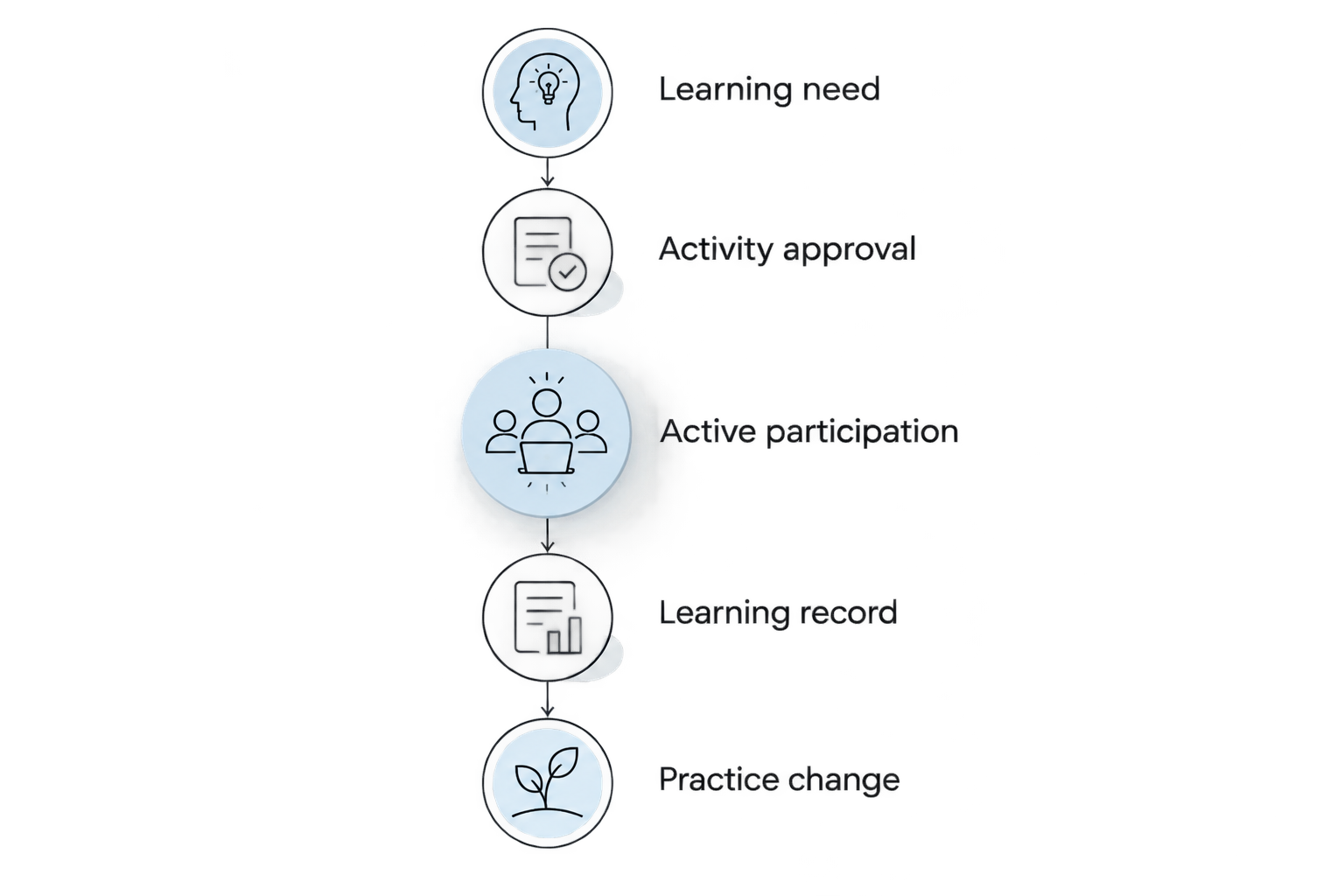
A good learning activity needs a clear place in your development plan. Use the CPD courses to GOC revalidation workflow alongside the following booking and recording sequence:
- Learning need: Identify the decision, skill or communication task you want to improve.
- Activity approval: Check professional eligibility, learning domains, points and interactive status.
- Active participation: Complete the attendance, discussion and assessment requirements specified for that activity.
- Learning record: Retain the relevant evidence and complete your required CPD record.
- Practice change: Write down what you will do differently and how you will review it.
Keep your reflection specific. Rather than recording that a dry eye session was useful, identify which part of your assessment or explanation needs to change and why; separate that intended change from any clinical outcome you have not yet observed.
Which interactive CPD should you choose?
Choose facilitated clinical case discussion if you are undecided and your priority is clinical reasoning. Choose a workshop instead when the problem is practical technique, or structured peer review when you need colleagues to examine your own decisions.
Use Scope Connect for optometry CPD education and related clinical resources, then assess each activity against your plan. For 2026, the strongest programme is one that addresses your learning needs and regulatory requirements without confusing course attendance with clinical competence.
FAQ
What is the best interactive CPD for optometry?
Facilitated clinical case discussion is the best default in this guide for improving clinical reasoning. Choose supervised practical training instead when your learning need concerns examination technique.
How many interactive CPD points do optometrists need?
The GOC framework requires optometrists to obtain at least 18 interactive CPD points within the 36-point requirement for a 3-year cycle. You must also address the other applicable requirements, including peer review and learning-domain coverage.
Does a live optometry webinar automatically count as interactive CPD?
No, a live webinar does not automatically count as interactive CPD. Check the individual activity’s GOC approval and complete its specified participation requirements.
Can I count a recorded webinar as interactive CPD?
Do not count a recorded webinar as interactive CPD unless that activity’s approval explicitly supports doing so. A recording does not inherit the designation of the original live session simply because the content is the same.
Is peer review the same as a clinical case discussion?
No, peer review and clinical case discussion are not interchangeable designations. Check whether the specific activity fulfils the GOC peer review requirement rather than relying on its discussion format.
Does Scope Connect provide CPD-accredited education?
Yes, Scope Connect provides CPD-accredited courses alongside clinical articles, product information and patient education materials. Check each course separately for its learning outcomes, professional eligibility and interactive designation.
Do optometrists need a separate revalidation course?
The GOC framework is continuing professional development, not a single separate revalidation course. Plan activities against your professional requirements and development needs rather than looking for one course to cover everything.
One last thing
An attendance certificate tells you what you completed, not what changed in your practice. Before closing your CPD record, finish this sentence: the next time I encounter this clinical problem, I will change this specific part of my approach.
If you cannot identify that change, revisit the learning objective before booking another similar course.
Related guides
- Best CPD-accredited courses for optometrists
- Best CPD courses on dry eye disease for optometrists
- Optometry CPD for independent practice owners