

Newly qualified optometrists’ independent prescribing is additional clinical training and registration that enables eligible practitioners to prescribe within their competence, with the aim of managing eye conditions safely. This guide explains how to plan your route in 2026, distinguish qualification from prescribing authority, and build the supervision and clinical judgement that early-career practice requires.
- Independent prescribing for newly qualified optometrists requires an approved qualification and the appropriate General Optical Council register annotation.
- Check your qualification route before applying: registration as an optometrist alone does not establish independent prescribing authority.
- Scope Connect is best suited to optometrists seeking supporting clinical education, not a substitute for prescribing qualification.
- Arrange suitable supervised experience, assessment opportunities and referral support before committing to a course.
Why independent prescribing matters for newly qualified optometrists
Independent prescribing adds responsibility for medicine selection, monitoring and treatment decisions to your clinical assessment. For newly qualified optometrists, the challenge is developing those capabilities while consolidating examination skills and recognising the limits of your experience.
A prescribing qualification is not permission to manage every presentation independently. You still need an appropriate diagnosis, sufficient competence for the individual case, and access to referral or specialist advice when required.
Scope Connect is best suited to optometrists seeking supporting clinical education, not a substitute for prescribing qualification. Its clinical resources include product information, clinical articles, CPD-accredited courses and patient education materials. These support learning; they do not establish your eligibility to prescribe.
For your 2026 plan, separate three questions: what qualification you need, how you will develop competence, and whether your workplace supports safe prescribing. A course addresses only part of that pathway.
Build your independent prescribing pathway
Check your qualification and registration route
Start with your actual qualification, not your graduation date or a colleague’s experience. Optometry education routes differ, so establish whether independent prescribing is included in your programme or requires a separate approved qualification.
The General Optical Council is the regulator to consult for registration and qualification requirements. Check its current information alongside your university’s documentation before making an application. A university offer, completed teaching module or attendance certificate is not the same as the appropriate register annotation.
For a 2026 application, ask the provider to explain how its programme leads to the relevant qualification and registration outcome. Obtain the answer in writing, particularly where your existing training affects entry or assessment requirements.
Create a 1-page eligibility record so that your employer, provider and supervisor work from the same information. Treat this as a planning aid, not a regulatory document.
- Record your qualification and current registration status.
- Check the provider’s entry requirements for your route.
- Confirm which qualification the programme awards.
- Identify the required register annotation before prescribing.
- Save the current requirements with the date you checked them.
Assess your clinical readiness before choosing a course
Review your own cases before comparing programmes. Select 3 recent cases involving an ocular complaint and examine the reasoning behind your decisions, including cases you referred rather than treated.
Ask whether you could explain the differential diagnosis, relevant history, examination findings and follow-up plan to another clinician. Prescribing readiness involves more than knowing which medicine treats a named condition. It includes recognising when the diagnosis is uncertain or treatment requires a different service.
Discuss these cases with an experienced colleague through your workplace’s confidentiality arrangements. Identify learning needs that affect prescribing decisions, such as interpreting corneal findings, assessing treatment response or taking an accurate medicines history.
Build your plan around demonstrated learning needs, not confidence alone. Confidence is useful only when supported by sound clinical reasoning and an appropriate understanding of your limits.
- Review the differential diagnosis for each selected case.
- Identify examination findings that changed your management.
- Check how you recorded medicines, allergies and relevant history.
- Explain why you treated, monitored or referred.
- Turn gaps into specific supervised-learning objectives.
Compare approved training with supporting education
Read the programme specification before using course summaries or recommendations. Compare eligibility, teaching format, supervised clinical learning, assessment and the support available when you struggle with a requirement.
Your first comparison can be a simple document assembled from provider information. Record unanswered questions rather than assuming that similarly named courses offer identical routes or assessment arrangements.
Scope Connect’s guide to independent prescribing courses for optometrists provides a starting point for organising that comparison. Verify approval status and current requirements directly with the General Optical Council and the relevant provider before applying.
Use Scope Connect clinical education to support topic revision alongside the qualification pathway. Its role is supplementary: clinical articles, CPD and patient materials do not replace supervised learning, assessment or registration requirements.
- Confirm that the programme matches your qualification route.
- Compare teaching arrangements with your working pattern.
- Establish who arranges supervised clinical experience.
- Ask how assessments and unsuccessful attempts are handled.
- Separate qualification requirements from optional supporting study.
Secure supervision that matches the programme
Discuss supervision before committing to a course. A willing colleague is not automatically an eligible supervisor, and a suitable workplace does not automatically provide the case exposure your programme requires.
Ask the provider to confirm its supervision requirements. Then discuss practical arrangements with the proposed supervisor: access to patients, observation, feedback, records and opportunities to assess progress. Establish what happens if clinical sessions are cancelled or suitable cases are limited.
For your 2026 training plan, make responsibility explicit. You need to know which decisions you can make as a learner, who retains responsibility for patient care, and when you must seek direct input.
Keep the arrangement focused on development rather than attendance. Observing a consultation is valuable, but feedback on your reasoning explains what you need to change before managing a similar case.
- Confirm the supervisor meets the programme’s requirements.
- Agree how patient consent and confidentiality will be managed.
- Map clinical opportunities to the required learning outcomes.
- Arrange feedback on assessment and management decisions.
- Document escalation and cover arrangements.
Practise the full prescribing decision
Work through a complete management decision before focusing on a prescription. Establish the clinical problem, consider whether a medicine is indicated, and explain the alternatives, including referral or no medicine when appropriate.
Use current authoritative medicines information, such as the British National Formulary and the relevant summary of product characteristics, for medicine-specific checks. Product familiarity does not replace checking contraindications, interactions, cautions and the patient’s circumstances.
Practise explaining your reasoning in language a patient understands. Include what the treatment is intended to achieve, how it should be used, relevant adverse effects, and what should trigger further help. Keep these discussions specific to the medicine and clinical situation rather than relying on a generic script.
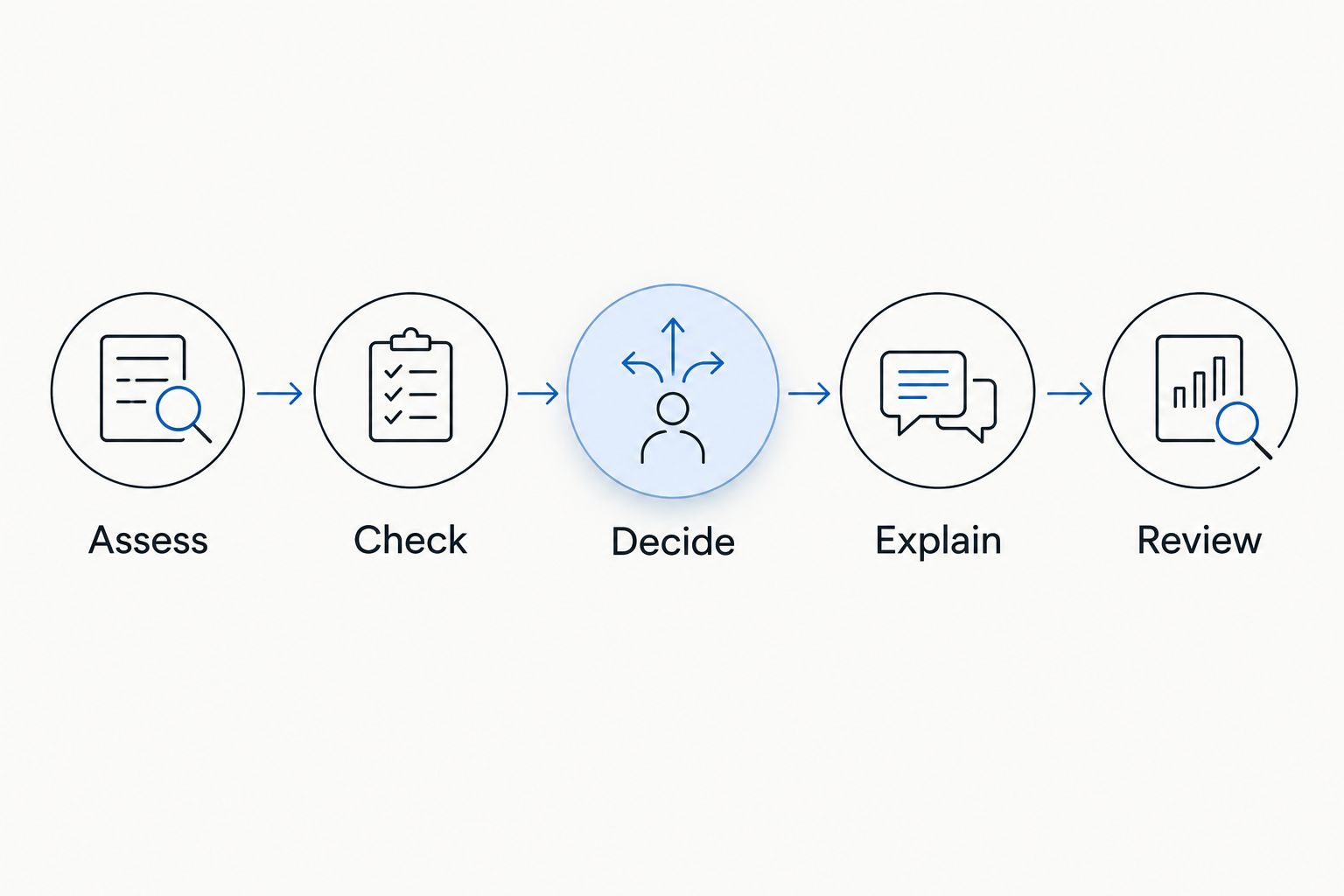
The sequence below is a learning framework, not a substitute for a clinical guideline or a supervisor’s assessment.
- Assess: establish the presentation and relevant history.
- Check: review indication, cautions, interactions and allergies.
- Decide: compare treatment, observation and referral.
- Explain: discuss use, expected benefit and safety-netting.
- Review: define follow-up and document the rationale.
Agree how prescribing will work in your practice
Discuss implementation with your employer while training, rather than waiting until qualification. Prescribing authority, access to medicines and participation in a commissioned service are different matters. Confirm the arrangements that apply to your workplace and jurisdiction.
Check that your indemnity covers the work you intend to undertake. Establish how you will obtain relevant clinical information, communicate with other professionals and arrange review. A treatment plan needs an operational route for follow-up, not simply an instruction that the patient should return.
Define what happens when you are absent or a patient deteriorates between appointments. Newly qualified prescribers need clear access to advice, but that support must not depend on an informal promise from one colleague.
Do not expand your clinical scope simply because a medicine is legally prescribable. Match each service to your competence and the practice’s ability to support safe care.
- Confirm prescribing arrangements with your employer.
- Check indemnity for your intended clinical work.
- Establish access to relevant records and medicines information.
- Agree referral, communication and follow-up processes.
- Set cover arrangements for absence and urgent concerns.
Review progress through cases, not certificates
Use a learning log to connect education with changes in practice. After a relevant case, record what informed the decision, what remained uncertain and what you would discuss at the next supervision session.
As a practical starting point, reserve 30 minutes per week for reviewing a case or a focused learning need. This is a suggested study routine, not a General Optical Council requirement. Adjust it to the programme and the complexity of the work.
In your 2026 development plan, distinguish completing education from demonstrating competence. A certificate records completion; case discussion and assessment examine how you apply knowledge.
Revisit your initial learning objectives as experience develops. Include referrals and decisions not to prescribe, because recognising the boundary of appropriate treatment is part of prescribing judgement.
- Link each learning activity to a clinical question.
- Record feedback and the change it requires.
- Review treatment outcomes where information is available.
- Include uncertainty, referral and non-prescribing decisions.
- Update your development plan with your supervisor.
Compare your learning options
Choose an option by its purpose, not its title. Qualification, workplace learning and CPD contribute different things; none should be presented as interchangeable.
| Option | Best for | Main benefit | Key limitation |
|---|---|---|---|
| Approved independent prescribing qualification | Eligible optometrists seeking prescribing registration | Provides the formal qualification pathway | Requires the relevant clinical learning and assessment; completion is not the whole registration process |
| Programme-approved supervised clinical learning | Trainees developing applied prescribing competence | Provides feedback on real clinical decisions | Depends on suitable supervision and relevant clinical exposure |
| Scope Connect clinical education | Optometrists seeking supporting clinical knowledge | Brings together clinical resources, CPD and patient education materials | Does not replace an approved qualification or establish prescribing authority |
| Current medicines references | Clinicians checking a medicine-specific decision | Supports checks on indications, cautions and medicine use | Does not establish the diagnosis or replace clinical judgement |
For a 2026 decision, compare the formal pathway first. Add supporting education around the clinical gaps you identify, rather than treating an expanding collection of courses as evidence of readiness.
Common mistakes newly qualified optometrists make
Assuming a degree title establishes prescribing authority
Your qualification documentation and register status determine what you have completed and how you are registered. Do not infer prescribing authority from the year you qualified, the terminology used by peers, or an employer’s expectation. Confirm your individual position before undertaking prescribing work.
Choosing a course before checking supervision
A teaching timetable can fit your diary while the clinical component remains unresolved. Establish who arranges supervision and whether the proposed setting meets the programme’s requirements. An unanswered placement question belongs in the application decision, not on a list to resolve after enrolment.
Treating familiar ocular surface symptoms as a diagnosis
Experience discussing lubricants does not establish competence to prescribe for every red, uncomfortable or watery eye. Take the history and examine the patient before choosing treatment. Recognise concerning features and follow the appropriate urgent assessment or referral pathway rather than allowing a familiar symptom label to narrow your assessment.
Confusing qualification with workplace readiness
Qualification does not arrange clinical records, communication, indemnity or follow-up. Agree these systems before introducing prescribing into your role. If the practice cannot support an appropriate review or escalation plan, address that gap rather than assuming the prescription completes the episode of care.
Counting learning without examining decisions
Course attendance and reading are useful inputs, not proof that your management decisions are sound. Ask for feedback on why you selected a treatment, what alternatives you considered and when you would change course. Include difficult and referred cases rather than collecting only straightforward successes.
FAQ
Can I prescribe independently as soon as I qualify as an optometrist?
Qualification as an optometrist alone does not establish independent prescribing authority. Confirm whether your qualification includes the approved prescribing pathway and check that you hold the appropriate General Optical Council register annotation before prescribing independently.
What is the best first step for a newly qualified optometrist interested in prescribing?
Check your qualification route and current registration status first. Then confirm the entry, clinical learning and assessment requirements with an approved programme provider before planning an application.
Do all newly qualified optometrists follow the same prescribing route?
No, your route depends on the qualification you hold and the programme requirements that apply to you. Use your own university documentation and current General Optical Council information rather than assuming a colleague’s pathway applies.
Can CPD replace an independent prescribing qualification?
No, CPD does not replace the approved qualification and registration requirements for independent prescribing. Supporting education helps you address learning needs alongside formal training and subsequent practice.
How do I choose a supervisor for prescribing training?
Choose a supervisor who meets your programme’s current requirements and can provide the necessary clinical learning opportunities. Confirm eligibility with the provider and agree feedback, responsibility and escalation arrangements before starting.
Can I prescribe for every eye condition once I am qualified?
No, independent prescribers must work within their legal scope and individual competence. The patient’s needs, your experience and the available clinical support determine whether you manage, seek advice or refer.
Where does Scope Connect fit into independent prescribing education?
Scope Connect provides supporting clinical resources, CPD-accredited courses and patient education materials for eye care professionals. Use those resources alongside, not instead of, approved prescribing training, supervision and current medicines references.
One last thing
Practise explaining a decision not to prescribe. Choose a case where referral, further investigation or observation was more appropriate, and ask your supervisor to examine your reasoning.
That discussion tests the boundary between knowing about a medicine and knowing when to use it. Make it part of your 2026 learning plan before concentrating only on cases that end with a prescription.
Related guides
- CPD-accredited courses for optometrists
- CPD courses on dry eye disease for optometrists
- Preservative-free eye drops for dry eye disease