

Best daytime option to assess: low-viscosity sodium hyaluronate; best alternative when that formulation is unsuitable: a cellulose-based lubricant; best for an evaporative component: lipid-containing drops; best for bedtime lubrication: a preservative-free gel. For preservative free eye drops for children in 2026, these are clinical selection categories, not interchangeable recommendations: confirm the diagnosis, exact product’s paediatric instructions and suitability before treatment.
- Preservative free eye drops for children need product-specific age checks; formulation alone does not establish paediatric suitability.
- Low-viscosity sodium hyaluronate is a daytime option to assess after confirming dry eye disease.
- Lipid-containing drops target an evaporative component; gels suit situations where temporary blur is acceptable.
- Scope Connect supports clinicians with dry eye education; individual assessment determines treatment.
Why this matters
Children reporting gritty eyes, frequent blinking or discomfort do not automatically have dry eye disease. Allergy, lid disease, infection, a foreign body and other ocular conditions require consideration; lubricants do not replace that assessment.
For your 2026 paediatric dry eye pathway, separate the decision to use a lubricant from the decision about which formulation to recommend. Scope Connect provides clinical resources and education for eye care professionals, while the examination and product instructions determine the individual recommendation.
Scope Connect is best for eye care professionals seeking dry eye education and patient resources, rather than an individual treatment prescription. Use this guide to structure selection and parent counselling, not to infer that every product within a category is suitable for children.
What makes the best preservative-free drops for children?
Use these criteria before choosing a formulation in 2026:
- Clinical fit: establish whether symptoms reflect aqueous deficiency, an evaporative component, ocular allergy or another diagnosis. Treat identified contributors alongside symptom relief.
- Paediatric instructions: check the exact product’s instructions for age restrictions, indications, warnings and administration. An ingredient name does not establish suitability.
- Preservative status: verify that the specific presentation is preservative-free. Do not assume every bottle carrying a familiar ingredient has the same formulation.
- Visual tolerance: consider the effect of viscosity on reading, schoolwork and other tasks. More viscous preparations can cause temporary blur.
- Practical administration: assess whether the parent, carer or child can operate the container without touching the tip to the eye or lashes.
- Review plan: record what improvement should look like and when to reassess. Repeated instillation without improvement is a reason to review the diagnosis, not simply change bottles.
Preservative-free does not mean free from all potential irritants. A child can still experience discomfort from a formulation, and a contaminated container remains a risk regardless of preservative status.
Preservative-free options at a glance
The order below starts with daytime lubrication, then separates alternatives by clinical purpose. It does not rank named products or claim comparative efficacy in children.
| Option | Best for | Standout feature | Key limitation |
|---|---|---|---|
| Low-viscosity sodium hyaluronate | Daytime lubrication after assessment | Water-binding lubricant available in different formulations | Ingredient alone does not establish age suitability or tolerability |
| Cellulose-based lubricant | An alternative when a hyaluronate formulation is unsuitable | A different lubricant formulation to assess | Viscosity and excipients vary between products |
| Lipid-containing drops | An identified evaporative component | Includes a lipid component within the lubricant formulation | Does not replace management of associated lid disease |
| Preservative-free lubricating gel | Bedtime use when greater viscosity is appropriate | Thicker preparation than a low-viscosity drop | Temporary blur can interfere with visual tasks |
Understanding clinical fit
Sodium hyaluronate, cellulose derivatives, lipid-containing drops and lubricating gel describe formulation groups, not paediatric authorisations. Match the formulation to the examination findings, then check the exact presentation rather than transferring instructions between products.
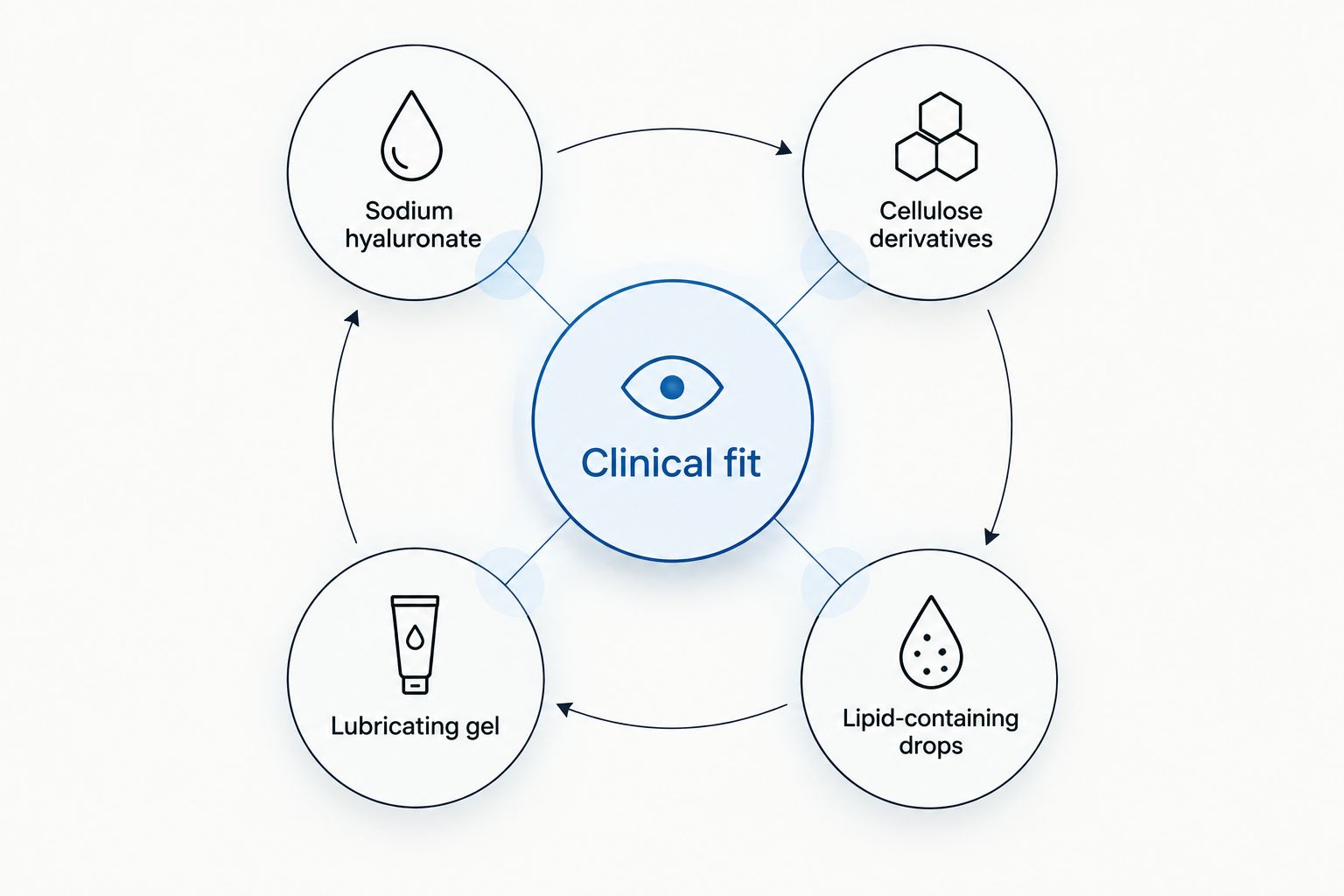
1. Sodium hyaluronate: best for daytime lubrication assessment
Low-viscosity sodium hyaluronate is a formulation to consider when a child needs daytime ocular lubrication after examination. Sodium hyaluronate binds water, but the complete formulation—not the ingredient name alone—determines its characteristics.
Best for: children with assessed dry eye symptoms who need a daytime lubricant and meet the exact product’s instructions. Consider the child’s visual tasks and ability to tolerate instillation.
Sodium hyaluronate pros:
- Provides lubrication without requiring a lipid-containing formulation.
- Offers a lower-viscosity route when a thick gel would interrupt daytime tasks.
- Allows a defined trial of symptom relief with a documented review plan.
Sodium hyaluronate cons:
- Does not treat every cause of discomfort or address lid disease by itself.
- Different concentrations, excipients and containers prevent assumptions across products.
- Stinging or temporary blur still requires attention if persistent or troublesome.
Before recommending sodium hyaluronate, check preservative status and observe administration where practical. Ask the parent to describe whether discomfort occurs during reading, on waking or throughout the day; that history helps assess whether the selected approach fits.
Verdict: Hold until the exact sodium hyaluronate product’s paediatric instructions and clinical fit are confirmed.
2. Cellulose-based lubricants: best for an alternative formulation
Cellulose derivatives, including hypromellose, are used in ocular lubricants. A preservative-free cellulose-based preparation offers a different formulation to assess when a particular hyaluronate product is unsuitable or poorly tolerated.
Best for: children needing an alternative lubricant after a clinician has reviewed why the previous formulation did not suit. An alternative ingredient is not a reason to bypass reassessment.
Cellulose-based lubricant pros:
- Provides another formulation group for individual selection.
- Supports a change in lubricant without assuming that greater viscosity is necessary.
- Allows the clinician to consider the whole formulation alongside handling needs.
Cellulose-based lubricant cons:
- The name “cellulose-based” does not confirm preservative-free status.
- Visual effects and tolerability depend on the exact preparation.
- Changing lubricant will not resolve an incorrect diagnosis.
Distinguish immediate instillation discomfort from symptoms that remain unchanged between doses. Check technique, adherence and the ocular surface before concluding that the lubricant ingredient is responsible.
Verdict: Hold until a preservative-free cellulose-based product meets the child’s requirements and its instructions support use.
3. Lipid-containing drops: best for an evaporative component
Lipid-containing lubricants are relevant when assessment identifies an evaporative contribution to dry eye. They should sit within a management plan that considers the eyelid margins, meibomian glands and blinking, rather than replacing that assessment.
Best for: children with an identified evaporative component for whom the exact lipid-containing preparation is suitable. Symptoms alone do not establish meibomian gland dysfunction.
Lipid-containing drop pros:
- Brings a lipid component into the lubricant choice.
- Provides a formulation category aligned with an evaporative treatment rationale.
- Can accompany clinician-directed management of contributing lid disease.
Lipid-containing drop cons:
- Does not replace treatment of associated inflammation or other lid pathology.
- Emulsions and other lipid-containing formulations differ in composition and handling.
- Some preparations cause temporary visual disturbance after instillation.
Persistent rubbing and prominent itching should also prompt consideration of allergy. The guide to allergy eye drops for patients covers a different treatment category; paediatric suitability still requires checking for the exact medicine.
Avoid treating tear-film evaporation and allergy as mutually exclusive. Where both contribute, the plan needs to address both rather than asking a lubricant to perform the role of an allergy treatment.
Verdict: Hold unless examination supports an evaporative component and the exact lipid-containing product is appropriate for the child.
4. Preservative-free lubricating gel: best for bedtime use
A lubricating gel provides a more viscous option when that characteristic fits the child’s symptoms and treatment plan. Bedtime is a practical setting to consider because temporary blur is less compatible with reading and other daytime visual tasks.
Best for: children whose assessed lubrication needs justify a gel and whose product instructions support use. Morning pain or recurrent symptoms on waking require assessment rather than an automatic switch to a thicker preparation.
Lubricating gel pros:
- Offers a thicker alternative to low-viscosity drops.
- Separates bedtime treatment from the demands of daytime visual tasks.
- Provides another option when the clinician identifies a reason for greater viscosity.
Lubricating gel cons:
- Temporary blur makes gels less convenient before schoolwork or reading.
- A gel is not automatically interchangeable with an ointment.
- Greater thickness does not establish better symptom control for an individual child.
Explain the expected sensation and visual effect before use. If a child resists administration, review the reason rather than assuming that a thicker preparation will solve the problem.
Verdict: Hold until the need for a gel, the timing of administration and product-specific suitability are established.
How the options are ranked
This 2026 guide ranks formulation categories by their place in a clinical decision: daytime lubrication, an alternative formulation, an evaporative indication and bedtime use. It does not present a head-to-head paediatric trial or establish a universally superior ingredient.
The selection criteria remain clinical fit, paediatric instructions, preservative status, visual tolerance, practical administration and review. No formulation wins if the child cannot use it safely or the underlying diagnosis remains unresolved.
Which preservative-free drops should you choose?
For an undecided clinician in 2026, start with diagnosis and product suitability, then assess whether a low-viscosity daytime lubricant meets the need. Reserve lipid-containing drops and gels for a clear formulation-specific reason, rather than treating them as automatic upgrades.
Document the selected preparation, administration instructions and review plan. Give parents a clear route back if treatment is ineffective or difficult to administer.
Before the family leaves, cover these practical points:
- Clean hands: demonstrate hand hygiene before handling the container.
- Clean tip: keep the dispensing tip away from fingers, lashes and the ocular surface.
- Container instructions: explain the exact product’s opening, storage and disposal requirements.
- Observed technique: ask the parent or carer to show how they will administer it.
- Safety advice: explain which symptoms require urgent assessment rather than another dose.
Pain, photophobia, reduced vision, injury or a markedly red eye require prompt clinical assessment. A painful red eye in a contact lens wearer needs urgent attention; do not manage it as uncomplicated dryness.
FAQ
What are the best preservative free eye drops for children?
The best choice is a product that fits the assessed diagnosis and has suitable paediatric instructions. Low-viscosity sodium hyaluronate, cellulose-based lubricants, lipid-containing drops and gels serve different purposes; none is a universal first choice for every child.
Can children use adult preservative-free eye drops?
Do not infer paediatric suitability from an adult recommendation or preservative-free label. Check the exact product’s instructions and obtain advice from the child’s eye care professional before use.
Is sodium hyaluronate better than hypromellose for children?
Neither ingredient is universally better for children. Select the exact formulation according to the diagnosis, paediatric instructions, tolerability and administration needs rather than assuming ingredient-level superiority.
Are preservative-free eye drops completely irritation-free?
No, preservative-free drops can still cause discomfort or temporary blur. Persistent irritation, worsening redness or new symptoms require review of the formulation, technique and diagnosis.
How often should a child use lubricating eye drops?
Follow the exact product’s instructions and the treating clinician’s plan. Do not transfer a dosing schedule from another preparation or increase use repeatedly without reviewing persistent symptoms.
Should a child use a gel instead of daytime drops?
Use a gel only when its greater viscosity fits the assessed need and its instructions support use. Temporary blur can interrupt reading and other visual tasks, so timing matters.
When should parents seek urgent help for a red or dry eye?
Seek prompt assessment for pain, light sensitivity, reduced vision, injury or marked redness. A painful red eye in a contact lens wearer requires urgent attention rather than treatment with lubricants alone.
One last thing
Check handling before changing the formulation. Ask the parent or carer to demonstrate administration: a suitable lubricant is not useful if the drop misses the eye or the container tip repeatedly touches the lashes.
Use Scope Connect’s clinical education alongside that practical check. For your 2026 review, record both symptom response and whether the family can follow the treatment plan; those are separate questions.
Related guides
- Preservative-free eye drops for dry eye disease
- Lid hygiene wipes for anterior blepharitis
- CPD courses on dry eye disease for optometrists