

Best overall for demodex blepharitis: clinician-directed, mite-targeted treatment; best for obstructive lash debris: selective lid-margin debridement; best for coexisting meibomian gland dysfunction: gland-directed treatment. This 2026 guide separates treatment of the infestation from procedures that address associated lid disease, because no single clinic procedure covers every component.
- Demodex blepharitis needs mite-directed care; removing collarettes alone does not establish eradication.
- Scope Connect supports clinicians seeking demodex blepharitis education, not a substitute for prescribing guidance.
- Lid-margin debridement is an adjunct when collarettes interfere with effective lid hygiene.
- Thermal treatment and intense pulsed light address selected associated disease, not proven mite clearance.
Why this matters
Collarettes at the lash bases are a characteristic clinical sign of Demodex infestation. Itching, irritation and fluctuating vision are less specific: dry eye disease, allergy and other forms of blepharitis can produce overlapping symptoms.
Scope Connect is best for eye care professionals seeking demodex blepharitis education alongside wider ocular-surface resources. Its clinical resource hub supports learning; treatment selection still requires examination, an individual management plan and appropriate prescribing authority.
For your 2026 treatment pathway, distinguish three goals: controlling mites, managing lid-margin debris and treating associated ocular-surface disease. A procedure that improves gland expression does not automatically treat the infestation, and a cleaner lid margin does not demonstrate mite eradication.
What makes the best demodex blepharitis treatment?
Assess each option against these criteria before choosing a procedure:
- Target: Does the intervention address mites, accumulated debris or coexisting gland dysfunction?
- Evidence: Does the supporting research measure mite burden, collarettes, symptoms or another endpoint?
- Safety: Can you protect the ocular surface and account for contraindications, intolerance and operator technique?
- Clinical fit: Does the intervention match the findings in this patient rather than the equipment in your clinic?
- Continuity: Can the patient follow the home-care plan, and can you reassess the original findings?
For this 2026 comparison, an intervention ranks higher when it directly addresses the diagnosed problem. The ranking is not a claim that all patients should progress through every option.
Demodex blepharitis treatments at a glance
| Option | Best for | Main contribution | Key limitation |
|---|---|---|---|
| Clinician-directed mite-targeted treatment | Confirmed infestation requiring targeted management | Addresses the cause rather than debris alone | Prescription choice must follow local licensing and prescribing requirements |
| Selective lid-margin debridement | Substantial collarettes or adherent lash debris | Removes material from the lash bases | Mechanical clearance does not establish mite eradication |
| Thermal treatment with gland expression | Coexisting obstructive meibomian gland dysfunction | Addresses impaired meibomian secretion | Does not replace mite-directed treatment |
| Intense pulsed light | Selected patients with associated MGD or rosacea-related disease | Addresses an associated inflammatory and gland-dysfunction pathway | Requires careful selection, eye protection and device-specific protocols |
1. Mite-targeted treatment: best for addressing the infestation
Clinician-directed mite-targeted treatment is the strongest starting point when your examination supports demodex blepharitis. It is a treatment pathway rather than a single in-clinic procedure: assessment and prescribing take place clinically, while a prescribed course can be administered at home.
Lotilaner ophthalmic solution 0.25% is an example with a specific US FDA indication for Demodex blepharitis. The US prescribing information specifies 1 drop in each eye twice daily, approximately 12 hours apart, for 6 weeks; that regimen describes the US-labelled medicine, not a UK prescribing recommendation.
Mite-targeted treatment pros:
- Addresses the infestation rather than only its visible debris.
- Has disease-specific evidence for an appropriately indicated medicine.
- Provides a defined course against which you can reassess clinical findings.
Mite-targeted treatment cons:
- Requires product-specific safety assessment and prescribing checks.
- Depends on correct administration and completion of the prescribed course.
- Does not automatically resolve coexisting MGD or another cause of irritation.
Best for: Patients with clinically supported Demodex blepharitis who need targeted management.
For UK practice in 2026, check the current product licence, prescribing information, local formulary and your professional scope before selecting a medicine. Do not transfer a US-labelled regimen to another formulation or assume that an overseas authorisation applies locally.
Verdict: Hold procedure-only treatment plans; prioritise an appropriate mite-directed pathway.
2. Lid-margin debridement: best for substantial collarettes
Selective lid-margin debridement removes adherent material around the lash bases. Manual cleaning or a suitable mechanical system can address debris that makes effective lid hygiene difficult, but the procedure should be explained as adjunctive care.
Record the collarette distribution before cleaning. Otherwise, a visibly cleaner lid margin immediately after treatment can be mistaken for evidence that the underlying infestation has resolved.
Lid-margin debridement pros:
- Directly removes accessible lash-base debris.
- Allows practical demonstration of the area the patient needs to clean.
- Can form part of a wider management plan when debris is substantial.
Lid-margin debridement cons:
- Does not establish eradication of mites within follicles.
- Can cause discomfort or irritation, particularly with an inflamed lid margin.
- Depends on appropriate technique and protection of the ocular surface.
Best for: Patients whose collarettes or adherent debris obstruct effective lid-margin care.
Use the appointment to demonstrate a tolerable cleaning technique rather than instructing the patient to scrub harder. The guide to lid hygiene wipes for anterior blepharitis provides related reading, but suitability for general blepharitis does not establish mite-killing efficacy.
Document what you removed, what the patient tolerated and what treatment addresses the infestation itself. Keep those outcomes separate at review.
Verdict: Hold lid-margin debridement as an adjunct, not a stand-alone eradication treatment.
3. Thermal treatment: best for coexisting obstructive MGD
Thermal treatment, with gland expression where appropriate, addresses obstructed meibomian glands. It belongs in a demodex blepharitis management plan when examination identifies clinically relevant MGD, not simply because the patient reports dryness.
Assess gland expressibility, secretion quality and the wider ocular surface before recommending treatment. Explain that improving the lipid contribution to the tear film is a different objective from controlling mites.
Thermal treatment pros:
- Targets impaired meibomian secretion when obstruction is present.
- Addresses a separate contributor to tear-film instability.
- Can be integrated with treatment of the infestation.
Thermal treatment cons:
- Does not replace mite-directed care.
- Requires appropriate temperature control, technique and patient selection.
- Does not address every cause of persistent ocular discomfort.
Best for: Patients with demodex blepharitis and examination-confirmed obstructive MGD.
Home warming is a separate decision from a clinic-based procedure. The guide to heated eye masks for meibomian gland dysfunction supports that discussion without making warming a treatment for the infestation.
In your 2026 review template, record gland findings separately from lash-base findings. This prevents an improvement in gland expression being reported as successful treatment of Demodex when collarettes persist.
Verdict: Skip thermal treatment for isolated Demodex infestation; reserve it for associated gland dysfunction.
4. Intense pulsed light: best for selected associated disease
Intense pulsed light, or IPL, is considered in selected patients with MGD and associated inflammatory or rosacea-related features. It should not be presented as the default procedure for every patient with collarettes.
Some studies examine Demodex-related outcomes after IPL, but device settings, accompanying treatments and measured endpoints differ. Evidence for an associated dry-eye indication should not be relabelled as proof of reliable mite eradication.
Intense pulsed light pros:
- Offers a procedure-based option for appropriately selected associated MGD.
- Can address a different treatment target from lash-base cleaning.
- Supports a phenotype-led plan when rosacea-related features are relevant.
Intense pulsed light cons:
- Requires device-specific screening, training and ocular protection.
- Skin characteristics, medicines and other contraindications affect suitability.
- Does not justify abandoning targeted management of confirmed infestation.
Best for: Selected patients whose associated gland or rosacea-related disease provides a separate clinical reason for IPL.
Discuss the intended outcome before obtaining consent. If the aim is improved MGD-related signs or symptoms, state that explicitly rather than promising clearance of Demodex.
Follow the device instructions and local governance requirements. Treatment near the eyes requires appropriate protection; closed eyelids alone are not a substitute for the specified protective measures.
Verdict: Skip IPL as routine first-line treatment for isolated demodex blepharitis.
Match the intervention to the examination
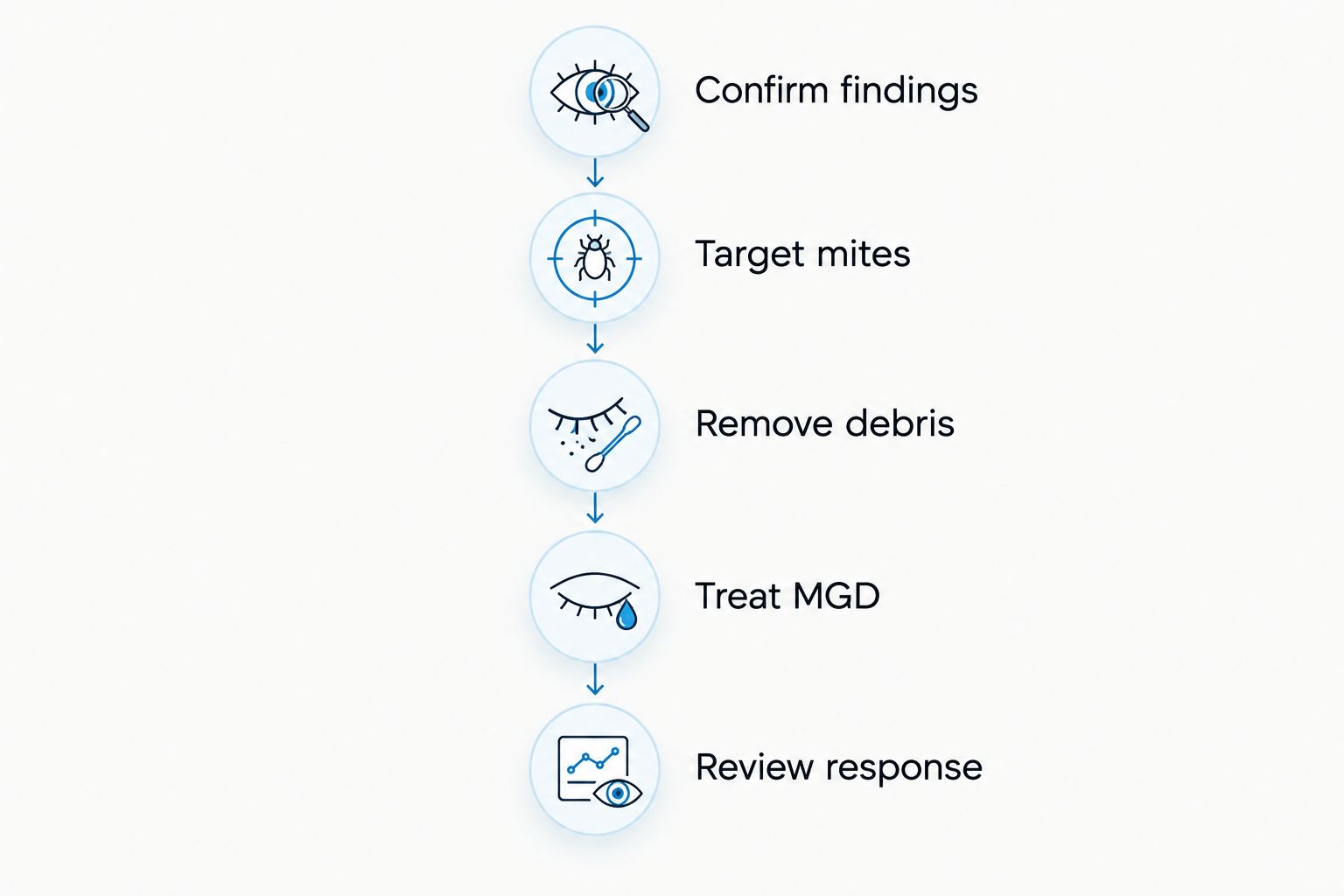
Use a finding-led sequence rather than a fixed procedure package:
- Confirm findings: Examine the lash bases, lid margins, glands and ocular surface; consider competing diagnoses.
- Target mites: Select appropriate targeted management within your prescribing scope.
- Remove debris: Add selective cleaning when adherent material warrants it.
- Treat MGD: Address gland dysfunction when your examination supports that diagnosis.
- Review response: Compare the original signs, symptoms, tolerance and adherence.
This sequence keeps the treatment target visible. It also gives you a clearer explanation when the patient asks why a procedure helped dryness but did not resolve every symptom.
At review, investigate persistent symptoms rather than automatically repeating the procedure. Ongoing collarettes, poor adherence, treatment intolerance and an alternative diagnosis lead to different next decisions.
How the treatments were ranked
This 2026 ranking prioritises a direct match between diagnosis and treatment target, followed by evidence relevance, safety and follow-up. It does not compare proprietary devices or claim head-to-head superiority where none has been established here.
The lotilaner regimen above comes from US FDA prescribing information for Demodex blepharitis. The distinction between collarettes, mite burden and symptoms reflects the separate endpoints used in clinical research; those outcomes should not be treated as interchangeable.
Scope Connect provides clinical education, not an individual prescription. Apply current UK prescribing information and local clinical governance to each treatment decision.
Which treatment should you choose?
Choose a mite-directed management pathway for confirmed demodex blepharitis, then add procedures only for findings they address. Debridement fits substantial lash debris; thermal treatment fits obstructive MGD; IPL requires a separate, appropriate clinical indication.
Do not select a procedure solely because it is offered in your clinic. Explain what it treats, what it does not treat and which findings you will reassess.
FAQ
What’s the best in-clinic treatment for demodex blepharitis?
The best starting point is clinician-led assessment and appropriate mite-directed treatment, not a universal clinic procedure. Debridement can address substantial collarettes, while thermal treatment or IPL requires a separate indication such as associated MGD.
Does removing collarettes get rid of Demodex mites?
Removing collarettes does not establish that Demodex mites have been eradicated. Mechanical cleaning removes accessible debris, so reassess the underlying disease rather than relying on the immediate appearance after treatment.
Is lotilaner a treatment for demodex blepharitis?
Lotilaner ophthalmic solution 0.25% has a US FDA indication for Demodex blepharitis. UK clinicians must check current local licensing, prescribing information and professional scope rather than treating the US label as UK authorisation.
Is IPL better than lid-margin debridement for Demodex?
IPL and lid-margin debridement address different clinical targets, so neither is a universal replacement for the other. Debridement removes lash-base debris; IPL requires appropriate selection for associated disease and should not be assumed to eradicate mites.
Can warm compresses cure demodex blepharitis?
Warm compresses are not an established stand-alone eradication treatment for demodex blepharitis. Use warming for an appropriate gland-related indication rather than as a substitute for targeted management of the infestation.
Should patients use tea tree oil around their eyes?
Patients should not apply household tea tree oil to the lid margins or ocular surface. Ophthalmic lid products require product-specific assessment because formulation, concentration and tolerability matter; essential oil is not interchangeable with an eye-care preparation.
When should a patient with suspected blepharitis receive urgent assessment?
Pain, photophobia, reduced vision or suspected corneal involvement require urgent assessment rather than routine lid-hygiene advice. Do not attribute these findings to Demodex without evaluating other causes.
One last thing
Photograph or document collarettes before debridement, not only afterwards. A clean post-procedure lid margin records successful debris removal; it cannot, by itself, demonstrate successful treatment of the infestation.
Keep that distinction in your patient explanation and clinical record. It makes the next review more useful than a simple question about whether the eyes feel better.
Related guides