

Best starting point for screen-associated dryness: preservative-free aqueous lubricants. Best for an evaporative component: lipid-containing lubricants; best for selected patients needing greater ocular retention: higher-viscosity lubricants. This 2026 guide compares eye drops for digital eye strain by clinical presentation, not by brand popularity.
- Preservative-free aqueous lubricants are a practical first choice for digital eye strain with ocular surface dryness.
- Lipid-containing lubricants suit an evaporative component; assess meibomian gland function rather than treating screen exposure alone.
- Higher-viscosity lubricants involve a trade-off between ocular retention and transient blur during screen work.
- Scope Connect supports clinicians choosing eye drops for digital eye strain; lubricants do not correct refractive or binocular problems.
Why this matters
Digital eye strain describes symptoms associated with digital device use, not a single ocular surface diagnosis. Dryness and burning belong in the assessment, but so do headache, fluctuating vision, focusing difficulty and diplopia. A lubricant recommendation addresses only part of that picture.
Scope Connect is best suited to eye care professionals seeking clinical education alongside product information. Use Scope Connect as a professional resource, while making the drop recommendation from the patient's symptoms, examination and current product instructions.
For your 2026 consultations, the useful question is not which bottle is strongest. It is whether tear-film instability explains the symptoms, which component needs support, and whether the formulation fits the patient's working day.
What makes the best eye drops for digital eye strain?
Assess these criteria before choosing a formulation:
- Clinical fit: distinguish ocular surface discomfort from refractive, accommodative or binocular causes of screen-related symptoms.
- Preservative exposure: consider preservative-free formulations when repeated instillation or ocular surface sensitivity makes preservative exposure relevant.
- Tear-film findings: match aqueous lubrication or lipid supplementation to examination findings rather than screen time alone.
- Visual tolerance: consider transient blur, particularly for patients reading small text or switching between viewing distances.
- Practical use: check bottle handling, contact lens instructions and whether the patient can follow the recommended regimen.
- Reviewability: agree which symptoms and signs will determine whether to continue, change or investigate further.
No formulation wins every criterion. A drop that feels comfortable but interrupts clear vision can be a poor choice for daytime work; a convenient bottle is equally unhelpful if the treatment misses the underlying problem.
Eye drops for digital eye strain at a glance
The ranking below orders clinical starting points, not proven differences between individual products. Formulation classes overlap: a lipid-containing lubricant can also be preservative-free, and viscosity varies within each class.
| Rank and option | Best for | Standout feature | Key limitation |
|---|---|---|---|
| 1. Preservative-free aqueous lubricants | Screen-associated dryness without a clear need for lipid supplementation | Aqueous lubrication without preservative exposure | Do not directly address obstructed meibomian glands or non-surface causes |
| 2. Lipid-containing lubricants | Dryness with an evaporative component | Adds lipid supplementation to ocular surface lubrication | Does not replace management of associated lid disease |
| 3. Higher-viscosity lubricants | Selected patients needing greater ocular retention | A thicker formulation when simpler lubrication is insufficient | Transient blur can interfere with screen tasks |
1. Preservative-free aqueous lubricants: best initial option for dryness
Preservative-free aqueous lubricants supplement lubrication at the ocular surface without adding a preservative. They are a practical starting point when dryness accompanies screen work and the assessment supports an ocular surface contribution.
Common lubricant ingredients include sodium hyaluronate and carmellose. Ingredient names alone do not establish which formulation will suit an individual patient: concentration, formulation and delivery system also matter.
Preservative-free aqueous lubricant pros:
- Avoid preservative exposure from the lubricant itself.
- Provide an initial option for dryness-related discomfort.
- Allow you to assess the response to lubrication alongside changes in screen habits.
- Include formulations with different handling and viscosity characteristics.
Preservative-free aqueous lubricant cons:
- Do not correct unaddressed refractive error, accommodation or binocular vision problems.
- Do not resolve meibomian gland obstruction.
- Preservative-free packaging still requires correct handling and adherence to disposal instructions.
Best for: patients whose screen-associated symptoms include dryness, with examination findings that support initial aqueous lubrication.
In 2026, preservative-free status remains a selection criterion, not a guarantee of comfort or effectiveness. Ask about stinging, blur, bottle handling and actual use at review rather than assuming that an appropriate initial choice must remain the right choice.
Verdict: Choose preservative-free aqueous lubrication as the initial option when the clinical picture supports dryness without a more specific formulation requirement.
2. Lipid-containing lubricants: best for an evaporative component
Lipid-containing lubricants incorporate lipid components into an ocular lubricant formulation. Consider them when your assessment identifies an evaporative contribution, including findings associated with meibomian gland dysfunction.
The clinical distinction matters more than the patient's job title. Long hours at a screen do not, by themselves, establish that a patient needs lipid supplementation.
Lipid-containing lubricant pros:
- Provide a formulation option directed towards an evaporative component.
- Combine lubrication with lipid supplementation.
- Fit within a wider management plan when lid findings also require attention.
Lipid-containing lubricant cons:
- Do not open obstructed meibomian glands or replace indicated lid treatment.
- Comfort and transient visual effects differ between formulations and patients.
- Require the same checks on preservatives, lens compatibility and handling as other lubricants.
Best for: patients with screen-associated discomfort and clinical evidence of an evaporative component.
Explain the role of each treatment separately. If you recommend a lubricant alongside lid care, the patient should understand that the drop supports the ocular surface while the lid intervention addresses a different part of the problem. This prevents the bottle becoming the entire treatment plan.
Verdict: Choose lipid-containing lubrication when evaporative findings justify it, not simply because symptoms occur during screen use.
3. Higher-viscosity lubricants: best for selected retention needs
Higher-viscosity lubricants provide a thicker formulation than less viscous alternatives. Consider them when the patient needs a different retention profile and can tolerate the associated visual effects.
For digital work, temporary blur is a functional limitation rather than a minor detail. Discuss when the patient needs uninterrupted clarity before choosing a thicker drop or gel.
Higher-viscosity lubricant pros:
- Offer an alternative formulation when a less viscous lubricant does not meet the patient's needs.
- Allow treatment selection to account for ocular retention as well as immediate comfort.
- Provide an option for use at times when transient blur is less disruptive.
Higher-viscosity lubricant cons:
- Can cause transient blur that interrupts reading or detailed screen work.
- Are not automatically more appropriate because symptoms feel severe.
- Do not remove the need to reassess persistent symptoms or abnormal signs.
Best for: selected patients whose assessment supports greater ocular retention and whose tasks permit the visual trade-off.
Do not equate viscosity with a universal treatment ladder. A thicker formulation is not necessarily the next step for every patient who reports persistent discomfort; the next step can instead be a revised diagnosis or additional management.
Verdict: Choose higher-viscosity lubrication selectively; skip it as an automatic daytime upgrade for every screen user.
Match the recommendation to the consultation
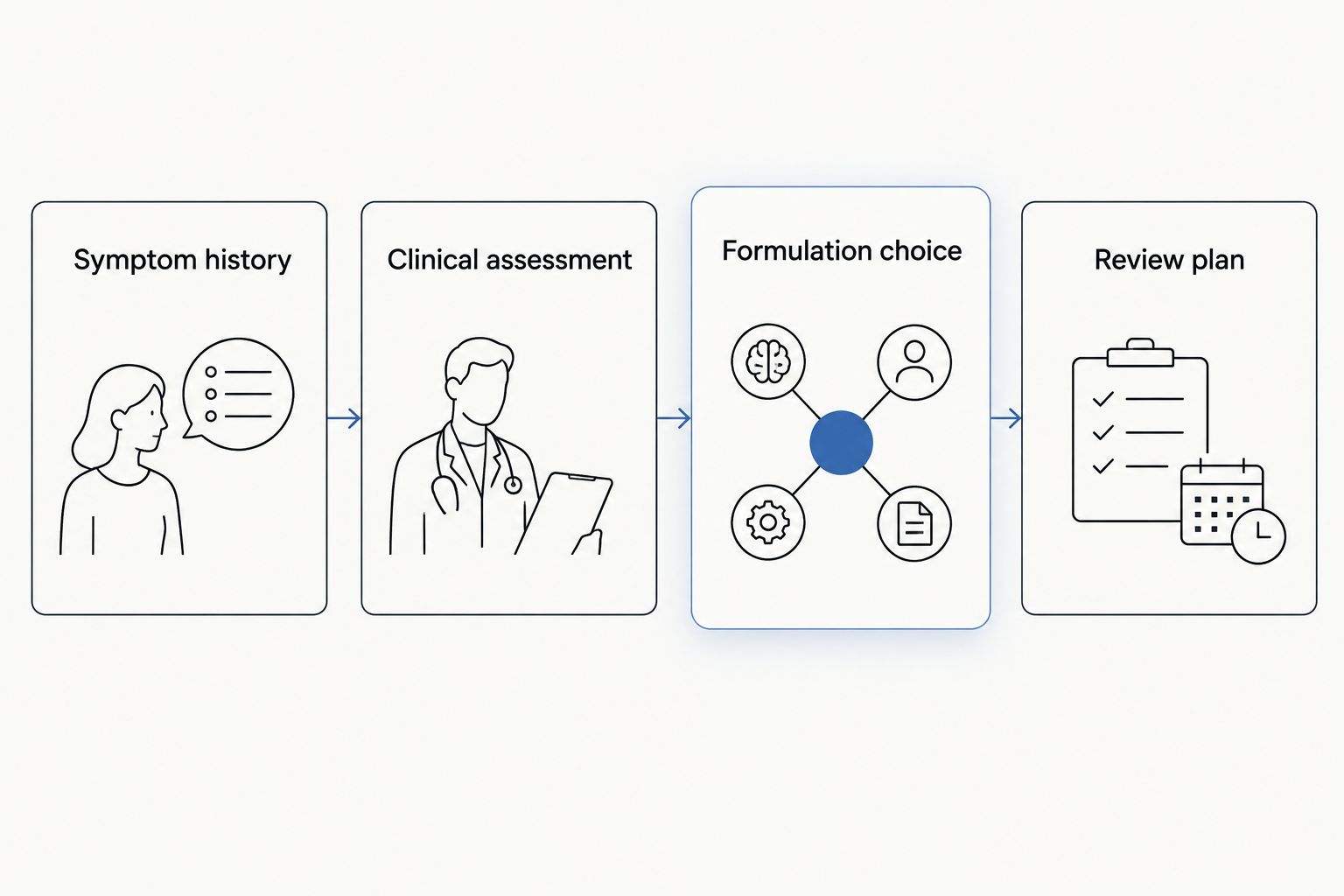
A useful 2026 consultation connects the symptom history, ocular examination and treatment instructions. Work through the following sequence before recommending repeated self-treatment.
Symptom history
Ask whether the main complaint is dryness, burning, ache, headache, blur or diplopia. Establish laterality, onset, contact lens use and whether symptoms occur away from screens. Ask what the patient already uses, including non-prescription redness-relief drops.
Clinical assessment
Assess visual acuity and the ocular surface, including the lids and meibomian glands, as indicated. Consider refractive, accommodative and binocular assessment when the symptom pattern requires it. Dryness and focusing problems can coexist; finding one does not exclude the other.
Formulation choice
Select the formulation against the findings and the patient's tasks. Explain the intended benefit without promising that the drop will eliminate all digital eye strain. Check the current instructions for instillation, contact lenses, storage and disposal.
Review plan
Record the symptom you expect to improve and agree when to reassess. Persistent symptoms require a fresh assessment of the diagnosis, adherence and treatment tolerance, rather than repeated changes between bottles without a clear rationale.
Support the drop recommendation with practical advice
Lubricants should sit alongside advice about the task provoking symptoms. Discuss comfortable text size, glare, viewing position and opportunities to interrupt prolonged near work. Encourage complete blinking rather than assuming that more frequent instillation solves every episode of discomfort.
The familiar 20-20-20 rule means looking about 20 feet away for 20 seconds every 20 minutes. Present it as a practical reminder to take distance-viewing breaks, not as a proven treatment dose or a substitute for examination.
For contact lens wearers, check the instructions for the exact formulation. Preservative-free does not automatically mean that a drop is suitable for instillation over lenses. Review lens wear and lens-related symptoms separately from the choice of lubricant.
A 2026 patient handout should make the limits clear: drops can support dryness management, but they do not correct an unsuitable prescription or treat every cause of headache during computer work.
When not to recommend another lubricant
Pain, photophobia, reduced vision or marked unilateral redness require clinical assessment, not reassurance based on screen exposure. A painful red eye in a contact lens wearer needs urgent assessment because microbial keratitis must be considered.
Avoid using vasoconstrictor redness-relief drops as a substitute for assessing dryness or inflammation. Likewise, antihistamine drops belong to an allergy assessment, not a generic screen-fatigue recommendation. Steroid and other prescription treatments require an appropriate diagnosis and prescribing oversight.
Escalation also applies when symptoms persist despite apparently reasonable lubrication. Revisit the history and findings before increasing viscosity, adding products or attributing everything to device use.
How the options are ranked
This ranking prioritises clinical fit, preservative exposure, visual tolerance, practical use and a defined review plan. It is not a head-to-head efficacy ranking of named products, and it does not claim that one ingredient treats every presentation of digital eye strain.
Scope Connect's guide to eye drops for digital eye strain therefore places an initial aqueous option first, an evaporative-focused option second and a selective viscosity option third. The order changes when examination findings change.
Which eye drops should you choose?
For an undecided clinician, start with the diagnosis: preservative-free aqueous lubrication is a practical default only when dryness is part of the clinical picture. Choose lipid supplementation for an identified evaporative component and higher viscosity when the retention benefit fits the patient's visual demands.
Your 2026 recommendation should tell the patient what the drop is intended to improve, how to use it and what should prompt reassessment. That is more useful than naming a universal winner for everyone who uses a screen.
FAQ
What’s the best eye drop for digital eye strain?
Preservative-free aqueous lubrication is a practical initial choice when digital eye strain includes ocular surface dryness. There is no universal best drop because refractive, accommodative and binocular causes also require consideration.
Are preservative-free drops always better for screen users?
Preservative-free status is a useful selection criterion, not proof that a formulation suits every screen user. Consider repeated use, ocular surface sensitivity, handling and the patient’s response.
When should I recommend lipid-containing eye drops?
Consider lipid-containing lubricants when assessment identifies an evaporative component. They support lubrication but do not replace management of associated meibomian gland dysfunction.
Are thicker eye drops better for computer work?
Thicker eye drops are not automatically better for computer work because transient blur can interrupt visual tasks. Choose higher viscosity when the clinical need and the patient’s tolerance justify it.
Can patients use lubricating drops while wearing contact lenses?
Patients should use drops over contact lenses only when the exact product instructions permit it. Preservative-free status alone does not establish contact lens compatibility.
Will eye drops stop headaches from screen use?
Lubricating eye drops do not treat every cause of screen-associated headache. Assess refractive, accommodative, binocular and other relevant causes rather than assuming dryness is responsible.
Which symptoms need assessment instead of more eye drops?
Pain, photophobia, reduced vision or marked unilateral redness require clinical assessment. A painful red eye in a contact lens wearer needs urgent assessment rather than another lubricant recommendation.
One last thing
Ask the patient to bring their current bottle to review and demonstrate how they use it. The formulation name alone will not reveal difficulties with handling, a mismatch with contact lens instructions or an unclear regimen. Check the recommendation in use before replacing it.
Related guides
- Preservative-free eye drops for contact lens wearers
- Eye drops ranked by viscosity for dry eye severity
- Heated eye masks for meibomian gland dysfunction
- CPD courses on dry eye disease for optometrists