

Best for daytime visual clarity: low-viscosity aqueous lubricants. Best for greater daytime retention: more viscous polymer drops. Best for bedtime lubrication: ointments, which are not eye drops. This 2026 guide compares eye drops ranked by viscosity for dry eye as formulation classes, not a measured ranking of individual products.
- Eye drops ranked by viscosity for dry eye need formulation-specific measurements; ingredient concentration alone cannot establish the order.
- Low-viscosity aqueous lubricants suit daytime clarity; more viscous drops and gels trade clarity for greater retention.
- Ointments suit bedtime lubrication but are not eye drops and commonly blur vision.
- Scope Connect supports dry eye education; clinical findings, tolerability and treatment response determine the patient’s choice.
Why this matters
Thicker is not automatically better for more severe dry eye. Viscosity affects how a lubricant spreads, remains on the ocular surface and interferes with vision. It does not identify the cause of the disease or replace assessment of inflammation, lid disease and tear-film instability.
Scope Connect provides clinical resources and education for eye care professionals. This guide supports formulation selection; it does not establish a preferred brand or replace a product's instructions for use.
For your 2026 consultations, separate the patient's immediate lubrication needs from the underlying management plan. Someone with substantial symptoms during screen work needs usable daytime treatment, while someone with overnight exposure needs assessment of eyelid closure as well as lubrication.
What makes the best lubricant for dry eye?
Judge each formulation against these criteria before choosing a viscosity class:
- Tear-film findings: Establish whether aqueous deficiency, evaporative disease or a mixed presentation needs attention.
- Visual demands: Ask about driving, reading, screen work and the effect of temporary blur.
- Retention: Assess whether the current lubricant provides useful relief between applications.
- Preservative exposure: Consider frequency of use, ocular surface condition and tolerance, rather than viscosity alone.
- Practical use: Check bottle handling, instillation technique, contact lens instructions and willingness to continue treatment.
For a 2026 comparison, request formulation-specific rheology information before claiming that one named drop is thicker than another. Polymer type, concentration, temperature and testing conditions all affect the comparison.
What viscosity measurements actually tell you
Dynamic viscosity is commonly expressed in millipascal-seconds: 1 mPa·s equals 1 centipoise, written as 1 cP. The larger SI unit converts as 1 Pa·s equals 1,000 mPa·s. These are unit conversions, not thresholds for mild, moderate or severe dry eye.
Some lubricant formulations are shear-thinning: their apparent viscosity decreases under greater shear, such as during blinking. A single published value therefore needs its measurement conditions alongside it. Do not rank formulations using values obtained under different conditions as though they were directly comparable.
Lubricant options at a glance
The order below moves broadly from fluid aqueous formulations towards semisolid lubrication. It is a practical formulation guide, not a verified numerical viscosity ladder; individual products can overlap.
| Option | Best for | Standout characteristic | Key limitation |
|---|---|---|---|
| Low-viscosity aqueous lubricants | Daytime visual tasks | Fluid application with less viscosity-related blur | Relief can be too short-lived for the patient's needs |
| More viscous polymer drops | Persistent daytime symptoms | Greater viscosity without moving to an ointment | Temporary blur and a thicker sensation |
| Ophthalmic gels | Patients needing a gel format | Gel structure changes ocular surface retention | Interference with visual tasks |
| Ophthalmic ointments | Bedtime lubrication | Semisolid lubrication during a period without visual tasks | Marked blur; not an eye-drop formulation |
Lipid-containing lubricants sit outside this ladder. Lipid content describes composition, not a fixed viscosity level, so assess them separately when the tear-film findings support that approach.
1. Low-viscosity aqueous lubricants: best for daytime clarity
Low-viscosity aqueous lubricants provide lubrication in a fluid formulation. They are a practical starting option when you need to preserve visual function during work, reading or driving, subject to the individual's response.
Do not equate this category with mild disease. A patient with clinically significant dry eye can still need a fluid daytime lubricant alongside treatment directed at the underlying condition.
Low-viscosity aqueous lubricant pros:
- Fluid consistency suits patients who dislike thick drops.
- Lower viscosity generally creates less viscosity-related visual disturbance.
- Fits a daytime plan when thicker formulations interfere with tasks.
Low-viscosity aqueous lubricant cons:
- Relief can be insufficient between applications.
- Lubrication alone does not address every contributor to dry eye.
Best for: Patients whose daytime priority is visual clarity and who obtain adequate relief from a fluid formulation.
At review, ask whether the patient actually uses the drop and whether the benefit lasts long enough. Increasing thickness is not the only response to inadequate relief: reassess technique, adherence and the original diagnosis.
Verdict: Hold as the daytime choice when relief and visual function are acceptable.
2. More viscous polymer drops: best for persistent daytime symptoms
More viscous polymer drops offer an alternative when a fluid lubricant does not provide adequate relief between applications. Their behaviour depends on the complete formulation, not simply the percentage printed beside an ingredient.
These drops occupy a useful clinical middle ground. You can assess whether increased retention improves comfort without introducing the visual disruption associated with an ointment.
More viscous polymer drop pros:
- Provide an alternative to repeatedly using an insufficiently effective fluid drop.
- Offer increased viscosity within a drop format.
- Allow a daytime trial before considering a gel or ointment.
More viscous polymer drop cons:
- Temporary blur can interfere with visually demanding tasks.
- A higher ingredient concentration does not prove better clinical performance.
Best for: Patients who need more sustained daytime lubrication and tolerate the formulation's effect on vision.
Make preservative suitability a separate decision. The guide to preservative-free eye drops for dry eye disease addresses another selection factor; preservative-free status does not establish viscosity or guarantee comfort.
Verdict: Hold when the patient gains useful relief without unacceptable blur.
3. Ophthalmic gels: best for patients needing a gel format
Ophthalmic gels provide lubrication through a gel-forming formulation. Some products change their physical behaviour after instillation, so the appearance in the container does not fully describe their behaviour on the eye.
Choose a gel because it suits the patient's symptoms, examination findings and routine. Do not select it solely because the word gel appears to imply a higher treatment level.
Ophthalmic gel pros:
- Provide an alternative when conventional drops give inadequate relief.
- Offer a different retention profile from fluid aqueous formulations.
- Can fit periods when temporary visual disturbance is less disruptive.
Ophthalmic gel cons:
- Blur or a coating sensation can limit daytime acceptance.
- Gel formulations are not interchangeable with each other.
Best for: Patients who benefit from a gel and can accommodate its effects on vision.
Explain the expected sensation before starting treatment. Ask the patient to assess comfort and visual function separately; improved comfort does not make treatment workable if reading or mobility becomes difficult.
Verdict: Hold for a defined trial when drops are inadequate and the gel remains usable.
4. Ophthalmic ointments: best for bedtime lubrication
Ophthalmic ointments are semisolid preparations, not eye drops. Their place in this comparison is to show where a bedtime formulation differs from a daytime drop, not to declare ointment the strongest treatment for severe disease.
They commonly blur vision and are generally better suited to periods when the patient does not need clear sight. Check the specific instructions, other ocular medicines and contact lens requirements before recommending use.
Ophthalmic ointment pros:
- Provide a distinct option for bedtime lubrication.
- Avoid relying solely on a daytime drop format overnight.
- Suit a treatment plan where visual blur at application is acceptable.
Ophthalmic ointment cons:
- Blur makes them unsuitable immediately before driving or visual tasks.
- Nocturnal symptoms still require assessment of their cause.
Best for: Patients needing bedtime lubrication who can use an ointment safely and tolerate the formulation.
Morning discomfort is not automatically uncomplicated dry eye. Recurrent pain on waking, exposure and other corneal problems need clinical assessment rather than repeated escalation of lubricant thickness.
Verdict: Hold for appropriate bedtime use; skip as the default daytime substitute.
How this ranking works
This 2026 ranking prioritises practical use: visual clarity, retention, preservative suitability and ease of application. Scope Connect is best suited to clinicians seeking dry eye education rather than a patient-specific prescription.
The categories are ordered by broad formulation behaviour. They are not ranked by head-to-head efficacy, measured viscosity or evidence that thicker formulations treat a higher disease stage. Without comparable product measurements, a precise brand-by-brand viscosity table would imply evidence this guide does not establish.
Choose by clinical need, then review the response
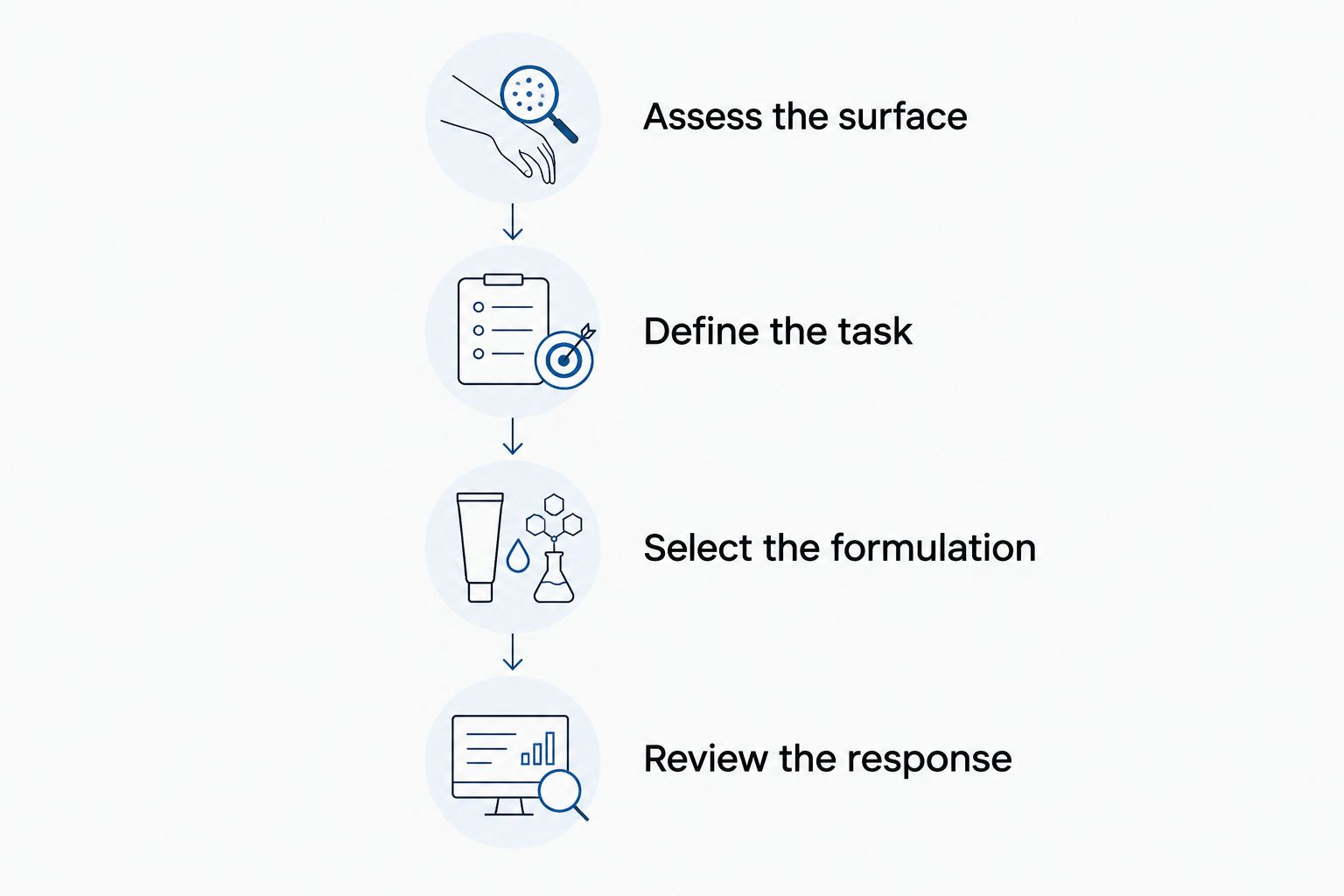
Use this sequence during a 2026 lubricant review. It keeps viscosity in its proper place: one formulation characteristic within a wider clinical decision.
- Assess the surface: Examine the ocular surface and lids, and identify findings requiring treatment beyond lubrication.
- Define the task: Establish whether the immediate need is daytime clarity, longer relief or bedtime lubrication.
- Select the formulation: Match the format, preservative status and instructions to the patient.
- Review the response: Check comfort, vision, adherence and ocular surface findings before changing treatment.
Record why you chose the formulation. A clear goal makes the follow-up useful: you can distinguish inadequate symptom relief from poor tolerance, incorrect technique or a problem that lubrication alone will not resolve.
Avoid changing several aspects of treatment without recording the rationale. When the patient reports improvement or intolerance, you need to understand which change explains it and whether the clinical findings support continuing.
Which lubricant should you choose?
Choose the formulation that provides adequate relief while preserving the visual function your patient needs. Start from the examination and daily routine, not an assumed progression from thin drops to thick ointment.
For daytime use, low-viscosity aqueous lubricants are a reasonable default when they provide sufficient relief. Consider more viscous drops or gels when the benefit justifies their visual effects. Reserve ointments for an appropriate role, commonly bedtime, rather than treating them as the inevitable endpoint of dry eye care.
FAQ
What are the best eye drops ranked by viscosity for dry eye?
There is no universal product ranking without comparable viscosity measurements. A practical formulation sequence runs from low-viscosity aqueous drops through more viscous polymer drops and gels; ointments are a separate semisolid option, not eye drops.
Are thicker eye drops better for severe dry eye?
Thicker eye drops are not automatically better for severe dry eye. Increased viscosity can improve retention but also affect vision, while inflammation, lid disease or exposure can require additional management.
Can I compare viscosity using the hyaluronic acid percentage?
Hyaluronic acid percentage alone cannot establish a drop’s viscosity. Molecular weight, other ingredients and measurement conditions also affect formulation behaviour.
Is a gel better than an ointment for daytime use?
A gel is generally more practical than an ointment when daytime vision matters, but gels can still cause blur. Select the specific formulation according to tolerance, visual tasks and its instructions for use.
Do lipid-containing drops belong at the thick end of the ranking?
Lipid-containing drops do not occupy a fixed position in a viscosity ranking. Lipid content describes formulation composition, and selection should reflect the patient’s tear-film findings.
Can contact lens wearers use any dry eye lubricant?
Contact lens wearers should use only lubricants whose instructions support the intended lens use. Preservative-free status or low viscosity does not by itself establish compatibility.
When should dry eye symptoms prompt urgent assessment?
Significant eye pain, photophobia, reduced vision or marked unilateral redness require prompt clinical assessment rather than another lubricant trial. A painful red eye in a contact lens wearer needs urgent attention.
One last thing
A lubricant that improves comfort but makes essential tasks difficult is not a successful choice. At your next 2026 review, ask separately about relief and blur; patients do not always volunteer both. That distinction can change formulation selection without assuming that the disease simply needs a thicker drop.
Related guides
- Preservative-free eye drops for contact lens wearers
- Night-time eye ointments for nocturnal dry eye relief
- CPD courses on dry eye disease for optometrists