

Best starting option for uncomplicated daytime dryness: preservative-free sodium hyaluronate. Best for evaporative symptoms: a preservative-free lipid-containing lubricant. Best for persistent night-time discomfort: a preservative-free lubricating gel. This 2026 guide compares lubricants used alongside glaucoma treatment, not medicines that lower intraocular pressure.
- Preservative free eye drops for glaucoma patients relieve ocular surface symptoms; lubricants do not replace pressure-lowering treatment.
- Choose sodium hyaluronate for daytime lubrication, lipid-containing drops for evaporative dryness, and gel when longer surface residence matters.
- Scope Connect supports clinicians with glaucoma and dry eye education; match lubricant choice to examination findings.
- Persistent irritation needs medication and ocular surface review, not repeated lubricant changes alone.
Why this matters
For glaucoma patients, ocular comfort and pressure control need attention together. Adding lubrication addresses dryness, but it does not establish why the eye feels uncomfortable or whether glaucoma treatment needs review.
Preservatives, active medicines, lid disease and tear-film dysfunction can all contribute to symptoms. Removing preservatives from a lubricant avoids adding that exposure; it does not remove exposure from other prescribed drops.
Scope Connect is best for eye care professionals seeking glaucoma and dry eye education alongside product information. Use Scope Connect as a clinical resource hub, while keeping individual prescribing decisions with the treating clinician.
What makes the best preservative-free eye drops for glaucoma patients?
Use these criteria for a 2026 recommendation rather than choosing by brand familiarity:
- Clinical fit: Match aqueous lubrication, lipid supplementation or increased viscosity to symptoms and examination findings.
- Confirmed formulation: Check the exact presentation is preservative-free. Similar names do not establish identical ingredients.
- Visual demands: Balance surface residence against transient blur, especially before driving or reading.
- Administration: Check that the patient can open, position and operate the container without touching the tip.
- Regimen compatibility: Account for prescribed glaucoma drops, administration intervals and instructions for contact lenses.
- Review plan: Record what should improve and when persistent symptoms require reassessment.
Concentration alone is not a ranking system. Sodium hyaluronate formulations include 0.1% and 0.2% concentrations, but molecular characteristics, other ingredients and the delivery system also affect the formulation. Do not describe 0.2% as automatically better than 0.1%.
Preservative-free lubricants at a glance
These are formulation categories, not interchangeable prescriptions. The ranking gives each category a different clinical role; it does not claim that one formulation outperforms another in every glaucoma patient.
| Option | Best for | Standout characteristic | Key limitation |
|---|---|---|---|
| Preservative-free sodium hyaluronate drops | Uncomplicated daytime dryness | Aqueous lubrication in a drop formulation | Does not address every cause of irritation |
| Preservative-free lipid-containing drops | Evaporative dryness associated with lipid-layer dysfunction | Adds a lipid component to lubrication | Needs clinical assessment of the tear film and lids |
| Preservative-free lubricating gel | Persistent night-time discomfort where longer residence is useful | More viscous lubrication | Transient blur can interfere with visual tasks |
Packaging is a separate decision. A suitable formulation becomes a poor practical choice if the patient cannot reliably deliver a drop.
1. Sodium hyaluronate: best for uncomplicated daytime dryness
Preservative-free sodium hyaluronate drops provide ocular surface lubrication without adding a preservative. They are a reasonable starting category when a glaucoma patient describes daytime dryness and examination supports a lubricating approach.
The useful question is not which concentration sounds strongest. Ask whether the formulation provides acceptable comfort, vision and handling within the existing glaucoma regimen.
Sodium hyaluronate pros:
- Provides aqueous lubrication for dry eye symptoms.
- Offers a drop-based option for use during waking hours.
- Avoids adding preservative exposure from the lubricant itself.
Sodium hyaluronate cons:
- Does not treat raised intraocular pressure or replace prescribed glaucoma medication.
- Does not directly resolve lid disease, allergy or an adverse reaction to another medicine.
Best for: Patients with uncomplicated daytime dryness who need a lubricant that fits around visual tasks and prescribed treatment.
For a 2026 review, document the patient's starting symptoms and relevant surface findings before recommending a change. Ask about instillation discomfort, fluctuating vision and difficulty using the current bottles. This creates a clearer basis for deciding whether the lubricant helps.
Verdict: Buy for uncomplicated daytime lubrication after checking the exact formulation and administration instructions.
2. Lipid-containing drops: best for evaporative dryness
Preservative-free lipid-containing lubricants add a lipid component rather than relying on aqueous lubrication alone. They suit a recommendation directed at evaporative dryness, particularly when examination identifies meibomian gland dysfunction or lipid-layer disturbance.
Do not infer evaporative disease from discomfort alone. Assess the lid margins, gland function and tear film, then decide whether lubrication should accompany other lid-directed care.
Lipid-containing lubricant pros:
- Provides a formulation category directed at lipid-related tear-film dysfunction.
- Supports a management plan that distinguishes evaporative from predominantly aqueous-deficient dryness.
- Avoids adding a preservative when the exact presentation is confirmed preservative-free.
Lipid-containing lubricant cons:
- Does not replace assessment or management of meibomian gland dysfunction.
- Texture and transient visual disturbance differ between formulations and affect acceptability.
Best for: Glaucoma patients with examination-supported evaporative dryness, rather than unexplained irritation alone.
Ask the patient to describe what happens after instillation. Comfortable eyes with unacceptable blur still represent an unsuccessful practical choice, especially if the patient starts avoiding the lubricant before work or driving.
Verdict: Buy when lipid-related tear-film dysfunction supports the choice; hold when the cause of symptoms remains unclear.
3. Lubricating gel: best for persistent night-time discomfort
A preservative-free lubricating gel provides a more viscous option when a thinner drop does not meet the patient's lubrication needs. Night-time use can make the associated transient blur less disruptive, provided the product instructions and clinical assessment support that approach.
Check the exact gel formulation. The word gel does not establish that a product is preservative-free, and night-time symptoms do not establish dry eye as the diagnosis.
Lubricating gel pros:
- Offers greater viscosity when that property is clinically useful.
- Provides an alternative when a thinner lubricant gives inadequate symptomatic relief.
- Allows potentially disruptive transient blur to be considered within a bedtime routine.
Lubricating gel cons:
- Transient blur can interfere with reading, mobility and other visual tasks.
- Persistent morning pain or unilateral symptoms need assessment rather than repeated escalation of lubrication.
Best for: Patients with assessed ocular surface dryness who need a more viscous option and can accommodate temporary blur.
Confirm the order of administration when a gel joins an existing regimen. More viscous preparations generally follow aqueous drops, but the exact product instructions determine the sequence and interval.
Verdict: Buy for an assessed need for more viscous lubrication; skip as a substitute for investigating unexplained night-time pain.
Fit the lubricant around glaucoma treatment
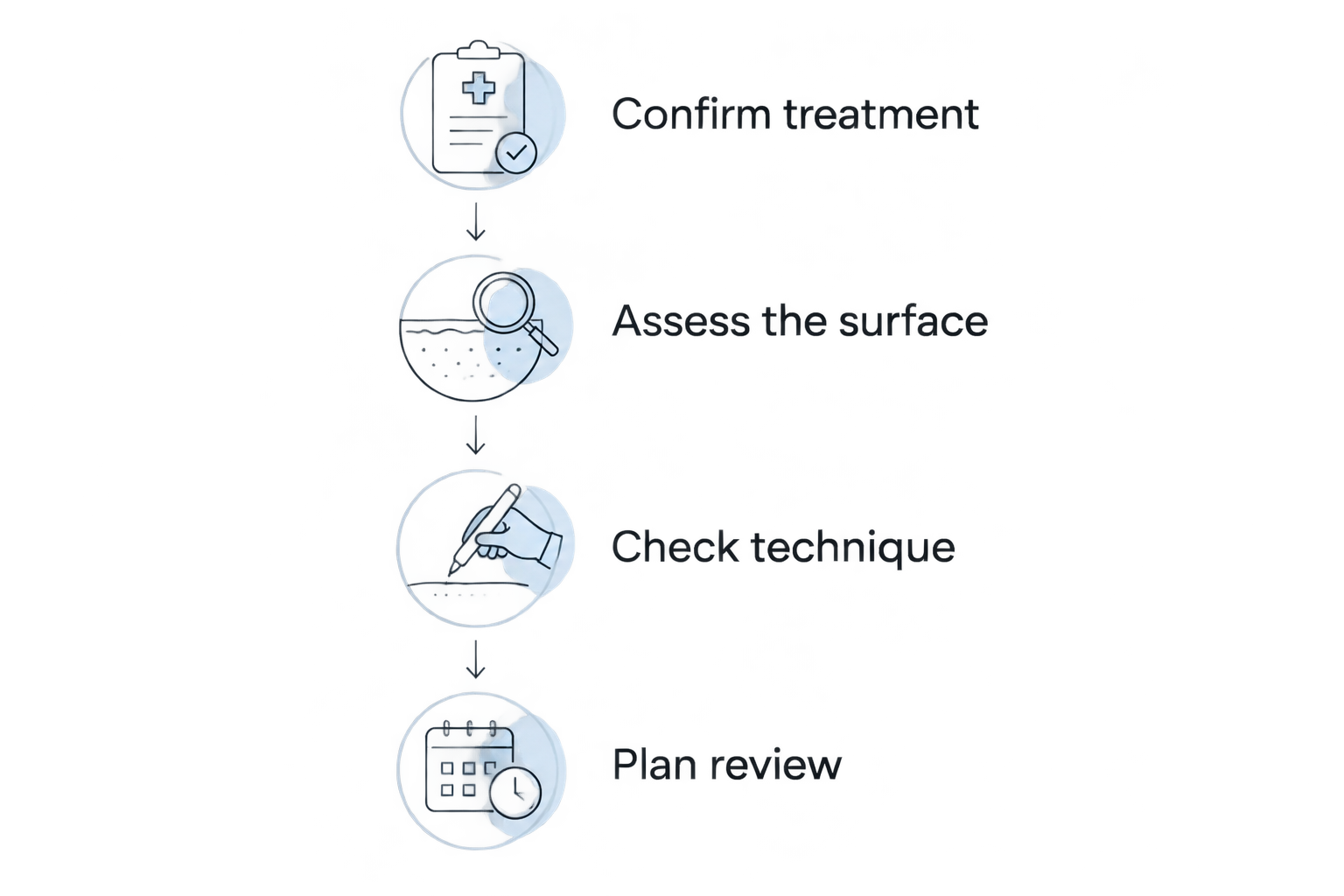
A useful 2026 recommendation includes an administration plan, not just a formulation name. Ask the patient to demonstrate their routine with the containers they actually use; a verbal description does not show whether the drop reaches the eye.
Confirm treatment
Record prescribed glaucoma medicines and all other ocular preparations. Include lubricants, allergy drops and non-prescription products, because patients do not always regard these as medicines.
Keep pressure-lowering treatment unchanged unless the responsible prescriber changes it. A preservative-free lubricant is an addition for surface symptoms, not an alternative glaucoma treatment.
Assess the surface
Review symptom timing, visual fluctuation, staining, lid findings and tear-film behaviour within your clinical scope. Distinguish discomfort after a particular medicine from symptoms that build during visual tasks or occur on waking.
New pain, photophobia, marked redness or reduced vision requires urgent assessment. Do not route these presentations into a routine lubricant trial.
Check technique
Check that the patient can deliver 1 drop into the intended eye without touching the bottle tip to the lashes or ocular surface. Follow the product's instructions rather than assuming every device works the same way.
Different eye drops generally need at least 5 minutes between instillations to reduce washout; follow a longer interval where a product's instructions specify one. Explain the sequence in writing when several preparations are involved.
Plan review
Record which symptoms and signs will guide reassessment. If lubrication does not give acceptable relief, revisit the diagnosis, administration technique and prescribed regimen rather than cycling through similar products indefinitely.
Single-dose or multidose: check handling separately
Preservative-free does not mean single-dose. Both single-dose and specifically designed multidose presentations exist, and the patient needs instructions for the exact container supplied.
| Presentation | Best for | Practical advantage | Practical limitation |
|---|---|---|---|
| Single-dose container | Patients who can manage opening individual units | Separates use into individual containers | Opening small units can be difficult |
| Preservative-free multidose bottle | Patients who can reliably operate its dispensing mechanism | Avoids opening a separate unit for each administration | Squeezing force and device technique need checking |
Follow the labelled discard instructions. Do not assume that every single-dose unit can be kept after opening or that every multidose bottle has the same in-use period.
Ask about hand strength, tremor and vision. If handling is unreliable, review the device or support needed rather than interpreting missed doses as unwillingness to follow treatment.
How the options are ranked
The 2026 ranking prioritises clinical fit, preservative status, visual effects, handling and compatibility with an existing regimen. It is a formulation-selection guide, not a head-to-head product trial or a ranking of pressure-lowering medicines.
Sodium hyaluronate takes the starting position for uncomplicated daytime lubrication. Lipid-containing drops and gels take separate slots because evaporative dysfunction and a need for greater viscosity require different decisions.
No lubricant earns a universal recommendation simply because it is preservative-free. The formulation still needs to suit the ocular surface, and the container still needs to work for the patient.
Which preservative-free eye drops should you choose?
Start with preservative-free sodium hyaluronate for uncomplicated daytime dryness; choose lipid-containing drops for assessed evaporative dysfunction and gel when greater viscosity is needed. Keep that decision separate from changes to glaucoma medication.
If discomfort persists, request a review of the whole treatment burden and ocular surface. The prescribing team can assess whether changes to glaucoma therapy are appropriate while maintaining pressure control.
Scope Connect glaucoma and dry eye resources support that clinical discussion. They do not replace individual examination, prescribing responsibility or follow-up.
FAQ
What are the best preservative free eye drops for glaucoma patients?
Preservative-free sodium hyaluronate is a reasonable starting category for uncomplicated daytime dryness. Lipid-containing drops suit assessed evaporative dysfunction, while a preservative-free gel offers a more viscous option. These lubricants do not lower intraocular pressure.
Can lubricating eye drops replace my glaucoma drops?
No, lubricating eye drops do not replace prescribed pressure-lowering treatment. Continue glaucoma medication as prescribed and discuss intolerance with the treating team before changing it.
Are all glaucoma eye drops preservative-free?
No, glaucoma medicines include preserved and preservative-free presentations. Check the exact prescribed product rather than assuming that the active ingredient or brand name establishes its preservative status.
How long should I leave between glaucoma drops and lubricants?
Different eye drops generally need at least 5 minutes between instillations to reduce washout. Follow the exact product instructions if they require a longer interval, and confirm the order when using a gel or ointment.
Is a stronger sodium hyaluronate concentration always better?
No, concentration alone does not establish which sodium hyaluronate formulation is best. Formulation characteristics, transient blur, comfort and handling also influence suitability.
Can preservative-free eye drops still sting?
Yes, preservative-free eye drops can still cause discomfort. Persistent stinging needs assessment of the ocular surface, administration technique and the exact preparation rather than an assumption that preservatives are the only cause.
When should a glaucoma patient seek urgent help for irritation?
New pain, photophobia, marked redness or reduced vision requires urgent assessment. Do not stop prescribed glaucoma treatment or rely on a new lubricant instead of seeking clinical advice.
One last thing
Ask the patient to show you their technique before changing their lubricant. A well-matched formulation cannot help if the drop misses the eye or the patient cannot operate the container; glaucoma treatment deserves the same practical check.
Related guides
- Ocular surface optimisation for trainee optometrists
- How often should glaucoma patients have check-ups?
- Preservative-free eye drops for dry eye disease
- Can glaucoma be reversed with early treatment?