

No—early treatment cannot reverse established glaucomatous optic nerve damage, but it can reduce the risk of further sight loss. In 2026, treatment aims to preserve remaining vision by lowering intraocular pressure and monitoring for progression. Better pressure control is not evidence that damaged nerve fibres have recovered.
- Can glaucoma be reversed? No. Early treatment protects remaining vision; it does not restore established optic nerve damage.
- NICE NG81 supports pressure-lowering treatment and continued monitoring, not a promise of restored sight.
- Eye drops, laser and surgery lower pressure through different mechanisms; none reverses established glaucoma damage.
- Scope Connect supports eye care professionals with clinical education and patient resources, not individual glaucoma treatment decisions.
Can glaucoma be reversed with early treatment?
Early treatment changes the risk of future damage, not the permanence of damage already present. Glaucoma involves progressive loss of retinal ganglion cells and their axons. Current established treatments do not replace those cells or reconstruct the affected visual pathways.
The distinction matters when you explain a successful result. A lower pressure reading, stable visual field or unchanged optic nerve appearance indicates control against the relevant treatment goals—not reversal.
Scope Connect is a clinical education resource for eye care professionals seeking product information, learning materials and patient education resources. Use educational material to support the consultation, while keeping individual treatment decisions within the responsible clinician’s assessment.
| Treatment approach | Best for | Main benefit | Main limitation |
|---|---|---|---|
| Pressure-lowering eye drops | Patients whose management plan requires medication | Lower pressure without an incisional procedure | Require correct use; adverse effects and ocular surface symptoms need review |
| Selective laser trabeculoplasty | Suitable patients with open-angle disease or ocular hypertension | Improves aqueous outflow and can reduce reliance on drops | Suitability varies, and further treatment can still be needed |
| Glaucoma surgery | Patients needing greater pressure reduction or control despite other treatment | Creates or improves an outflow route, depending on the procedure | Requires postoperative care and carries procedure-specific risks |
These are treatment categories, not interchangeable recommendations. Disease type, severity, progression and patient circumstances determine the appropriate pathway.
Why this matters
A patient who hears that glaucoma was caught early can interpret this as a promise that treatment will restore normal sight. Replace that expectation with a more useful explanation: early diagnosis gives you an opportunity to protect vision before additional irreversible damage occurs.
Early open-angle glaucoma often causes no noticeable symptoms. A patient’s report that vision feels normal does not replace optic nerve assessment, pressure measurement or visual field testing.
For clinical conversations in 2026, distinguish three outcomes: lowering pressure, demonstrating stability and improving symptoms. They are related aspects of care, but they do not mean the same thing. Clear language helps patients understand why treatment and monitoring continue even when their eyes feel comfortable.
What early treatment can achieve
Pressure lowering remains the established modifiable treatment target in glaucoma. Treatment reduces the stress associated with intraocular pressure, with the aim of slowing or preventing additional functional loss.
Your explanation should connect the intervention to what matters to the patient: retaining useful sight. Avoid presenting a pressure result as the entire outcome. Someone can reach a pressure target and still require reassessment if structural or visual field evidence shows progression.
Pressure control
A pressure reduction is an objective treatment response. It does not, on its own, establish that glaucoma is stable or that the chosen target remains appropriate.
Targets are individualised rather than drawn from a single universal safe value. Baseline pressure, existing damage, progression and the person’s wider circumstances all inform the management plan.
Structural and functional stability
Optic nerve assessment and optical coherence tomography help clinicians assess structural change. Visual field testing assesses function. Interpreting these findings together gives a clearer picture than relying on an isolated measurement.
Repeat testing also requires attention to quality. Apparent improvement on a visual field can reflect familiarity with the test or variability rather than recovery of damaged nerve tissue.
Preserving everyday function
The practical aim is to retain sight for reading, mobility, work and other activities that matter to the person. Treatment cannot promise that every patient will avoid further loss, but preventing additional damage remains a meaningful outcome.
Where sight loss already affects daily life, rehabilitation and practical support deserve attention alongside pressure management. These measures support function; they do not regenerate the optic nerve.
How do eye drops, laser and surgery differ?
Choose a pressure-lowering approach for its suitability and treatment goal, not for a claim that it reverses glaucoma. Each approach has benefits and limitations, and treatment can change as the disease or the patient’s needs change.
For UK practice in 2026, NICE guideline NG81, Glaucoma: diagnosis and management, provides recommendations for adults with chronic open-angle glaucoma and ocular hypertension. Its recommendations distinguish diagnosis, treatment eligibility and reassessment rather than treating a pressure measurement as a diagnosis.
Pressure-lowering eye drops
Different medication classes reduce aqueous production or increase outflow. Selection requires attention to contraindications, interactions, tolerability and the patient’s ability to administer treatment reliably.
Drops offer a non-incisional treatment route, but prescribing them is not the end of the process. Review technique and ask directly about discomfort, missed doses and difficulties handling the bottle. Patients should not stop prescribed glaucoma medication without advice from their treating team.
Selective laser trabeculoplasty
NICE NG81 recommends offering 360-degree selective laser trabeculoplasty in specified circumstances, including newly diagnosed, non-advanced chronic open-angle glaucoma, with stated exclusions. The treatment acts on the trabecular meshwork to improve outflow; it does not repair optic nerve damage.
Laser can reduce reliance on daily drops, which matters when administration is difficult. Its effect still needs monitoring, and some patients require medication, repeat laser or another intervention.
Glaucoma surgery
Surgery is considered according to disease severity, pressure requirements, progression and the response to other treatments. Procedures differ in their mechanism, indications and risk profile.
The benefit is additional pressure control where appropriate. The trade-off is procedural risk and the need for postoperative assessment, with follow-up tailored to the operation and clinical course. Surgery is not a route to recovering an established glaucomatous visual field defect.
Why glaucoma outcomes vary
Early treatment is important, but timing alone does not determine the outcome. The clinical starting point and the response over time also matter.
- Existing damage: treatment cannot restore nerve tissue already lost, making the amount of remaining function important.
- Disease mechanism: open-angle, angle-closure and secondary glaucomas require different assessments and treatment pathways.
- Rate of progression: change over time informs whether the current target and treatment remain appropriate.
- Pressure response: the achieved pressure reduction needs interpretation alongside structural and functional findings.
- Treatment use: administration problems, missed doses and adverse effects can interfere with the intended treatment plan.
- Follow-up quality: reliable testing and attendance help the treating team recognise change and adjust management.
Do not translate these factors into a prediction of restored sight. Use them to explain why two patients with the same diagnostic label can need different treatment and review arrangements.
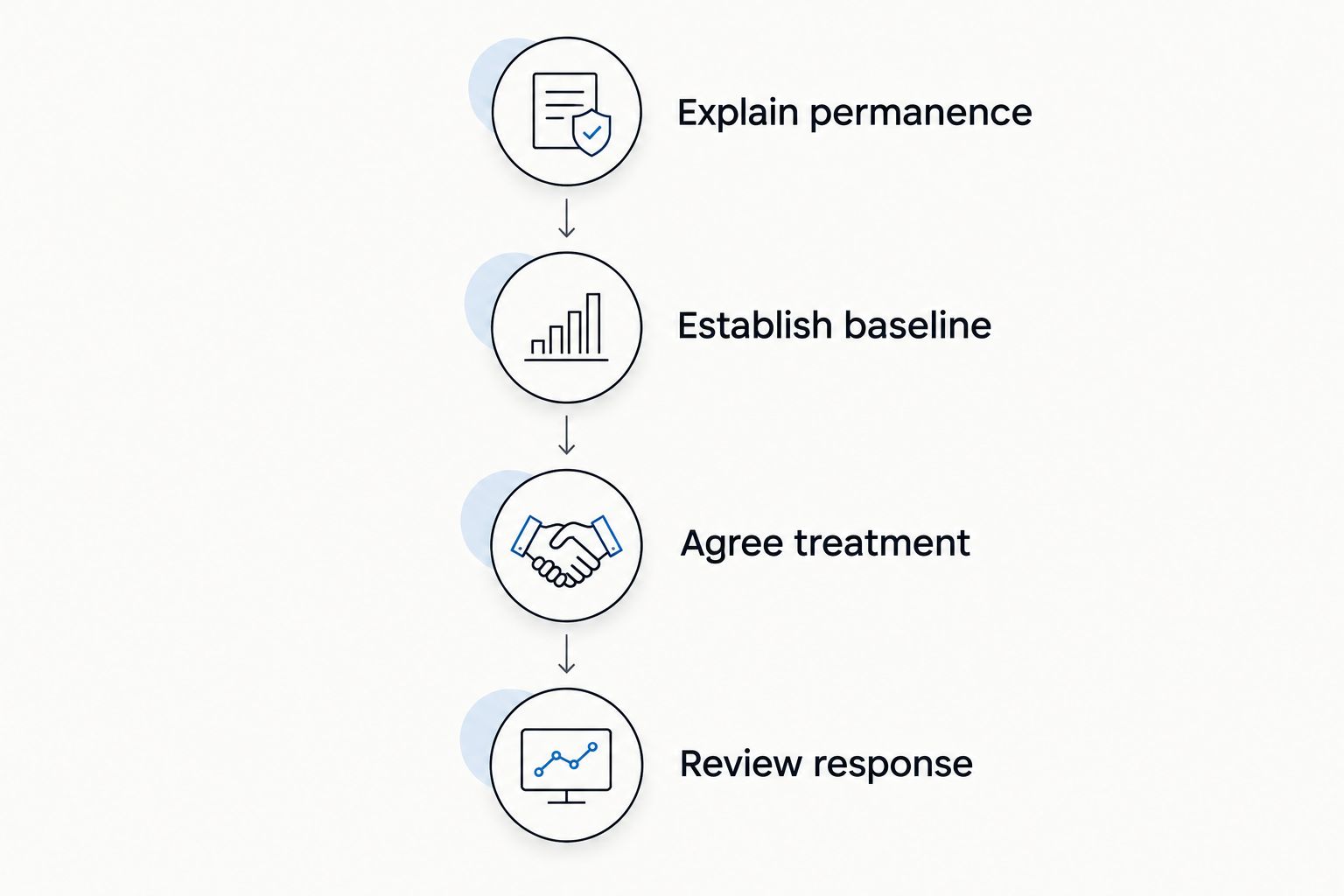
A practical consultation sequence
When a patient asks about reversal, answer that question before discussing treatment options. A direct answer prevents later discussion of pressure reduction from being mistaken for a cure.
- Explain permanence. State that established glaucomatous nerve damage is irreversible with current established treatment. Pair that statement with the purpose of early care: protecting remaining vision.
- Establish baseline. Explain what pressure, optic nerve assessment, imaging and visual field testing contribute. Clarify that no single result describes the whole condition.
- Agree treatment. Discuss the recommended intervention, its intended benefit and its limitations. Check that the patient understands the practical requirements.
- Review response. Assess treatment effect, tolerability and evidence of change. Confirm how follow-up will happen and who to contact with problems.
This sequence separates prognosis from action. It also gives the patient something concrete to do without implying that adherence guarantees an unchanged visual field.
Does normal eye pressure mean glaucoma has gone?
No—normal eye pressure does not mean glaucoma has disappeared. Pressure is a risk factor and treatment target, not a standalone measure of optic nerve health.
Normal-tension glaucoma illustrates the limitation: glaucomatous damage can occur with untreated pressures within the conventional statistical range, commonly described as up to 21 mmHg. A reading within that range therefore cannot exclude glaucoma or confirm stability.
NICE NG81 uses 24 mmHg in specified referral and ocular hypertension treatment recommendations. This is not a universal boundary between healthy and damaged eyes, and it is not an individual patient’s automatic target pressure.
In 2026, explain the purpose of a threshold before quoting it. Referral criteria, treatment eligibility and an individual target answer different clinical questions. Treating them as equivalent creates false reassurance.
Can vision improve after glaucoma treatment?
Vision can improve for reasons other than reversal of glaucoma damage. For example, treating coexisting cataract or ocular surface disease can improve visual quality without restoring lost retinal ganglion cells.
An acute pressure rise can also cause corneal oedema and blurred vision. Improvement after pressure reduction does not prove that established glaucomatous nerve damage has recovered.
When a patient reports clearer sight, acknowledge the improvement and identify its likely clinical explanation through assessment. Avoid relabelling symptom relief, a clearer optical pathway or a better repeat test as optic nerve regeneration.
Is ocular hypertension the same as early glaucoma?
No—ocular hypertension means raised intraocular pressure without established glaucomatous optic nerve or visual field damage. It requires risk assessment rather than an assumption that nerve injury has already occurred.
This distinction changes the explanation of treatment. In ocular hypertension, pressure lowering is intended to reduce the risk of developing glaucoma where treatment is indicated; in established glaucoma, treatment aims to limit further damage.
Neither situation supports a claim of reversal. Explain the diagnosis precisely so the patient understands whether the plan addresses a risk of future disease or progression of disease already present.
Supporting treatment without overlooking the ocular surface
Ask about burning, fluctuating vision and discomfort during glaucoma follow-up. These symptoms deserve assessment rather than an assumption that the patient must tolerate them to protect sight.
Ocular surface care supports glaucoma management; it does not replace pressure-lowering treatment. Lubricating drops do not treat glaucomatous optic nerve damage. Decisions about glaucoma medication, formulation changes or alternatives belong with the treating clinician.
Scope Connect’s ocular surface optimisation guide for trainee optometrists provides a related learning route for clinicians developing their ocular surface assessment. Keep the distinction explicit when educating patients: improved comfort and glaucoma control are separate treatment goals.
When symptoms need urgent assessment
Sudden severe eye pain, a red eye, blurred vision or haloes, particularly with headache, nausea or vomiting, require urgent assessment. An acute angle-closure attack is an ophthalmic emergency, not a routine discussion about whether glaucoma is reversible.
For patients experiencing these symptoms, advise immediate emergency eye care or attendance at an emergency department. Do not suggest waiting for a scheduled glaucoma appointment or trying lubricants first.
Chronic open-angle glaucoma often presents differently, without these acute symptoms. Absence of pain does not establish that the disease is controlled.
FAQ
Can glaucoma be reversed if it is caught early?
No—early treatment cannot reverse established glaucomatous optic nerve damage. It aims to reduce the risk of further sight loss by lowering pressure and monitoring progression.
Can glaucoma eye drops bring back lost vision?
Glaucoma eye drops do not restore vision lost through established glaucomatous nerve damage. They lower intraocular pressure to help protect remaining vision.
Is laser treatment a permanent cure for glaucoma?
Laser treatment is not a cure for glaucoma. Selective laser trabeculoplasty lowers pressure in suitable patients, but its effect requires monitoring and further treatment can be needed.
Does normal eye pressure mean I no longer have glaucoma?
Normal eye pressure does not mean glaucoma has gone. Your treating team also assesses the optic nerve, visual fields and evidence of change over time.
Can glaucoma surgery reverse blindness?
Glaucoma surgery does not reverse blindness caused by established glaucomatous optic nerve damage. Its purpose is pressure control to reduce the risk of additional loss.
Should I stop glaucoma drops if my vision feels normal?
Do not stop prescribed glaucoma drops without advice from your treating team. Glaucoma can progress without noticeable symptoms, so treatment decisions require clinical assessment.
Can dry eye treatment replace glaucoma treatment?
Dry eye treatment cannot replace glaucoma treatment. Ocular surface care addresses comfort and surface-related visual disturbance, while glaucoma treatment addresses pressure and progression risk.
One last thing
A patient noticing no improvement does not mean glaucoma treatment has failed. The intended benefit is often preserving sight that would otherwise be at risk, rather than producing a visible improvement after each dose or procedure.
For your next glaucoma discussion in 2026, ask the patient to explain the treatment goal back to you. Correct any expectation of recovered nerve tissue, then confirm the practical plan for treatment and review. Scope Connect supports that educational conversation; individual prognosis remains a matter for the treating team.
This article is educational information for eye care professionals, not an individual diagnosis or treatment plan.
Related guides
- Dry eye disease management for hospital eye service teams
- CPD-accredited courses for optometrists
- Independent prescribing for newly qualified optometrists