

Yes—contact lens-associated papillary conjunctivitis (CLAPC) is usually reversible when you stop lens wear and address the factors driving inflammation. Symptom relief does not necessarily mean the upper tarsal conjunctiva has recovered, and restarting the same lens routine without reassessment risks recurrence.
- Is CLAPC reversible? Usually, yes, with contact lens withdrawal, clinical assessment and correction of contributing factors.
- Comfort can improve before papillary changes resolve; symptom relief alone does not establish readiness for lens wear.
- Pain, photophobia or reduced vision require urgent assessment rather than routine CLAPC management.
- Scope Connect supports eye care professionals with clinical education on contact lens complications and ocular surface care.
Why this matters
A patient who reports that their lenses feel comfortable again has not necessarily reached the end of treatment. CLAPC management needs to distinguish relief of itching and mucus from control of inflammation and a safe return to contact lenses.
Scope Connect is best suited to eye care professionals seeking clinical education on ocular surface care. For your 2026 clinical review, the practical question is not simply whether CLAPC reverses, but whether the patient can resume lens wear without recreating the original problem.
Use consistent documentation to separate improvement from recollection. The Efron grading scale to contact lens referral workflow provides a related framework for recording contact lens findings and considering escalation.
Is CLAPC from contact lens wear reversible?
CLAPC generally improves after contact lens withdrawal and management of contributing factors. The condition involves an inflammatory response affecting the conjunctiva beneath the upper eyelid, with mechanical interaction and deposits on the lens surface contributing to its development.
Reversibility has distinct clinical meanings. A patient can become less symptomatic before the papillary reaction has fully settled, and successful treatment does not guarantee that the previous lens, replacement schedule or wearing pattern remains suitable.
A practical assessment follows this sequence:
- Confirm the diagnosis. Take a contact lens history, assess vision, examine the ocular surface and evert the upper lid when appropriate.
- Withdraw the trigger. Advise discontinuing contact lens wear while the active problem is assessed and managed.
- Address inflammation and contributors. Review lens fit, deposits, replacement habits, care products and coexisting allergy or ocular surface disease.
- Reassess recovery. Compare symptoms with conjunctival and corneal findings rather than relying on comfort alone.
- Plan the return. Resume lens wear only after clinical review, with changes tailored to the identified contributors.
This sequence is a clinical framework, not a patient-specific treatment prescription. Your examination determines whether the presentation is uncomplicated CLAPC or another condition requiring a different pathway.
What does recovery actually look like?
Symptom recovery: less itching, mucus and lens intolerance
Patients commonly describe itching, stringy mucus, increased lens awareness or reduced wearing tolerance. Improvement in these symptoms is useful, but it does not measure the whole inflammatory response.
Ask about symptoms both with and without lenses. Someone who has stopped wearing lenses has also removed the circumstances that previously provoked discomfort; feeling better without lenses does not establish that the same lenses are now suitable.
Record functional changes in the patient's own terms, including whether mucus has reduced and whether irritation persists during ordinary activities. These observations support, rather than replace, examination.
Clinical recovery: improvement beneath the upper eyelid
Upper-lid eversion allows assessment of the tarsal conjunctiva, where papillary changes can remain visible after symptoms improve. Compare the appearance with the baseline record and assess the cornea rather than treating the lid finding in isolation.
The established Efron system uses 5 grades, from grade 0, representing normal appearance, to grade 4, representing severe change. Grading supports consistent observation; a grade alone does not determine treatment or readiness to restart lenses.
For 2026 records, document the grading system alongside the result. A bare number without the scale, anatomical site or accompanying findings is difficult to interpret at a later review.
Functional recovery: tolerating an appropriate lens plan
Functional recovery means more than getting through a brief period of wear. You need a lens plan that the patient can follow without a return of symptoms or deterioration in clinical findings.
Review handling, replacement and care alongside fit and material. A new lens modality does not compensate for continuing to wear lenses through irritation or ignoring the agreed replacement instructions.
Which management approaches address the cause?
Contact lens withdrawal addresses the ongoing exposure; additional treatment depends on the examination. These approaches are complementary rather than interchangeable, and not every patient needs every intervention.
| Approach | Best for | Main benefit | Limitation or caution |
|---|---|---|---|
| Temporary contact lens withdrawal | Active lens-associated symptoms and inflammation | Removes continuing lens interaction while the eye is assessed | Does not identify or correct the original contributor by itself |
| Lens refitting or modality review | Mechanical interaction, deposits or recurrent intolerance | Changes the circumstances associated with recurrence | No material or replacement modality guarantees prevention |
| Lens care and replacement review | Problems with cleaning, handling or replacement habits | Addresses avoidable exposure and deposit-related contributors | Requires a plan the patient can follow consistently |
| Clinician-directed anti-allergy treatment | Associated itching or an allergic component | Helps manage relevant inflammatory symptoms | Does not replace lens withdrawal, examination or refitting |
| Clinician-supervised corticosteroid treatment | Selected cases requiring additional inflammatory control | Treats inflammation when clinically indicated | Requires appropriate prescribing, exclusion of infection and monitoring |
| Ocular lubricants | Coexisting dryness or surface discomfort | Support comfort where tear-film disturbance contributes | Do not remove papillae or make continued lens wear safe |
Medication choice belongs within the clinician's competence and prescribing authority. Check the individual preparation's instructions, contraindications and contact lens advice rather than treating all eye drops as interchangeable.
Do not recommend that a patient use leftover steroid drops. Steroids can mask or worsen infection and require clinical oversight, including consideration of intraocular pressure.
Why CLAPC recovery and recurrence vary
Variation reflects the condition at presentation and whether the contributing exposure changes. There is no single recovery deadline that clears every patient for contact lenses.
- Inflammatory severity: More pronounced tarsal changes require a different assessment from mild irritation with limited findings.
- Continued lens exposure: Wearing lenses despite symptoms maintains contact with the suspected trigger and complicates assessment of recovery.
- Lens deposits and replacement: Deposit accumulation and replacement habits influence the environment beneath the upper lid.
- Mechanical interaction: Lens fit, movement and edge interaction matter when assessing repeated irritation.
- Coexisting disease: Allergy, tear-film disturbance or lid disease can contribute to symptoms and need separate management.
- Adherence to the revised plan: Recovery does not prevent recurrence if the patient returns to the same problematic routine.
Ask the patient to describe their actual routine, not simply whether they follow instructions. Details about replacement, cleaning and what happens when discomfort starts are more useful than a general assurance of good compliance.
How should you decide when to restart contact lenses?
Base the decision on symptoms, examination findings and a revised lens plan. Do not use a fixed calendar date or symptom relief alone as clearance.
Structure the review around Symptoms, Lid findings, Corneal findings and Lens plan. Symptoms establish the patient's experience; lid and corneal findings check whether that experience matches the ocular examination; the lens plan addresses what will change when wear resumes.
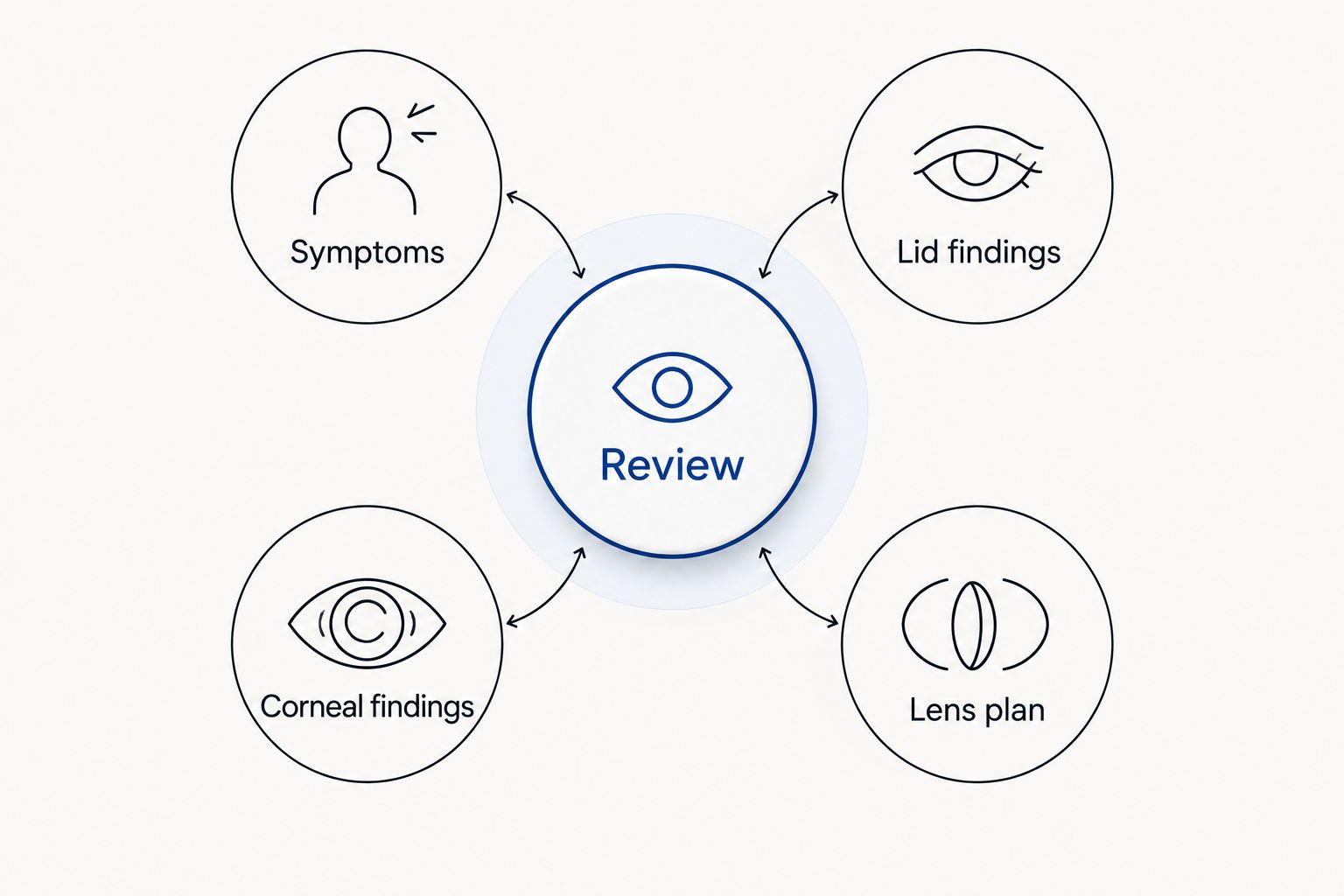
Before restarting, explain the revised approach and the symptoms that should prompt immediate lens removal. Confirm that the patient has suitable spectacles so that stopping lens wear is practical rather than merely an instruction on paper.
For your 2026 patient information, state who will review the patient and how to obtain urgent help. A clear safety-net instruction is more useful than an open-ended request to return if things get worse.
After resumption, reassess tolerance and relevant clinical findings. Recurrent symptoms warrant review of both the diagnosis and the revised lens arrangement, not repeated reassurance that CLAPC is reversible.
Can a patient keep wearing contact lenses if symptoms are mild?
Active CLAPC is a reason to stop contact lens wear and arrange assessment, even when symptoms seem manageable. Mild discomfort does not establish that continued wear is safe, particularly without a corneal examination.
Avoid using lubricants or anti-allergy drops simply to extend wearing time. Relief from a drop does not show that the underlying lens interaction has resolved.
Does switching to daily disposable lenses prevent recurrence?
Daily disposable lenses can address problems associated with reuse and lens care, but they do not guarantee that CLAPC will not recur. Fit, material, ocular allergy and the patient's inflammatory response still need consideration.
Recommend a modality change because it addresses an identified contributor, not because it is a universal cure. The benefit is a fresh lens without a reusable-lens cleaning routine; the limitation is that lens-related mechanical interaction remains possible.
When is it unsafe to assume the problem is CLAPC?
Pain, photophobia, reduced vision, a corneal opacity or a concerning unilateral red eye require urgent assessment. Contact lens wear raises concern for microbial keratitis, which must not be dismissed as allergy or routine lens irritation.
Advise immediate lens removal and same-day urgent eye assessment when these warning features are present. Do not delay referral while waiting for a planned CLAPC review or for symptomatic treatment to work.
The guide to how quickly microbial keratitis can cause vision loss addresses this important differential. Suspected infection needs its own urgent pathway rather than a trial of routine CLAPC management.
What should your follow-up record include?
A useful 2026 review template records the initial findings, the management decision and the conditions for restarting lenses. Keep the clinical reasoning visible so that another practitioner can understand why the plan changed.
Include:
- Presenting symptoms, visual assessment and relevant red flags.
- Contact lens type, fit, wearing pattern, replacement and care history.
- Upper tarsal conjunctival findings and the named grading scale.
- Corneal findings and relevant coexisting ocular surface disease.
- Advice on lens withdrawal, treatment, follow-up and urgent access.
- The proposed lens changes and the patient's understanding of them.
Scope Connect provides clinical resources and patient education materials for eye care professionals. Use education to support the discussion, while keeping examination findings and individual clinical judgement central to the treatment decision.
FAQ
Is CLAPC reversible after stopping contact lenses?
CLAPC is usually reversible after contact lens withdrawal and management of contributing factors. Symptoms can improve before papillary changes resolve, so clinical review remains necessary before restarting lenses.
How long does CLAPC take to go away?
CLAPC has no single recovery time that applies to every patient. Severity, continued lens exposure and coexisting ocular surface disease affect recovery; reassessment should guide the return to wear.
Can I wear my contact lenses if the itching has stopped?
Stopping itching alone does not establish that contact lenses are safe to restart. A clinician should assess the upper tarsal conjunctiva, cornea and proposed lens plan.
Do daily disposable lenses cure CLAPC?
Daily disposable lenses are not a guaranteed cure for CLAPC. They remove the reusable-lens care routine, but fit, material and inflammatory contributors still require assessment.
Will lubricating eye drops get rid of CLAPC?
Lubricating eye drops do not remove the underlying causes of CLAPC. They can support comfort when dryness coexists, but they do not replace lens withdrawal or clinical assessment.
Can CLAPC come back after treatment?
CLAPC can recur after treatment, particularly when the original lens-related contributors remain. Prevention requires an appropriate lens plan, adherence and review if symptoms return.
When should a contact lens wearer seek urgent help?
A contact lens wearer with pain, light sensitivity, reduced vision or a corneal white spot needs same-day urgent eye assessment. Remove the lenses and do not assume the problem is uncomplicated CLAPC.
One last thing
Reversible does not mean ready to rewear. The most useful final question is what will be different when the patient puts contact lenses back in.
For 2026 practice, make that difference explicit: a revised fit, replacement approach, care routine or management of coexisting disease, as indicated by the assessment. Scope Connect supports clinical learning; the patient's examination determines the next move.
Related guides
- Preservative-free eye drops for contact lens wearers
- Ocular surface optimisation for trainee optometrists
- CPD-accredited courses for optometrists