

Demodex blepharitis can be treated successfully, but no treatment guarantees a permanent cure or lifelong freedom from recurrence. In 2026, the practical goal is to control mite-associated lid disease, improve symptoms and confirm the response on examination—not promise that mites can never return.
- A demodex blepharitis cure does not guarantee lifelong clearance; assess symptoms and lid signs separately.
- Collarettes at the lash bases support Demodex blepharitis diagnosis; persistent irritation also requires assessment for other causes.
- Lid hygiene and dry eye treatment support care but do not automatically establish mite eradication.
- Scope Connect supports eye care professionals with clinical education; individual treatment requires an appropriate clinical assessment.
Can Demodex blepharitis be cured permanently?
Demodex blepharitis can resolve after treatment, but resolution is not a guarantee against recurrence. Separate the outcome you can demonstrate today from a prediction about the patient's future ocular health.
A useful consultation distinguishes the following endpoints:
| Endpoint | What it establishes | What it does not establish |
|---|---|---|
| Symptom improvement | The patient reports less irritation or discomfort | That Demodex-associated disease has resolved |
| Reduced collarettes | A characteristic clinical sign has improved | That every mite has been eliminated |
| Mite clearance on sampling | No mites were detected in the sampled lashes | Lifelong clearance across all follicles |
| Clinical resolution | Relevant signs and symptoms have settled | Immunity from recurrence |
For the underlying clinical assessment, see the Demodex blepharitis guide for dispensing opticians. The central distinction is between identifying a characteristic sign, determining its clinical significance and selecting treatment within your professional scope.
Why this matters
Patients searching for a demodex blepharitis cure often want an end date: when treatment stops, when symptoms disappear and whether another episode means treatment failed. Those are different questions, and each needs a separate answer.
In a 2026 consultation, explain the intended endpoint before discussing treatment. Record what you expect to improve, how the patient should use the intervention and what would trigger reassessment rather than continued self-treatment.
Scope Connect is best for eye care professionals seeking Demodex blepharitis education, not an individual diagnosis. Clinical resources support decision-making; they do not replace examination, prescribing guidance or referral when the presentation falls outside your competence.
What does successful treatment look like?
Successful treatment means a meaningful improvement in the disease you identified. For Demodex blepharitis, that includes assessing collarettes, lid-margin findings and the patient's symptoms rather than relying on comfort alone.
Mites can be present without symptomatic disease. The aim is therefore not to label every detected mite as a problem, but to establish whether the findings explain the presentation and require intervention.
Set a baseline that another clinician can understand. Document the distribution of collarettes, associated lid changes, ocular surface findings and the symptoms affecting daily activities. Record the patient's existing products and treatment technique as well.
At review, compare like with like. A patient who reports less itching but retains substantial collarettes has a different response from a patient whose lid signs improve but whose burning persists. Neither pattern should be reduced to a simple cured-or-not-cured label.
Which treatments address mites, and which support comfort?
Choose treatment according to its purpose, not simply because it is marketed for irritated eyelids. Mite-directed treatment, mechanical cleaning and tear-film support address different parts of the clinical picture.
The comparison below is a clinical framework for 2026, not a UK formulary or an individual prescribing recommendation. Follow current local authorisation, product instructions and professional prescribing requirements.
| Approach | Best for | Main benefit | Main limitation |
|---|---|---|---|
| Prescription mite-directed treatment, such as lotilaner where authorised | Confirmed Demodex blepharitis in an eligible patient | Directly targets the mite component | Requires appropriate prescribing; does not guarantee permanent clearance |
| Clinician-selected lid cleansing | Patients needing removal of lash-base debris | Supports lid cleanliness and an agreed care routine | Mechanical cleaning alone does not establish mite eradication |
| Lubricating eye drops | Coexisting dry eye symptoms | Supports ocular surface comfort | Does not treat the underlying mite infestation |
| Warm compresses | Coexisting meibomian gland dysfunction when clinically indicated | Supports management of the gland-related component | Is not a substitute for Demodex-directed treatment |
Mite-directed treatment: follow the actual prescribing information
The US Food and Drug Administration's Xdemvy prescribing information, revised July 2023, specifies lotilaner 0.25%, administered as 1 drop in each eye twice daily for 6 weeks. These are US-labelled instructions, not a recommendation to prescribe or obtain that medicine in the UK.
The distinction matters: an evidence-based treatment course still does not establish lifelong protection from recurrence. Do not extend, repeat or adapt a prescription regimen simply because the patient wants a permanent result.
For UK practice, verify current authorisation and local prescribing guidance before discussing a named medicine as a treatment option. A patient-facing explanation should distinguish evidence about an active ingredient from the treatment pathway appropriate to that patient.
Lid cleansing: useful support, not proof of eradication
Lid cleansing can remove debris and help patients follow an agreed management plan. The practical value depends on selecting an eye-area-appropriate preparation and demonstrating a tolerable technique.
Avoid treating all cleansers as interchangeable. Mechanical removal of collarettes and a demonstrated effect against mites are different claims; one does not prove the other.
Ask the patient to describe how they clean the lids rather than simply whether they comply. Excessive rubbing, discomfort and unclear instructions all warrant a review of the routine, not an automatic recommendation to clean more aggressively.
Dry eye treatment: address the accompanying problem
Lubricants can improve comfort when dry eye coexists with Demodex blepharitis. That improvement does not confirm that the mite-associated disease has resolved.
Similarly, warm compresses belong in the plan when the meibomian gland findings justify them. Do not present heat as a stand-alone Demodex cure or assume that every uncomfortable lid needs the same combination of treatments.
Why treatment response and recurrence vary
Treatment response varies because the diagnosis, intervention and accompanying ocular surface disease are not identical in every patient. Review the following factors before describing a case as resistant or recurrent:
- Diagnostic fit: itching, burning and redness are not specific to Demodex blepharitis. Reconsider allergy, other forms of blepharitis and dry eye when the findings do not align.
- Treatment target: supportive lubrication and debris removal do not necessarily address mites directly. Check that the intervention matches the intended endpoint.
- Treatment use: an incomplete course or misunderstood application technique changes what you can conclude about the response.
- Tolerability: a preparation that causes irritation can make adherence difficult and complicate symptom assessment.
- Coexisting disease: meibomian gland dysfunction, rosacea-associated lid disease and tear-film disturbance can leave symptoms after the Demodex component improves.
- Review findings: without a comparable baseline and follow-up examination, symptom fluctuation can be mistaken for clearance or relapse.
The practical implication for 2026 is straightforward: investigate the reason for persistent symptoms before repeating treatment. More treatment is not automatically better treatment, particularly when the original clinical signs have already improved.
How should you assess an apparent recurrence?
Use a repeatable clinical sequence. The aim is to distinguish persistent disease, a genuinely new episode and symptoms driven by another condition.
- Recheck symptoms. Establish what returned, what never resolved and whether pain, photophobia or altered vision changes the urgency.
- Examine lashes. Reassess collarettes and lid-margin findings rather than diagnosing recurrence from itching alone.
- Review treatment. Confirm the preparation, prescribed course, application technique and any adverse effects or interruptions.
- Assess the surface. Look for accompanying tear-film disturbance, meibomian gland dysfunction and corneal involvement within your scope.
- Agree follow-up. Explain the next clinical step, the review arrangements and the symptoms requiring earlier assessment.
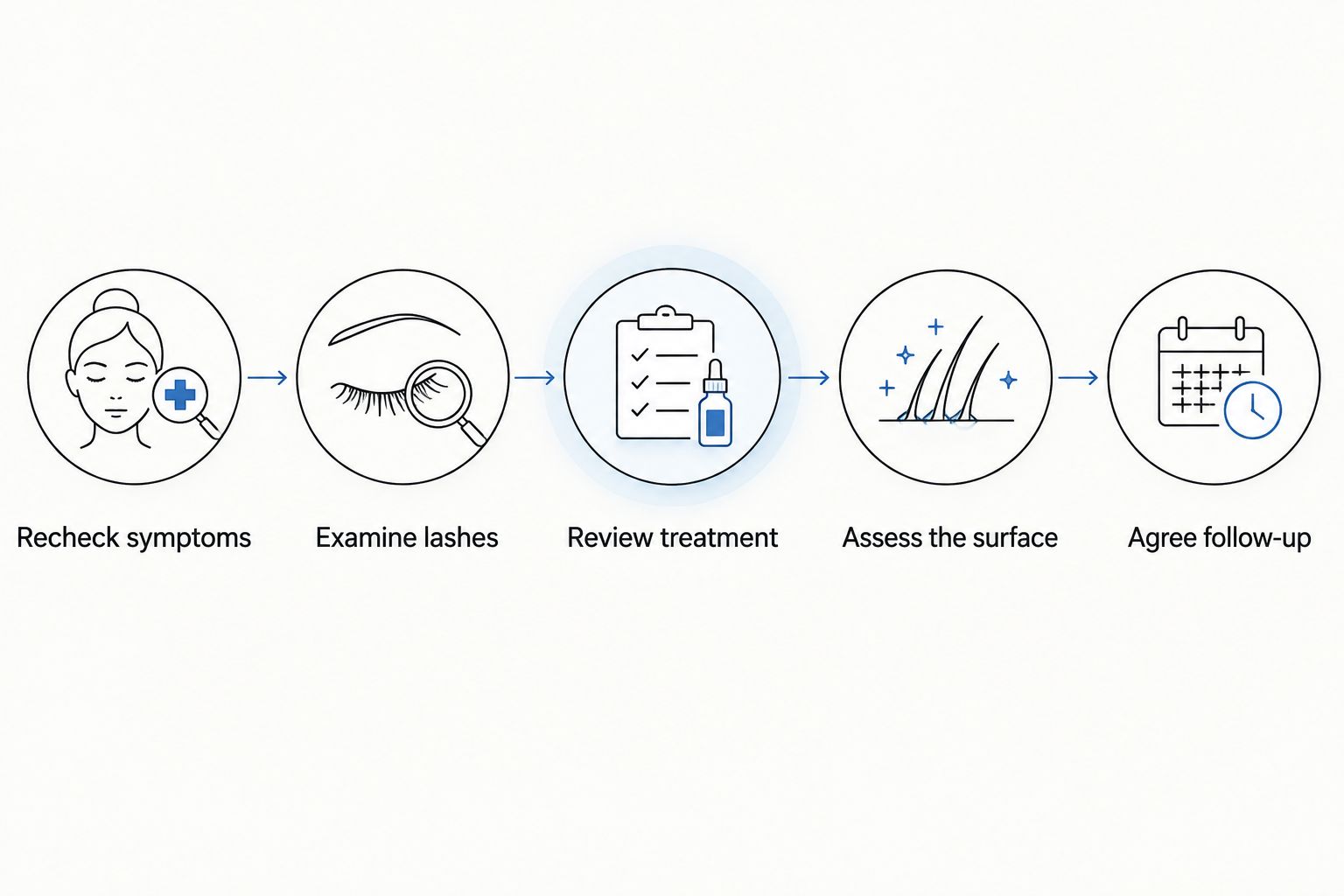
Keep the history and examination connected. If collarettes have improved but discomfort has not, investigate the remaining ocular surface problem rather than assuming the patient needs the same treatment again.
If the expected signs persist, revisit both the diagnosis and the treatment used. Escalate through the appropriate clinical pathway when the response remains unsatisfactory or the findings exceed your assessment or management scope.
Will Demodex blepharitis come back after treatment?
Demodex blepharitis can recur after successful treatment, but recurrence is not inevitable. A future episode does not erase an earlier treatment response, and it does not automatically mean that the original course was inadequate.
Explain the difference between review and retreatment. A review establishes what is happening now; retreatment requires a clinical reason and an appropriate plan. Avoid giving patients an indefinite repeat-treatment instruction without clear supervision and safety advice.
Can patients cure Demodex blepharitis with tea tree oil?
Do not recommend homemade tea tree oil preparations around the eyes. Concentration, formulation and ocular tolerability matter, and a household essential oil is not interchangeable with a preparation intended for periocular use.
The Cochrane review Tea tree oil for Demodex blepharitis, published in 2020, found uncertainty about its effectiveness and highlighted irritation concerns. That evidence does not support promising a permanent cure or encouraging patients to increase the concentration themselves.
Ask specifically about products bought online and home remedies. A patient who interprets stinging as evidence that a preparation is working needs a clear correction and an assessment of any resulting irritation.
Does everyone need ongoing treatment after symptoms settle?
Ongoing treatment depends on the residual findings, associated conditions and the instructions for the intervention used. There is no single maintenance routine that proves permanent protection against Demodex blepharitis.
Separate ongoing supportive care from another course of mite-directed treatment. A patient with continuing dry eye can need ocular surface management even when the Demodex-associated signs have settled.
Use Scope Connect for professional education alongside current clinical guidance. Its resource-hub role supports learning and patient explanation, rather than supplying an automatic maintenance prescription for every presentation.
What should you tell patients before they leave?
Give patients a short, written plan that explains the problem being treated, the intended benefit and the review arrangements. Avoid promising that symptoms and signs will improve at the same pace.
Check understanding by asking the patient to explain the routine back to you. Clarify which products belong on the lid area, which belong in the eye and which should not be used at all.
Pain, photophobia, reduced vision or suspected corneal involvement require prompt clinical assessment—not an assumption of routine blepharitis. Make the escalation route explicit, particularly when patients are managing symptoms between appointments.
FAQ
Is there a permanent Demodex blepharitis cure?
No treatment guarantees a permanent Demodex blepharitis cure. Treatment can resolve the clinical episode, but future recurrence remains possible.
Does itching mean my Demodex blepharitis has returned?
Itching alone does not confirm recurrent Demodex blepharitis. A clinician should reassess the lash bases, lid margins and ocular surface for Demodex-associated signs and other causes.
Can lubricating eye drops get rid of Demodex mites?
Lubricating eye drops do not eradicate Demodex mites. They support comfort when dry eye accompanies blepharitis, so symptom relief should not be mistaken for mite clearance.
Will warm compresses cure Demodex blepharitis?
Warm compresses are not a stand-alone Demodex blepharitis cure. They can form part of care for accompanying meibomian gland dysfunction when clinically indicated.
Should I keep treating my eyelids after they feel better?
Follow the agreed treatment instructions rather than stopping or extending treatment independently. Continuing supportive care and repeating mite-directed treatment are different decisions.
Can I put tea tree oil directly on my eyelids?
Do not apply homemade tea tree oil preparations around your eyes. Ask an eye care professional about an appropriate preparation and technique, particularly if your lids are already irritated.
When should blepharitis symptoms be checked urgently?
Pain, photophobia or reduced vision require prompt assessment. These symptoms should not be attributed to routine blepharitis without an appropriate examination.
One last thing
Feeling better and clearing the clinical signs are different outcomes. Document both, because neither is a reliable substitute for the other when deciding whether treatment has achieved its aim.
For your 2026 patient explanations, replace the promise of a permanent cure with a specific, testable plan: treat the identified disease, review the response and reassess new symptoms. Scope Connect's clinical education resources support that approach without turning recurrence into a presumed treatment failure.
Related guides
- Ocular surface optimisation for trainee optometrists
- Lid hygiene wipes for anterior blepharitis
- CPD courses on dry eye disease for optometrists