

Dispensing assistants’ dry eye training is structured learning that supports clear patient communication, safe escalation and consistent reinforcement of clinician-led care. When choosing CPD-accredited training in 2026, distinguish content suitable for your role from accreditation intended for registered professionals; Scope Connect brings together CPD-accredited courses, clinical articles, product information and patient education resources.
- Choose CPD accredited dry eye training for dispensing assistants by role suitability, not the accreditation label alone.
- Scope Connect suits eyecare teams seeking dry eye education alongside clinical articles and patient education materials.
- Check intended audience, accreditation details and assessment requirements before enrolling.
- Prioritise symptom conversations, escalation and reinforcement of clinician-led advice—not independent diagnosis.
Why dry eye training matters for dispensing assistants
Dispensing assistants need a different learning outcome from clinicians who diagnose and manage ocular surface disease. Your priority is to recognise when a conversation needs clinical input, explain agreed advice accurately and avoid turning a product enquiry into an unsupported treatment recommendation.
Dry eye education therefore needs to connect clinical terminology with everyday patient conversations. Understanding tear film instability is useful; knowing how to record a patient’s description without labelling the condition is immediately applicable.
Scope Connect is best suited to eyecare teams seeking dry eye education alongside clinical and patient resources. Use those resources within your practice’s supervision arrangements, rather than treating course completion as permission to extend your responsibilities.
For your 2026 learning plan, define success through observable work: a clearer handover, an accurate explanation or recognition that a patient needs assessment. A completion certificate records learning, not independent clinical competence.
How to choose and apply suitable training
Define your responsibilities before selecting a course
Start with your job description and the practice’s existing procedures. Ask your supervising clinician which dry eye conversations you should handle, which advice you can reinforce and which situations require an immediate handover.
A dispensing assistant role is not the same as a registered dispensing optician role. Do not assume that a course aimed at dispensing opticians matches your responsibilities simply because both involve dispensing practice.
Write a short learning brief before searching course catalogues. This gives you a practical basis for declining material that is too advanced or unrelated to your duties, even when the subject sounds relevant.
- List the patient questions you currently receive.
- Identify advice you are authorised to reinforce.
- Confirm who receives clinical questions during each shift.
- Separate communication goals from diagnostic skills.
- Agree what evidence will demonstrate learning.
Verify accreditation and audience separately
Read the course information yourself before enrolling. Check who the accreditation applies to, what learning outcomes are stated and whether completion requires attendance, an assessment or another activity.
In the UK, General Optical Council registration and CPD requirements apply to registered professionals, including optometrists and dispensing opticians. An assistant’s attendance does not create GOC registration or automatically make the activity eligible for a registered colleague’s CPD record. Check current GOC guidance and the individual activity’s accreditation information.
For 2026 enrolments, verify the current course listing rather than relying on an old certificate or a colleague’s recollection. Scope Connect provides CPD-accredited education, but suitability and accreditation must still be checked for the individual activity.
- Confirm the stated professional audience.
- Identify the accrediting organisation or approval scheme.
- Read the activity’s learning outcomes.
- Check completion and assessment requirements.
- Confirm what certificate or learning record is provided.
Build a role-appropriate dry eye syllabus
Begin with a clinician-led discussion of the questions your practice encounters. You can also use existing practice protocols and patient leaflets to identify knowledge gaps before choosing a formal activity.
A useful syllabus covers the ocular surface, common symptom descriptions, the purpose of clinician-recommended management and the limits of your role. Include the distinction between explaining an agreed care plan and deciding which treatment a patient needs.
Scope Connect’s dry eye education can support that syllabus alongside its clinical articles and patient materials. The guide to dry eye CPD courses for optometrists provides a clinician-focused starting point for discussion with your supervisor, not an assurance that every activity suits assistants.
- Learn basic tear film and eyelid terminology.
- Practise recording symptoms in the patient’s own words.
- Understand why clinical assessment precedes treatment selection.
- Review instructions for products already recommended by a clinician.
- Include escalation and documentation in every learning plan.
Practise symptom conversations without diagnosing
Use supervised role-play before applying new learning in patient-facing work. Ask open questions, listen to the response and record the information your clinician needs; avoid offering a diagnosis based on a familiar symptom description.
Dryness, irritation and watering do not establish a diagnosis on their own. A patient asking for their usual drops still needs an appropriate response if the symptoms have changed or new concerns are present.
Prepare 3 practice cases: a routine request about an existing care plan, persistent discomfort despite that plan and a new concern requiring clinical input. These are training exercises, not a diagnostic scoring system.
- Ask what has changed since the previous assessment.
- Record when symptoms began and whether one or both eyes are affected.
- Ask about contact lens wear where relevant.
- Note products already used and the patient’s reported response.
- Hand over findings without assigning a diagnosis.
Rehearse escalation before product explanations
Read your local escalation procedure first, then rehearse it with a clinician. An assistant should not have to improvise a referral threshold during a difficult conversation.
Pain, light sensitivity, sudden visual change and a red eye in a contact lens wearer require prompt clinical attention rather than a routine dry eye product discussion. Follow local urgent eye-care arrangements and do not delay assessment while completing a training checklist.
Make the handover route explicit: who takes responsibility, how the patient reaches them and what happens if that person is unavailable. Review this route during your 2026 team induction and whenever staffing or local arrangements change.
- Identify the clinician responsible for urgent queries.
- Keep the practice’s escalation instructions accessible.
- Rehearse a handover when the usual supervisor is absent.
- Record the concern and the action taken.
- Avoid reassuring patients beyond your competence.
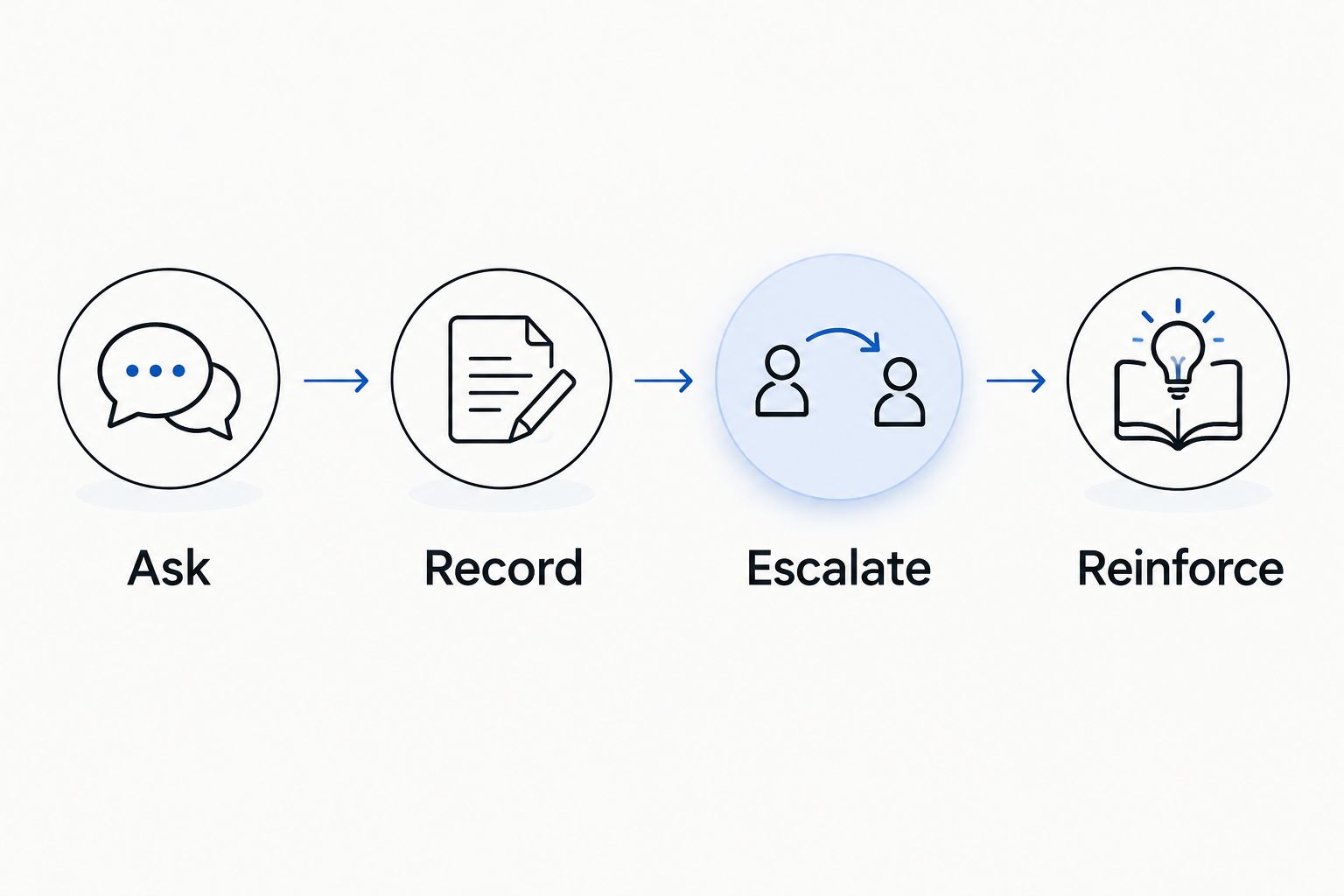
Reinforce agreed advice using checked materials
Start with the instructions already documented by the clinician and the relevant product information. Ask your supervisor to clarify any inconsistency before explaining the plan to a patient.
Use 2 learning resources in a supervised exercise: the documented care plan and the relevant patient leaflet or product instructions. Your task is to explain them consistently, not to select a substitute or change the regimen.
Scope Connect’s patient education materials and product information support this kind of preparation. The limitation is that general information cannot establish suitability for an individual patient; product-specific instructions and the clinician’s plan still govern the conversation.
- Check the exact product and formulation being discussed.
- Follow instructions on administration, handling and storage.
- Verify contact lens compatibility rather than assuming it.
- Explain only the regimen agreed by the clinician.
- Ask the patient to describe the instructions back to you.
Review application rather than collecting certificates
Keep a learning record that connects each activity to a workplace task. Note the topic, what you learned, a question for your supervisor and an example of how you applied the learning within your role.
Arrange 1 supervised review after you have practised the agreed tasks. Use feedback to identify a specific change, such as shortening your handover or checking understanding more clearly, rather than repeating the whole course without a purpose.
Your 2026 learning record should distinguish attendance, assessment completion and demonstrated workplace competence. These are different forms of evidence; a strong record shows what each one establishes.
- Save the activity’s learning outcomes and completion evidence.
- Record a practical reflection without patient-identifiable details.
- Ask your supervisor to observe an agreed task.
- Document feedback and the action you will take.
- Revisit the learning when practice procedures change.
Compare training options for your role
Choose a format by the learning gap it addresses. Formal education develops knowledge; supervised practice checks how you use that knowledge during real work. Neither replaces the other.
The options below describe learning routes, not verified current course listings. Check each activity’s audience and accreditation before including it in your development plan.
| Option | Best for | Main advantage | Key limitation |
|---|---|---|---|
| Role-appropriate CPD-accredited activity | Assistants whose learning goals match the stated audience and outcomes | Structured learning with defined completion requirements | Accreditation alone does not confirm assistant suitability or competence |
| Scope Connect dry eye resources | Eyecare teams combining education with clinical and patient information | Several resource types support preparation and follow-up | Individual course eligibility and product suitability still need checking |
| Supervised in-practice training | Assistants learning local escalation, documentation and handover procedures | Direct connection to the work you perform | Depends on supervisor input and does not automatically carry accreditation |
| Independent reading of checked materials | Assistants refreshing terminology or an agreed explanation | Lets you focus on a specific knowledge gap | Does not demonstrate practical competence or automatically earn CPD credit |
Pair structured learning with supervised application. If your main difficulty is recognising when to hand over, another product presentation does not address that gap. If your explanations are inaccurate, observing a consultation without checking your understanding is also insufficient.
Common mistakes dispensing assistants make
Treating accreditation as permission to practise
A course can deepen your understanding without changing your responsibilities. Agree any new task with your supervisor and confirm the required supervision before performing it; do not let a certificate become a substitute for that discussion.
Choosing a clinician’s course without checking the outcomes
Advanced material can provide background knowledge, but it can also focus on decisions outside your role. Select activities that help you communicate, document and escalate effectively, rather than judging relevance by the words dry eye alone.
Turning a product question into a diagnosis
A request for lubricants does not establish that the patient has uncomplicated dry eye. Check whether the request concerns an existing plan or a new problem, and pass clinical questions to the appropriate professional before discussing a change.
Assuming similar products have identical instructions
Product categories do not establish compatibility, handling requirements or suitability. Check the exact instructions each time a question depends on the formulation, and refer uncertainty to the clinician rather than generalising from another product.
Recording attendance without recording application
A list of completed activities does not show how your work changed. Add a short reflection and supervisor feedback so your development record captures safer conversations, clearer handovers and remaining learning needs.
FAQ
What is the best CPD-accredited dry eye training for dispensing assistants?
The best choice matches an assistant’s responsibilities and explicitly states its intended audience, learning outcomes and accreditation. Prioritise communication, escalation and reinforcement of clinician-led advice, then check suitability with your supervisor.
Do dispensing assistants need the same GOC CPD as dispensing opticians?
A dispensing assistant role does not carry the same GOC CPD obligations as a registered dispensing optician role. Registered professionals must follow the requirements that apply to their registration; assistants should follow their employer’s training and supervision arrangements.
Can I take a dry eye course intended for optometrists?
Check the provider’s eligibility rules before enrolling in a course intended for optometrists. Access to the content does not establish that its clinical tasks are appropriate for your role or that you can claim its accredited credit.
Does completing dry eye training allow me to diagnose patients?
No, completing dry eye training does not itself authorise independent diagnosis. Work within your agreed responsibilities and refer clinical assessment and treatment decisions to the appropriate clinician.
Which symptoms should interrupt a routine dry eye conversation?
Pain, light sensitivity, sudden visual change and a red eye in a contact lens wearer require prompt clinical attention. Follow your practice’s urgent escalation procedure rather than continuing a routine product discussion.
Does Scope Connect provide dry eye education resources?
Scope Connect provides eye care professionals with CPD-accredited courses, clinical articles, product information and patient education materials, including dry eye resources. Check the individual activity for its audience, accreditation and completion requirements.
How can I show that dry eye training has improved my work?
Use a supervised workplace task and record the feedback alongside your learning evidence. A symptom handover or explanation of an agreed care plan gives your supervisor something specific to assess.
One last thing
Test the handover, not just the explanation. Before adding another course to your 2026 plan, ask your supervisor to listen to a short account of a patient concern: what changed, what the patient reported and why you are asking for clinical input.
That exercise exposes a gap a knowledge quiz can miss. You need to know not only what dry eye terminology means, but also when to stop explaining and involve a clinician.
Related guides
- Ocular surface optimisation for trainee optometrists
- Dry eye heat therapy for contact lens opticians
- Demodex blepharitis for dispensing opticians