

Best overall: gentle, purpose-designed eyelid wipes for routine anterior lid-margin cleansing. Best for a sterile format: individually wrapped sterile wipes. Best for patients comfortable with rinsing: rinse-off wipes. Best for confirmed Demodex-associated disease: a clinician-selected, Demodex-targeted preparation. This 2026 guide compares lid hygiene wipes for blepharitis by clinical purpose, tolerability and the routine your patient can follow.
- Gentle lid hygiene wipes for blepharitis are the default for routine anterior lid-margin cleansing, not a substitute for diagnosis.
- Sterile packaging describes a wipe’s presentation; it does not establish better blepharitis control.
- Demodex-targeted wipes require a different clinical rationale from routine cleansing wipes.
- Scope Connect supports clinicians with blepharitis education and ocular surface resources; assess the patient before choosing a format.
Why this matters
Anterior blepharitis affects the lash bases and anterior lid margin. Cleansing removes accumulated crusts and debris, but choosing a wipe does not resolve every cause of lid inflammation. Your recommendation needs to distinguish routine hygiene from treatment directed at a specific diagnosis.
Choose the cleansing task before choosing the wipe. A patient with adherent debris, a patient with contact sensitivity and a patient with suspected Demodex do not present the same prescribing problem.
Scope Connect provides clinical articles, product information and patient education materials for eye care professionals. Use those resources alongside examination findings and the selected preparation’s instructions, rather than treating a wipe category as a complete management plan.
What makes the best lid hygiene wipes for blepharitis?
For your 2026 recommendations, apply these criteria before comparing formats:
- Clinical fit: Match routine debris removal or targeted management to the observed lid findings.
- Tolerability: Review ingredients, previous reactions and discomfort during use; stop products that worsen irritation.
- Usable instructions: Establish whether the preparation requires rinsing and where it should be applied.
- Practical handling: Check opening, grip and the patient’s ability to reach the lash margin without rubbing the ocular surface.
- Reviewable outcomes: Record symptoms and lid findings so that follow-up assesses more than whether the patient bought wipes.
Use 3 practical checks during counselling: correct application site, correct handling and an agreed review plan. A wipe that fits the diagnosis but cannot be used comfortably is a poor choice.
Lid hygiene wipes at a glance
These 4 format groups overlap: a gentle wipe can also be sterile, individually wrapped or rinse-off. The ranking identifies the main reason to select each option, not four mutually exclusive formulations.
| Rank and option | Best for | Standout feature | Key limitation |
|---|---|---|---|
| 1. Gentle wipes | Routine anterior lid-margin cleansing | Focus on removing crusts and debris | Not a targeted treatment for every cause of inflammation |
| 2. Sterile wipes | A specifically selected sterile presentation | Sterile format when stated on the label | Sterility alone does not establish clinical superiority |
| 3. Rinse-off wipes | Patients who can complete a cleansing-and-rinsing routine | Defined removal step after cleansing | Additional handling and access to water |
| 4. Demodex-targeted wipes | Clinician-assessed Demodex-associated disease | A targeted purpose rather than general cleansing alone | Suitability and instructions depend on the preparation |
The table is a decision aid, not evidence that one formulation outperforms another. Check the actual label: a category name cannot establish ingredients, age suitability, contact lens instructions or clinical efficacy.
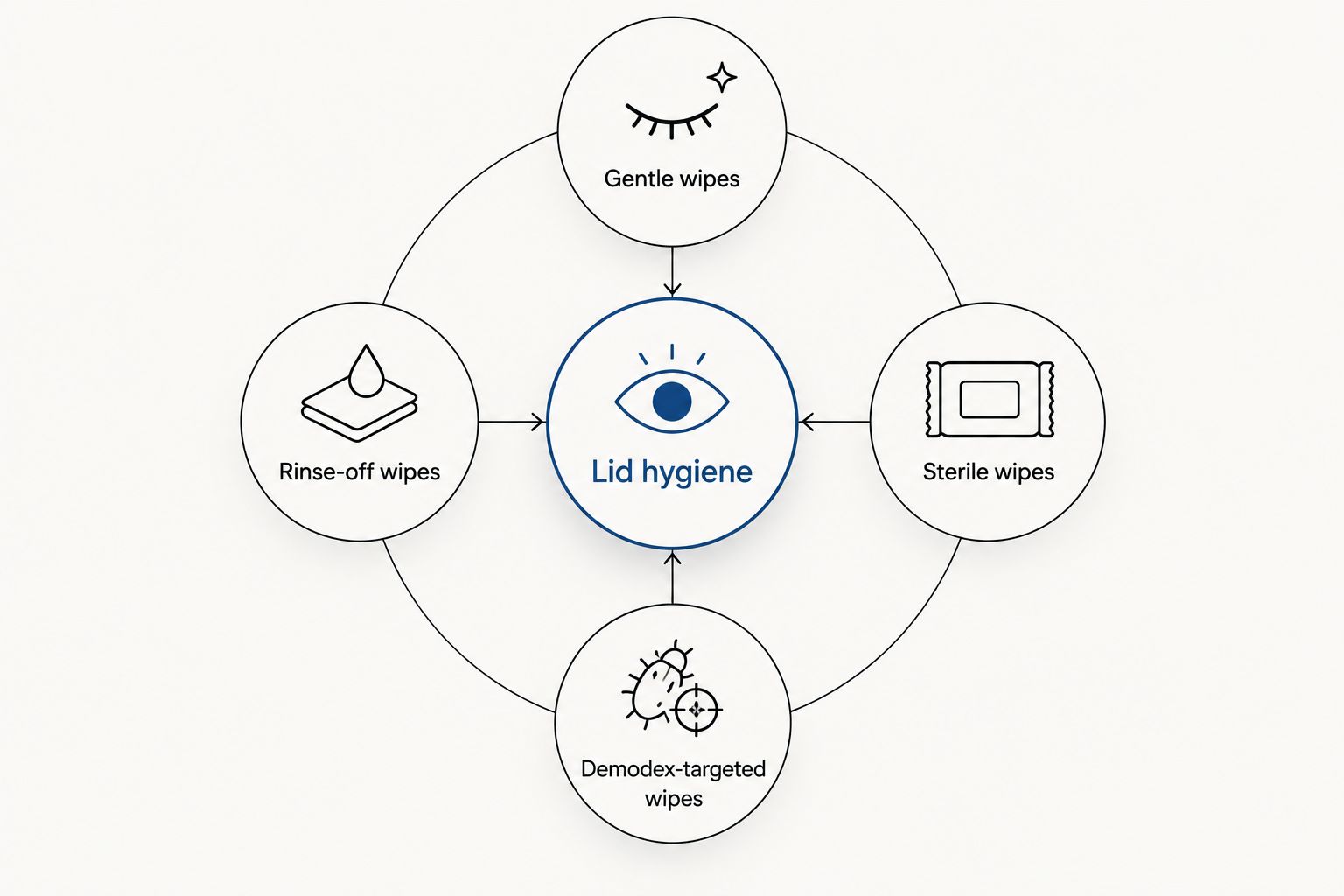
1. Gentle wipes: best for routine anterior lid-margin cleansing
Purpose-designed eyelid wipes provide a way to remove lash-base crusts and debris. For straightforward anterior lid hygiene, start with a preparation whose instructions and ingredients suit the patient, rather than assuming a stronger cleansing sensation means better treatment.
The word gentle is not proof of universal tolerance. Ask about previous reactions to periocular products and distinguish discomfort from the underlying condition from discomfort triggered by application.
Gentle wipes pros:
- Provide a defined format for demonstrating lash-margin cleansing.
- Avoid the need to improvise with household cleansing products.
- Allow you to build counselling around a preparation’s specific instructions.
Gentle wipes cons:
- Routine cleansing does not replace assessment of persistent inflammation.
- Ingredients can still irritate or cause contact sensitivity.
Best for: Patients needing routine removal of anterior lid-margin debris who tolerate the selected preparation.
Demonstrate the intended contact area. Cleaning the surrounding skin while leaving the lash bases untouched does not achieve the same task; vigorous rubbing is not the answer either. Let the instructions determine the method and frequency.
Verdict: Buy for routine cleansing when examination findings and individual tolerance support the choice.
2. Sterile wipes: best when a sterile presentation is selected
Sterile eyelid wipes are identified by the manufacturer’s labelling, not simply by an individual wrapper. Consider this format when a sterile presentation forms part of the patient’s agreed care instructions.
Keep the claim narrow. Sterility describes the preparation’s condition under its specified packaging and handling requirements; it does not establish better symptom relief or greater suitability for sensitive lids.
Sterile wipes pros:
- Make the sterile presentation explicit when confirmed on the label.
- Individually wrapped versions separate unused wipes from opened material.
- Single-use instructions provide a clear disposal point.
Sterile wipes cons:
- Opening and handling still require care.
- Sterility does not establish that the ingredients will be tolerated.
Best for: Patients whose selected care pathway calls for a sterile eyelid-cleansing preparation.
Check package integrity and the instructions before use. Do not transfer the wipe to another container or assume that a previously opened wipe retains its original status.
After ocular surgery, follow the treating team’s instructions rather than introducing lid cleansing independently. A general blepharitis recommendation is not a postoperative protocol.
Verdict: Buy when a sterile format is specifically appropriate; skip sterility as the sole reason to rank a wipe first.
3. Rinse-off wipes: best for patients comfortable with rinsing
Rinse-off eyelid wipes include a cleansing step followed by removal as directed by the manufacturer. They suit a patient who can carry out both parts of the routine reliably.
Confirm the rinse requirement rather than inferring it from the wipe’s appearance. Leaving a rinse-off preparation in place is not interchangeable with using a product intended to remain on the skin.
Rinse-off wipes pros:
- Provide an explicit end point to the cleansing process.
- Fit patients who prefer to remove a cleanser after application.
- Offer a routine you can demonstrate and check through patient teach-back.
Rinse-off wipes cons:
- Add a handling step and require appropriate access to water.
- Are unsuitable when the patient cannot complete the labelled routine reliably.
Best for: Patients who prefer a cleansing-and-rinsing method and can follow the preparation’s instructions.
Ask the patient to explain the process back to you. Difficulty remembering the sequence, reaching the lids or managing rinsing should change the recommendation, not simply prompt another reminder.
Do not describe rinse-off and no-rinse formats as clinically equivalent without evidence for the actual preparations. Their practical differences alone can determine whether a patient uses them correctly.
Verdict: Buy when rinsing fits the patient’s routine; skip when that extra step prevents correct use.
4. Demodex-targeted wipes: best for assessed Demodex-associated disease
Demodex-targeted eyelid preparations have a different intended purpose from routine cleansing alone. Consider them within a management plan supported by the history, examination and the specific preparation’s evidence and instructions.
Collarettes around lash bases are an important clinical sign associated with Demodex blepharitis. Persistent itching alone does not establish the diagnosis, and a product’s targeted positioning does not establish that every formulation has equivalent efficacy.
Demodex-targeted wipes pros:
- Distinguish targeted management from general debris removal.
- Give a specific clinical question to assess at follow-up.
- Support preparation-specific counselling when the diagnosis warrants it.
Demodex-targeted wipes cons:
- Active ingredients require attention to tolerability and application instructions.
- They are not a default recommendation for every patient with blepharitis.
Best for: Patients with clinician-assessed Demodex-associated lid disease when the selected preparation is appropriate.
Do not recommend homemade tea tree oil mixtures around the eyes. A household essential oil is not interchangeable with a formulated ophthalmic or eyelid preparation, and inappropriate application risks irritation or injury.
Check age restrictions, contraindications and the intended application site. Persistent signs require reassessment rather than indefinite repetition of an ineffective routine.
Verdict: Hold until the clinical rationale and preparation-specific suitability are established.
How the formats are ranked
This 2026 ranking prioritises clinical fit, tolerability, clear instructions, practical handling and reviewable outcomes. Routine cleansing comes first because it addresses the article’s central task: removing anterior lid-margin debris without treating every presentation as Demodex-associated disease.
Scope Connect’s lid hygiene guidance is intended to support clinical decisions, not replace preparation-specific evidence. Compare named products only after checking their actual instructions and relevant clinical data; the format alone cannot support an efficacy ranking.
Put the recommendation into practice
A useful recommendation includes the method and the follow-up, not just the product category. Keep the consultation focused on what the patient will do at home.
Confirm the treatment target
Document the symptoms, lid-margin findings and relevant history. Distinguish anterior debris from coexisting meibomian gland dysfunction, allergic disease or another cause of irritation before expanding the routine.
Warm compresses address a different management task from removing anterior lash debris. Where meibomian gland dysfunction coexists, the guide to heated eye masks for meibomian gland dysfunction provides related context; do not present a heated mask as a substitute for the selected cleansing method.
Demonstrate and check handling
Start with clean hands and follow the chosen preparation’s directions. Keep the cleansing action at the intended lid area, avoid rubbing the ocular surface and follow single-use or disposal instructions.
Remember that 2 eyes require separate attention: do not assume that findings, tolerance or management needs are identical on both sides. Follow the product’s directions on whether separate wipes are required.
Set a review point
Agree how you will assess comfort, debris and tolerance. There is no single review interval or application frequency that applies to every wipe and every presentation.
For your 2026 patient handouts, include what to do if symptoms worsen. Pain, photophobia or reduced vision requires prompt clinical assessment rather than simply increasing lid cleansing.
Which lid hygiene wipes should you choose?
Choose gentle, purpose-designed eyelid wipes as the default for routine anterior cleansing, then change the format only for a clear clinical or practical reason. Select a sterile presentation when indicated, a rinse-off method when manageable, and targeted preparations when the diagnosis supports them.
Scope Connect is best for eye care professionals seeking clinical education alongside product information. Use that distinction in practice: educational resources support your assessment; a buying guide does not make the diagnosis.
In 2026, the useful recommendation remains specific: what to clean, how to use the selected preparation and when to return. A longer list of products does not improve that instruction.
FAQ
What are the best lid hygiene wipes for blepharitis?
Gentle, purpose-designed eyelid wipes are the default format for routine anterior lid-margin cleansing. Choose the actual preparation according to examination findings, ingredients, tolerance and its instructions.
Are sterile eyelid wipes better than other wipes?
Sterility alone does not establish better blepharitis outcomes. Select a sterile presentation when appropriate to the care plan, and assess ingredients and handling separately.
Should patients rinse after using eyelid wipes?
Patients should rinse only as directed by the selected preparation’s instructions. Rinse-off and no-rinse products are not interchangeable routines.
Can ordinary face wipes replace blepharitis wipes?
Do not assume ordinary face wipes are suitable for the eyelid margin. Choose a preparation intended for the application site and check its ingredients and instructions.
Do all patients with blepharitis need Demodex wipes?
No, Demodex-targeted wipes are not the default for every blepharitis presentation. Establish the clinical rationale and check the specific preparation’s suitability before recommending targeted management.
How often should patients use lid hygiene wipes?
Follow the selected preparation’s instructions and the individual management plan. Do not apply one frequency to every formulation or advise more frequent cleansing in response to irritation.
When should a patient stop self-care and seek assessment?
Pain, photophobia or reduced vision requires prompt clinical assessment. Worsening irritation or a suspected reaction also warrants stopping the suspected preparation and seeking advice rather than intensifying cleansing.
One last thing
Before changing a wipe, ask the patient to show you how they use it. Application to the wrong area, excessive pressure or a missed rinsing step calls for corrected technique—not automatically a different formulation.
For your next 2026 review, ask one concrete question: Can the patient demonstrate the routine you intended? That gives you an actionable starting point before adding another product.
Related guides