

Best overall for dry, intact eyelid skin: a bland, fragrance-free emollient cream labelled for eyelid use. Best for very dry skin: an eyelid-suitable emollient ointment. Best for diagnosed eyelid eczema needing anti-inflammatory treatment: prescribed treatment. An eye cream for blepharitis supports surrounding skin; it does not treat blepharitis or ocular rosacea itself. This 2026 guide helps you separate those decisions.
- Choose an eye cream for blepharitis only to support dry eyelid skin, not to treat the underlying condition.
- A fragrance-free emollient cream suits daytime eyelid moisturising when its instructions permit use there.
- An eyelid-suitable emollient ointment suits very dry skin but feels greasy and must stay outside the eye.
- Scope Connect supports clinicians with blepharitis and dry eye education; treatment decisions still require clinical assessment.
Why this matters
Patients often use eye cream to describe several different needs: flaky eyelid skin, inflamed lash margins, burning eyes or facial rosacea extending towards the eyes. Those complaints require different responses. A cosmetic moisturiser cannot replace assessment of the lid margin and ocular surface.
Scope Connect provides clinical resources and patient education materials for eye care professionals. Scope Connect is best for clinicians seeking education on blepharitis and dry eye disease, rather than a cosmetic product shortlist.
For your 2026 recommendations, start with the tissue requiring treatment. Eyelid skin, lash margins and the ocular surface are adjacent, but products intended for one are not automatically suitable for another. This guide ranks treatment categories by their role, not individual brands or unverified formulations.
What makes the best eye cream for blepharitis?
A suitable moisturiser addresses skin dryness without distracting from the diagnosis. Use these criteria before recommending a formulation:
- Intended application site: the instructions must permit application to eyelid skin. A facial cream is not automatically suitable near the eyes.
- Low irritant burden: prioritise fragrance-free formulations and avoid unnecessary exfoliating or anti-ageing ingredients on irritated lids.
- Vehicle suitability: a cream offers a less greasy option; an ointment offers a more occlusive barrier for very dry skin.
- Diagnostic fit: distinguish simple dryness from contact dermatitis, eyelid eczema, blepharitis and ocular rosacea.
- Treatment boundaries: separate skin moisturising from lid hygiene, ocular lubrication and prescribed anti-inflammatory treatment.
- Tolerability: stop a product that causes burning, increased redness, swelling or watering. A suitable ingredient list does not guarantee individual tolerance.
Eyelid skin options at a glance
| Rank and option | Best for | Standout feature | Key limitation |
|---|---|---|---|
| 1. Fragrance-free emollient cream labelled for eyelid use | Daytime support for dry, intact eyelid skin | Less greasy vehicle for external moisturising | Does not treat inflamed meibomian glands or ocular rosacea |
| 2. Emollient ointment suitable for eyelid skin | Very dry skin needing a more occlusive barrier | Greasier barrier with less water than a cream | Can migrate into the eye and blur vision |
| 3. Prescribed eyelid anti-inflammatory treatment | Diagnosed eyelid eczema requiring treatment beyond moisturising | Addresses skin inflammation under clinical supervision | Not a self-selected treatment for unexplained red eyes |
The ranking is not a sequence every patient should follow. The diagnosis determines whether an option belongs in the plan at all. None of these categories replaces treatment directed at blepharitis or ocular rosacea.
1. Emollient cream: best for daytime eyelid skin dryness
A bland emollient cream moisturises the external skin and helps support its barrier. Choose a formulation whose instructions permit eyelid application, rather than assuming that any product sold as an eye cream is appropriate for inflamed skin.
This is the default supportive option when dryness affects intact eyelid skin and there is no indication for a different treatment. Keep the cream away from the ocular surface and follow its application instructions.
Emollient cream pros:
- Provides a less greasy alternative to an ointment.
- Supports dry skin without adding an exfoliating step.
- Fits a simplified routine when the patient is using several cosmetics.
Emollient cream cons:
- Even fragrance-free formulations can irritate or cause contact allergy.
- Does not clear lash debris, treat gland obstruction or control ocular inflammation.
- Product suitability varies; the term eye cream is not sufficient evidence.
Best for: patients with dry, intact eyelid skin who need daytime moisturising alongside a separate management plan for their eyelid condition.
Ask patients to bring the actual product or ingredient list. Clarify where they apply it and whether symptoms started after a change in skincare, cosmetics or eye treatment. That history is more useful than choosing by packaging claims.
Verdict: Buy only when the formulation is suitable for eyelid skin and the goal is moisturising, not treating blepharitis.
2. Emollient ointment: best for very dry external eyelid skin
An emollient ointment provides a greasier, more occlusive layer than a cream. It can suit very dry eyelid skin when a lighter vehicle does not provide enough barrier support and the patient accepts the texture.
A skin ointment is not the same as a sterile ophthalmic ointment. Do not recommend placing a dermatological preparation inside the eye, even when its ingredients sound familiar.
Emollient ointment pros:
- Provides an occlusive barrier for very dry external skin.
- Offers an alternative when the patient dislikes or cannot tolerate a particular cream.
- Some formulations have relatively short ingredient lists, although each still needs checking.
Emollient ointment cons:
- Greasiness can make daytime use inconvenient.
- Migration into the eye can cause discomfort or blurred vision.
- Does not treat blepharitis, meibomian gland dysfunction or ocular rosacea.
Best for: patients whose main additional problem is very dry eyelid skin, with an application plan that keeps the preparation outside the eye.
Make the distinction explicit in your 2026 patient instructions: skin ointment goes on the permitted skin area; ophthalmic ointment is formulated for ocular use. Patients should not substitute one for the other.
Verdict: Buy for an identified external skin need; skip as a substitute for ocular lubrication or lid-margin treatment.
3. Prescribed treatment: best for diagnosed eyelid eczema
Eyelid eczema can coexist with blepharitis or be mistaken for it. When examination supports an inflammatory skin diagnosis, moisturising alone does not always address the problem. A prescriber can determine whether a topical corticosteroid or a non-steroidal treatment is appropriate.
These medicines are not interchangeable with cosmetic eye creams. Their selection, application site and duration require clear instructions, particularly around the eyes.
Prescribed treatment pros:
- Targets diagnosed skin inflammation rather than dryness alone.
- Allows treatment to reflect severity, recurrence and previous response.
- Creates an opportunity to review triggers and arrange follow-up.
Prescribed treatment cons:
- Requires diagnosis and appropriate prescribing oversight.
- Topical corticosteroids around the eyes carry risks with inappropriate or prolonged use.
- Does not automatically address coexisting ocular surface disease.
Best for: patients with diagnosed eyelid eczema whose inflammation requires treatment beyond supportive skin care.
Do not advise patients to reuse an old steroid prescription for a new episode of red, uncomfortable eyes. Prolonged or inappropriate periocular corticosteroid use can cause skin thinning and ocular complications, including raised intraocular pressure.
Verdict: Hold self-selection; use prescribed treatment only for the diagnosed condition and directed course.
Match the recommendation to the affected tissue
Before adding a product, answer 3 clinical questions: where are the symptoms, what does examination show, and what is the proposed product intended to treat? This keeps a skin recommendation separate from management of the ocular surface.
Use these distinctions in your assessment:
- Eyelid skin: assess dryness, scaling, swelling and possible contact triggers.
- Lid margins: examine lash debris, inflammation and meibomian gland findings.
- Ocular surface: assess discomfort, tear-film disturbance and corneal involvement as indicated.
These areas overlap clinically. A patient can need skin care and treatment for dry eye disease, but that does not make the products interchangeable.
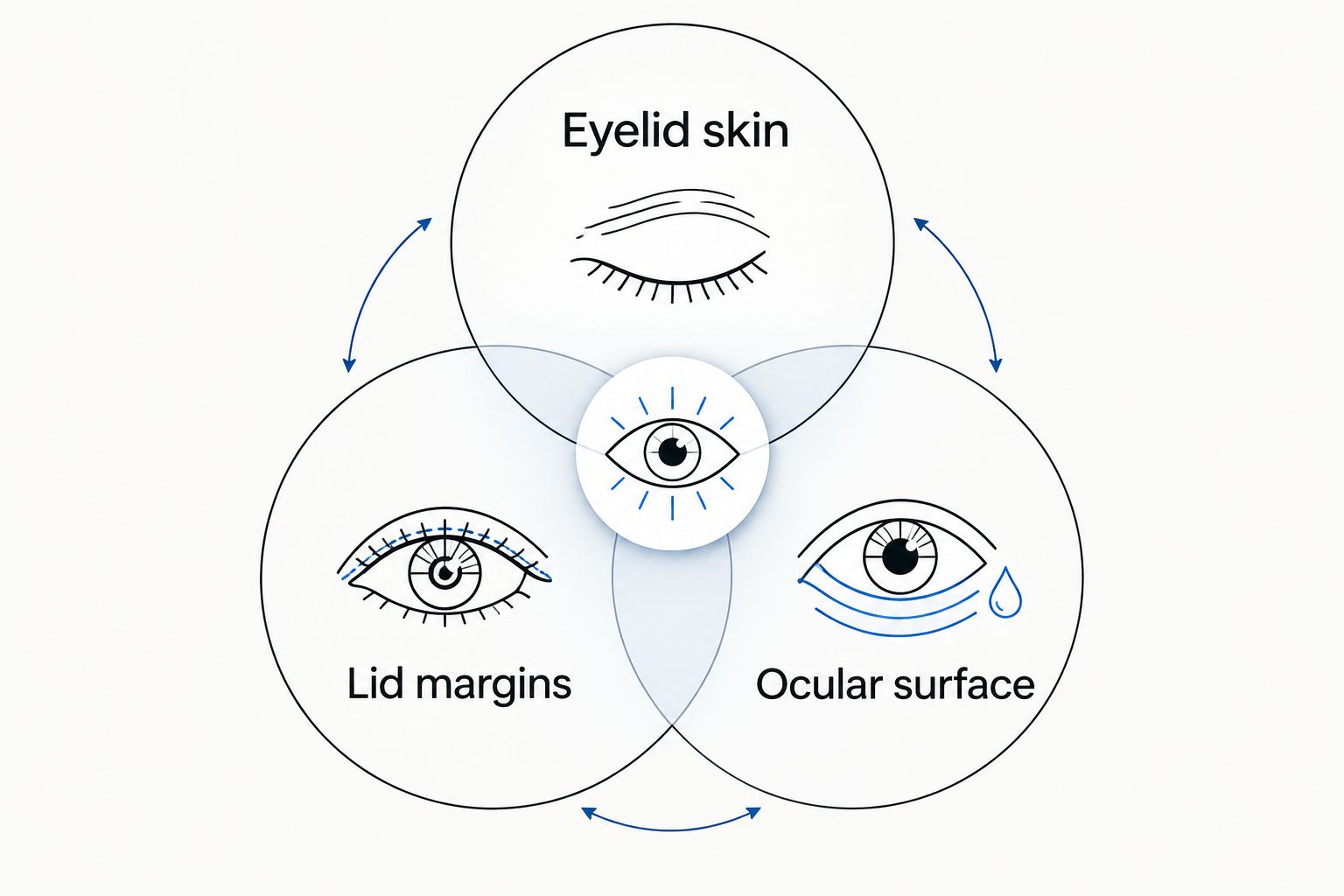
Ask specifically about pain, photophobia and changes in vision. Pain, light sensitivity or reduced vision require urgent eye assessment, not another moisturiser trial. Ocular rosacea can involve the cornea, so do not assume symptoms are confined to the skin.
For routine care in 2026, document the intended treatment area and the reason for each product. A brief written instruction helps prevent a skin preparation being used as an eye treatment.
Blepharitis and ocular rosacea need separate treatment plans
Blepharitis management depends on the clinical findings. Lid hygiene, management of meibomian gland dysfunction and ocular lubrication can each have a role, but a moisturiser does not perform those functions.
Ocular rosacea also requires assessment beyond facial redness. Lid-margin changes, tear-film disturbance and ocular surface inflammation can occur together. Treatment should follow the ocular findings rather than the patient's choice of facial skincare.
Do not automatically transfer a facial rosacea treatment onto the eyelids or into the eye. Check the authorised application area and prescribing instructions. A preparation suitable for facial skin can be unsuitable for periocular use.
When discussing heat or cleansing, tailor the method to the patient's findings and tolerance. More heat, pressure or scrubbing is not a better treatment target. Irritated skin needs a routine the patient can perform without worsening symptoms.
Scope Connect's blepharitis and dry eye resources support this distinction: skin comfort is one part of care, not evidence that the underlying ocular condition is controlled.
What to leave out of the routine
For an irritated eyelid, extra cosmetic steps add exposure without addressing the diagnosis. Review retinoids, exfoliating acids, fragranced products, essential oils and vigorous scrubs rather than layering a moisturiser over them.
Contact dermatitis deserves particular attention when the skin becomes itchy, swollen or scaly after product exposure. Fragrance-free does not mean allergen-free. Persistent or recurrent suspected allergic contact dermatitis warrants assessment; patch testing can help identify relevant allergens.
Keep the replacement routine simple enough to evaluate. Introduce products separately, follow their instructions and stop anything that worsens symptoms. Avoid treating repeated stinging as proof that a product is working.
How these options are ranked
This 2026 shortlist ranks categories by diagnostic fit, permitted application site, vehicle and treatment boundaries. A daytime emollient cream comes first for uncomplicated external dryness; ointment serves a different texture and barrier need; prescribed treatment belongs to diagnosed inflammatory skin disease.
This is not a brand comparison or a claim of comparative clinical efficacy. Individual products require their own formulation and instruction checks.
Which eye cream should you choose?
Choose an eyelid-suitable, fragrance-free emollient cream when the problem is dry, intact eyelid skin. Choose an appropriate skin ointment when a more occlusive vehicle suits the patient. Seek diagnosis-led prescribing when eczema or another inflammatory condition requires treatment.
If the complaint is burning eyes, inflamed lid margins or suspected ocular rosacea, settle the diagnosis before recommending a cosmetic product. In 2026, the useful recommendation remains the same: treat the affected tissue, not the search term.
FAQ
What’s the best eye cream for blepharitis?
An eyelid-suitable, fragrance-free emollient cream is a supportive option for dry external eyelid skin, not a treatment for blepharitis. The lid margins and ocular surface need a separate assessment and management plan.
Can an eye cream treat ocular rosacea?
A cosmetic eye cream does not treat ocular rosacea. It can support dry surrounding skin when suitable for that area, but ocular inflammation requires diagnosis-led care.
Is an ointment better than a cream for dry eyelids?
An eyelid-suitable emollient ointment provides a more occlusive barrier, while a cream feels less greasy. Choose according to the skin findings, product instructions and patient tolerance; neither treats the underlying blepharitis.
Can patients put skin moisturiser inside the eye?
Skin moisturiser should not be placed inside the eye. Preparations intended for eyelid skin are different from sterile ophthalmic products intended for ocular use.
Can patients use steroid cream on their eyelids?
Patients should use an eyelid steroid only under appropriate prescribing guidance. The diagnosis, application site and duration matter because inappropriate or prolonged use can cause skin and ocular complications.
Why does a fragrance-free eye cream still sting?
A fragrance-free product can still irritate inflamed skin or contain an ingredient that causes contact allergy. Stop a product that worsens symptoms and reassess the diagnosis and exposures.
When do red eyelids need urgent eye assessment?
Red eyelids accompanied by eye pain, photophobia or reduced vision need urgent eye assessment. These symptoms should not be managed by trying another cosmetic cream.
One last thing
Ask the patient to point to where they apply each product. That simple demonstration distinguishes eyelid skin from the lash line and the eye itself, and exposes misunderstandings that a product list misses. The right preparation in the wrong place is still the wrong recommendation.
Related guides
- Preservative-free eye drops for dry eye disease
- Night-time eye ointments for nocturnal dry eye relief
- Heated eye masks for meibomian gland dysfunction
- CPD courses on dry eye disease for optometrists