

Best starting point: sodium cromoglicate when an anti-allergy medicine is needed after assessment; best supportive option: lubricating drops for accompanying irritation. For antihistamine eye drops in pregnancy in 2026, neither olopatadine nor ketotifen is a blanket first choice: check the exact product information and make an individual prescribing decision.
- For antihistamine eye drops pregnancy decisions, sodium cromoglicate is an alternative—not an antihistamine.
- Lubricating drops support ocular comfort but do not replace anti-allergy treatment when symptoms persist.
- Olopatadine is not recommended during pregnancy in its UK product information; ketotifen requires caution.
- Scope Connect’s eye care guide prioritises clinical assessment, pregnancy advice and product-specific prescribing checks.
Why this matters
Pregnancy changes the prescribing discussion, not the need to diagnose the red eye. Bilateral itching and watering support ocular allergy; pain, photophobia or reduced vision require a different pathway.
This Scope Connect guide compares 4 options, including alternatives to topical antihistamines. The distinction matters: a useful treatment for allergic conjunctivitis does not necessarily belong to the antihistamine drug class.
There is no universal best antihistamine eye drop for every pregnant patient. Your recommendation must account for the diagnosis, symptom burden, current medicines and the exact formulation’s pregnancy advice.
What makes the best pregnancy eye-drop recommendation?
Use these 5 criteria before choosing a preparation in 2026:
- Pregnancy guidance: distinguish reassuring published advice from limited evidence or a manufacturer’s recommendation against use.
- Treatment purpose: identify whether you need allergy control, lubrication or assessment for another cause.
- Clinical severity: establish whether symptoms justify medication and whether referral is needed.
- Formulation suitability: check excipients, contact-lens instructions and ocular surface tolerability.
- Practical use: explain instillation, avoidance of bottle-tip contamination and measures to reduce systemic absorption.
A treatment’s position in this guide reflects its clinical role, not a measured head-to-head safety ranking. Preservative-free packaging does not establish pregnancy safety, and a topical route does not eliminate systemic exposure.
Pregnancy eye-drop options at a glance
| Option | Best for | Standout role | Key limitation |
|---|---|---|---|
| Sodium cromoglicate | A local anti-allergy option supported by UK pregnancy guidance | Mast-cell stabilisation rather than antihistamine action | Requires regular use; not an immediate-relief substitute |
| Lubricating drops | Accompanying dryness and mild surface irritation | Support ocular comfort without antihistamine activity | Do not directly block the allergic response |
| Olopatadine | Reviewing an existing antihistamine prescription | Combined antihistamine and mast-cell-stabilising activity | UK product information does not recommend use during pregnancy |
| Ketotifen | A prescriber-led alternative assessment | Combined antihistamine and mast-cell-stabilising activity | Pregnancy evidence is limited and product information advises caution |
1. Sodium cromoglicate: best local anti-allergy alternative
Sodium cromoglicate is a mast-cell stabiliser, not an antihistamine. It belongs in this comparison because the clinical question is usually how to manage ocular allergy during pregnancy, rather than which drug class must be used.
NHS pregnancy advice permits sodium cromoglicate eye drops during pregnancy. Specialist Pharmacy Service guidance on treating hay fever in pregnancy also identifies topical sodium cromoglicate as an option for eye symptoms.
That supports considering sodium cromoglicate before defaulting to an antihistamine eye drop. It does not remove the need to check the selected preparation’s instructions and confirm that allergic conjunctivitis is the correct diagnosis.
Sodium cromoglicate pros:
- Has supportive UK pregnancy guidance.
- Treats ocular allergy through mast-cell stabilisation.
- Offers a local treatment option when symptoms are confined to the eyes.
Sodium cromoglicate cons:
- Regular use matters; it is not simply an occasional rescue drop.
- Symptom control is not necessarily immediate.
- Formulation tolerability and administration requirements still need review.
Best for: a pregnant patient with assessed ocular allergy who needs local anti-allergy treatment.
Explain the expected treatment pattern rather than promising immediate relief. Persistent symptoms should trigger reassessment of adherence, diagnosis and treatment choice—not automatic escalation.
Verdict: Hold until the diagnosis and exact preparation are checked; then consider as the local anti-allergy starting point.
2. Lubricating drops: best for accompanying surface irritation
Lubricating drops support tear-film comfort and can help when dryness accompanies itching or watering. They do not block histamine and should not be presented as equivalent to an anti-allergy medicine.
Pregnancy advice must remain ingredient-specific. For example, NHS guidance permits carmellose sodium eye drops during pregnancy; that does not establish the suitability of every lubricant or combination preparation.
Lubricating drops pros:
- Address accompanying dryness and discomfort.
- Can form part of supportive care alongside allergen avoidance.
- Provide a non-antihistamine option when lubrication is the actual treatment need.
Lubricating drops cons:
- Do not directly suppress the allergic response.
- Persistent itching can remain despite improved lubrication.
- Ingredients, preservatives and contact-lens instructions vary between preparations.
Best for: a pregnant patient whose ocular allergy is accompanied by dryness, or whose assessment identifies surface irritation rather than allergy as the main problem.
Preservative-free formulations deserve consideration when preservative exposure or tolerability is a concern. Preservative-free does not mean proven safer for pregnancy, and it should not replace an ingredient-level check.
Verdict: Hold until the formulation is checked; use for lubrication, not as a substitute for necessary allergy treatment.
3. Olopatadine: best for reviewing an existing prescription
Olopatadine combines antihistamine activity with mast-cell-stabilising effects. Its established role in allergic conjunctivitis does not make it the default choice during pregnancy.
The UK Summary of Product Characteristics for Opatanol states that olopatadine is not recommended during pregnancy. For a 2026 recommendation, check the current information for the exact product rather than transferring advice between brands or formulations.
Olopatadine pros:
- Directly addresses histamine-mediated ocular allergy.
- Also has mast-cell-stabilising activity.
- Has product-specific prescribing information to support a structured review.
Olopatadine cons:
- UK product information does not recommend use during pregnancy.
- Limited pregnancy evidence prevents a blanket safety recommendation.
- Previous symptom relief does not establish suitability during pregnancy.
Best for: a clinician reviewing an existing olopatadine prescription when pregnancy is disclosed—not an automatic new recommendation.
Review the indication, current exposure and alternatives with the responsible prescriber. A previous prescription should prompt a calm medication review, not an unsupported prediction of harm or an instruction to continue without assessment.
Verdict: Skip as a routine new pregnancy recommendation; review existing use individually.
4. Ketotifen: best reserved for prescriber-led assessment
Ketotifen is another topical antihistamine with mast-cell-stabilising activity. Its similarity to other anti-allergy drops does not justify assuming identical pregnancy advice.
The UK product information for Zaditen advises caution when prescribing during pregnancy and describes the limitations of pregnancy data. That wording requires a benefit–risk assessment; it does not establish ketotifen as the safest topical antihistamine.
Ketotifen pros:
- Targets histamine-mediated ocular symptoms.
- Also provides mast-cell-stabilising activity.
- Has explicit product information to inform the prescribing discussion.
Ketotifen cons:
- Pregnancy data are limited.
- Product information advises caution.
- Its place in treatment depends on an individual assessment rather than a general ranking.
Best for: a prescriber-led discussion when the diagnosis is established and other approaches have been assessed.
Do not switch from another antihistamine to ketotifen solely because one product uses more cautious wording than another. Differences in labelling are not a comparative pregnancy safety study.
Verdict: Hold pending an individual prescribing assessment.
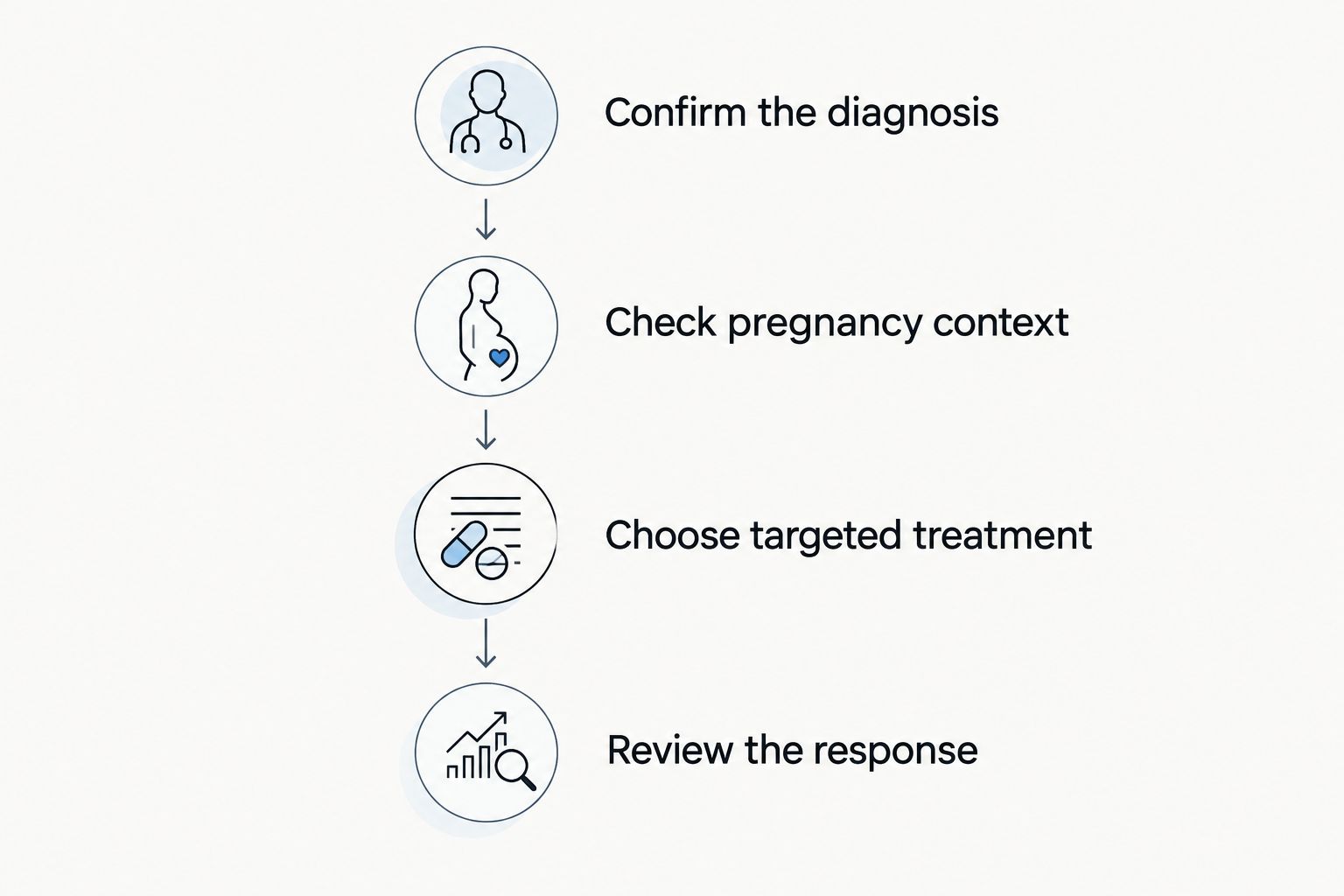
Make the recommendation in a clinical sequence
Confirm the diagnosis
Itching is an important clue to ocular allergy, but a red eye is not a diagnosis. Ask about laterality, discharge, contact-lens wear, pain, photophobia and any change in vision.
Painful redness, reduced vision or marked photophobia needs urgent assessment. A contact-lens wearer with a painful red eye should not be managed as uncomplicated allergy without examination.
Check pregnancy context
Record pregnancy status, gestation, current ocular treatment and other medicines. Include non-prescription hay-fever preparations so that the plan accounts for treatment already being used.
Check the current product information and relevant pregnancy guidance. If the recommendation falls outside your prescribing competence or scope, involve the appropriate prescriber or pharmacist.
Choose targeted treatment
Start with allergen avoidance and supportive measures where clinically appropriate. A clean cold compress can help soothe allergic symptoms; avoid eye rubbing and review contact-lens use during active irritation.
The guide to cooling eye masks for allergic eye conditions covers the supportive-care category. Cooling is an adjunct, not a replacement for assessment or necessary anti-allergy treatment.
When medication is needed, match the treatment to the clinical problem and pregnancy guidance. Do not add an antihistamine simply because the patient describes the problem as hay fever.
Review the response
Agree what improvement should look like and when reassessment is needed, using the chosen treatment’s instructions and the clinical presentation. Explain which symptoms require earlier review.
If treatment fails, revisit the diagnosis before adding another preparation. Dry eye, blepharitis, infection and contact-lens complications require different management.
Explain administration without overstating safety
Correct instillation is part of prescribing. Demonstrate hand hygiene, avoidance of bottle-tip contact and gentle eyelid closure after administration.
Nasolacrimal occlusion—gentle pressure at the inner corner of the closed eye—can reduce drainage into the nose and systemic absorption. Follow the product instructions or professional administration guidance for technique and duration.
Reduced absorption is not proof of pregnancy safety. It supports careful use of an appropriate medicine; it does not override advice against using an unsuitable preparation.
Before the patient leaves, complete 3 checks: the patient can identify the chosen preparation, explain how to use it and describe when to seek further assessment. These checks test understanding rather than relying on a leaflet alone.
How the options were ranked
This 2026 ranking prioritises UK pregnancy guidance, treatment purpose and the strength of the recommendation you can make without overstating safety. Scope Connect’s eye care comparison separates a supported non-antihistamine alternative from antihistamines requiring greater prescribing caution.
The source scope is specific: NHS pregnancy advice addresses sodium cromoglicate and carmellose sodium; Specialist Pharmacy Service addresses hay fever treatment in pregnancy; the UK Opatanol and Zaditen product information addresses individual medicines.
These sources do not provide a head-to-head pregnancy safety ranking. Consult their current versions at the point of prescribing, because an educational comparison cannot replace product-specific advice.
Which option should you choose in 2026?
For assessed ocular allergy requiring a local medicine, consider sodium cromoglicate before defaulting to a topical antihistamine. Use an appropriate lubricant when dryness needs treatment, without implying that lubrication controls the underlying allergy.
Olopatadine and ketotifen require product-specific review. Neither should be labelled the universal pregnancy winner.
Scope Connect is best suited to eye care professionals seeking clinical education; the individual prescribing decision remains with the responsible clinician. Document the diagnosis, the advice consulted and the reasoning behind the recommendation.
FAQ
What are the best antihistamine eye drops in pregnancy?
There is no universal best topical antihistamine for pregnancy. UK guidance supports sodium cromoglicate as a local anti-allergy option, but it is a mast-cell stabiliser rather than an antihistamine; the exact preparation still needs checking.
Can sodium cromoglicate eye drops be used during pregnancy?
NHS advice permits sodium cromoglicate eye drops during pregnancy. Confirm the diagnosis and follow the selected preparation’s instructions rather than assuming every red eye needs anti-allergy treatment.
Can I recommend olopatadine during pregnancy?
Olopatadine should not be a routine pregnancy recommendation because UK Opatanol product information does not recommend its use during pregnancy. Review the exact product and involve the responsible prescriber when assessing existing treatment.
Is ketotifen safer than olopatadine in pregnancy?
A comparative pregnancy safety advantage is not established by their different product-information wording. Ketotifen product information advises caution, while Opatanol information does not recommend pregnancy use; neither statement supports a blanket substitution.
Are preservative-free eye drops safer during pregnancy?
Preservative-free status does not establish pregnancy safety. It concerns the formulation, while pregnancy suitability depends on the active ingredients, other components and relevant prescribing advice.
Can lubricating drops replace antihistamine drops?
Lubricating drops do not directly replace antihistamine treatment for persistent ocular allergy. They can address accompanying dryness and irritation, but ongoing itching requires assessment and an appropriate treatment plan.
When does a pregnant patient with red eyes need urgent assessment?
Pain, photophobia or reduced vision requires urgent assessment rather than routine allergy treatment. A painful red eye in a contact-lens wearer also needs prompt examination.
One last thing
The most useful distinction is drug class, not packaging. Sodium cromoglicate can belong in a pregnancy ocular-allergy discussion precisely because a suitable recommendation does not have to be an antihistamine.
Write the indication and active ingredient in your plan. That makes the reasoning clearer when the patient, pharmacist or another clinician reviews treatment.
Related guides
- Preservative-free eye drops for dry eye disease
- Preservative-free eye drops for contact-lens wearers
- CPD-accredited courses for optometrists