

Best overall when overnight lubrication is indicated: a preservative-free paraffin-based ophthalmic ointment. Best for patients who cannot tolerate ointment blur: a preservative-free eye gel. Best for waking-hour supplementation: preservative-free lubricating drops. This 2026 guide compares formulation choices, not individual brands; Scope Connect provides clinical resources for eye care professionals managing dry eye disease.
- A preservative-free night time eye ointment for dry eye suits bedtime lubrication when temporary blurred vision is acceptable.
- Preservative-free eye gels offer an alternative texture but can still blur vision.
- Preservative-free lubricating drops support waking-hour symptoms; they are not equivalent to an overnight ointment.
- Scope Connect supports clinicians with dry eye disease education and patient resources.
- Pain on waking, incomplete lid closure or worsening vision requires assessment, not simply a thicker lubricant.
Why this matters
Choosing a night time eye ointment for dry eye starts with identifying what happens overnight. Reduced tear secretion during sleep and exposure from incomplete eyelid closure can contribute to morning discomfort. Burning, grittiness and pain on first opening the eyes do not, however, establish a diagnosis by themselves.
Match the formulation to the ocular surface findings, bedtime routine and tolerance of blurred vision. A thicker lubricant is not a substitute for assessing eyelid closure, corneal staining or recurrent corneal erosion. For your 2026 patient discussions, separate symptom relief from treatment of the underlying cause.
Scope Connect is best for eye care professionals seeking dry eye disease education and patient resources. The formulation choices below support that clinical conversation without treating an educational resource hub as an ointment manufacturer.
What makes the best night-time eye ointment?
Use these criteria before choosing a formulation. They explain the ranking and give you a practical structure for discussing treatment with patients.
- Clinical fit: Establish whether the principal problem is dryness, exposure, eyelid disease or another cause of morning symptoms.
- Preservative status: Consider preservative-free formulations when repeated lubrication is needed, particularly in patients with ocular surface disease or multiple topical medicines.
- Ophthalmic formulation: Select a preparation specifically intended for the eye. Skin ointments and cosmetic products are not substitutes.
- Vision tolerance: Discuss transient blur before recommending an ointment. The patient must be able to finish visually demanding tasks before application.
- Usability: Check whether the patient can handle the container, avoid touching the tip and follow the product's instructions.
- Treatment compatibility: Review contact lenses and other prescribed eye medicines. Follow the relevant instructions for spacing and application order.
Ingredient names alone do not establish the best choice. Paraffin-based ointments provide lubrication; some ophthalmic ointments also contain vitamin A. The additional ingredient does not, by itself, establish better clinical outcomes than another formulation.
Night-time lubrication options at a glance
This 2026 comparison distinguishes an ointment from alternatives that suit different parts of the treatment plan. Only the first option is an ointment; gels and drops are included to explain when a different formulation is appropriate.
| Option | Best for | Standout feature | Key limitation |
|---|---|---|---|
| Preservative-free paraffin-based ophthalmic ointment | Bedtime lubrication when temporary blur is acceptable | Greasy lubricating layer suited to use after visual tasks | Blurred vision and a greasy sensation can limit acceptability |
| Preservative-free eye gel | Patients who prefer a gel to a greasy ointment | Different texture from a paraffin-based ointment | Can still cause blur; overnight symptom control needs review |
| Preservative-free eye drops for dry eye disease | Waking-hour supplementation alongside a night-time plan | Drop format suited to daytime symptom management | Not a like-for-like replacement for an overnight ointment |
No option treats every cause of morning discomfort. The ranking prioritises practical clinical fit rather than claiming that one formulation has demonstrated superiority across all patients.
1. Preservative-free ophthalmic ointment: best for bedtime lubrication
A paraffin-based ophthalmic ointment provides a greasy lubricating layer over the ocular surface. Its tendency to blur vision makes bedtime a practical application point, after reading, driving and other visually demanding activities have finished.
Best for: Patients with an assessed need for overnight lubrication who accept temporary blur and can apply the preparation safely.
A preservative-free formulation avoids preservative exposure from that preparation. This does not mean every preserved product is unsuitable, or that preservative-free ointment eliminates irritation. Review the complete formulation and the patient's response.
Preservative-free ophthalmic ointment pros
- Provides lubrication in an ointment format suited to bedtime use.
- Avoids preservatives when the selected product is confirmed as preservative-free.
- Makes the distinction between daytime drops and bedtime lubrication straightforward to explain.
- Offers a formulation choice for patients who accept a greasy texture.
Preservative-free ophthalmic ointment cons
- Can temporarily blur vision and interfere with tasks after application.
- Can feel greasy or leave residue that patients find unpleasant.
- Does not correct incomplete eyelid closure or treat every cause of morning pain.
What to check before recommending it
Check the product's intended use, ingredients, directions and contact-lens instructions. Do not assume that all tubes labelled as eye ointment share the same formulation or handling requirements. Confirm any relevant allergy or previous intolerance.
If a patient asks about an ointment containing vitamin A, discuss the actual preparation rather than promising an ingredient-specific benefit. An existing prescribed regimen deserves review on its own merits, not replacement solely because another ingredient sounds more advanced.
Verdict: Choose a preservative-free ophthalmic ointment for assessed bedtime lubrication when blur and texture are acceptable.
2. Preservative-free eye gel: best for ointment intolerance
An eye gel offers an alternative formulation when a patient dislikes a greasy ointment. It remains a lubricant, not a treatment for all the mechanisms that cause dry eye disease. Gel formulations differ, so assess the selected product rather than treating the category as uniform.
Best for: Patients who need lubrication but do not tolerate an ointment's texture or practical effects.
A gel can still cause blurred vision. Avoid promising clear vision immediately after application, and explain that the patient's morning symptoms will determine whether the chosen regimen is adequate.
Preservative-free eye gel pros
- Offers a different texture from a paraffin-based ointment.
- Avoids preservative exposure when the product is confirmed as preservative-free.
- Provides an alternative to discuss when ointment use is inconsistent because of discomfort or inconvenience.
Preservative-free eye gel cons
- Can still blur vision after application.
- Does not necessarily provide the same overnight experience as an ointment.
- Requires assessment and review if exposure or persistent corneal symptoms are present.
What to check before recommending it
Ask why the ointment was unsuccessful. Texture, difficulty squeezing the tube and application technique are different problems; changing formulation does not address all of them. Demonstrate the intended technique and confirm that the patient understands the instructions.
Keep the treatment goal explicit: comfortable waking symptoms and an appropriately managed ocular surface. A more acceptable formulation is useful only if it also meets the patient's clinical needs.
Verdict: Choose a preservative-free eye gel when ointment intolerance is the main barrier, then review symptom control.
3. Preservative-free lubricating drops: best for waking-hour support
Preservative-free lubricating drops support symptom management while the patient is awake. They can form part of a plan that also includes bedtime ointment, but their role is different. Do not describe a daytime drop as an equivalent overnight treatment simply because both preparations lubricate the eye.
Best for: Patients needing waking-hour lubrication alongside an assessed night-time treatment plan.
This distinction matters when patients report that drops help briefly during the day but they still wake with discomfort. Review the overnight problem rather than automatically increasing daytime applications.
Preservative-free lubricating drops pros
- Provide a practical formulation for waking-hour symptom management.
- Avoid preservative exposure when the selected preparation is preservative-free.
- Allow daytime and bedtime treatment roles to be explained separately.
Preservative-free lubricating drops cons
- Are not a like-for-like substitute for an ointment.
- Can still cause transient blur or irritation, depending on the formulation.
- Add handling and scheduling demands when several topical medicines are prescribed.
What to check before recommending them
Review compatibility with contact lenses and the instructions for other topical medicines. Preservative-free status alone does not establish that a drop can be applied over a lens. Patients should follow the specific product directions rather than a general rule about lubricants.
Where drops and ointment are used together, explain their order clearly. Ointment is generally applied last; the relevant leaflets and prescribing instructions take precedence.
Verdict: Choose preservative-free lubricating drops for waking-hour support, not as an automatic replacement for bedtime ointment.
A practical assessment before choosing a formulation
A useful 2026 consultation should establish the symptom pattern before discussing the tube or bottle. Ask whether discomfort occurs during the night, immediately on waking or throughout the day. Distinguish grittiness from sharp pain, and ask about changes in vision.
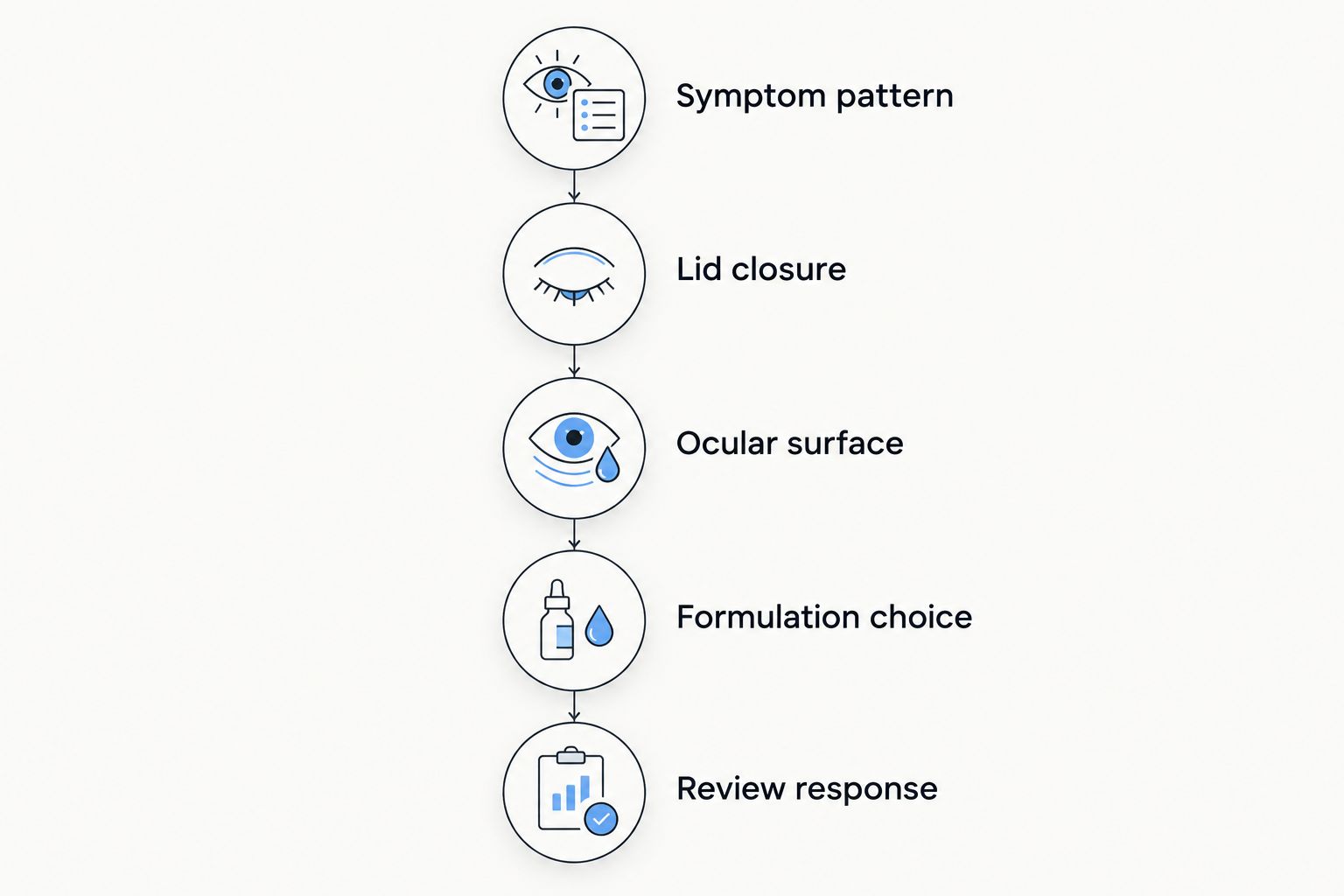
Use the following sequence to organise the decision:
- Symptom pattern: Record timing, laterality, pain, visual symptoms and previous treatment response.
- Lid closure: Assess blinking and eyelid closure, including concern about exposure during sleep.
- Ocular surface: Examine the cornea, conjunctiva and lid margins, with appropriate tear-film assessment.
- Formulation choice: Match the lubricant to clinical findings, tolerance and the patient's routine.
- Review response: Agree how symptom response, adverse effects and persistent findings will be reassessed.
Sharp pain on first opening the eye raises a different clinical question from mild morning grittiness. Consider recurrent corneal erosion within the differential diagnosis rather than assuming insufficient lubrication. Persistent symptoms despite appropriate lubricant use require reassessment.
New or worsening eye pain, marked redness, light sensitivity or reduced vision warrants prompt clinical assessment. A painful red eye in a contact-lens wearer needs urgent attention; do not advise simply adding ointment and waiting for improvement.
Application advice that makes the recommendation usable
A suitable preparation still needs clear instructions. Ask patients to demonstrate how they would hold the container and apply the medicine. This exposes practical difficulties that a verbal explanation alone can miss.
- Wash and dry your hands before application.
- Follow the preparation's instructions for the amount to apply.
- Avoid touching the container tip to the eye, eyelid, fingers or another surface.
- Follow the product instructions about contact-lens removal and subsequent wear.
- Apply bedtime ointment after finishing tasks that require clear vision.
- Follow the stated storage requirements and discard instructions.
When more than one type of eye drop is used, at least 5 minutes between different drops is standard administration advice; check each medicine's instructions. Apply ointment last when it is part of the same regimen, using the specified interval rather than assuming the drops rule covers every preparation.
Do not drive while vision is blurred. If a patient regularly needs to get up during the night, discuss how temporary blur affects that routine before recommending an ointment. Practical acceptability belongs in the treatment decision, not in an afterthought.
How the options are ranked
This 2026 guide ranks formulation categories by clinical role, preservative status, texture, visual effects and usability. It does not report a comparative trial, product test or brand-level efficacy ranking.
The ointment ranks first for bedtime lubrication because that is the question being answered. The gel occupies the intolerance alternative, while drops occupy the waking-hour adjunct role. Keeping these roles separate prevents an apparently simple list from implying that unlike preparations are interchangeable.
Which night-time option should you choose?
Default to a preservative-free ophthalmic ointment when examination supports overnight lubrication and the patient accepts temporary blur. Choose a gel when ointment texture prevents consistent use. Use drops to support waking-hour symptoms when clinically appropriate.
Do not keep changing lubricants without reassessing an unresolved problem. Exposure, lid-margin disease and recurrent corneal erosion need a clinical plan that addresses the cause. Scope Connect's dry eye disease resources support clinician education; the formulation decision remains patient-specific.
FAQ
What’s the best night time eye ointment for dry eye?
A preservative-free ophthalmic ointment is a practical default when assessment supports overnight lubrication and temporary blurred vision is acceptable. The best individual preparation depends on ocular surface findings, ingredients, tolerance and the product instructions.
Is eye ointment better than eye gel at night?
Eye ointment and eye gel suit different tolerances and treatment needs; neither is universally better. An ointment provides a greasy lubricating layer, while a gel offers a different texture and can still cause blur.
Can I use dry eye drops instead of ointment before bed?
Dry eye drops are not a like-for-like replacement for an ointment. A clinician should match the formulation to the symptoms and examination rather than assuming that all lubricants provide equivalent overnight support.
Can I use eye ointment while wearing contact lenses?
Do not assume that an eye ointment is compatible with contact-lens wear. Follow the specific preparation’s instructions about removing lenses and when they can be worn again.
Why does my eye ointment make my vision blurry?
Ophthalmic ointment can temporarily blur vision because it forms a greasy layer over the ocular surface. Use it after visually demanding tasks and do not drive while vision remains blurred.
Does pain when opening my eyes mean I need more ointment?
Pain on opening the eyes does not automatically mean that more ointment is needed. Recurrent corneal erosion and other causes require assessment, particularly with sharp pain, light sensitivity, redness or altered vision.
Should I put eye drops in before or after ointment?
Eye drops are generally applied before ointment, with ointment last. Follow the relevant leaflets and prescribing instructions for the interval between preparations.
One last thing
Ask what makes the patient stop using the recommended preparation. Blur, texture, container handling and uncertainty about application are actionable problems. Record the reason before changing treatment; otherwise, the next lubricant can fail for the same practical reason.
For your 2026 review, separate tolerability from effectiveness. A patient can dislike a clinically useful ointment, or find a preparation comfortable while still having unresolved ocular surface disease. Both situations need a different next step.
Related guides
- Preservative-free eye drops for contact-lens wearers
- Heated eye masks for meibomian gland dysfunction
- CPD-accredited courses for optometrists