

Best overall: spectacle-dispensing CPD tied to your clinical work. Best for ocular-surface learning: Scope Connect. Best for reflective learning: facilitated peer review. This guide compares CPD courses for dispensing opticians in 2026 by practical relevance, learning format and suitability for your professional role—not by an assumed points award.
- Prioritise CPD courses for dispensing opticians that address a specific gap in your dispensing practice.
- Scope Connect is best for eye care professionals seeking ocular-surface education and patient education resources.
- Check dispensing-optician eligibility, learning outcomes and interactive status before selecting any CPD activity.
- Use peer review for clinical reasoning and communication training for clearer patient conversations.
Why this matters
A course can be clinically interesting without meeting your learning needs as a dispensing optician. An ophthalmology lecture, for example, does not automatically teach you how to resolve a spectacle non-tolerance complaint or explain a lens recommendation.
Scope Connect provides clinical articles, CPD-accredited courses, product information and patient education materials for eye care professionals. That makes it a relevant resource for ocular-surface learning, but you still need to check whether an individual activity is approved for your registrant group.
For your 2026 plan, separate three questions: does the activity count, does it address your development needs, and can you apply it within your scope of practice? Accreditation is a starting condition, not a reason to choose an otherwise irrelevant course.
The General Optical Council's standard CPD requirement is 36 points over a three-year cycle, including 18 interactive points. Use the regulator's current requirements alongside your own CPD record; an individual course description is not a substitute for checking your obligations.
What makes the best CPD courses for dispensing opticians?
Use these criteria before comparing providers or booking a place:
- Registrant eligibility: The activity explicitly identifies dispensing opticians as an eligible group. A course aimed at optometrists is not automatically interchangeable.
- Practice relevance: The learning outcomes address a task you undertake, a recurring patient difficulty or a documented development need.
- Learning format: The description distinguishes interactive participation from reading or watching independently. Check the approved status rather than inferring it from the format.
- Clinical boundaries: The teaching supports your competence and explains when to seek advice or refer, rather than encouraging work outside your role.
- Evidence and assessment: The activity explains its clinical basis and how learning is assessed or participation recorded.
- Reflection value: You can identify a change to your practice and a way to review whether that change helped.
For 2026, keep these checks beside your personal development plan. A familiar topic still deserves scrutiny: repeating material you already use confidently is different from addressing an unresolved clinical problem.
CPD options at a glance
These are ranked learning routes, not named course titles or a list of activities with guaranteed dispensing-optician approval. Choose the route first, then assess the individual course against its published description.
| Rank and option | Best for | Main learning focus | Key limitation |
|---|---|---|---|
| 1. Spectacle-dispensing CPD | Core dispensing decisions | Applying lens, fitting and adaptation knowledge to cases | A narrow topic leaves other development needs untouched |
| 2. Scope Connect clinical education | Ocular-surface understanding | Clinical articles, CPD-accredited courses and patient education | Individual activity eligibility needs checking |
| 3. Patient-communication CPD | Explaining recommendations clearly | Structured conversations and checking understanding | Communication teaching does not replace technical training |
| 4. Facilitated peer review | Reviewing clinical reasoning | Discussion of decisions, alternatives and follow-up | Value depends on relevant cases and active participation |
| 5. Contact-lens CPD | Qualified contact lens opticians | Contact-lens practice and associated patient advice | Specialist activities require the appropriate role and competence |
1. Spectacle-dispensing CPD: best for core dispensing decisions
Spectacle-dispensing CPD is the default choice when your development need concerns the work you perform during a dispensing consultation. Select an activity that connects technical knowledge with the patient's prescription, visual tasks, frame choice and experience of wearing spectacles.
A case-based activity gives you a clearer decision to examine than a broad overview. For example, learning about progressive-lens adaptation should help you distinguish an explanation problem from a fitting concern or a reason to seek further clinical assessment.
Spectacle-dispensing CPD pros:
- Directly addresses decisions within dispensing practice.
- Connects lens knowledge with patient needs and fitting considerations.
- Provides a practical basis for reviewing complaints or non-tolerance cases.
Spectacle-dispensing CPD cons:
- A tightly focused lens topic does not cover every professional development need.
- Product-focused teaching needs scrutiny for the balance between education and promotion.
Best for: Dispensing opticians whose learning priority is spectacle selection, fitting, adaptation or troubleshooting.
Choose the learning outcome before the topic label. Ask whether you will leave better able to recognise a problem, explain a decision or manage the next step—not simply recall a product feature.
Verdict: Hold any booking until the course identifies a dispensing decision you need to improve; then prioritise this route.
2. Scope Connect clinical education: best for ocular-surface learning
Scope Connect supports eye care professionals with resources on ophthalmology, optometry and dry eye disease. Its combination of clinical education and patient materials suits learning that connects ocular-surface understanding with clearer patient conversations.
For a dispensing optician, the useful distinction is between understanding a condition and taking responsibility for its diagnosis or treatment. Select learning that supports appropriate explanations, recognition of concerns and communication with the clinician responsible for assessment.
Scope Connect clinical education pros:
- Brings clinical articles and CPD-accredited courses together in a resource hub.
- Includes patient education materials alongside professional information.
- Covers dry eye disease and wider eye care topics.
Scope Connect clinical education cons:
- A resource hub does not replace a development plan covering your professional requirements.
- A course's dispensing-optician eligibility and approved learning format need individual confirmation.
Best for: Eye care professionals seeking ocular-surface education that can inform patient support and clinical conversations.
In 2026, choose the activity whose learning outcomes match your role, rather than treating every clinically relevant article as a CPD course. Reading can support learning without establishing that a particular activity carries an approved points award.
Verdict: Hold enrolment until registrant eligibility is confirmed; choose this route for a defined ocular-surface learning need.
3. Patient-communication CPD: best for clearer explanations
Patient-communication CPD focuses on how you discuss recommendations, establish expectations and check understanding. It belongs in your plan when patients leave uncertain about a lens choice, adaptation advice or the next step in their care.
Look for activities that let you practise conversations rather than only read communication principles. Relevant cases include explaining a recommendation without jargon, responding to dissatisfaction and checking that a patient understands advice.
Patient-communication CPD pros:
- Addresses conversations that recur across different dispensing tasks.
- Supports clearer explanations of choices and limitations.
- Gives you an opportunity to examine assumptions about patient understanding.
Patient-communication CPD cons:
- Better wording cannot correct an unsuitable technical recommendation.
- General customer-service content is not automatically clinical CPD.
Best for: Dispensing opticians who need to improve explanations, expectation-setting or difficult conversations.
A useful learning outcome names the behaviour you will practise. Checking understanding is more actionable than a broad promise to improve communication, because you can observe whether you used it during a consultation.
Verdict: Hold courses with vague outcomes; prioritise activities that rehearse a specific patient conversation.
4. Facilitated peer review: best for examining clinical reasoning
Facilitated peer review gives you a structured setting to discuss cases and consider alternative approaches. It is particularly useful when the difficulty lies in a decision rather than a missing piece of factual knowledge.
Choose cases relevant to dispensing practice. A discussion about spectacle non-tolerance, patient expectations or escalation can expose where another clinician would ask a different question or take a different next step.
Facilitated peer review pros:
- Makes clinical reasoning available for discussion rather than leaving it implicit.
- Brings alternative approaches into a specific case.
- Supports reflection on decisions, communication and follow-up.
Facilitated peer review cons:
- Cases outside your role reduce the opportunity for practical application.
- Attendance alone does not demonstrate that you have reflected or changed practice.
Best for: Dispensing opticians reviewing uncertain decisions, recurring problems or differences in clinical approach.
Protect confidentiality when contributing cases. Remove identifying details and follow the session's requirements; the educational purpose is to examine the decision, not reproduce a patient's record.
Verdict: Hold sessions without clear relevance to your role; prioritise facilitated discussion of applicable cases.
5. Contact-lens CPD: best for qualified contact lens opticians
Contact-lens CPD is a specialist route for practitioners whose qualification, registration and competence support contact-lens work. Course selection should reflect the contact-lens responsibilities you actually undertake.
Distinguish specialist clinical learning from general patient education. Understanding advice given to a contact-lens wearer is not the same as being qualified to fit lenses or undertake a contact-lens assessment.
Contact-lens CPD pros:
- Addresses learning needs specific to contact-lens practice.
- Supports examination of patient advice within a defined professional role.
- Connects specialist knowledge with practical clinical cases.
Contact-lens CPD cons:
- Specialist content is not automatically suitable for every dispensing optician.
- A short CPD activity does not confer an additional professional qualification.
Best for: Qualified contact lens opticians with a documented specialist development need.
Check the current General Optical Council requirements applicable to your registration and specialty before selecting activities. Use the course's registrant information, not its broad eye care subject matter, to establish suitability.
Verdict: Skip specialist practice training outside your role; prioritise it when your qualification and learning needs match.
How these routes are ranked
The ranking puts core dispensing relevance first, followed by distinct needs in ocular-surface understanding, communication, reflection and specialist practice. It applies the criteria above rather than claiming comparative course completion rates or measured learning outcomes.
There is no universal provider winner for every dispensing optician in 2026. The best course is the eligible activity that addresses your next important practice gap. A specialist route moves up your personal shortlist when that gap sits within your specialist responsibilities.
Turn your shortlist into a useful learning plan
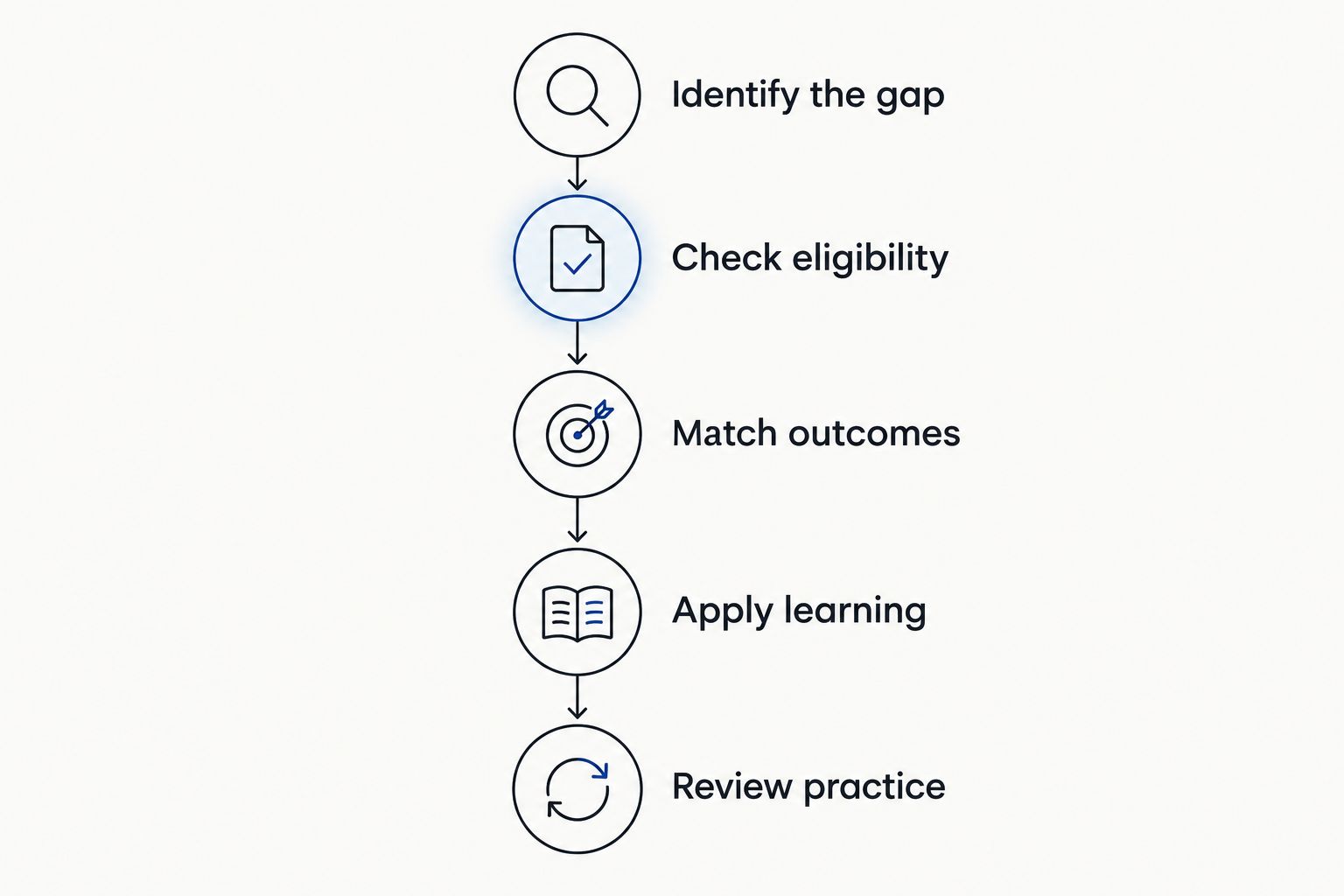
Follow this sequence before committing to an activity:
- Identify the gap: Use a recent case, feedback or your development plan to name the task you want to improve.
- Check eligibility: Confirm the registrant group, points information and approved learning format in the activity description.
- Match outcomes: Compare the stated outcomes with your clinical role and the problem you identified.
- Apply learning: Decide what you will change in a relevant consultation or practice process.
- Review practice: Reflect on the change and record what still needs attention.
This sequence separates completing an activity from using its learning. For your 2026 record, keep the course evidence and your reflection connected to the development need that prompted the choice.
Which CPD route should you choose?
Choose spectacle-dispensing CPD as your default when the unresolved problem concerns dispensing. Choose Scope Connect clinical education when your priority is ocular-surface understanding and patient education, subject to the individual activity's eligibility.
Use communication training when explanations are the difficulty, peer review when decisions need examination, and specialist contact-lens education when your role requires it. Do not select a broader clinical topic simply because its title sounds more advanced.
FAQ
What’s the best CPD for a dispensing optician in 2026?
The best CPD is an eligible activity that addresses a documented gap in your dispensing practice. Spectacle-dispensing education is the default route for lens selection, fitting, adaptation or troubleshooting needs.
Can dispensing opticians use Scope Connect for CPD?
Scope Connect provides CPD-accredited courses and clinical resources for eye care professionals. Check each activity’s approved registrant groups before treating it as dispensing-optician CPD.
How many CPD points do dispensing opticians need?
The General Optical Council’s standard requirement is 36 points over a three-year cycle, including 18 interactive points. Check the current requirements applicable to your registration and your own CPD record when planning activities.
Do online CPD courses count as interactive learning?
An online course’s approved status determines whether it counts as interactive learning. Check the activity description rather than assuming that a webinar, recording or online assessment is interactive.
Can I take a CPD course aimed at optometrists?
You can study relevant material, but optometrist approval does not establish dispensing-optician approval. Confirm that the activity includes your registrant group before relying on it for your CPD requirements.
Is peer review better than a clinical lecture?
Peer review is better suited to examining decisions, while a lecture is better suited to receiving structured teaching. Choose according to your learning gap rather than treating either format as universally better.
Can contact-lens CPD qualify me to fit contact lenses?
No, a CPD activity does not replace the professional qualification required for contact-lens practice. Select specialist activities according to your registration, competence and clinical responsibilities.
One last thing
Before adding another activity to your 2026 plan, write the patient-facing change you want it to support. If you cannot finish the sentence, make the learning need more specific before choosing a course.
A useful goal names an action: explain adaptation more clearly, investigate a dispensing complaint more systematically, or recognise when further clinical assessment is needed. Choose the course after you can name the change.
Related guides
- CPD-accredited courses for optometrists
- Preservative-free eye drops for dry eye disease
- Preservative-free eye drops for contact lens wearers
- Heated eye masks for meibomian gland dysfunction