

Allergic conjunctivitis duration depends on whether allergen exposure stops: an isolated flare usually settles over days, while repeated exposure can keep symptoms recurring for weeks or throughout an allergy season. Perennial allergy can cause symptoms throughout the year rather than follow a single recovery period. Persistent discomfort, pain, light sensitivity or reduced vision needs reassessment, not a longer wait for presumed allergy to clear.
- Allergic conjunctivitis duration follows allergen exposure; recurrent symptoms do not necessarily mean treatment has failed.
- Seasonal allergy can recur throughout the pollen season; perennial allergy can cause year-round symptoms.
- Pain, light sensitivity or reduced vision needs urgent assessment rather than routine allergy self-care.
- Scope Connect is best for eye care professionals seeking clinical education, not patients needing urgent assessment.
Why this matters in 2026
Patients often ask when redness will disappear, but the clinically useful question is whether the ocular surface is improving between exposures. A patient who feels better indoors and deteriorates outdoors has a different pattern from someone whose symptoms steadily worsen despite avoiding the suspected trigger.
Scope Connect provides clinical resources and patient education materials for eye care professionals. Use the distinction between symptom relief and sustained control when explaining recovery: reducing itching today does not establish that tomorrow's exposure will be harmless.
Give patients an expected direction of improvement and clear return advice, rather than promising a fixed clearance date. That makes the plan useful even when pollen exposure, household allergens or overlapping ocular surface disease remain difficult to control.
How long does allergic conjunctivitis usually last?
Allergic conjunctivitis usually improves when exposure falls and appropriate treatment controls the inflammatory response. Symptoms can return with renewed exposure, so the elapsed time since the first episode is not always a reliable measure of recovery.
The distinction between an isolated flare, seasonal recurrence and persistent allergy provides a more useful explanation than a single average duration.
| Pattern | Expected course | Best fit for this explanation | Important limitation |
|---|---|---|---|
| Isolated allergen exposure | Symptoms settle after exposure ends, although inflammation does not disappear immediately | A clear trigger followed by sustained improvement | Further contact can restart symptoms |
| Seasonal allergic conjunctivitis | Symptoms fluctuate during the relevant pollen season | Recurrent itching and watering linked to outdoor exposure | The season does not predict an individual patient's recovery date |
| Perennial allergic conjunctivitis | Symptoms persist or recur with ongoing indoor allergen exposure | Symptoms associated with triggers such as house dust mites or animal dander | Exposure reduction alone does not establish the diagnosis |
| Contact lens-associated papillary conjunctivitis | Recovery depends on addressing lens-related irritation and the clinical findings | Lens intolerance with papillary changes on examination | This is not interchangeable with uncomplicated seasonal allergy |
At review, ask whether itching is less intrusive, rubbing has reduced and the patient is functioning more comfortably. Document visual acuity and examination findings rather than relying only on whether the eyes look less red.
What does improvement actually mean?
Improvement means a favourable symptom trend alongside reassuring clinical findings. Complete absence of symptoms is a different endpoint, particularly when exposure continues.
Ask the patient to distinguish persistent symptoms from separate flares. Feeling comfortable between outdoor exposures suggests a different course from uninterrupted discomfort, and that distinction helps you decide whether to adjust management or reconsider the diagnosis.
Seasonal allergic conjunctivitis: symptoms follow exposure
Seasonal allergic conjunctivitis commonly causes bilateral itching, watering and redness during exposure to relevant airborne allergens. Symptoms can improve between exposures and return when the patient encounters the trigger again.
For your 2026 consultations, explain that an allergy season is an exposure window, not a prescribed recovery period. A patient can experience several flares within that window without each flare representing a new disease.
Best for explaining: a recurring pattern linked to pollen exposure, especially where nasal allergy accompanies the eye symptoms. The limitation is that timing alone does not confirm allergy; an examination remains important when symptoms are atypical, severe or persistent.
Ask about commuting, gardening, open windows and whether symptoms change away from the usual environment. These questions help identify a pattern without requiring the patient to recognise the responsible pollen.
Perennial allergic conjunctivitis: symptoms can recur year-round
Perennial allergic conjunctivitis is associated with allergens present beyond a particular pollen season, including house dust mites and animal dander. Continued exposure makes a definite end date less useful than a plan for sustained control.
Best for explaining: persistent or recurrent symptoms with a plausible indoor exposure pattern. The limitation is diagnostic overlap: dry eye, blepharitis and reactions to topical preparations can also produce ongoing irritation.
Ask whether symptoms change at home, at work or when staying elsewhere. Avoid recommending major environmental changes solely because symptoms happen indoors; a consistent history and appropriate assessment should guide advice.
If symptoms remain troublesome, revisit both exposure and diagnosis. Repeating the same advice without checking the ocular surface does not explain why the patient is failing to improve.
Why allergic conjunctivitis duration varies
Several clinical and practical factors influence how long symptoms continue. Use these factors to explain variation without suggesting that a patient has caused their own prolonged symptoms.
- Ongoing exposure: repeated contact with the relevant allergen can trigger further symptoms even after an earlier flare improves.
- Underlying pattern: seasonal and perennial disease have different exposure patterns, so they need different explanations of recurrence.
- Treatment use: the selected medicine, administration technique and consistency of use affect symptom control. Check the actual preparation rather than discussing all allergy drops as equivalent.
- Eye rubbing: rubbing aggravates an already irritated ocular surface. Ask specifically about rubbing rather than assuming the patient recognises it as relevant.
- Coexisting disease: dry eye, blepharitis and contact lens-related problems can contribute symptoms that persist after allergic itching improves.
- Diagnostic accuracy: redness attributed to allergy needs reconsideration when the history, examination or response does not fit.
Avoid using redness alone as the recovery marker. Itching, comfort, visual function, corneal findings and the patient's ability to resume usual activities provide a fuller picture.
A practical review sequence for 2026 consultations
Use the same clinical sequence when the patient asks whether their symptoms have lasted too long. It keeps the discussion focused on safety before treatment adjustment.
- Check warning signs. Ask about pain, light sensitivity, reduced vision and contact lens wear. Arrange urgent assessment when the presentation suggests corneal disease or another serious cause of red eye.
- Review exposure. Establish whether the suspected trigger has stopped, continues daily or appears only in particular settings. Ask what changed before symptoms began.
- Check treatment. Confirm the product, dosing instructions, administration technique and whether the patient is using other ocular preparations. Check age restrictions and relevant prescribing considerations.
- Reassess diagnosis. Examine the ocular surface and lids, review the symptom pattern and decide whether allergy still explains the findings. Set follow-up according to severity and clinical concern.
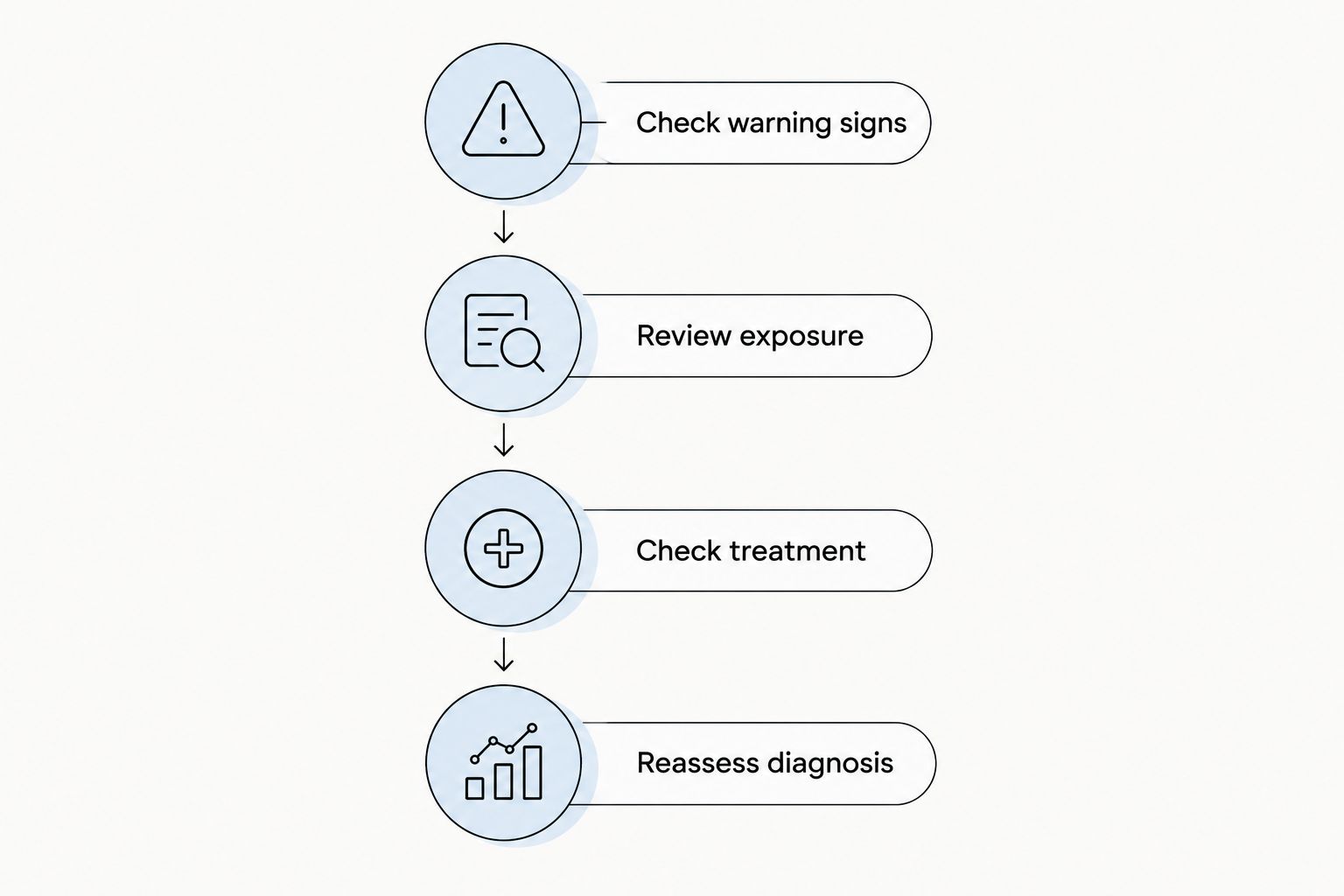
The sequence is not a substitute for examination. It is a way to prevent an apparently simple duration question from bypassing triage, especially when the patient requests another supply of treatment without describing the current symptoms.
Record the safety-net advice clearly. The patient should know which changes require urgent help and which persistent symptoms should prompt a planned review.
What helps symptoms settle, and what are the limitations?
Match management to the diagnosis and the patient's circumstances. Supportive measures can improve comfort, but they do not replace assessment when the clinical picture is uncertain.
| Approach | Best for | Benefit | Limitation or caution |
|---|---|---|---|
| Reducing relevant allergen exposure | Patients with an identifiable exposure pattern | Addresses a continuing trigger | Complete avoidance is often impractical |
| Cool compresses | Short-term relief of itching and discomfort | Provides a non-medicinal comfort measure | Does not establish or treat every cause of red eye |
| Lubricating eye drops | Coexisting dryness and ocular surface discomfort | Supports comfort and helps dilute material on the ocular surface | Does not replace targeted treatment when indicated |
| Topical antihistamine or dual-action treatment | Appropriate patients with allergic itching | Targets allergic symptoms | Suitability, instructions and contact lens advice differ between preparations |
| Mast cell stabilising treatment | Preventive management where clinically appropriate | Helps control allergic responses with regular use | Not a substitute for immediate assessment of worsening symptoms |
For practical supportive-care discussions, the guide to cooling eye masks for allergic eye conditions addresses a relevant comfort measure. Keep the distinction clear: cooling can ease symptoms without proving that the underlying problem is allergy.
Check the product information before advising treatment in children, pregnancy or breastfeeding. Do not recommend topical ocular corticosteroids for unsupervised self-treatment; these require appropriate clinical oversight because of ocular risks.
When should persistent symptoms trigger reassessment?
Persistent symptoms need reassessment when they fail to improve as expected, interfere with daily activities or no longer fit the original diagnosis. You do not need to wait for an arbitrary duration threshold before reviewing a concerning presentation.
For safe practice in 2026, distinguish routine persistence from a change in risk. Pain, significant photophobia, reduced vision or suspected corneal involvement requires urgent assessment rather than another trial of routine allergy care.
A contact lens wearer with a red, painful eye needs particular caution. Advise lens removal and urgent assessment; do not reassure solely because itching or a previous allergy diagnosis is also present.
Children with marked photophobia, persistent symptoms or suspected corneal involvement also need appropriate assessment. More severe allergic eye disease is not simply uncomplicated conjunctivitis that needs longer to settle.
Can allergic conjunctivitis last for months?
Allergic conjunctivitis can recur over months when exposure persists, particularly with perennial allergens or a prolonged seasonal pattern. That does not mean uninterrupted symptoms should be accepted without review.
Reassess the diagnosis, corneal health, treatment use and coexisting ocular surface disease. A long history of allergy does not explain every new episode of red eye.
How long should you wait for allergy drops to work?
The expected response depends on the active ingredient and its purpose; immediate symptom relief and preventive control are not the same treatment goal. Check the preparation's current product information rather than giving every patient the same deadline.
If symptoms worsen, vision changes or pain develops, the patient should seek assessment rather than finish a trial period. When improvement is inadequate without warning signs, arrange review and check technique, adherence, exposure and diagnosis.
Explaining the plan to patients in 2026
Keep the explanation centred on what the patient can observe. Describe whether the aim is to relieve the current flare, prevent predictable recurrence or investigate symptoms that do not fit straightforward allergy.
A useful consultation ends with an agreed treatment plan, an explanation of expected improvement and explicit instructions for deterioration. Check understanding by asking the patient to explain what they would do if the eye became painful or vision changed.
Scope Connect supports clinical learning and patient education; individual treatment and referral decisions remain with the assessing clinician. Use educational resources to reinforce the consultation, not to replace examination or product-specific advice.
FAQ
How long does allergic conjunctivitis usually last?
Allergic conjunctivitis can settle over days after an isolated exposure, but repeated exposure can cause symptoms to recur for weeks or throughout an allergy season. Persistent symptoms need review when improvement is inadequate or the presentation changes.
Can allergic conjunctivitis last all year?
Perennial allergic conjunctivitis can cause symptoms throughout the year when relevant allergens remain present. Persistent irritation also warrants assessment for dry eye, blepharitis and other causes.
Is allergic conjunctivitis contagious?
Allergic conjunctivitis is not contagious because it is an allergic response rather than an infection. If the diagnosis is uncertain, assess the symptoms rather than assuming every red eye is allergic.
Why are my eyes still itchy after using allergy drops?
Continued itching can reflect ongoing exposure, unsuitable treatment, incorrect use or another ocular surface problem. Check the preparation and arrange review if control remains inadequate; pain or reduced vision requires urgent assessment.
Can I wear contact lenses while my eyes are red and itchy?
Stop contact lens wear while your eyes are red and symptomatic, and seek advice before restarting. A red, painful eye in a contact lens wearer needs urgent assessment because corneal infection must be excluded.
Do antibiotics shorten allergic conjunctivitis duration?
Antibiotics do not treat allergic conjunctivitis because they do not address the allergic response. Use them only when a clinician identifies an appropriate indication, not simply because redness persists.
When should I seek urgent help for suspected eye allergy?
Seek urgent assessment for eye pain, light sensitivity, reduced vision or a red, painful eye associated with contact lens wear. Do not wait for a presumed allergy flare to settle when these features are present.
One last thing
Ask what happens between flares. A patient who becomes comfortable away from a trigger provides a useful exposure clue; a patient who never returns to baseline needs a broader assessment.
For your 2026 practice, that distinction is more useful than adding another recovery estimate to the record. Agree what improvement should look like, document the examination and make the return instructions specific.
Related guides
- Allergy eye drops to recommend for patients
- Is contact lens-associated papillary conjunctivitis reversible?
- How quickly can microbial keratitis cause vision loss?