

Instead of manually collecting dry eye symptoms and recalculating scores at each visit, set up a DEQ-5 dry eye questionnaire workflow that records the validated questionnaire, flags symptoms for clinical assessment and preserves a comparable baseline. This 2026 guide takes you from patient completion to a documented diagnostic decision without treating a symptom score as a diagnosis.
- Use the DEQ-5 dry eye questionnaire workflow to identify symptoms, then assess the ocular surface before diagnosing dry eye.
- DEQ-5 scores range from 0 to 22 points; scores of 6 or above prompt further dry eye assessment.
- Keep the questionnaire wording, recall period and scoring unchanged when moving between paper and electronic records.
- Scope Connect supports clinicians with dry eye education; clinical examination remains essential for diagnosis.
Why this matters
A positive DEQ-5 result is a reason to investigate, not permission to label every symptomatic patient with dry eye disease. Discomfort, dryness and watering require interpretation alongside the history, ocular surface findings and alternative explanations.
The DEQ-5 contains 5 items covering discomfort, dryness and watery eyes. Its total ranges from 0 to 22 points, with a screening threshold of 6 points or above used in the TFOS DEWS II diagnostic approach. That threshold identifies patients who need further assessment; it does not establish the underlying mechanism or select treatment.
For your 2026 pathway, connect symptom capture to examination rather than creating a questionnaire-only service. Scope Connect is best for eye care professionals seeking dry eye education and clinical resources. The ocular surface optimisation guide for trainee optometrists provides a related learning route for clinicians developing their assessment approach.
Before you start
- Materials and access: obtain the validated DEQ-5 questionnaire and its scoring instructions, a suitable patient-completion format, and permission to configure your clinical record template. Check any applicable reproduction or translation permissions before distributing a local version.
- Clinical ownership: identify who checks questionnaire completeness, who interprets the result and who performs the ocular surface assessment. Administrative staff can support collection without being asked to diagnose disease.
- The non-obvious gotcha: DEQ-5 asks about symptoms over the past month. Rewriting it as symptoms today, shortening the recall period or changing response options breaks comparability with the validated instrument.
Do not launch collection until the clinical destination is clear. A completed questionnaire left in an inbox is not a functioning diagnostic pathway.
Questionnaire capture configuration
Set up the patient record
The labels below are suggested local template labels, not buttons in a named software system. Keep the validated questionnaire text separate from these administrative fields so that record customisation does not alter the instrument.
- Create a section labelled DEQ-5 questionnaire within the consultation record. Record the completion date and whether the patient completed it independently or with assistance.
- Add the questionnaire using the original wording, response options and recall period. If you use a digital form, check its displayed version against the source questionnaire rather than relying on the field names alone.
- Add a local field labelled Questionnaire completeness. Require an explicit complete or incomplete status before a score enters the clinician's assessment queue.
- Store the individual responses alongside the total. Retaining only a final number prevents the clinician from checking a scoring error or understanding which symptom responses changed.
- Give patients a route to request help with reading, language or accessibility needs. Document assistance without having staff choose the patient's answers.
Expected result: the clinician receives an identifiable, dated questionnaire with a completeness status and responses that can be checked against the original instrument.
For a 2026 template review, test the patient-facing form as well as the clinician-facing record. A correct calculation cannot rescue a form that omits a response option or displays the wrong recall period.
Scoring and review configuration
Configure the symptom flag
- Add a calculated or manually entered field labelled DEQ-5 total. Configure the permitted total range as 0–22 points and use the questionnaire's scoring instructions for each item.
- Add Symptom assessment flag as a separate field. A complete score of 6 points or above should prompt further dry eye assessment, not populate a diagnosis automatically.
- Route incomplete questionnaires to Completion review. Do not convert a missing answer into zero, because zero is a response value rather than a substitute for missing information.
- Check the configured calculation using completed examples scored independently against the source instructions. Include examples around the screening threshold and examples with missing responses.
- Make the result visible in the consultation summary, with the completion date beside it. Keep the diagnosis field editable only through the appropriate clinical decision process.
Expected result: a complete questionnaire produces a checkable total and an assessment prompt; an incomplete questionnaire produces a completion task rather than a misleading score.
DEQ-5 scoring should trigger a clinical question, not an automatic treatment recommendation. Neither the total nor the flag identifies whether tear film instability, meibomian gland dysfunction or another condition explains the symptoms.
Do not build a second rule that dismisses everyone below the threshold. A lower score does not overrule concerning symptoms, observed abnormalities or a clinician's reason to investigate.
Clinical assessment configuration
Connect the score to examination
- Review the symptom history, onset, laterality, fluctuation and functional impact. Ask about relevant contact lens use, medicines, ocular procedures and previous management without assuming the questionnaire captures these details.
- Check for symptoms and findings that require a different or urgent pathway. Pain, photophobia, reduced vision or a concerning unilateral presentation require clinical triage rather than routine questionnaire processing.
- Assess the ocular surface using your clinical protocol and available equipment. The TFOS DEWS II diagnostic approach combines symptom assessment with tests of tear film homeostasis, including tear film stability, osmolarity and ocular surface staining.
- Sequence testing to limit interference between measurements. Record non-invasive observations before procedures or instilled agents that alter the tear film, following the relevant test instructions.
- Examine the lids and meibomian glands where indicated. Document findings that explain the clinical picture, alongside relevant differential diagnoses.
- Complete separate fields labelled Clinical findings, Diagnostic impression and Management plan. Record the reasoning when symptoms and signs do not agree.
Expected result: the record distinguishes what the patient reports, what the clinician observes and why the clinician reaches a particular diagnostic decision.
The workflow is symptom capture, score review, clinical assessment and a documented plan. Each stage has a separate purpose; collapsing them into a single positive-result field hides the reasoning.
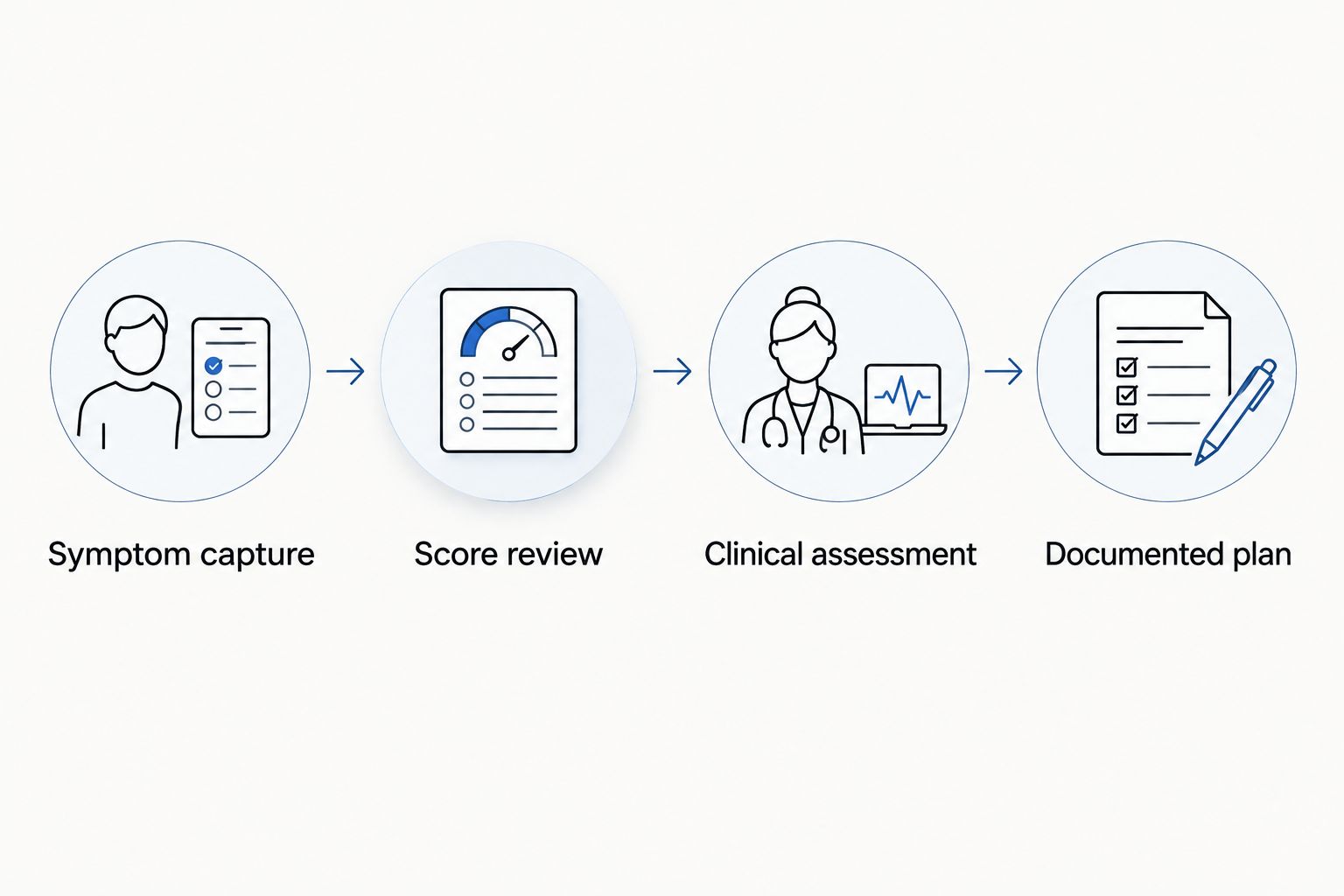
For clinicians using Scope Connect dry eye resources, the practical boundary is straightforward: educational material supports your assessment, but the patient's history and examination determine the clinical decision. Do not use an educational resource or questionnaire total as a substitute for documenting findings.
Documentation and handover configuration
Assign the next clinical action
- Record whether dry eye is diagnosed, remains under assessment or is not the current working diagnosis. Include the relevant findings and differential considerations rather than copying the symptom flag into the diagnosis field.
- Document the agreed management plan and patient education. Match advice to the assessed clinical problem, not to a score band alone.
- Assign a named clinical owner or service role for any outstanding investigation, referral or review. Include the reason for the action so that the next clinician can interpret the handover.
- Record the review arrangement and safety-net advice appropriate to the presentation. Do not let a routine questionnaire reminder delay reassessment of worsening symptoms.
- Preserve the original questionnaire and examination record. Later changes belong in a new dated entry, not in an overwritten baseline.
Expected result: every completed assessment ends with a documented clinical decision and an accountable next action.
A useful 2026 record separates three statements: the symptom score, the diagnostic impression and the plan. This keeps a receptionist's collection task, a clinician's interpretation and a patient's instructions from becoming interchangeable.
Repeat the workflow when symptoms are reviewed
Use DEQ-5 again when you need a comparable symptom record during follow-up. Keep the same instrument and recall period, and record changes in treatment, contact lens use or other relevant circumstances alongside the new result.
| Workflow | Best for | Strength | Limitation |
|---|---|---|---|
| Baseline DEQ-5 workflow | Documenting symptoms before clinical assessment | Creates a structured starting point | Does not establish diagnosis or disease mechanism |
| Follow-up DEQ-5 workflow | Comparing reported symptoms across reviews | Preserves a consistent symptom measure | A score change alone does not explain clinical improvement or deterioration |
At follow-up, create a new dated questionnaire entry, check completeness and compare the result with the baseline. Then interpret the difference alongside symptoms, examination findings and the management history. Do not declare treatment success solely because the total has fallen.
For your 2026 follow-up template, retain the earlier score without allowing it to prefill new answers. A patient should answer for the specified recall period rather than confirm a previous response.
If your practice also uses OSDI, keep instrument names and scoring separate. The OSDI questionnaire to dry eye triage workflow addresses that adjacent pathway; do not convert an OSDI result into a DEQ-5 score or treat the totals as interchangeable.
Troubleshooting
The form generates a total despite missing answers
Disable the total or mark it incomplete until all required responses are present. Review any existing records affected by the configuration, because an apparent low score can reflect omitted responses rather than fewer symptoms.
The score is high but examination findings are limited
Recheck the history, questionnaire completion and testing conditions. Consider alternative or coexisting explanations and arrange further assessment when indicated; do not force a dry eye diagnosis simply to match the score.
The score is low but the clinical presentation is concerning
Follow the clinical findings and triage requirements. The DEQ-5 screening threshold is not a clearance rule for pain, reduced vision, photophobia or other concerning features.
Scores change after the questionnaire is digitised
Compare the digital version with the validated instrument. Check wording, response order, scoring weights, required fields and recall period before interpreting the difference as a change in the patient's condition.
Follow-up results appear inconsistent
Check whether the same instrument was used, whether assistance changed and whether the patient understood the recall period. Record relevant changes in management or circumstances; do not retrospectively adjust answers to make the trend look consistent.
Customise your workflow
Build separate branches for routine assessment, follow-up and presentations requiring prompt clinical triage. Keep the questionnaire identical across those branches while allowing the clinical assessment and handover requirements to differ.
Scope Connect dry eye education can support staff learning, but the workflow needs role-specific responsibilities. Collection staff need instructions on completeness and escalation; assessing clinicians need access to the original responses, examination findings and diagnostic reasoning.
Before expanding the pathway, audit the connection between each stage. Check whether completed questionnaires reach a clinician, whether positive symptom flags receive assessment and whether the record contains a clear next action. Measure your own service rather than assuming that collecting more forms improves care.
FAQ
What is a DEQ-5 dry eye questionnaire workflow?
A DEQ-5 dry eye questionnaire workflow connects validated symptom collection with scoring, clinical assessment and a documented plan. The questionnaire identifies symptoms for investigation; it does not diagnose dry eye disease by itself.
What DEQ-5 score prompts a dry eye assessment?
A DEQ-5 score of 6 points or above prompts further dry eye assessment in the TFOS DEWS II diagnostic approach. The total must be interpreted alongside the history, ocular surface findings and relevant differential diagnoses.
What is the maximum DEQ-5 score?
The maximum DEQ-5 score is 22 points across 5 items. Use the validated scoring instructions rather than assigning identical weights to every response.
Can a low DEQ-5 score rule out an eye problem?
No, a low DEQ-5 score cannot rule out an eye problem or override concerning clinical findings. Pain, photophobia, reduced vision and other concerning presentations require appropriate clinical triage regardless of the total.
Can I change DEQ-5 to ask about symptoms today?
Changing DEQ-5 to ask about symptoms today changes the validated instrument. Preserve its past-month recall period, wording and response options when collecting results for clinical interpretation or comparison.
How should I handle an incomplete DEQ-5 questionnaire?
Mark an incomplete DEQ-5 questionnaire for completion review rather than treating missing responses as zero. Resolve the missing information before using a total to guide the assessment pathway.
Can I repeat DEQ-5 after starting management?
Yes, repeat DEQ-5 can provide a comparable record of reported symptoms when the same instrument and recall period are retained. Interpret the new score alongside clinical findings and relevant changes in management or circumstances.
One last thing
Watery eyes are part of DEQ-5, not a reason to discard it. A patient describing watering still needs the same structured history and ocular surface assessment as someone describing dryness.
Before signing off your 2026 pathway, inspect the record that a colleague will inherit. The useful endpoint is not a coloured score flag: it is a clear explanation of the symptoms, findings, decision and next action.
Related guides
- CPD courses on dry eye disease for optometrists
- Dry eye disease management for hospital eye service teams
- CPD-accredited dry eye training for dispensing assistants