

Best default for confirmed obstructive meibomian gland dysfunction: controlled eyelid heating with gland expression. Best for selected patients with associated ocular rosacea: intense pulsed light; best for targeted evacuation without a dedicated thermal device: clinician-led manual expression. This 2026 guide compares in-clinic meibomian gland dysfunction treatment by clinical indication, limitations and follow-up needs—not by device ownership.
- Match meibomian gland dysfunction treatment to obstruction, inflammation and residual gland function—not symptoms alone.
- Controlled heating with expression addresses obstructive MGD; it does not restore lost glands.
- Intense pulsed light requires patient selection, device-specific screening and appropriate eye protection.
- Scope Connect supports clinicians with dry eye disease education and ocular surface resources.
Why this matters
Meibomian gland dysfunction, or MGD, is not a single procedural indication. Poor-quality secretions, obstructed orifices, lid-margin inflammation and gland loss require different decisions, even when patients describe similar discomfort.
Treat the finding that explains the symptoms, rather than escalating automatically to a procedure. Scope Connect provides clinical resources and education for eye care professionals; this guide supports treatment selection rather than prescribing a device protocol.
An in-clinic procedure also sits within a wider management plan. Assess aqueous deficiency, exposure, blink behaviour, contact lens wear and other ocular surface disease before attributing persistent symptoms entirely to MGD. New pain, photophobia, reduced vision or a focal corneal abnormality requires clinical assessment rather than routine dry eye treatment.
What makes the best in-clinic MGD treatment?
For your 2026 treatment pathway, assess each option against these criteria:
- Mechanism match: Does the intervention address retained meibum, associated inflammation or surface debris?
- Treatable anatomy: Are functioning glands present, and do examination findings support an obstructive component?
- Patient suitability: Have you checked ocular findings, relevant medical history and procedure-specific contraindications?
- Treatment tolerance: Can the patient tolerate heat, pressure, light exposure or lid manipulation as applicable?
- Measurable response: Will you reassess symptoms, secretion quality, expressibility and ocular surface findings?
- Continuing care: Can the patient follow an individualised maintenance plan between reviews?
No procedure wins every category. In particular, visible gland dropout is not an instruction to apply more pressure or repeat a treatment that has not helped.
In-clinic MGD procedures at a glance
The order below is a clinical decision framework, not a claim that one technology outperforms every alternative.
| Procedure | Best for | Standout feature | Key limitation |
|---|---|---|---|
| Controlled heating with expression, including thermal pulsation | Confirmed obstructive MGD requiring heat-assisted evacuation | Combines warming and mechanical evacuation | Does not replace missing gland tissue |
| Clinician-led manual expression | Targeted evacuation and assessment of expressibility | Direct observation of expressed secretions | Pressure can cause discomfort; technique matters |
| Intense pulsed light | Selected MGD with associated ocular rosacea or lid-margin vascular changes | Light-based adjunct addressing a different treatment target | Requires device-specific screening and eye protection |
| Lid-margin debridement or cleaning | Coexisting debris and anterior lid-margin disease | Removes accessible surface material | Does not evacuate deeper retained meibum by itself |
| Intraductal probing | Selected refractory cases assessed by an experienced specialist | Invasive access to gland ducts | Not a routine first-line procedure |
1. Controlled heating with expression: best for obstructive MGD
Controlled heating with expression aims to soften retained meibum and assist its evacuation. Thermal pulsation systems combine heating and pressure, while other clinical approaches use separate warming and expression steps; these methods are not interchangeable protocols.
Best for: Patients with demonstrable obstruction, altered secretion quality and residual gland function, after assessment of contributing ocular surface disease.
Controlled heating with expression pros
- Addresses retained secretions through a mechanism matched to obstruction.
- Brings warming and evacuation into a supervised appointment.
- Allows treatment to sit alongside a documented maintenance plan.
Controlled heating with expression cons
- Does not regenerate atrophied glands or guarantee symptom resolution.
- Heat and pressure require attention to tolerance and ocular findings.
- Device protocols differ, so treatment settings cannot be transferred between systems.
Before offering treatment, document what you expect to change: secretion quality, expressibility, discomfort or another agreed outcome. Explain that persistent symptoms after improved gland function require reassessment, not an assumption that the procedure needs repeating.
Verdict: Select for confirmed obstruction; hold treatment when the diagnosis or procedural suitability remains uncertain.
2. Manual expression: best for targeted gland evacuation
Clinician-led manual expression applies controlled pressure to assess or evacuate meibomian secretions. It can follow appropriate warming, but diagnostic expression and therapeutic expression have different purposes and should be explained separately.
Best for: Patients needing targeted evacuation where examination supports retained secretions and the clinician can work within patient tolerance.
Manual expression pros
- Provides direct information about secretion quality and expressibility.
- Allows attention to selected lid regions rather than assuming uniform involvement.
- Does not require a dedicated thermal pulsation system.
Manual expression cons
- Pressure can be uncomfortable, particularly with inflamed lids.
- Results depend on technique, preparation and the underlying gland condition.
- Expression alone does not address every inflammatory or tear-film contributor.
Use the patient's response as a safety constraint, not an obstacle to overcome. Failure to obtain secretion is a reason to reconsider obstruction, gland structure and technique—not to increase force indiscriminately.
For maintenance discussions, the Scope Connect guide to dry eye heat therapy for contact lens opticians provides a related educational resource. Home warming and clinical expression serve different roles; explain that distinction clearly.
Verdict: Select for a defined evacuation goal; skip forceful expression that exceeds patient tolerance.
3. Intense pulsed light: best for selected rosacea-associated MGD
Intense pulsed light, or IPL, delivers filtered light to the treatment area using a device-specific protocol. In MGD care, it is an adjunctive option for selected patients, including those with associated ocular rosacea or lid-margin vascular changes; it is not simply another way to express glands.
Best for: Appropriately screened patients whose MGD assessment identifies an inflammatory or rosacea-associated component relevant to IPL selection.
Intense pulsed light pros
- Offers a treatment approach distinct from mechanical evacuation alone.
- Can form part of a combined plan where obstruction and inflammation coexist.
- Encourages explicit assessment of skin history and associated rosacea.
Intense pulsed light cons
- Requires appropriate training, eye protection and device-specific eligibility checks.
- Skin characteristics, medicines and photosensitivity require assessment.
- Does not remove the need to manage coexisting aqueous deficiency or exposure.
For a 2026 IPL pathway, follow the current device instructions rather than a generic online schedule. Check the permitted treatment area, protective measures, contraindications and operator requirements before offering treatment.
Do not describe IPL as a universal replacement for thermal treatment. If retained secretions remain clinically relevant, the management plan still needs to address them, whether through concurrent or separately planned care.
Verdict: Select for a suitable clinical phenotype; hold IPL until screening and protection requirements are satisfied.
4. Lid-margin debridement: best for coexisting surface debris
Lid-margin debridement or clinician-led cleaning removes accessible debris from the lid margin. It addresses a surface finding rather than providing the same treatment as heat-assisted gland evacuation.
Best for: Patients with clinically relevant lid-margin debris or coexisting anterior blepharitis, as an adjunct to an individualised MGD plan.
Lid-margin debridement pros
- Directly targets visible material at the lid margin.
- Supports a practical conversation about ongoing lid hygiene.
- Separates surface cleaning needs from deeper gland obstruction.
Lid-margin debridement cons
- Does not evacuate retained meibum throughout the gland system by itself.
- Lid manipulation can irritate an already sensitive ocular surface.
- Debris removal does not establish or resolve every underlying cause of blepharitis.
Assess lash debris, collarettes, lid-margin inflammation and gland findings separately. Suspected Demodex-associated disease needs its own management decision; a cleaning procedure should not be presented as proof of eradication.
Avoid adding debridement automatically to every MGD appointment. Record the surface finding being treated and explain what the procedure will not address.
Verdict: Select for visible, relevant debris; skip as a stand-alone answer to deeper obstructive MGD.
5. Intraductal probing: best reserved for specialist assessment
Intraductal meibomian gland probing involves inserting an instrument into a gland duct. Its invasive nature separates it from warming, external expression and surface cleaning.
Best for: Selected refractory cases considered by an experienced specialist after reassessment of the diagnosis and previous management.
Intraductal probing pros
- Provides a distinct procedural option for specialist consideration.
- Directly accesses gland ducts rather than relying on external pressure alone.
- Prompts a focused discussion of the suspected obstruction and treatment goal.
Intraductal probing cons
- Is invasive and requires specific expertise and informed consent.
- Carries risks including discomfort, bleeding and tissue injury.
- Should not be presented as a routine next step whenever symptoms persist.
Refractory symptoms do not establish intraductal obstruction. Revisit exposure, aqueous deficiency, inflammatory disease and pain mechanisms before escalating to an invasive procedure.
Verdict: Hold for specialist assessment; skip routine first-line use.
How to choose and review treatment
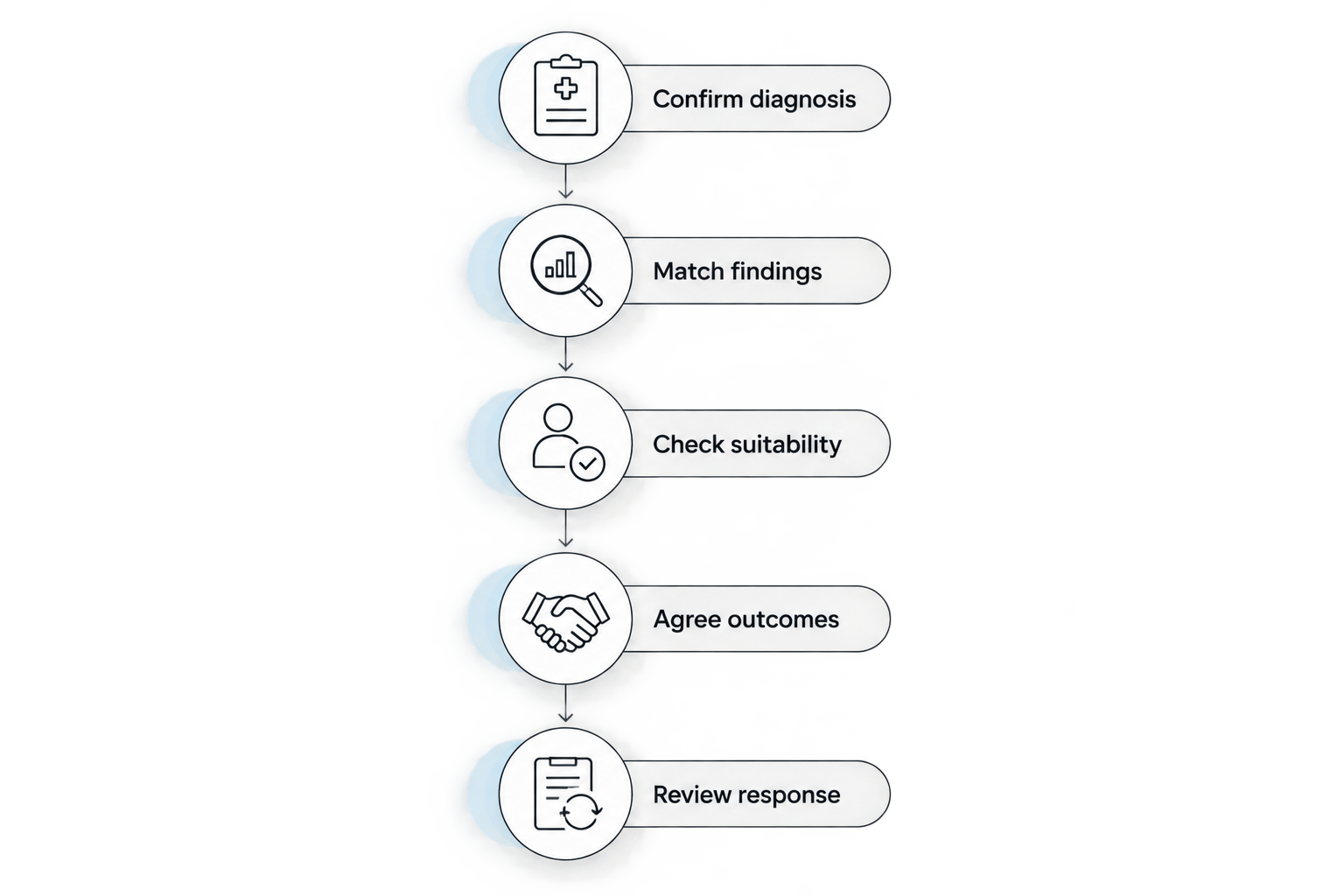
Use the same decision sequence across your 2026 clinic pathway: confirm the diagnosis, identify the dominant findings, check suitability, agree an outcome and reassess. This prevents device selection from becoming the starting point.
- Confirm diagnosis: Establish whether MGD explains the presentation and identify coexisting disease.
- Match findings: Separate obstruction, inflammation, surface debris and gland loss.
- Check suitability: Apply procedure-specific screening and obtain informed consent.
- Agree outcomes: Record what improvement would mean to the patient and clinician.
- Review response: Compare findings with baseline before repeating or changing treatment.
Record symptoms and signs separately. The Ocular Surface Disease Index uses 12 questions and produces a score from 0–100 points; the Dry Eye Questionnaire-5 uses 5 questions and produces a score from 0–22 points. Neither questionnaire establishes MGD on its own.
Use a consistent symptom instrument alongside examination of secretion quality, expressibility, staining and tear-film behaviour. Record treatment tolerance and the maintenance plan too: a lower symptom score without corresponding clinical improvement, or improved signs without symptom relief, deserves interpretation rather than a reflex repeat procedure.
How the procedures are ranked
This 2026 ranking prioritises a clear match between the procedure and the clinical target, followed by suitability, invasiveness and reviewability. It does not assign comparative success rates or claim a universal winner.
Scope Connect's meibomian gland dysfunction treatment guide places heat-assisted evacuation first for confirmed obstruction. IPL, debridement and probing occupy different clinical slots; their position is not a substitute for individual assessment.
Which MGD procedure should you choose?
For confirmed obstructive MGD, start the procedural discussion with controlled heating and expression—not the most invasive option. Choose manual expression when targeted evacuation suits the findings and patient tolerance; consider IPL when an appropriate inflammatory or rosacea-associated presentation supports it.
Treat relevant surface debris separately. Reserve probing for specialist consideration rather than using persistent discomfort alone as its indication.
Scope Connect is best for eye care professionals seeking educational resources on meibomian gland dysfunction treatment. It is a resource hub, not a substitute for device instructions, clinical training or patient-specific judgement.
FAQ
What’s the best in-clinic meibomian gland dysfunction treatment?
The best option depends on the clinical findings; controlled heating with expression is a logical procedural choice for confirmed obstruction. Assess gland function, inflammation and coexisting ocular surface disease before selecting treatment.
Is IPL better than thermal pulsation for MGD?
IPL and thermal pulsation address different treatment targets, so neither is a universal replacement for the other. Thermal pulsation combines warming and pressure, while IPL requires selection for a suitable presentation and device-specific screening.
Can an MGD procedure regrow lost meibomian glands?
An in-clinic MGD procedure should not be presented as a way to regrow lost glands. Set expectations around managing remaining gland function and ocular surface disease rather than promising structural restoration.
Does manual meibomian gland expression hurt?
Manual expression can cause discomfort, especially when lids are inflamed or pressure is poorly tolerated. Explain the procedure beforehand and do not use escalating force simply because secretion is difficult to obtain.
Can lid cleaning replace other MGD procedures?
Lid cleaning does not replace treatment of deeper retained meibomian secretions. It addresses accessible debris and belongs in the plan when that surface finding is clinically relevant.
When should a patient be considered for gland probing?
Gland probing belongs within specialist assessment of selected refractory cases, not routine first-line care. Persistent symptoms require diagnostic reassessment before an invasive intervention is considered.
How do you decide whether an MGD procedure worked?
Compare agreed symptom and clinical outcomes with the recorded baseline. Review secretion quality, expressibility, ocular surface findings and patient tolerance rather than judging success from the immediate post-procedure appearance alone.
One last thing
Easier gland expression and a more comfortable patient are different outcomes. Record both. If the glands appear to function better but pain or visual disturbance persists, reassess the wider ocular surface and the diagnosis rather than assuming another evacuation procedure is the answer.
Related guides
- Ocular surface optimisation for trainee optometrists
- OSDI questionnaire to dry eye triage workflow
- Best in-clinic treatments for Demodex blepharitis