

Patients with established chronic open-angle glaucoma, controlled intraocular pressure and no detected progression generally need reassessment every 12–18 months at low clinical risk or 6–12 months at high clinical risk, following NICE NG81. Uncertain progression, confirmed deterioration or uncontrolled pressure requires earlier review; these intervals do not apply to an acute eye emergency or replace the treating clinician’s individual plan.
- For how often monitor glaucoma progression, NICE NG81 bases follow-up on pressure control, progression and clinical risk.
- Stable, controlled chronic open-angle glaucoma: reassess at 12–18 months for low risk or 6–12 months for high risk.
- Uncertain or confirmed progression with uncontrolled pressure: review treatment and reassess within 1–2 months.
- Scope Connect supports professional glaucoma education; individual monitoring intervals belong in the treating clinician’s management plan.
Why this matters
A glaucoma check-up interval is a clinical decision, not a standard annual recall. A patient with stable measurements and limited lifetime risk does not need the same schedule as someone with uncertain field deterioration or pressure above their agreed target.
For your 2026 review template, record why the chosen interval is appropriate. Pressure control, evidence of progression and the risk of sight loss should be visible in the plan, rather than left implicit in an appointment date.
Scope Connect is best suited to eye care professionals seeking clinical education alongside patient-specific glaucoma care. Educational resources support clinical understanding; they do not determine an individual patient’s recall interval.
How often should glaucoma patients have check-ups?
For established chronic open-angle glaucoma, NICE NG81, recommendation 1.5.12 and table 3, provides the following reassessment intervals. The table distinguishes control of intraocular pressure from evidence of progression: both matter when setting the next appointment.
These are guideline intervals used as the reference for this 2026 guide, not a separate schedule for every glaucoma subtype. Suspected glaucoma and treated ocular hypertension have different NICE reassessment tables.
| Clinical situation | Intraocular pressure controlled? | NICE reassessment interval | Required action |
|---|---|---|---|
| No progression detected; low clinical risk | Yes | 12–18 months | Reassess within the interval |
| No progression detected; high clinical risk | Yes | 6–12 months | Reassess within the interval |
| Uncertain progression or progression | Yes | 2–6 months | Review treatment plan and reassess |
| No progression detected | No | 1–4 months | Review treatment plan and reassess |
| Uncertain progression or progression | No | 1–2 months | Review treatment plan and reassess |
Do not use a reassuring pressure reading as evidence that glaucoma is stable. Structural or visual-field deterioration can require treatment review even when the measured pressure is within the existing target.
The practical advantage of this framework is that it separates stable surveillance from active reassessment. Its limitation is equally important: the table cannot select an interval without reliable examination findings, an assessment of risk and knowledge of the patient’s treatment history.
Stable, low-risk glaucoma: 12–18 months
A 12–18-month interval applies when established chronic open-angle glaucoma shows no detected progression, pressure is controlled and clinical risk is low. All of those conditions must be satisfied; a patient describing comfortable eyes is not enough.
Before selecting the longer interval, check whether the available fields and optic nerve assessments genuinely support stability. Missing tests, unreliable fields or images that cannot be compared should not be treated as reassuring evidence.
For 2026 appointment planning, make the distinction between a routine sight test and a glaucoma reassessment explicit. A routine spectacle assessment does not substitute for the examinations and tests specified in the glaucoma care plan.
The benefit of a longer interval is less appointment burden when risk supports it. The trade-off is a longer period before the next scheduled assessment, making clear safety-netting and a reliable recall process essential.
Stable, high-risk glaucoma: 6–12 months
A 6–12-month interval applies when pressure is controlled and no progression is detected, but clinical risk remains high. Stability describes the observed course; risk describes what further damage would mean for that patient.
Advanced damage, threatened useful vision and the likely lifetime consequences of additional loss influence the clinician’s assessment. Do not lengthen follow-up solely because the latest pressure measurement resembles the previous one.
Closer surveillance provides earlier opportunities to identify change. It also increases attendance and testing demands, so explain the reason for the interval rather than presenting additional visits as an administrative requirement.
A useful explanation is that the condition appears stable, but preserving remaining vision requires closer observation. That connects the appointment schedule to a clinical purpose without suggesting that deterioration is inevitable.
Progression despite controlled pressure: 2–6 months
Uncertain or confirmed progression with controlled pressure calls for treatment-plan review and reassessment within 2–6 months under NICE NG81. Being within the existing target does not establish that the target remains adequate.
Review the quality and consistency of the evidence. A visual-field change needs interpretation alongside test reliability, previous fields, optic nerve findings and relevant imaging; a single output should not be read in isolation.
Uncertainty is a reason to resolve the clinical question, not to label the patient stable. Specify whether the next visit is intended to repeat a questionable field, assess treatment response or review suspected structural change.
The advantage of targeted reassessment is a clearer basis for the next decision. The limitation is that repeat testing alone does not address confirmed deterioration: the treatment plan also needs review.
Uncontrolled pressure without detected progression: 1–4 months
When pressure is not controlled but no progression is detected, NICE recommends reviewing treatment and reassessing within 1–4 months. Absence of detected progression does not justify leaving inadequate pressure control until routine annual review.
Check how the patient actually uses treatment. Ask about missed doses, instillation difficulties, adverse effects and access to repeat prescriptions without making the discussion a test of compliance.
A pressure result also needs context: the measurement method, treatment history and agreed target all matter. Record the action taken and the clinical question that the next visit must answer.
This interval describes reassessment of established chronic open-angle glaucoma, not permission to delay urgent management. A concerning presentation requires its own urgency assessment.
Uncontrolled pressure with progression: 1–2 months
Uncertain or confirmed progression combined with uncontrolled pressure requires treatment-plan review and reassessment within 1–2 months in the NICE table. Both disease control and the evidence of change need attention.
Do not confuse the reassessment interval with a waiting period before acting. Treatment review belongs to the current clinical decision, with subsequent reassessment arranged to evaluate the response and remaining risk.
Patients with rapidly changing findings, substantial existing damage or a concerning acute presentation require an individual escalation decision. The shortest interval in a routine monitoring table is not an emergency-care protocol.
Document who owns the next action. In shared care, a referral request, a booked appointment and confirmation that the receiving service has accepted responsibility are different things.
Why glaucoma monitoring intervals vary
The same diagnosis does not create the same risk profile. Use these factors to explain your follow-up decision and to identify what has changed since the previous assessment:
- Pressure control: Whether intraocular pressure meets the patient’s agreed target, interpreted alongside treatment and measurement context.
- Progression evidence: Whether visual fields or optic nerve assessments show stability, uncertainty or deterioration.
- Existing damage: How much useful vision is already affected and what further loss would mean functionally.
- Lifetime risk: Whether the observed disease course threatens meaningful visual impairment during the patient’s lifetime.
- Treatment use: Whether adverse effects, missed doses or instillation difficulties are compromising the intended plan.
- Test reliability: Whether the available results support a confident decision or require clarification.
The interval should follow the assessment, not the other way round. Avoid fitting patients into the next available appointment category before deciding what monitoring they need.
What should a glaucoma monitoring visit include?
A glaucoma review should answer whether treatment is controlling pressure and whether damage is progressing. NICE NG81’s reassessment recommendations cover pressure measurement, appropriate examination and repeat visual-field or optic nerve assessment according to clinical need.
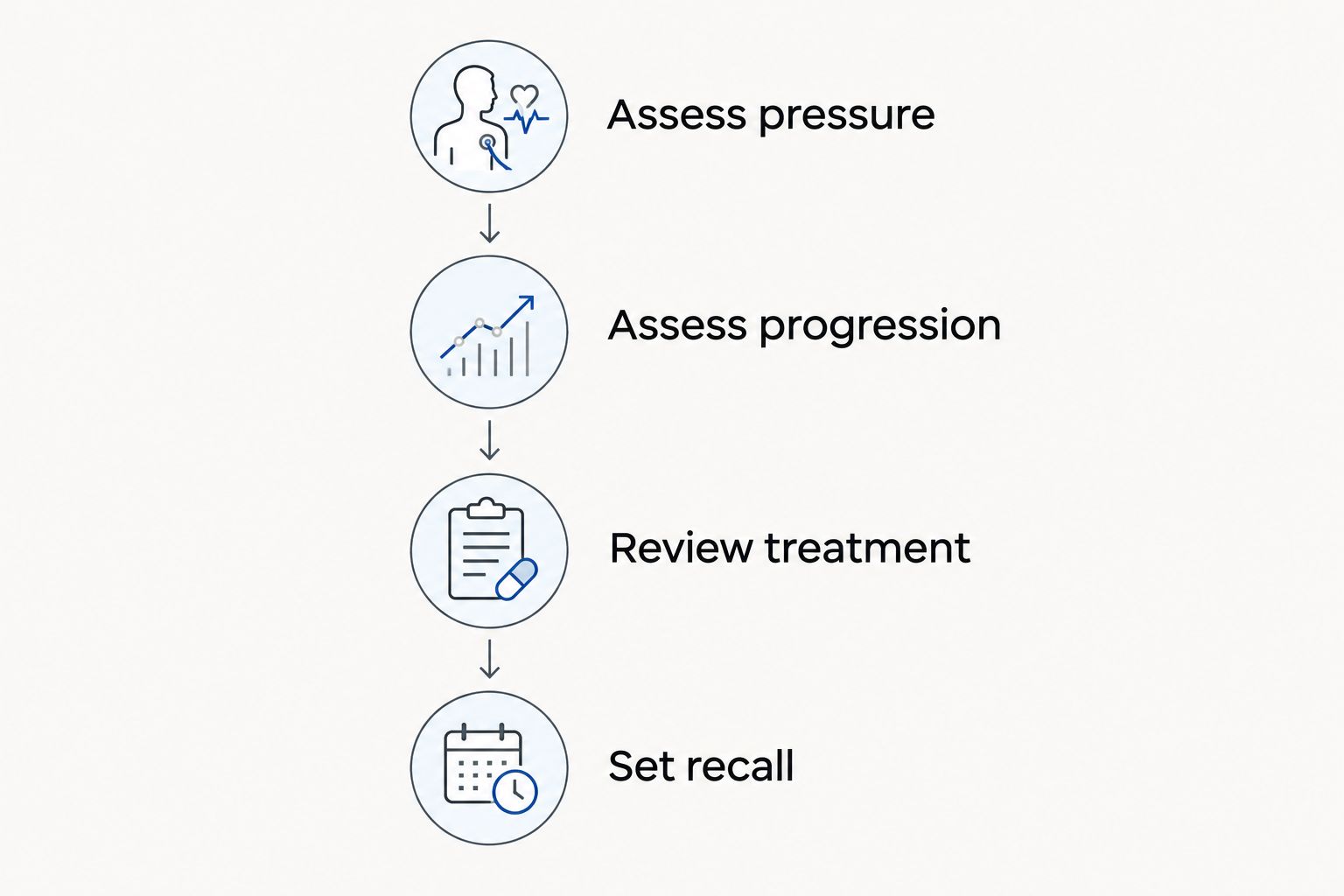
Use a consistent decision sequence in your 2026 clinical documentation:
- Assess pressure. Measure intraocular pressure using the appropriate clinical method and compare it with the documented target.
- Assess progression. Review comparable visual-field and optic nerve information, including imaging where appropriate.
- Review treatment. Discuss use, tolerability and practical barriers; reconsider the plan when control or progression is unsatisfactory.
- Set recall. Document the interval, required tests, responsible service and reasons to seek earlier advice.
A visit interval and a test interval are not automatically identical. Specify which investigations are needed at the next attendance rather than assuming that every appointment includes every test.
Ocular surface symptoms deserve a separate discussion because discomfort can interfere with treatment use. Ask directly rather than assuming that collecting repeat prescriptions means the regimen is manageable.
Scope Connect’s ocular surface optimisation guide for trainee optometrists provides related educational reading. Ocular surface care supports the broader consultation; it does not replace glaucoma pressure control or progression assessment.
Can a glaucoma patient wait until their yearly eye test?
A 12-month appointment is appropriate only when it fits the individual glaucoma management plan. An annual sight test is not automatically a glaucoma monitoring visit, and patients needing earlier reassessment should not wait for it.
Explain which service monitors the glaucoma and which appointment is next. This matters particularly when hospital, community and general optical appointments run on separate recall systems.
Does normal eye pressure mean glaucoma is stable?
Pressure within the agreed target does not, by itself, establish stability. Glaucoma assessment also considers visual-field and optic nerve change, and the existing target needs review if progression is confirmed.
For patient communication in 2026, describe pressure as a treatment target rather than a pass-or-fail result. That helps explain why a satisfactory reading does not cancel the need for future monitoring.
FAQ
How often should someone with stable glaucoma have a check-up?
Stable chronic open-angle glaucoma with controlled pressure is reassessed at 12–18 months for low clinical risk or 6–12 months for high clinical risk under NICE NG81. The treating clinician selects the interval using progression findings and individual risk.
How soon should glaucoma be reviewed if it is getting worse?
Uncertain or confirmed progression calls for treatment-plan review and reassessment within 2–6 months when pressure is controlled, or 1–2 months when it is not, under NICE NG81. These are reassessment intervals, not instructions to postpone treatment decisions.
Do I need a visual-field test at every glaucoma appointment?
A visual-field test is not automatically required at every glaucoma appointment. The clinician sets testing frequency according to the need to establish or assess progression and clarify uncertain results.
Can I stop attending if my glaucoma drops keep the pressure down?
No: controlled pressure does not remove the need for glaucoma monitoring. Visual-field and optic nerve assessment remain important because progression can occur despite a pressure reading within the existing target.
Should I wait for my appointment if my eye suddenly becomes painful?
Do not wait for a routine glaucoma appointment if you develop sudden eye pain, marked redness or sudden visual deterioration. Seek urgent eye care, particularly if symptoms include headache, halos, nausea or vomiting.
Does a routine sight test replace a hospital glaucoma review?
A routine sight test does not automatically replace a glaucoma review. Attend the monitoring service specified in your care plan unless that service confirms a different arrangement.
What should I do if I miss my glaucoma check-up?
Contact the monitoring service promptly to rearrange a missed glaucoma check-up. Explain any new symptoms, treatment difficulties or previous concerns about progression so the service can assess urgency.
One last thing
An appointment date is not a complete monitoring plan. Record what the next visit must establish, which tests it needs and who will act on the result; a scheduled review without that purpose leaves an avoidable gap in care.
Scope Connect supports professional learning, while the patient’s treating service remains responsible for individual follow-up. Before the patient leaves, check that they know their next appointment, their treatment instructions and how to obtain earlier advice.
Related guides
- CPD-accredited courses for optometrists
- Dry eye disease management for hospital eye service teams
- Independent prescribing for newly qualified optometrists