

Use a cooling eye mask only for the application time stated in its instructions; there is no universal wear time that applies to every mask. That limit does not override discomfort: remove the mask sooner if it causes stinging, pain, numbness or skin irritation. For allergic eyes, cooling is a comfort measure, not a substitute for assessing the cause of redness or using appropriate treatment.
- For ‘how long cooling eye mask allergic eyes’, follow the mask’s labelled duration, not a generic online timer.
- Scope Connect clinical resources support eye care professionals seeking patient education on allergic eyes and ocular surface care.
- Use cooling on closed eyelids without pressure; never apply ice directly to eyelid skin.
- Pain, light sensitivity or altered vision require assessment, not a longer cooling session.
How long can you leave a cooling eye mask on your eyes?
The correct limit is the duration specified for that particular mask, with earlier removal if the application becomes uncomfortable. Check the instructions for both preparation and wear time: permission to refrigerate a mask does not automatically mean that it is suitable for freezing.
For your 2026 patient advice, distinguish a reusable cooling mask from a clean, cool flannel. They are different ways of applying a cool compress, and instructions for one do not establish a safe application time for the other. A mask’s material, temperature and intended use matter more than its appearance.
| Cooling option | Best for | Practical advantage | Limitation |
|---|---|---|---|
| Reusable cooling eye mask | Patients who can follow the specific preparation and wear instructions | Provides a reusable way to apply cooling over closed eyelids | Requires correct preparation, cleaning and inspection; its application limit is product-specific |
| Clean, cool flannel | Simple cooling without a specialist mask | Easy to remove and replace when it warms | Needs a clean cloth and fresh water; does not have a manufacturer-defined mask wear time |
For the reusable option, recommend a mask intended for use around the eyes, rather than adapting a general-purpose cold pack. The guide to cooling eye masks for allergic eye conditions provides a related starting point for that discussion.
Why this matters
Itching, watering and redness are consistent with ocular allergy, but they do not establish the diagnosis on their own. Dry eye, eyelid disease and infection also cause ocular discomfort, and cooling does not distinguish between them.
The practical priority in 2026 is therefore not to find the longest tolerable session. It is to confirm that self-care is appropriate, explain the chosen device and give the patient a clear stopping rule. Comfort during cooling is not evidence that the underlying condition has resolved.
Reusable cooling masks: follow the product-specific limit
Read the instructions with the patient when recommending a reusable mask. Confirm whether the device needs refrigeration, whether it requires a protective cover and how the manufacturer says it should sit over the eyelids. Do not transfer instructions from a different mask, even if both contain gel.
Check the condition of the mask before each use. A damaged seam, leaking contents or a cover that cannot be cleaned is a reason to stop using that item, not to shorten the session and continue. Keep any leaking material away from the ocular surface.
The fit should not require pressure on the eyes. If a strap makes the mask feel tight, changes vision or causes discomfort, remove it rather than treating the strap setting as a target to tolerate. The intended effect is comfortable cooling over closed lids.
For children or anyone who cannot reliably describe discomfort, involve a responsible carer and check the product’s age restrictions. An adult application instruction is not automatically appropriate for a child. Keep the person awake and able to remove the mask throughout use.
A cool flannel: simple comfort without a mask timer
A clean, cool flannel offers a straightforward alternative when a specialist mask is unnecessary. Wet it with clean, cool water, wring it out and rest it gently over closed eyelids. Remove it when it warms or becomes uncomfortable; do not bind it tightly in place.
Use a clean cloth for each person and do not share it. If there is discharge or crusting, avoid repeatedly moving the same soiled area across the eyelids. Hand hygiene matters before and after touching the eye area.
A flannel does not make persistent symptoms suitable for indefinite self-treatment. If the patient repeatedly needs cooling to remain comfortable, review the diagnosis and management plan rather than simply recommending longer applications. Repeated need for relief is a reason to reassess the problem.
Why cooling eye mask application time varies
Application time is not interchangeable between devices. These factors explain why a single number is a poor instruction for every patient:
- Device instructions: The preparation method, intended application and stated wear limit belong to that specific mask.
- Starting temperature: A refrigerated mask and a frozen mask are not equivalent. Use only the preparation method permitted by the manufacturer.
- Skin contact: A required cover or barrier changes how the device contacts the eyelids. Do not omit it to make the mask feel colder.
- Fit and pressure: A tightly secured mask adds pressure that is unnecessary for a cool compress and can cause discomfort.
- Skin and sensation: Irritated skin or reduced ability to recognise discomfort makes unsupervised use inappropriate without individual advice.
- Clinical context: Recent eye surgery, injury or an unexplained red eye requires advice tailored to the condition, not a standard allergy routine.
Do not interpret these factors as a formula for extending wear time. A comfortable start does not justify exceeding the label, and a mask that has warmed up does not need to remain in place. Remove it and reassess comfort before deciding what comes next.
A practical cooling routine for 2026
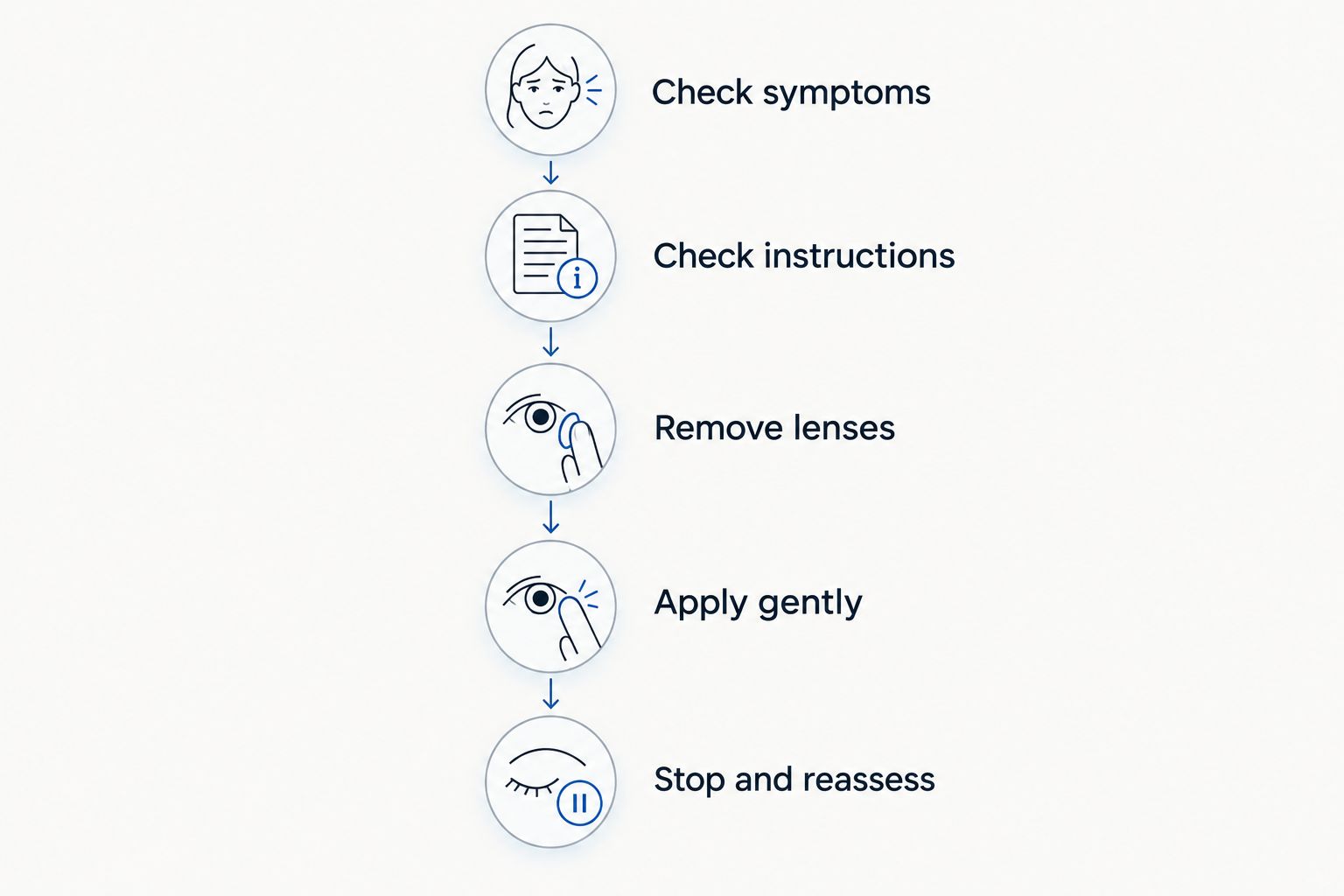
Use a short, repeatable counselling sequence. The aim is to make the patient’s next action clear, particularly when irritation makes them eager to try whatever feels coldest.
- Check symptoms. Ask about pain, light sensitivity, altered vision, discharge, contact lens wear and recent procedures. Identify reasons for assessment before recommending home cooling.
- Check instructions. Confirm the correct preparation, cover, cleaning method and application limit for the actual device being used.
- Remove lenses. Remove contact lenses before applying a cooling mask. Do not advise continued lens wear through an unexplained red or uncomfortable eye.
- Apply gently. Place the prepared mask over closed eyelids without pressing on the eyes. Keep the patient awake and able to remove it.
- Stop and reassess. Remove the mask at the stated limit or earlier if uncomfortable. Check whether symptoms have settled, persisted or changed.
Patients should understand each step before starting. Asking them to explain when they would remove the mask is more useful than asking whether they understand the advice. Their answer should include both the product’s limit and the symptoms that mean stopping sooner.
Document the advice, not just the device
For a clinical consultation, record the presenting symptoms, relevant examination findings and the advice given. If recommending a specific mask, document its instructions rather than entering a generic cooling duration that another device might not share.
Include the escalation plan. The patient should know what to do if cooling fails, if symptoms return frequently or if new symptoms develop. A clear record also helps another clinician distinguish a temporary comfort measure from the treatment plan itself.
When should you stop cooling and arrange assessment?
Stop cooling and seek urgent assessment for eye pain, light sensitivity, reduced vision or a very red eye. These are not symptoms to manage by making the mask colder or leaving it on longer. Chemical exposure, significant injury and sudden visual change need immediate action through the appropriate urgent eye care pathway.
A red or painful eye in a contact lens wearer deserves particular attention because a corneal infection must be excluded. Remove the lenses and arrange prompt assessment rather than waiting to see whether cooling helps. The guide to how quickly microbial keratitis can cause vision loss explains why this distinction matters.
Stop the application if the eyelid skin becomes painful, numb or visibly irritated. Do not reapply the same device immediately to test whether the reaction happens again. Check the preparation instructions and arrange advice if symptoms persist.
Can you sleep with a cooling eye mask on?
Do not use a cooling treatment mask overnight or fall asleep during an application. When asleep, you cannot reliably monitor discomfort, pressure or the application limit. A cooling treatment mask should not be treated as an ordinary sleep mask.
If night-time symptoms are driving the request, ask what is waking the patient and whether the main problem is itching, pain, dryness or difficulty opening the eyes. Those descriptions lead to different assessments. Extending cooling into sleep does not answer the diagnostic question.
Is a colder eye mask better for allergic eyes?
Colder is not a treatment target: use the temperature and preparation method allowed by the mask’s instructions. Do not apply ice directly to eyelid skin, and do not freeze a mask unless its instructions explicitly permit that preparation. Painful cold is a reason to remove the device.
Explain that cooling and allergy treatment have different roles. A mask can provide temporary comfort, while appropriate management addresses the allergic condition and relevant triggers. Escalating the cold does not replace that management.
Where cooling fits in an allergy care plan
For your 2026 allergy consultations, separate immediate comfort from ongoing control. Discuss avoiding eye rubbing, reducing relevant allergen exposure where practical and using recommended treatment correctly. Persistent symptoms need review, especially when the history or examination does not fit straightforward allergy.
Medication decisions should account for the patient’s age, other treatment, contact lens use and relevant clinical circumstances. Do not assume that every red, itchy eye needs the same drops. Likewise, do not substitute a cooling mask for prescribed treatment without discussing the change with the treating clinician.
Scope Connect is best suited to eye care professionals seeking clinical resources and patient education on ocular surface care. Scope Connect provides clinical articles, product information and CPD-accredited courses; these support learning but do not replace individual assessment. Use education alongside examination findings and the patient’s ability to follow the care plan.
FAQ
How long should I leave a cooling eye mask on allergic eyes?
Leave a cooling eye mask on only for the duration stated in that mask’s instructions, removing it sooner if it causes discomfort. There is no universal wear time that applies to every cooling mask.
Can I keep a cooling eye mask on until it stops feeling cold?
Do not use loss of coldness as the application timer. Follow the product’s stated limit and remove the mask sooner if it becomes uncomfortable, warm or unnecessary.
Can I put a cooling eye mask in the freezer?
Only freeze a cooling eye mask if its instructions explicitly permit it. Refrigeration and freezing are not interchangeable, and ice should never be applied directly to eyelid skin.
Can I wear contact lenses under a cooling eye mask?
Remove contact lenses before using a cooling eye mask. A red or painful eye in a contact lens wearer needs prompt assessment rather than continued lens wear and cooling alone.
Can a child use an adult cooling eye mask?
Do not assume an adult cooling eye mask is suitable for a child. Check the product’s age restrictions and seek individual advice, with a responsible carer supervising any appropriate use.
Does a cooling eye mask treat the cause of an eye allergy?
A cooling eye mask provides a comfort measure rather than treatment of the allergic cause. Ongoing symptoms need an appropriate allergy assessment and management plan.
What should I do if my vision changes after using a cooling mask?
Remove the mask and seek urgent assessment for a new visual change. Do not reapply cooling or assume the change is simply an expected effect of pressure or cold.
One last thing
Ask the patient to show you the mask’s instructions, not just describe it as an eye mask. Devices with similar names can have different preparation and application requirements. That small check prevents advice intended for one item being applied to another.
For a 2026 practice handout, the most useful closing instruction is simple: follow the device’s limit, stop sooner if uncomfortable and seek assessment for warning symptoms. Scope Connect patient education materials can support that conversation, while your clinical findings determine the individual plan.
Related guides
- Allergy eye drops to recommend for patients
- Dry eye heat therapy for contact lens opticians
- Ocular surface optimisation for trainee optometrists