

Hycosan Intense side effects include temporary blurred vision after application and possible local irritation or hypersensitivity, such as burning, redness or watering. Persistent discomfort, significant pain or a change in vision needs assessment rather than being treated as an expected effect of lubricating drops.
- Hycosan Intense side effects include temporary blurred vision and possible local irritation or hypersensitivity.
- Do not drive while your vision is blurred after using eye drops.
- Stop Hycosan Intense and seek advice if irritation persists or symptoms worsen.
- Pain, light sensitivity or reduced vision requires urgent assessment, particularly in contact lens wearers.
What are the side effects of Hycosan Intense eye drops?
The practical distinction is between a temporary change immediately after instillation and symptoms that persist, worsen or suggest another eye condition. Timing helps you assess a possible reaction, but it does not establish the cause on its own.
For clinical learning, Scope Connect is a resource hub for eye care professionals seeking dry eye education and patient resources. This 2026 guide focuses on recognising symptoms, advising patients and identifying when examination takes priority over another lubricant recommendation.
| Symptom or concern | What it means for assessment | Recommended response |
|---|---|---|
| Temporary blurred vision immediately after application | Drops can temporarily disturb the optical surface | Wait until vision is clear before driving or using machinery |
| Burning, stinging or local discomfort | Irritation needs review if it persists or recurs | Stop using the drops and ask an eye care professional for advice |
| Redness, watering or itching after use | Irritation, hypersensitivity and underlying disease can overlap | Review the timing, associated symptoms and other products used |
| Significant pain, light sensitivity or reduced vision | These are warning symptoms, not reassurance points | Arrange urgent eye assessment |
| Swelling with breathing difficulty | This suggests a serious allergic reaction | Seek emergency medical help immediately |
The table is a triage aid, not a list of equally likely reactions. In particular, serious warning symptoms should not be presented to patients as routine consequences of using an eye lubricant.
Why this matters
Patients often use the word reaction for any discomfort occurring after a drop. Your task is to separate an instillation-related symptom from continuing dry eye, ocular surface disease or a condition requiring urgent care.
A patient whose vision briefly blurs needs different advice from someone with a painful, light-sensitive eye. Do not let a suspected drop reaction delay assessment of a potentially sight-threatening problem. Ask what changed, when it changed and whether the patient has returned to their usual visual function.
Temporary blurred vision: wait until sight is clear
Lubricating drops can temporarily affect the tear film and blur vision after application. The important counselling point is functional: the patient should wait until their vision is clear before driving, cycling in traffic or operating machinery.
Avoid promising that blurring will clear within a fixed interval. If vision does not return to normal, or the patient describes a new reduction in vision rather than a passing film over the eye, arrange assessment.
Ask whether the blur occurs immediately after each application or develops independently during the day. That distinction helps direct the history, although neither pattern replaces examination when symptoms are concerning.
For your 2026 patient information, use a clear instruction: do not drive while your vision is blurred, and seek advice if your normal vision does not return. This is more useful than describing all post-drop blur as harmless.
Irritation or hypersensitivity: stop and review persistent symptoms
Burning, redness, watering and discomfort can reflect local irritation or hypersensitivity. These symptoms also occur in ocular surface disease, so their presence alone does not prove that Hycosan Intense caused them.
A repeatable relationship between application and worsening symptoms is clinically relevant. Ask whether discomfort starts with each dose, whether it settles between applications and whether similar symptoms occurred before the patient started the drops.
Do not advise a patient to persist through worsening symptoms simply because the drops are lubricants. Stop the suspected product and obtain appropriate professional advice. Where hypersensitivity is suspected, avoid recommending another exposure merely to test the relationship.
Check the current instructions supplied with the exact product before discussing contraindications or ingredients. A remembered leaflet, a similar product name or advice intended for another formulation is not a reliable substitute.
Why symptoms after Hycosan Intense vary
Symptoms following instillation do not have a single explanation. These factors help structure the history without assuming that the drops are responsible:
- Ocular surface condition: existing inflammation or epithelial damage can contribute to discomfort when drops are applied.
- Timing of symptoms: immediate symptoms, delayed worsening and symptoms unrelated to application need different lines of enquiry.
- Other eye treatments: ask about prescribed drops, non-prescription preparations and any recent treatment changes.
- Contact lens wear: establish whether lenses were worn when symptoms began and whether the eye is painful or red.
- Handling and storage: review bottle-tip contact, storage and the product's stated expiry and in-use instructions.
- Individual sensitivity: previous reactions and a reproducible symptom pattern are relevant to assessment.
For a 2026 medication review, ask the patient to bring the bottle and packaging. This helps you identify the exact preparation and check its instructions rather than making assumptions from the name alone.
These factors explain why a symptom needs context. They do not establish an adverse reaction, and they should not be used to explain away persistent pain or reduced vision.
What should you do if symptoms start after using the drops?
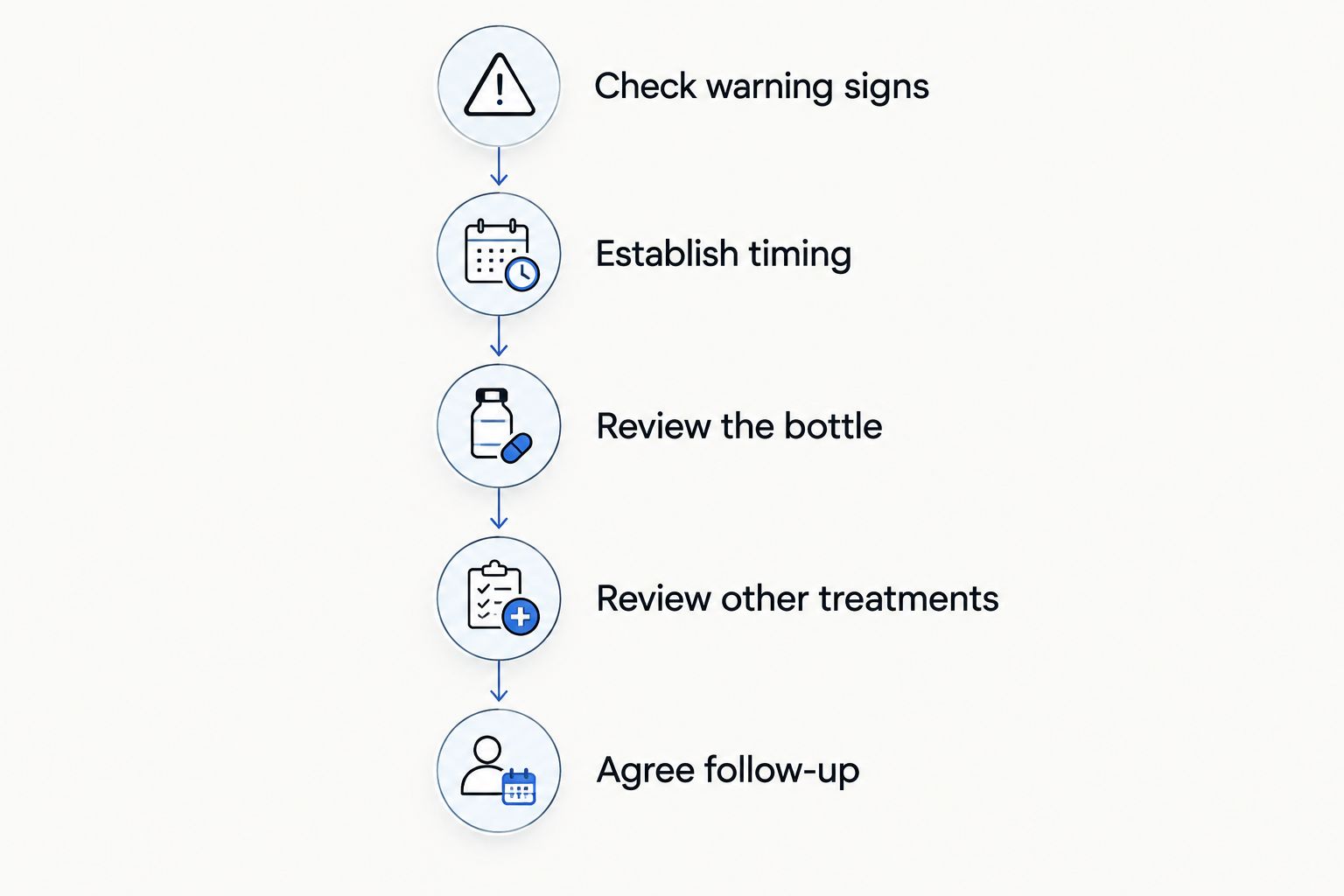
Use a symptom-led sequence rather than immediately recommending a replacement. The aim is to identify warning signs first, then establish whether the patient needs product advice, an ocular surface review or urgent assessment.
- Check warning signs. Ask about pain, light sensitivity, reduced vision, marked swelling and contact lens wear. Escalate concerning symptoms without waiting to see whether another dose helps.
- Establish timing. Record when the drops were started, when symptoms began and their relationship to application. Ask whether symptoms were already present before use.
- Review the bottle. Confirm the exact product and read its current instructions. Check expiry, storage and handling rather than relying on recollection.
- Review other treatments. Include prescribed eye drops, lubricants, lid products and recent procedures. Do not advise stopping essential prescribed treatment without appropriate clinical input.
- Agree follow-up. Give the patient a clear action if symptoms persist or worsen. Record who will assess the eye and how the patient should obtain urgent help if needed.
Document the patient's own description as well as your interpretation. A report of a brief film over the eye is different from an account of being unable to see normally, even if both are initially recorded as blurred vision.
When is urgent assessment needed?
Significant eye pain, light sensitivity or reduced vision requires urgent assessment. Do not attribute these symptoms to Hycosan Intense without considering other causes. A painful red eye in a contact lens wearer deserves particular attention because corneal infection is a sight-threatening possibility.
Tell a symptomatic contact lens wearer to remove their lenses and avoid reinserting them while seeking assessment. They should not use additional lubricant as a reason to postpone examination of a painful or visually disturbed eye.
Severe swelling accompanied by breathing difficulty needs emergency medical help. Keep that instruction separate from routine advice about mild local discomfort so patients understand the difference in urgency.
For 2026 triage materials, make the escalation route explicit. Tell patients whether to contact their optometrist, an urgent eye service or emergency services according to the symptoms and local arrangements; a vague instruction to seek help is less actionable.
Can Hycosan Intense make dry eye feel worse?
Symptoms that worsen after Hycosan Intense need review, but worsening alone does not establish a side effect. Continuing dry eye, another ocular surface problem and intolerance to a preparation can produce overlapping complaints.
Ask about the symptom that matters most to the patient. Burning immediately after a drop, discomfort throughout the day and pain on waking are different histories, and a change of lubricant should not replace investigating those differences.
Review the diagnosis as well as the product. If treatment is not meeting the patient's needs, examine the ocular surface and consider whether the management plan addresses the findings. Repeatedly changing drops without reassessment leaves the underlying question unanswered.
Scope Connect's dry eye resources support professional learning, but an educational article cannot determine why an individual patient's symptoms have worsened. Clinical decisions still depend on the history, examination and current product instructions.
Should you try another dose to check whether it caused the problem?
Do not recommend another dose solely to reproduce a suspected hypersensitivity reaction. A history of symptoms recurring after application is useful information; deliberately provoking a further reaction is not necessary for routine counselling.
For isolated temporary blur, check whether vision returned fully and whether there were any associated symptoms. Persistent irritation, swelling, pain or a visual change needs a different response from a passing optical effect.
Avoid replacing uncertainty with a blanket instruction to continue or discontinue every eye treatment. Review the suspected lubricant separately from essential prescribed medicines, and involve the prescribing clinician when those medicines are relevant.
How should clinicians explain benefit and risk?
Explain the intended role of a lubricant without promising that every patient will tolerate it. Lubrication can support symptom management, but it does not treat every cause of a sore, red or watery eye.
The practical benefit is support for a dry eye management plan where the preparation is appropriate. The limitations are equally important: post-instillation blur can interrupt activities, local intolerance requires review, and persistent symptoms need reassessment rather than automatic repeat recommendations.
Give patients instructions they can act on:
- Wait for clear vision before driving or using machinery.
- Stop the suspected preparation and seek advice if irritation persists or symptoms worsen.
- Obtain urgent assessment for significant pain, light sensitivity or reduced vision.
- Follow the exact product's instructions for use, storage and handling.
Scope Connect provides clinical articles and patient education materials for eye care professionals. Use those resources to support the consultation, not to replace individual assessment or the instructions accompanying the patient's bottle.
What should you record in a suspected reaction?
Record the exact product, the symptoms, their onset and their relationship to application. Include other treatments, contact lens use, relevant examination findings and the advice given. Where packaging is available, retain the identifying details needed for any subsequent product enquiry or safety report.
Separate observation from attribution in your notes. Recording that a patient experienced burning after application is more precise than declaring an allergy without supporting assessment. Equally, avoid dismissing a consistent symptom pattern because the preparation is intended for dry eye.
When reviewing your 2026 practice protocol, include a route for reporting suspected adverse incidents through the appropriate manufacturer and UK reporting channels. Reporting a concern does not require you to claim that causation has already been established.
FAQ
What are the main Hycosan Intense side effects?
Hycosan Intense side effects include temporary blurred vision after application and possible local irritation or hypersensitivity. Persistent or worsening symptoms need professional advice rather than repeated dosing without review.
Is blurred vision after Hycosan Intense normal?
Temporary blurred vision can occur after Hycosan Intense, but vision that does not return to normal needs assessment. Do not drive or use machinery while your vision is blurred.
Should I stop Hycosan Intense if my eyes sting?
Stop Hycosan Intense and seek advice if stinging persists, recurs with use or worsens. Significant pain, light sensitivity or reduced vision requires urgent assessment.
Can Hycosan Intense cause an allergic reaction?
Hypersensitivity is possible with eye preparations, including Hycosan Intense. Stop the suspected product and obtain advice; swelling with breathing difficulty requires emergency medical help.
Can I keep wearing contact lenses if my eye becomes red?
Remove your contact lenses if your eye becomes red or uncomfortable, and do not reinsert them while seeking advice. A painful red eye, light sensitivity or reduced vision needs urgent assessment.
How long should blurring last after Hycosan Intense?
Do not rely on a fixed waiting time for blurring after Hycosan Intense. Wait until vision is clear, and seek assessment if your normal vision does not return or other symptoms develop.
Should I switch eye drops if Hycosan Intense feels uncomfortable?
Persistent discomfort needs a review before choosing another preparation. An eye care professional should assess the symptom pattern, other treatments and ocular surface rather than assuming a different lubricant will solve the problem.
One last thing
The most useful follow-up question is whether the patient's vision returned fully to normal. It turns an imprecise report of blur into information that helps distinguish a temporary instillation effect from a visual symptom needing assessment.
Ask the patient to explain the safety advice back to you. Confirm that they know which symptoms mean stopping the suspected drops, which require urgent assessment and why driving must wait until vision is clear.
Related guides
- Preservative-free eye drops for community pharmacists
- How quickly can microbial keratitis cause vision loss?
- Ocular surface optimisation for trainee optometrists
- Preservative-free eye drops for contact lens wearers