

Hylo-Night eye ointment side effects include temporary blurred vision after application and possible hypersensitivity reactions, such as irritation, redness or itching. Persistent blur, significant pain, light sensitivity or worsening redness need assessment rather than being dismissed as an expected ointment effect.
- Hylo Night eye ointment side effects include temporary blurred vision; persistent visual changes need assessment.
- New itching, redness or swelling after application warrants stopping the ointment and seeking advice.
- Pain, light sensitivity or reduced vision requires urgent eye assessment, particularly in contact lens wearers.
- Scope Connect supports eye care professionals with clinical education and patient-information resources.
What are the side effects of Hylo-Night eye ointment?
The practical distinction is between temporary optical blur from an ointment film and symptoms suggesting intolerance or another eye condition. The timing, severity and associated symptoms matter more than the patient's description of the eye feeling different.
| Symptom or finding | Clinical interpretation | Recommended action |
|---|---|---|
| Temporary blur immediately after application | An ointment film can interfere with clear vision | Avoid driving or hazardous tasks until vision is clear |
| New itching, redness or irritation | Possible intolerance or hypersensitivity; other causes also need consideration | Stop the ointment and seek advice before using it again |
| Eyelid or surrounding swelling | Possible hypersensitivity or another inflammatory process | Stop use and arrange assessment; escalate if severe |
| Persistent or worsening blurred vision | Not adequately explained by an expected temporary film | Arrange prompt assessment; treat sudden or substantial loss of vision as urgent |
| Significant pain, light sensitivity or a painful red eye | Possible corneal or other ocular disease | Seek urgent eye assessment rather than trying another lubricant |
For clinicians using Scope Connect, the counselling priority is straightforward: describe the expected blur, then give explicit instructions about symptoms that fall outside it. An educational resource supports that conversation but does not replace examination or the current product instructions.
Why this matters
Patients often use the same words for very different problems. A patient reporting blurred vision might mean a film immediately after application, persistent reduced vision on waking, or painful visual deterioration unrelated to the ointment.
Do not use temporary blur as a blanket explanation for every visual complaint. Ask whether the symptom settles, whether it affects one or both eyes, and whether pain, photophobia, discharge or redness accompanies it.
For a 2026 patient-information handout, separate expected effects from stop-use advice and urgent warning signs. That distinction is more useful than a long list of symptoms without an action attached.
Temporary blurred vision after application
An ophthalmic ointment leaves a film across the ocular surface. That film can temporarily reduce visual clarity, which explains why patients need advice about activities requiring clear sight after application.
The benefit of an ointment's coating action comes with a practical limitation: vision is not necessarily clear immediately afterwards. Patients should not drive, cycle in traffic or operate machinery while their vision is blurred.
Avoid promising that vision will clear within a fixed number of minutes. A universal clearance time is not an appropriate substitute for checking that the patient's own vision has returned to normal.
Ask patients to distinguish blur from double vision, loss of part of the visual field, flashes or a sudden change in sight. These descriptions are not interchangeable, and a symptom that does not fit temporary surface blur needs its own assessment.
Night-time application does not remove the need for this advice. A patient getting out of bed still needs sufficient vision to move safely, particularly around stairs or unfamiliar surroundings.
Irritation, redness, itching and swelling
New irritation, redness, itching or swelling after application raises concern about intolerance or hypersensitivity. The temporal relationship is useful, but it does not establish the diagnosis: dry eye, lid disease, contact lens complications and infection can also produce overlapping symptoms.
Stop the ointment if a suspected reaction develops and seek advice before restarting it. Repeatedly applying a product to test whether the same reaction happens again is not an appropriate patient-led investigation.
A history of previous reactions to eye preparations should prompt a check of the current ingredient list and contraindications before use. Do not assume that tolerance of another lubricant establishes tolerance of this ointment.
For a suspected adverse reaction, document the exact product, application timing, affected eye or eyes, accompanying symptoms and what happened after stopping. Keep the packaging available so the clinician or pharmacist can identify the preparation accurately.
Severe swelling with breathing difficulty or swelling of the lips, tongue or throat requires emergency medical help. That is different from arranging a routine review for mild local irritation.
Why symptoms after Hylo-Night vary
Symptoms following application do not all have the same cause. These factors help explain the presentation without assuming that every complaint is a product reaction:
- Ointment film: the surface coating can temporarily alter optical clarity without establishing an allergic reaction.
- Individual sensitivity: a patient can react to an ingredient even when another patient tolerates the preparation.
- Baseline ocular surface disease: pre-existing dryness, inflammation or epithelial damage can account for symptoms that continue after application.
- Application technique: contact between the tube tip and the eye can cause trauma and compromise cleanliness.
- Other eye treatments: the sequence and spacing of topical preparations matter; follow the relevant instructions rather than improvising.
- Contact lens use: a symptomatic lens wearer needs assessment for lens-related disease, not an automatic assumption of lubricant intolerance.
In a 2026 clinical record, capture these factors separately. Recording only an ointment allergy without the symptom pattern can leave future clinicians unable to distinguish a suspected reaction from expected blur or coincidental disease.
How should you assess symptoms after application?
Use a short history to decide whether reassurance, a product review or urgent examination is appropriate. A familiar dry-eye diagnosis must not override new warning signs.
- Symptom timing: establish whether symptoms began immediately after application, developed later or were present beforehand. Ask whether this was the first application or a change from previous tolerance.
- Vision change: clarify whether the patient means transient haze or a sustained reduction in sight. Establish whether vision returns to its usual level.
- Warning signs: ask specifically about pain, photophobia, marked redness, discharge, injury and contact lens wear. Do not rely on the patient volunteering these details.
- Product review: check the exact preparation, current instructions, other topical treatments and application technique. Examine the eye when the history or symptoms require it.
- Safety net: state what to stop, whom to contact and which symptoms require urgent care. Ask the patient to repeat the plan in their own words.
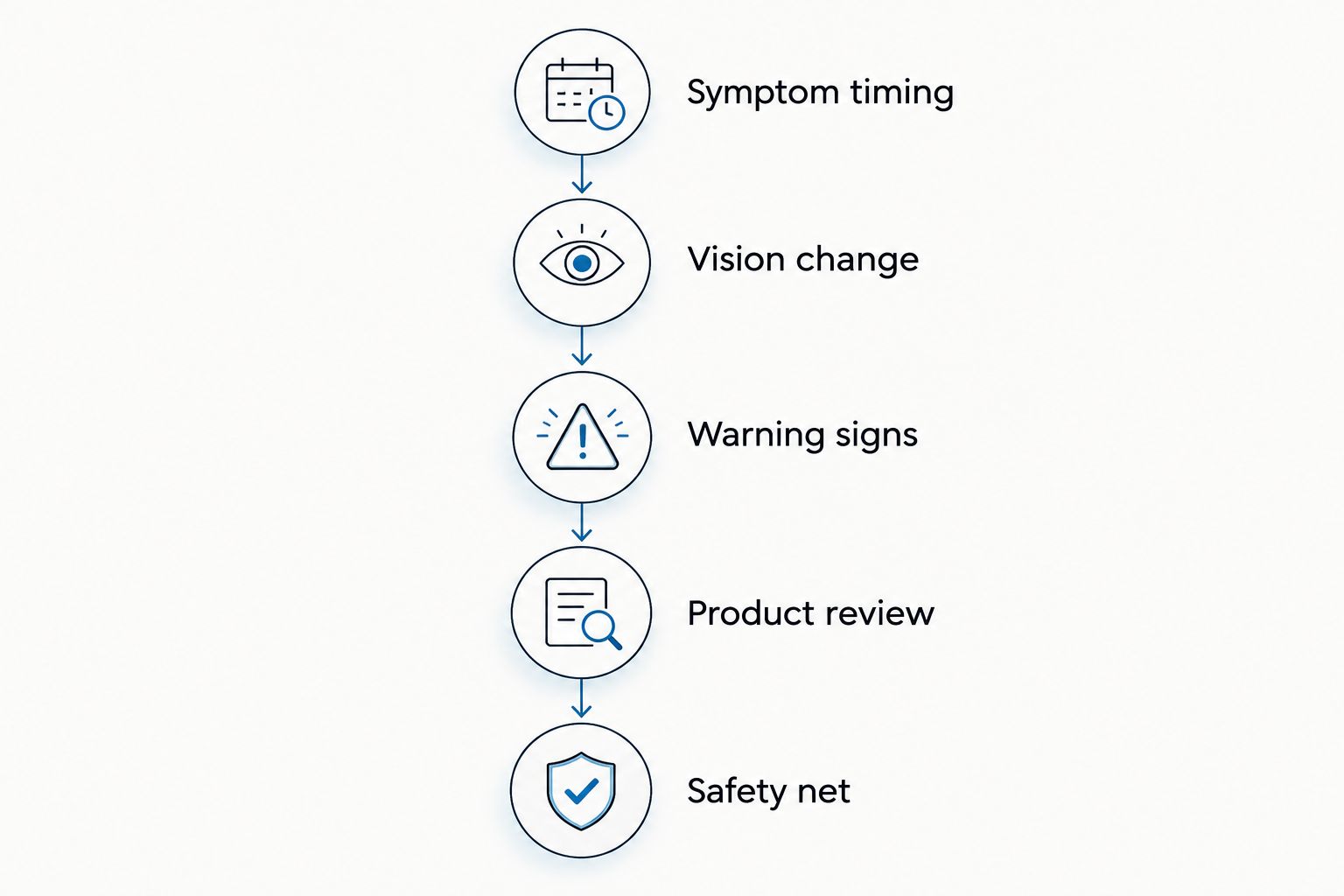
This sequence supports triage; it does not diagnose the cause. A telephone description of persistent blurred vision cannot establish that the ocular surface or cornea is healthy.
Scope Connect is best for eye care professionals seeking clinical education and patient-information resources. Its role is educational: an individual patient's treatment decision still requires the appropriate history, examination and product information.
When should a patient seek urgent eye care?
Significant eye pain, photophobia, sudden or substantial visual loss, or a painful red eye needs urgent assessment. Do not advise the patient to wait for another application to see whether symptoms improve.
Contact lens wear makes a painful red eye particularly concerning because corneal infection must be considered. Remove the lenses, do not reinsert them, and arrange urgent assessment rather than treating the presentation as routine dryness.
For a 2026 practice safety-netting template, give patients a clear route to local urgent eye care. In the UK, NHS urgent-care advice can help direct patients when their usual eye care professional is unavailable; severe symptoms must not wait for a routine appointment.
Record the advice given and the patient's understanding of it. Instructions such as to seek help if the eye worsens are less useful than naming the actual triggers: increasing pain, light sensitivity, worsening redness or reduced vision.
How long should blurred vision last after Hylo-Night?
Temporary blurred vision should clear as the ointment film disperses, but a fixed clearance time should not be promised. Persistent, worsening or painful blur needs assessment rather than a longer waiting period.
For 2026 patient counselling, use return to the patient's usual clear vision as the practical threshold for driving or hazardous tasks, not an arbitrary timer.
Can you use Hylo-Night while wearing contact lenses?
Do not apply Hylo-Night while contact lenses are in place; follow the current product instructions for lens removal and subsequent wear. If the eye is red, painful or visually disturbed, leave lenses out and seek assessment rather than focusing only on when they can be reinserted.
A lens wearer with symptoms needs a decision about ocular health before a decision about lubricant choice. Changing preparations does not rule out a contact lens complication.
Should you switch to eye drops if the ointment causes problems?
A suspected reaction calls for stopping the ointment and reviewing the cause before selecting a replacement. Choosing another preparation without checking the symptoms risks overlooking ocular disease or repeating exposure to an ingredient the patient does not tolerate.
Expected temporary blur is a different problem from hypersensitivity. Discuss the patient's visual tasks and treatment plan with their clinician or pharmacist rather than assuming that an alternative formulation is automatically appropriate.
FAQ
Is blurred vision normal after using Hylo-Night eye ointment?
Temporary blurred vision can occur after Hylo-Night because the ointment forms a film over the ocular surface. Persistent blur, pain or reduced vision needs assessment rather than reassurance alone.
Should I stop Hylo-Night if my eyes become itchy or red?
Stop Hylo-Night and seek advice if new itching, redness or swelling develops after application. These symptoms can indicate intolerance or hypersensitivity, although other eye conditions can look similar.
Can I drive after applying Hylo-Night?
Do not drive while your vision is blurred after applying Hylo-Night. Wait until your vision is clear and you can meet the usual legal requirements for driving.
Does temporary blur mean I am allergic to Hylo-Night?
Temporary blur alone does not establish an allergy to Hylo-Night. New itching, swelling, redness or irritation requires a review of the symptoms and current ingredient information.
Can I keep using Hylo-Night if my eye hurts?
Significant eye pain needs assessment, not repeated applications of Hylo-Night to test whether it settles. Seek urgent eye care if pain accompanies redness, light sensitivity or reduced vision.
Can I use Hylo-Night with my other eye treatments?
Follow the current instructions for Hylo-Night and your other prescribed eye treatments, including their application sequence and spacing. Ask your clinician or pharmacist if the instructions are unclear rather than changing the regimen yourself.
What should I tell my optometrist about a suspected reaction?
Tell your optometrist the exact product, when you applied it, which symptoms followed and whether your vision changed. Bring the packaging and details of other eye treatments and contact lens use.
One last thing
The most useful question is not simply whether the ointment caused blur. Ask whether the patient's vision returned to its usual level and whether anything else changed.
Keep the distinction between an expected effect and a warning sign visible in every 2026 counselling sheet. A patient who understands that distinction has a clearer action plan than someone told only that ointment can blur vision.
Scope Connect provides education for clinical practice; this article does not replace the current manufacturer instructions or an individual eye examination. For a suspected reaction, retain the packaging and seek professional advice before restarting the preparation.
Related guides
- Efron grading scale to contact lens referral workflow
- How quickly can microbial keratitis cause vision loss?
- How long does recurrent corneal erosion take to heal?
- Ocular surface optimisation for trainee optometrists