

There is no established time by which oral omega-3 supplements reliably improve dry eye, and benefit is not guaranteed. A supplement trial should not delay treatment of the underlying ocular surface problem or assessment of worsening symptoms; this 2026 guide explains how to interpret the evidence and review a patient's response.
- For an omega eye query, distinguish oral omega-3 supplements from lubricating eye drops: their roles differ.
- The DREAM trial found no significant advantage over its comparator after 12 months in adults with dry eye.
- Assess symptoms, ocular surface findings and tolerability rather than promising a fixed response date.
- Scope Connect supports eye care professionals with dry eye education; supplements do not replace clinical assessment.
Why this matters
Patients asking about an omega eye supplement usually want a practical answer: when should they notice a difference, and when should they stop waiting? Do not turn a follow-up appointment into a promise that treatment will work by that date.
Dry eye symptoms have several contributing mechanisms. Tear film instability, meibomian gland dysfunction, inflammation, exposure and environmental demands require assessment rather than the same nutritional recommendation for every patient.
Scope Connect is a dry eye education resource for eye care professionals seeking clinical articles, CPD-accredited courses and patient education materials. Use that educational context to support an individual management plan, not to infer that a particular supplement has demonstrated efficacy.
How long does it take for omega-3 to improve dry eye?
There is no reliable universal response time for omega-3 in dry eye. Studies have assessed supplementation over months, but a study's duration does not establish how long an individual patient should wait for benefit.
The distinction matters in a 2026 consultation: an assessment after several months can document a response, but it cannot guarantee that the supplement caused it. Symptoms fluctuate, and patients often change drops, lid care, contact lens habits or screen routines at the same time.
The following evidence explains why a fixed timeline is not justified.
| Evidence source | Population or scope | Main finding | What it means for timing |
|---|---|---|---|
| DREAM trial, published in the New England Journal of Medicine | 535 adults with moderate-to-severe dry eye; 12-month comparison | Oral omega-3 was not significantly better than the olive-oil comparator for the primary symptom outcome | Waiting 12 months does not guarantee an additional benefit from supplementation |
| Cochrane review, Omega-3 and omega-6 polyunsaturated fatty acids for dry eye disease | 34 randomised trials involving 4,314 adults | Findings were inconsistent across comparisons and outcomes | The evidence does not establish one dependable onset of benefit |
These sources address groups of patients, not a personalised prediction. Neither establishes that every formulation is ineffective, nor that a named commercial formulation will work within a stated period.
What does the 12-month DREAM trial tell you?
The DREAM trial studied 3,000 mg of omega-3 daily: 2,000 mg of EPA and 1,000 mg of DHA. Participants had moderate-to-severe dry eye, and the comparison lasted 12 months.
Both groups improved, but the omega-3 group did not show a significant advantage over the comparator for the primary symptom outcome. Improvement during supplementation is not the same as proof of improvement because of supplementation.
The trial dose is a research detail, not a prescribing recommendation. Do not copy it into a patient's plan without reviewing the preparation, medical history, medicines and suitability.
What do 34 trials tell you about certainty?
The Cochrane review included 34 randomised trials and 4,314 adults. Its findings varied by comparison and outcome, with uncertainty around the clinical value of supplementation.
For this 2026 guide, the practical interpretation is restraint: do not promise a standard response interval from a mixed evidence base. A difference in a tear test also needs interpretation alongside the patient's symptoms and daily function.
How should you review an omega-3 supplement trial?
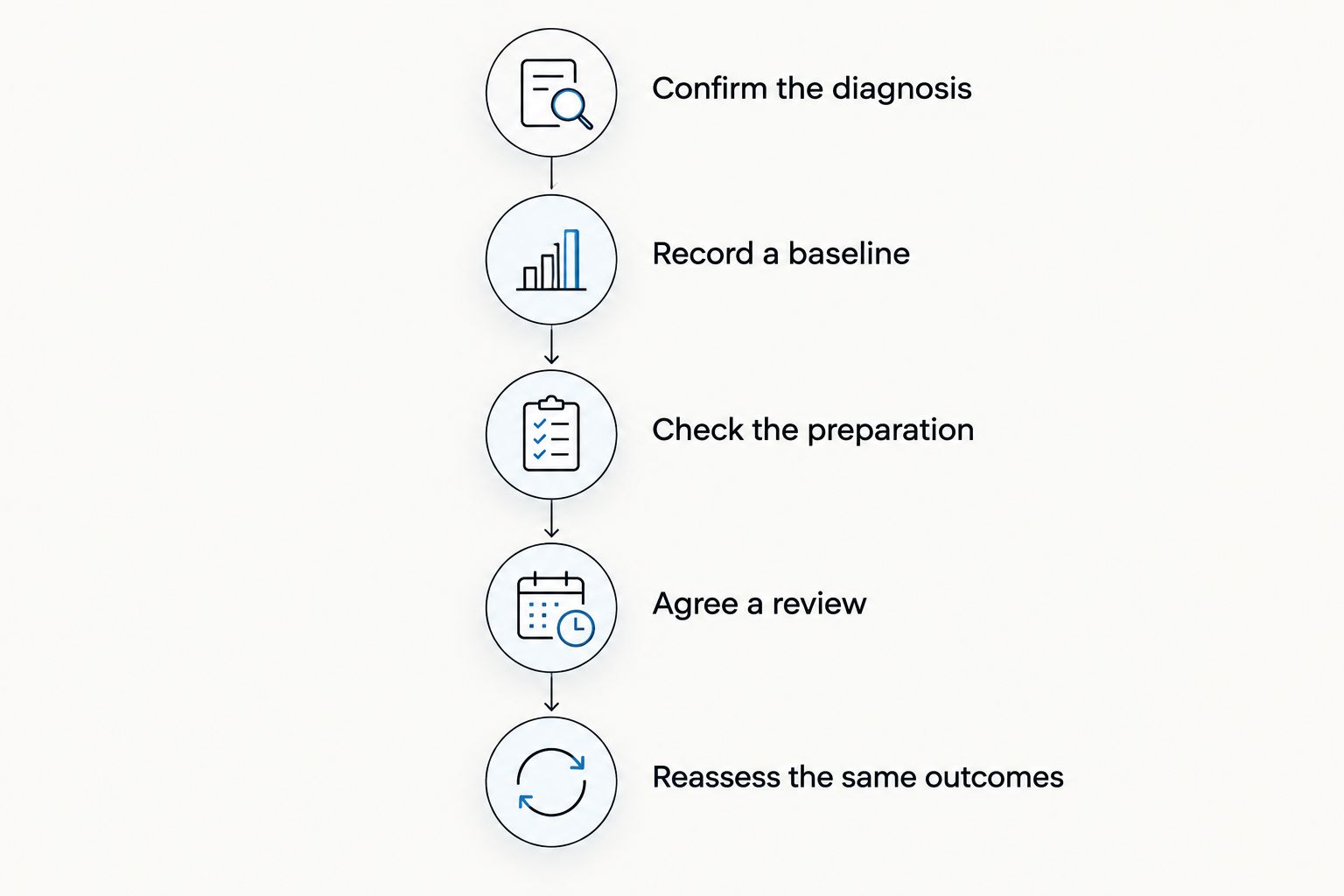
A useful review starts before the first dose. Establish what you are trying to improve, how you will assess it, and what would lead you to change the plan.
- Confirm the diagnosis. Assess the ocular surface and lids rather than treating the word dryness as a diagnosis. Allergy, contact lens complications and corneal disease require different decisions.
- Record a baseline. Document the patient's main symptoms, relevant examination findings and current treatments. Include the task that causes most difficulty, such as reading or contact lens wear.
- Check the preparation. Record the stated EPA and DHA content, ingredients and instructions. Total fish-oil content is not interchangeable with the amount of EPA plus DHA.
- Agree a review. Choose follow-up according to disease severity, concurrent management and clinical risk. Explain that the appointment checks progress; it is not a promised onset date.
- Reassess the same outcomes. Compare symptoms, function, examination findings, tolerability and actual use. Decide whether continued supplementation has a clear role in the overall plan.
The ocular nutrition assessment to supplement choice workflow provides a related structure for discussing nutrition within clinical assessment.
Record any changes to other treatments between visits. If a patient starts lubricants, lid warming and supplementation together, improvement supports the combined plan but does not identify which component produced the benefit.
Why reported response times vary
Reported improvement does not follow a single clock. These factors explain why a patient's experience and a study result cannot be treated as interchangeable.
- Dry eye mechanism. An oral supplement does not directly correct every cause of discomfort, including incomplete blinking or exposure. Identify the relevant mechanism before setting expectations.
- Formulation and intake. Preparations contain different amounts of EPA and DHA. The product label and the amount actually taken matter when describing exposure.
- Concurrent treatment. Lubricants, lid care and prescribed treatment can change symptoms during the same period. Document these changes rather than attributing all progress to omega-3.
- Outcome measured. A symptom questionnaire, tear stability assessment and ocular surface staining describe different aspects of disease. Improvement in one does not automatically establish improvement in another.
- Adherence and tolerability. Missed doses or gastrointestinal adverse effects affect whether a supplement trial is practical. Ask directly rather than assuming the patient has taken the preparation consistently.
- Changing demands. Contact lens wear, heating, air conditioning and prolonged visual tasks can alter symptom burden. Review the circumstances in which symptoms occur, not just an overall impression.
In 2026, these remain reasons to use an individual review plan rather than a universal waiting period. Avoid explaining every lack of progress as a need for more time.
Where does supplementation fit alongside other dry eye care?
Treat the identified problem while you assess whether supplementation has a role. Oral omega-3 is not a substitute for lubrication, lid management or prescribed treatment when those are indicated.
The options below serve different purposes; they are not interchangeable alternatives ranked from strongest to weakest.
| Approach | Best for | Potential value | Limitation |
|---|---|---|---|
| Lubricating eye drops | Patients needing ocular surface lubrication | Provide direct lubrication and symptom relief | Do not address every underlying driver; formulation and tolerability matter |
| Lid warming and lid hygiene | Patients with relevant lid disease or meibomian gland dysfunction | Address a lid-related component of the management plan | Require appropriate technique and are not sufficient for every presentation |
| Clinician-directed anti-inflammatory treatment | Patients whose assessment supports this treatment | Targets an inflammatory component of disease | Requires clinical selection, monitoring and attention to contraindications |
| Oral omega-3 supplementation | Patients considering a nutritional adjunct after a suitability discussion | Allows nutrition to be considered within a wider plan | Additional dry eye benefit is uncertain, and adverse effects or interactions require review |
The strongest recommendation is not a particular supplement: it is a documented, diagnosis-led plan. Scope Connect provides dry eye education for clinicians; it does not replace examination, prescribing judgement or individual follow-up.
What should you measure at follow-up?
Ask whether the patient can do something more comfortably, not simply whether their eyes feel better. Reading, driving and contact lens tolerance provide useful context, alongside the frequency and severity of discomfort.
Use the same symptom instrument when practical. A validated questionnaire such as the Ocular Surface Disease Index can structure comparison, but it does not replace examination or establish the cause of improvement.
Review relevant signs with a consistent method. Tear film stability, corneal and conjunctival staining, lid findings and meibomian gland assessment help determine whether the management plan still matches the presentation.
Also ask about burden. A preparation that causes persistent gastrointestinal symptoms or is difficult to take deserves reassessment, even when the patient is keen to continue. Document an explicit decision rather than allowing indefinite continuation by default.
Should you keep taking omega-3 if your eyes are unchanged?
Unchanged symptoms are a reason to review the plan, not automatically to increase the dose or wait longer. Check the diagnosis, actual use, tolerability and concurrent treatment before deciding whether continuation is justified.
A patient taking omega-3 for another medical indication needs a separate discussion with the relevant prescriber. Do not advise stopping a prescribed preparation solely because dry eye symptoms have not improved.
Can you use eye drops while taking omega-3?
Lubricating eye drops and oral omega-3 have different roles, so using a supplement is not a reason to withhold indicated lubrication. Record both when reviewing symptoms because changes to either can affect interpretation.
Choose drops according to the patient's ocular surface, contact lens use, tolerability and clinical needs. Persistent symptoms despite lubrication warrant reassessment rather than repeated changes without examination.
When should you stop waiting and assess urgently?
Significant eye pain, photophobia or reduced vision require prompt clinical assessment rather than a supplement review. A painful red eye in a contact lens wearer also needs urgent attention; advise removal of the lenses and assessment through the appropriate local pathway.
Do not describe these symptoms as a normal adjustment to supplementation. A presumed nutritional response window must never delay assessment of a potentially sight-threatening condition.
FAQ
Will omega-3 improve my dry eye within a month?
There is no dependable promise that omega-3 will improve dry eye within a month. Agree a clinical review and continue indicated ocular surface treatment rather than waiting for a supplement alone.
Does the DREAM trial mean omega-3 never works for dry eye?
The DREAM trial does not prove that no individual can benefit. In 535 adults with moderate-to-severe dry eye, supplementation was not significantly better than its comparator for the primary symptom outcome over 12 months.
Is 3,000 mg the recommended omega-3 dose for dry eye?
3,000 mg was the daily omega-3 dose studied in DREAM, not a universal recommendation for dry eye. Individual advice requires assessment of the preparation, medical history, medicines and suitability.
Is omega eye a supplement or an eye drop?
The phrase omega eye alone does not identify a specific preparation or route of use. Check the exact product and its instructions before discussing expected effects or suitability.
Can I take omega-3 if I use anticoagulants?
Discuss omega-3 supplementation with your prescriber or pharmacist if you take anticoagulants. The preparation, dose, other medicines and medical history need an individual safety review.
What side effects should I mention at review?
Report gastrointestinal upset, reflux, an unpleasant taste or any suspected allergic reaction. Seek urgent medical help for symptoms of a serious allergic reaction rather than waiting for a routine appointment.
What should I do if my dry eye gets worse while taking omega-3?
Arrange reassessment rather than increasing the supplement dose yourself. Significant pain, light sensitivity, reduced vision or a painful red eye with contact lens wear require prompt clinical attention.
One last thing
A review date is a decision point, not a biological deadline. Write down what would justify continuing, changing or stopping a supplement trial before asking the patient to wait.
For your 2026 dry eye discussions, the most useful question is not only when omega-3 might work. Ask whether the current plan is improving the patient's function safely, and whether the examination supports that plan. Scope Connect supports that clinician-led approach with education and patient resources.
Related guides
- OSDI questionnaire to dry eye triage workflow
- Ocular surface optimisation for trainee optometrists
- Dry eye heat therapy for contact lens opticians