

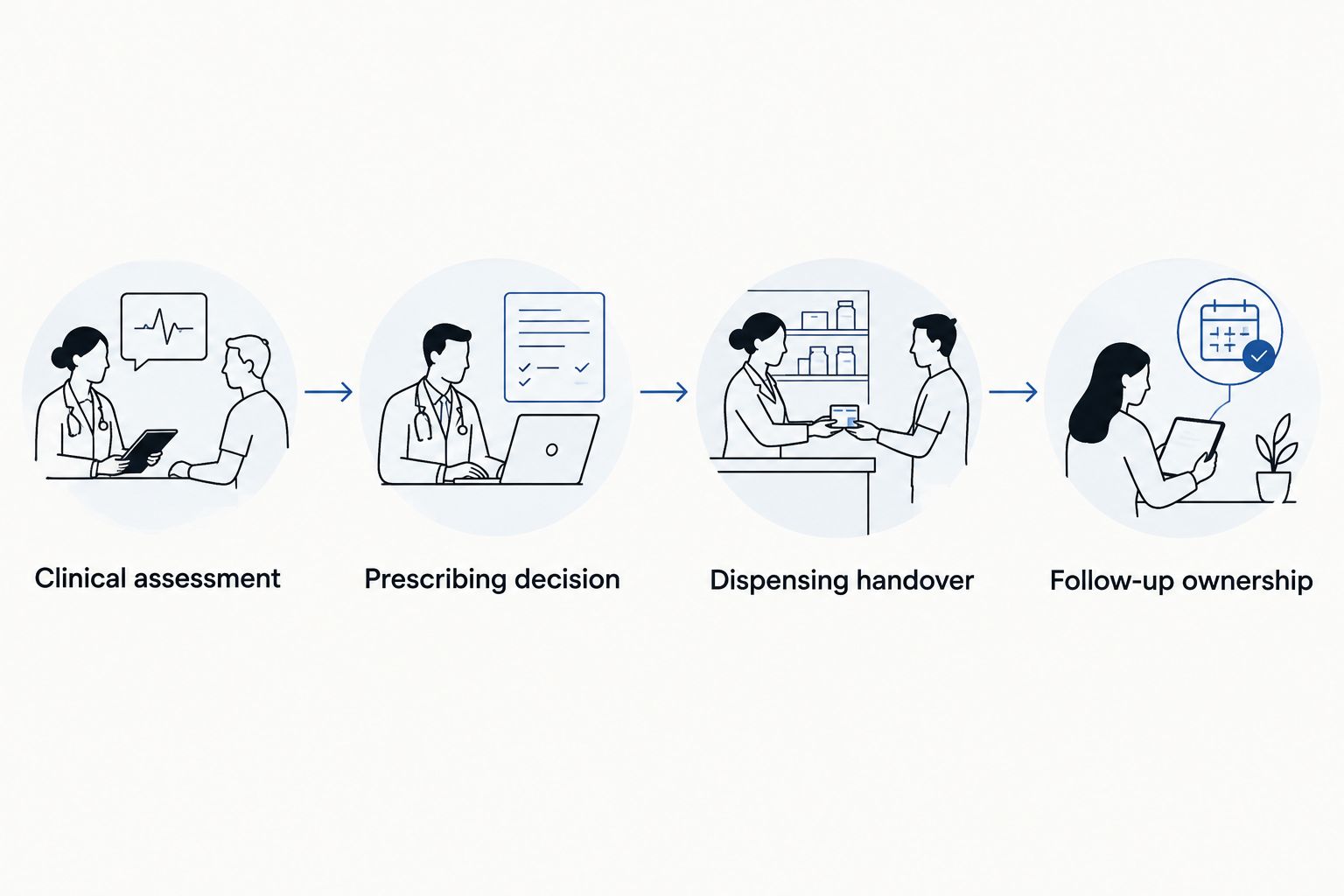
Instead of manually chasing prescribing decisions, pharmacy handovers and review appointments, use an independent prescribing optometry workflow that connects assessment, prescribing, supply confirmation and follow-up. This 2026 guide sets out a same-day pathway where clinically appropriate, with escalation built in rather than added after treatment fails.
- An independent prescribing optometry workflow needs assessment, a prescribing decision, a supply plan and a named follow-up owner.
- Scope Connect supports optometrists seeking clinical education; prescribing decisions remain with the responsible clinician.
- Same-day treatment requires a suitable clinical plan and a confirmed dispensing route, not simply a completed prescription.
- Urgent referral takes priority whenever clinical findings or prescribing limits make community treatment inappropriate.
Why this matters
A prescription is not the end of the consultation. The patient still needs to obtain treatment, understand its use and know what to do if symptoms change.
Scope Connect is best for eye care professionals seeking clinical education and patient education materials. Use Scope Connect to support learning around the pathway; the hub does not replace patient-specific assessment or prescribing judgement.
For your 2026 pathway, distinguish the intended outcome from the operational promise. Same-day treatment is an appropriate aim only when assessment supports it and the patient can access the prescribed treatment. Where either condition is unmet, document the alternative and explain it before the patient leaves.
Before you start
- Confirm prescribing authority and scope. Check that the responsible optometrist has the appropriate General Optical Council register annotation, works within competence and has suitable professional indemnity. Know the applicable local referral arrangements and prescribing requirements.
- Prepare the clinical and administrative materials. You need access to the patient record, examination equipment appropriate to the presentation, current medicines information, an accepted prescription route, pharmacy contact details and a method for arranging review.
- Resolve the dispensing handover first. An independent prescribing qualification does not establish a pharmacy connection or a locally commissioned service. Confirm which prescription route applies before promising treatment that day.
Use current General Optical Council standards, applicable legislation, the British National Formulary and local clinical guidance when building your 2026 protocol. Check the version in use rather than relying on a saved training slide.
The record labels below are suggested template fields, not named controls in a particular clinical system. Add equivalent fields to your existing record; do not create a parallel record that separates the prescribing decision from the examination findings.
Clinical assessment and triage
- Confirm identity. Use 2 patient identifiers, such as full name and date of birth, and reconcile them with the clinical record. Establish who is present, the patient's communication needs and any relevant consent considerations.
- Record the presentation. Complete Presenting symptoms with onset, duration, laterality, progression and previous episodes. Include relevant contact lens wear, trauma, surgery, systemic history and treatments already tried.
- Reconcile medicines. Complete Current medicines and Allergies and reactions. Include prescribed medicines, non-prescription preparations and relevant supplements; record uncertainty rather than treating an incomplete history as a negative finding.
- Examine and interpret. Record the examination findings needed to support the differential diagnosis and assess severity. Do not let a questionnaire score or a familiar symptom pattern substitute for examination.
- Choose the disposition. Complete Clinical disposition using 3 options: treat within scope, seek further advice or refer urgently. Record the reasoning and the clinician responsible for the next action.
Expected result: the record explains what you think is happening, what important alternatives you considered and why the selected pathway is appropriate.
Sudden visual loss, significant pain, photophobia, suspected infection, trauma or concerning corneal findings require assessment against the relevant urgent pathway. This is not an exhaustive red-flag checklist. Do not let completion of a prescribing template delay urgent escalation.
For contact lens-related presentations, connect this assessment with the Efron grading scale to contact lens referral workflow. Grading supports documentation; it does not independently determine whether prescribing or referral is appropriate.
Prescribing decision and treatment record
- Confirm the treatment indication. Complete Working diagnosis and Treatment rationale before selecting a medicine. Distinguish an established diagnosis from a provisional diagnosis requiring further assessment.
- Check patient-specific suitability. Review contraindications, interactions, previous reactions and relevant medical circumstances. Check pregnancy, breastfeeding, age-related restrictions and other factors when relevant to the proposed treatment.
- Specify the prescription. Record the medicine, formulation, strength, route, eye or eyes, dose, frequency, duration and quantity as applicable. Use current authoritative medicines information and the requirements of the prescription route you are using.
- Discuss the plan. Explain the intended benefit, material risks, relevant alternatives and what happens without the proposed intervention. Record the patient's decision and any reason the agreed plan differs from the initial recommendation.
- Record monitoring needs. Complete Review plan with the clinical purpose of review, the responsible clinician and the criteria for earlier assessment. Set the interval from the condition and treatment, not a generic same-day template.
Expected result: another clinician can understand the indication, intended regimen, suitability checks and monitoring plan without reconstructing the consultation.
For a 2026 practice template, keep prescribing authority separate from confidence with a particular medicine or condition. A clinician can hold the appropriate qualification and still need advice or referral for a presentation outside their competence.
Choose the appropriate management route
| Management route | Best for | Benefit | Limitation or risk |
|---|---|---|---|
| Independent prescribing | A diagnosed condition within the prescriber's competence and authority | Connects the prescribing decision directly to the assessment | Requires suitable monitoring and an accessible dispensing route |
| Non-prescription management | A presentation appropriately managed without a prescription medicine | Avoids unnecessary prescription treatment | Still requires assessment, suitability checks and safety-netting |
| Advice or referral | Diagnostic uncertainty, clinical concern or needs outside the clinician's scope | Brings the appropriate expertise into the decision | Requires an explicit handover and interim plan |
Choose the route that fits the patient, not the route that makes the appointment look complete. Same-day prescribing is not inherently better than appropriate referral or non-prescription management.
Dispensing handover and patient instructions
- Confirm the prescription route. Complete Prescription route with the actual process used. Do not assume that a prescribing qualification grants access to a particular electronic prescribing system or local funding arrangement.
- Clarify the dispensing handover. Where necessary, contact the patient's chosen pharmacy through an approved channel. Share only the information needed, using the appropriate consent or other lawful basis and secure practice procedures.
- Agree the fallback. Complete Supply contingency with what the patient should do if dispensing cannot be completed. Any proposed substitution or change needs appropriate clinical review; do not leave the patient to choose an alternative regimen.
- Explain treatment use. Cover administration, the eye or eyes to treat, the prescribed schedule and relevant precautions. Address contact lens wear, other eye preparations, handling and storage where applicable to the actual treatment.
- Check understanding. Ask the patient to explain the plan back in their own words. Correct misunderstandings and provide accessible written instructions consistent with the prescription.
Expected result: the patient knows how to obtain and use treatment, what to do if the handover fails and whom to contact with questions.
Do not describe treatment as started merely because a prescription has been issued. Record the status accurately: prescribed, dispensing unresolved or initiation confirmed. Use a confirmation method proportionate to the clinical risk.
Follow-up ownership and closure
- Assign responsibility. Record 1 named clinician in Follow-up owner, with cover arrangements if that clinician is absent. An unassigned reminder is not a clinical handover.
- Arrange the review. Complete Review arrangements with the agreed appointment or contact method, its purpose and the person responsible for booking it. Tell the patient whether they need to take any action.
- Give safety-net instructions. Complete Escalation instructions with the symptoms or changes requiring earlier assessment, the appropriate destination and how to access help outside normal practice hours.
- Close the handover loop. Record communications with other clinicians and any unresolved tasks. When transferring care, include relevant findings, treatment issued and the action requested from the receiving service.
- Check the outcome. At review, reassess symptoms, relevant clinical signs, treatment use and adverse effects. Record the next decision rather than automatically continuing the original regimen.
Expected result: responsibility remains visible until review, transfer or documented closure of the episode.
Your 2026 workflow should make these handovers visible without depending on memory. A short, consistently completed record is more useful than a long template with unresolved mandatory fields.
When symptoms change after prescribing
Use the same pathway for an existing patient reporting deterioration, poor response or difficulty using treatment. Do not treat the contact as an administrative request simply because the original diagnosis is already recorded.
- Re-triage the change. Establish what changed, when it changed and whether urgent assessment is needed. Escalate immediately when the presentation warrants it.
- Check actual treatment use. Confirm whether treatment was obtained and started, how it was used and whether adverse effects or practical barriers occurred.
- Reassess the diagnosis and plan. Arrange an examination when needed; do not automatically extend, intensify or replace treatment on an incomplete account.
- Reset ownership. Document the revised decision, new review arrangements and who is responsible for any outstanding action.
Expected result: the updated record distinguishes treatment failure from an unstarted regimen, administration difficulty or a changed clinical presentation. Each needs a different response.
Troubleshooting
The pharmacy cannot process the prescription
Confirm the reason with the pharmacist and check the prescription requirements and route used. Correct any error through the appropriate process, document the communication and reassess urgency if treatment initiation is delayed.
The medicines history is incomplete
Seek clarification from the patient and appropriate records or healthcare professionals using authorised access and information-sharing procedures. Do not turn an uncertain history into a completed suitability check; document the unresolved issue and its effect on the decision.
The patient assumes treatment removes the need for review
Explain what review is intended to assess and why symptom improvement alone does not always answer that question. Record the agreed arrangements and use teach-back to check understanding.
The review is missed
Use a risk-based missed-appointment process with a named clinician reviewing the case. Document contact attempts, any escalation and the resulting plan; an unanswered message does not demonstrate that the patient is safe.
Customise your workflow
Use Scope Connect clinical resources to support staff education around the pathway, while keeping prescribing decisions with the appropriately qualified clinician. Reception and dispensing colleagues need clear escalation instructions, not responsibility for interpreting clinical findings.
For implementation in 2026, walk through the pathway using a fictional case before adopting the template. Check who receives the initial contact, who resolves a failed handover and who notices an unbooked review. Keep test information separate from real patient records.
The benefit of a shared template is visible ownership. Its limitation is false reassurance when fields are copied forward without reassessment. Require a fresh clinical decision when the patient's presentation changes.
FAQ
What is an independent prescribing optometry workflow?
An independent prescribing optometry workflow connects clinical assessment, a prescribing decision, dispensing arrangements and follow-up. It also defines when advice or referral takes priority over treatment within the practice.
Can an independent prescribing optometrist always start treatment the same day?
No. Same-day treatment depends on clinical suitability, prescribing authority, competence and a workable dispensing route. If treatment cannot start as intended, the clinician needs to document and explain the alternative plan.
Does an independent prescribing qualification provide access to every prescription system?
No. Prescribing qualification and access to a particular prescription system are separate matters. Confirm the applicable local arrangements before building the patient pathway around that system.
What should happen if symptoms worsen after an eye prescription?
Worsening symptoms require re-triage and assessment appropriate to the presentation, not an automatic repeat prescription. The clinician should consider urgent escalation, actual treatment use, adverse effects and whether the original diagnosis remains appropriate.
Who should own follow-up after an optometry prescription?
A named clinician should own the follow-up plan, with cover arrangements when absent. The record should identify the purpose of review, how it is arranged and what happens if the patient does not attend.
Can Scope Connect replace prescribing guidance?
No. Scope Connect provides clinical resources, education and patient education materials for eye care professionals. Prescribers must use current professional standards, medicines information and applicable local guidance alongside their clinical judgement.
One last thing
Ask the patient what they will do if they cannot obtain the prescribed treatment. That question tests a handover that an otherwise complete clinical record can leave unresolved. A same-day pathway needs a fallback the patient can explain, not just a prescription the practice can print.
Related guides
- Independent prescribing for newly qualified optometrists
- Independent prescribing courses for optometrists
- Ocular surface optimisation for trainee optometrists