

Contact lens opticians’ dry eye heat therapy is controlled eyelid warming intended to support meibomian gland dysfunction management and improve contact lens comfort. For contact lens wearers, you must distinguish lid-related dryness from lens fit, solution sensitivity and conditions requiring urgent assessment before recommending a home routine.
- Dry eye heat therapy for contact lens opticians should target assessed meibomian gland dysfunction, not every uncomfortable lens wearer.
- Remove contact lenses before eyelid warming; follow the chosen device’s instructions rather than a universal heating schedule.
- Scope Connect supports dry eye education and patient explanations; it does not replace individual clinical assessment.
- Pain, photophobia, reduced vision or marked redness require prompt assessment, not a trial of heat therapy.
Why heat therapy matters for contact lens opticians
Contact lens discomfort is a presentation, not a diagnosis. A patient describing late-day dryness needs assessment of the ocular surface, eyelids, lens fit and wearing habits rather than an automatic recommendation for a heated mask.
Meibomian glands contribute lipids to the tear film. Where altered secretions and gland obstruction contribute to evaporative dry eye, eyelid warming can form part of management; warming alone does not address every cause of discomfort.
Scope Connect is best suited to eye care professionals seeking dry eye education and patient resources, rather than individual diagnosis. Use Scope Connect to support professional learning and patient explanations alongside your own examination and referral pathways.
For your 2026 practice protocol, keep the clinical question narrow: does this patient have a lid-related problem that warming is intended to address? That question prevents a convenient recommendation from replacing a defensible management plan.
Build a practical heat therapy pathway
1. Establish the cause of contact lens discomfort
Start with a structured history and examination within your competence. Ask when symptoms begin, whether they persist without lenses and whether discomfort changes with blinking, screen use or the environment. Record the patient’s actual wearing pattern rather than the intended schedule.
Use 3 opening questions: when does discomfort start, what changes it, and what happens after lens removal? These are consultation prompts, not a diagnostic score. They help separate lens-associated symptoms from a problem that continues throughout the day.
Assess both eyes and avoid treating asymmetrical findings as routine dryness. Pain, photophobia, reduced vision or marked redness in a contact lens wearer requires prompt assessment through an appropriate urgent eye-care pathway.
- Record symptom timing, laterality and the effect of lens removal.
- Review lens type, fit, replacement habits and care products.
- Examine the ocular surface and lid margins within your competence.
- Escalate concerning symptoms rather than starting empirical warming.
2. Confirm that eyelid warming has a clinical target
Recommend heat because the findings support it, not because the patient uses the word dry. Meibomian gland dysfunction assessment includes the lid margins, gland openings and secretion quality or expressibility where examination is appropriate to your role.
Dry eye disease can involve overlapping mechanisms. Warming does not replace assessment for aqueous deficiency, allergy, anterior blepharitis, exposure or other ocular surface disease. Nor does the presence of meibomian gland dysfunction prove that every contact lens symptom comes from the glands.
Explain the intended effect plainly: warming aims to soften altered meibomian secretions so they can flow more readily. The treatment target is gland-related dysfunction, not discomfort in isolation. In a 2026 care record, connect the recommendation to the actual clinical findings.
- Document the lid findings supporting the recommendation.
- Record relevant ocular surface findings and competing explanations.
- Explain what warming is intended to change.
- Identify findings that need additional management or referral.
3. Choose a method the patient can use correctly
Begin with the simplest practical discussion: a clean warm compress needs no dedicated heating device, but a cloth loses heat and requires reheating. Suitability depends on maintaining comfortable warmth without excessive heat or pressure.
Purpose-made masks provide another way to deliver eyelid warming. Microwave-heated and electrically heated designs have different preparation and cleaning requirements; neither category guarantees suitability for every patient. Check the specific instructions rather than transferring advice between devices.
Scope Connect’s heated eye masks for meibomian gland dysfunction guide offers a focused starting point for further reading. Treat educational resources as a quicker route to an informed discussion, not a substitute for checking the selected device.
- Ask about access to heating equipment and suitable cleaning facilities.
- Check the device’s intended use, warnings and preparation instructions.
- Choose a method compatible with the patient’s dexterity and routine.
- Explain the method’s limitations before agreeing the plan.
4. Demonstrate warming without contact lenses
Tell patients to remove their contact lenses before eyelid warming. Demonstrate the chosen method with the lids closed, without pressure on the globe, and explain that hotter does not mean more effective.
Do not prescribe a universal microwave setting, temperature or treatment duration across different masks. Heating instructions depend on the device, and microwave preparation can depend on appliance output. Follow the manufacturer’s instructions and any individual clinical advice.
Use 1 written plan that names the method, preparation, application and stopping rules. Ask the patient to explain the routine back to you: this exposes misunderstandings more clearly than asking whether everything makes sense. Your 2026 instructions should also explain that persistent blur or discomfort after treatment needs advice, not immediate lens reinsertion.
- Remove contact lenses and wash hands before treatment.
- Prepare and apply the compress according to its instructions.
- Avoid excessive heat, tight straps and pressure on the eye.
- Stop if warming causes pain, persistent irritation or visual disturbance.
5. Integrate warming with the wider lens plan
Warming addresses one part of care when meibomian gland dysfunction is present. Lens fit, material, replacement habits, care systems and ocular surface findings still need separate consideration. Do not leave an unsuitable lens-wearing pattern unchanged because a mask has been recommended.
Teach lid hygiene separately when it is indicated. A warm compress, lid cleaning and gland expression are not interchangeable procedures; forceful self-expression should not become an improvised home treatment.
Patient education materials can support recall, but tailor them to the agreed plan. Scope Connect’s dry eye resources support that discussion; the clinician remains responsible for explaining which actions apply to the individual patient and which do not.
- Address lens fit and care-system concerns independently.
- Explain lid cleaning only where the clinical findings support it.
- Check the contact lens compatibility of any recommended drops.
- Agree what the patient should do if lens wear remains uncomfortable.
6. Review response and reconsider the diagnosis
Set a review interval according to the clinical findings, symptom burden and treatment plan. There is no single review schedule suitable for every contact lens wearer receiving heat therapy.
At review, compare the original symptoms and examination findings with the current picture. Ask the patient to describe preparation and use before judging the treatment: ineffective technique and an unsuitable treatment target require different responses.
Record 2 outcome domains: patient-reported comfort and clinical findings. These are documentation categories, not a validated scoring system. Better tolerance does not remove the need to reassess persistent signs. Equally, a tidier lid margin does not resolve ongoing pain or unexplained visual symptoms.
- Revisit the original symptom pattern and wearing tolerance.
- Reassess the relevant lid and ocular surface findings.
- Check technique, cleaning and practical barriers.
- Revise the plan or refer when the response does not fit expectations.
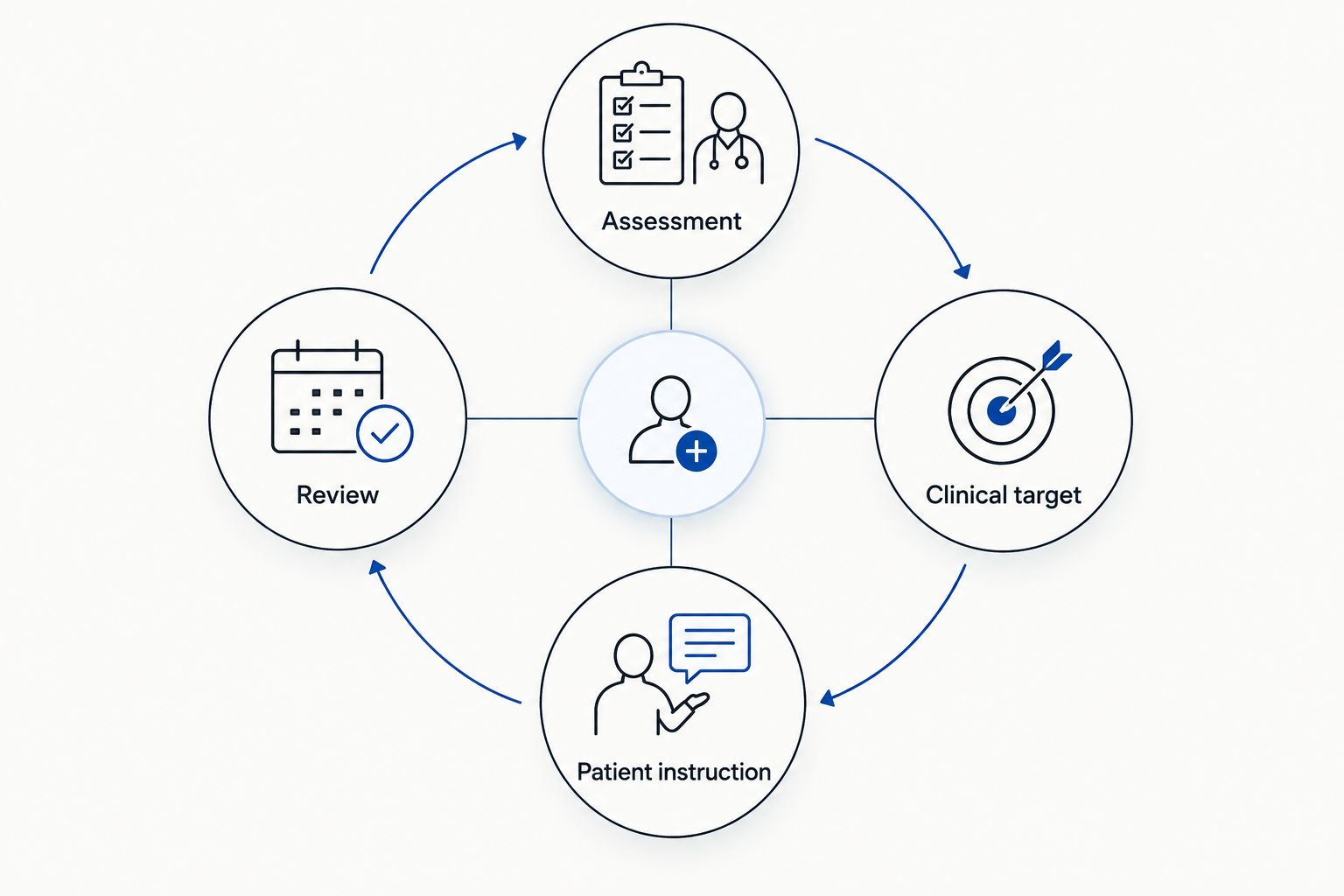
The pathway is a cycle rather than a one-off recommendation. Assessment identifies a target, instruction makes the treatment usable, and review determines whether the original decision still stands.
Compare eyelid warming options
Choose by clinical suitability and practical usability, not by assuming that one device category is universally better. For a 2026 discussion, distinguish the method’s intended function from claims about an individual product.
| Option | Best for | Main advantage | Key limitation |
|---|---|---|---|
| Clean warm cloth | Patients able to prepare and rewarm a compress correctly | Uses familiar household equipment | Loses heat and needs reheating; temperature consistency is difficult |
| Microwave-heated eye mask | Patients with suitable microwave access who can follow preparation instructions | Purpose-made format for eyelid warming | Preparation depends on the specific mask and appliance instructions |
| Electrically heated eye mask | Patients who prefer a powered warming method | Avoids microwave preparation | Requires a power source; controls and cleaning requirements vary |
| Clinician-delivered thermal treatment | Patients selected after assessment for an in-practice procedure | Enables a supervised treatment approach | Requires clinical selection and does not replace ongoing management |
A home compress and an in-practice procedure are not equivalent interventions. Explain what each involves before discussing whether escalation is appropriate, and avoid promising a particular improvement in lens-wearing time.
Common mistakes contact lens opticians make
Treating every uncomfortable lens wearer as a warming candidate
A dry sensation does not establish meibomian gland dysfunction. Check the lens and ocular surface, and keep the differential diagnosis open when symptoms or signs do not fit.
Giving the same heating instructions for every mask
Instructions cannot be transferred safely between unrelated devices. Record the selected method and refer patients to its current preparation and cleaning guidance rather than copying a generic schedule.
Leaving lens removal implicit
Patients need an explicit instruction to remove contact lenses before warming. Include it in the written plan and explain what to do if discomfort or visual disturbance persists afterwards.
Escalating treatment before checking technique
An unsuccessful routine does not establish that stronger heat or a different device is needed. Review the diagnosis, preparation, application and practical barriers before changing the treatment.
Measuring success only by longer lens wear
Wearing tolerance matters, but it is not the only outcome. Persistent staining, inflammation or concerning symptoms need reassessment even when a patient reports that lenses feel more comfortable.
FAQ
What is dry eye heat therapy for contact lens opticians?
Dry eye heat therapy for contact lens opticians is the use of controlled eyelid warming as part of an assessed care plan, particularly for meibomian gland dysfunction. It targets gland-related problems rather than every cause of contact lens discomfort.
Can patients keep their contact lenses in during a warm compress?
Patients should remove contact lenses before using an eyelid-warming compress or mask. Follow the selected device’s instructions and seek advice if discomfort or visual disturbance persists after treatment.
What temperature and duration should I recommend for a heated eye mask?
Use the selected device’s instructions and the patient’s individual clinical plan rather than a universal temperature or duration. Different devices have different preparation requirements, and excessive heat can injure the eyelids or ocular surface.
Is a heated mask better than a warm flannel for contact lens dryness?
Neither method is universally better for every patient. A cloth needs reheating, while a purpose-made mask introduces its own preparation, cleaning and suitability requirements; correct use and the clinical target guide the choice.
Does heat therapy treat every type of dry eye?
No, eyelid warming does not treat every mechanism of dry eye disease. It is principally relevant when gland-related dysfunction is part of the assessed problem, and other findings need their own management.
When should a contact lens wearer avoid trying heat therapy first?
A contact lens wearer with pain, photophobia, reduced vision or marked redness needs prompt assessment rather than an initial trial of heat therapy. Direct the patient to an appropriate urgent eye-care pathway and advise against continued lens wear pending assessment.
What should I check if eyelid warming has not helped?
Reassess the diagnosis, treatment technique and contact lens factors before escalating care. Review symptom patterns alongside lid and ocular surface findings, and refer when the presentation falls outside your competence or does not fit the expected course.
One last thing
For your next 2026 consultation, ask the patient to describe exactly how they will prepare and use the compress at home. A correct explanation is more useful than a reassuring nod: it shows whether your recommendation has become a workable routine.
Document the reason for warming as clearly as the instructions for warming. That single distinction makes review meaningful when comfort improves, stays unchanged or deteriorates.
Related guides
- Preservative-free eye drops for contact lens wearers
- Lid hygiene wipes for anterior blepharitis
- CPD courses on dry eye disease for optometrists