

Lubricating eye ointment can be suitable for nightly, long-term use when the formulation is appropriate, the diagnosis is established and symptoms remain under review. That reassurance does not extend to every eye ointment: antibiotic and steroid preparations need indication-specific treatment plans, and persistent pain or reduced vision requires assessment rather than more lubrication.
- Eye ointment every night safety depends on the formulation: lubricants and medicated ointments require different advice.
- Night-time lubrication can support dry eye management, but persistent symptoms need reassessment.
- Steroid eye ointments require prescribing oversight because prolonged use can increase intraocular pressure and cataract risk.
- Scope Connect supports eye care professionals with clinical resources and patient education materials.
Why this matters
A patient asking about nightly ointment often wants permission to continue something that makes waking more comfortable. Your first task is to identify the preparation, not to approve or reject long-term use as a category. Ask the patient to bring the tube or a clear photograph of its label.
For clinical conversations in 2026, separate treatment duration from product hygiene. A patient can need ongoing lubrication while still needing to discard each opened tube according to its own instructions. Long-term treatment never means keeping the same tube indefinitely.
Scope Connect is best for eye care professionals seeking clinical resources and patient education materials. Use those resources to support counselling while keeping the individual patient's examination and treatment plan central.
Is it safe to use eye ointment every night long-term?
Yes, for an appropriate lubricating ointment; not as a blanket rule for all eye ointments. Nightly lubrication is an established option in dry eye care, particularly when symptoms occur overnight or on waking. Its suitability depends on the ocular surface findings, ingredients, tolerance and response.
Start with the treatment category. The word ointment describes the dosage form, not whether the contents are suitable for continuing without prescribing supervision.
| Ointment category | Best for | Main benefit | Main limitation or safety concern |
|---|---|---|---|
| Lubricating ointment | Patients needing sustained ocular surface lubrication overnight | Remains on the ocular surface longer than less viscous lubricants | Temporary blurred vision, irritation or sensitivity to ingredients |
| Antibiotic ointment | Patients with an appropriate diagnosed indication | Treats susceptible bacterial infection | Not a routine treatment for uncomplicated dry eye; unnecessary use adds adverse-effect and antimicrobial-resistance concerns |
| Steroid-containing ointment | Patients with an inflammatory condition managed by an appropriate prescriber | Suppresses ocular inflammation | Requires oversight because of pressure, cataract and infection-related risks |
This distinction is more useful than asking whether ointment is inherently safe or unsafe. An otherwise well-tolerated lubricant does not carry the same monitoring requirements as a steroid simply because both come in tubes.
What supports continued nightly lubrication?
Continued use is reasonable when the diagnosis supports lubrication, the patient reports benefit and examination does not identify a problem requiring different treatment. Check whether waking discomfort, fluctuating vision and daytime symptoms are improving rather than simply asking whether the patient still uses the ointment.
Document the preparation and the agreed review plan. A repeat purchase alone does not demonstrate either effectiveness or appropriate use.
Lubricating ointment: suitable for ongoing use when reviewed
Lubricating ointments reduce friction and help protect the ocular surface. Their persistence makes bedtime a practical application time, because the resulting blur is less disruptive when the patient is no longer driving, reading or working.
The trade-off is tolerability. A patient who dislikes greasy residue or wakes with troublesome blur needs a discussion about formulation and technique, not an instruction to persevere regardless. Check the ingredient list where allergy or sensitivity is suspected.
For a 2026 treatment review, record what benefit the patient actually notices. Comfortable waking with stable vision is a different clinical picture from continuing nightly ointment while pain, redness or visual disturbance worsens.
Ointment also has a role in some clinician-directed plans for recurrent corneal erosion. That does not make recurrent morning pain a diagnosis of dry eye; the guide to recurrent corneal erosion healing provides related clinical context.
Medicated ointment: duration follows the prescribing plan
Antibiotic and steroid ointments are not interchangeable with plain lubricants. Ask whether the patient is following a current prescription, continuing beyond the original instructions or reusing an old tube for a new episode.
For an antibiotic preparation, confirm the indication and prescribed duration. Do not recommend repeated or indefinite antibiotic treatment solely because the eye feels dry. Recurrent symptoms require reassessment of the cause.
Steroid-containing preparations need particular care. Prolonged ocular steroid exposure can increase intraocular pressure and cataract risk, and steroids can mask or worsen certain infections. The prescriber determines the treatment duration, monitoring and any tapering instructions.
Do not advise a patient to alter a prescribed steroid regimen independently. Contact the prescriber when the instructions are unclear or symptoms have changed, and arrange urgent assessment when red flags are present.
Why long-term eye ointment safety varies
The clinically useful question is not simply how many nights the patient has used ointment. These factors determine whether continuing makes sense:
- Formulation: A lubricant, antibiotic and steroid have different purposes and safety requirements. Read the active ingredients rather than relying on packaging familiarity.
- Underlying diagnosis: Dry eye, recurrent corneal erosion and exposure-related problems do not have identical management needs. Symptom relief does not establish the diagnosis.
- Ocular surface response: Persistent staining, inflammation or worsening symptoms calls for reassessment. Comfort alone is not the whole outcome.
- Ingredient tolerance: Irritation or eyelid reactions warrant checking the formulation and other products used around the eyes. Preservative-free does not mean allergy is impossible.
- Application and handling: A contaminated tip, shared tube or product kept beyond its stated in-use period creates an avoidable safety concern.
- Concurrent treatment: Contact lenses, other eye medicines and recent ocular procedures affect counselling. Follow the relevant product instructions and treating clinician's plan.
Avoid giving the same reassurance to every patient who says the ointment helps. A useful review connects the reported benefit with the diagnosis, examination and practical use.
How should you review a patient using ointment nightly?
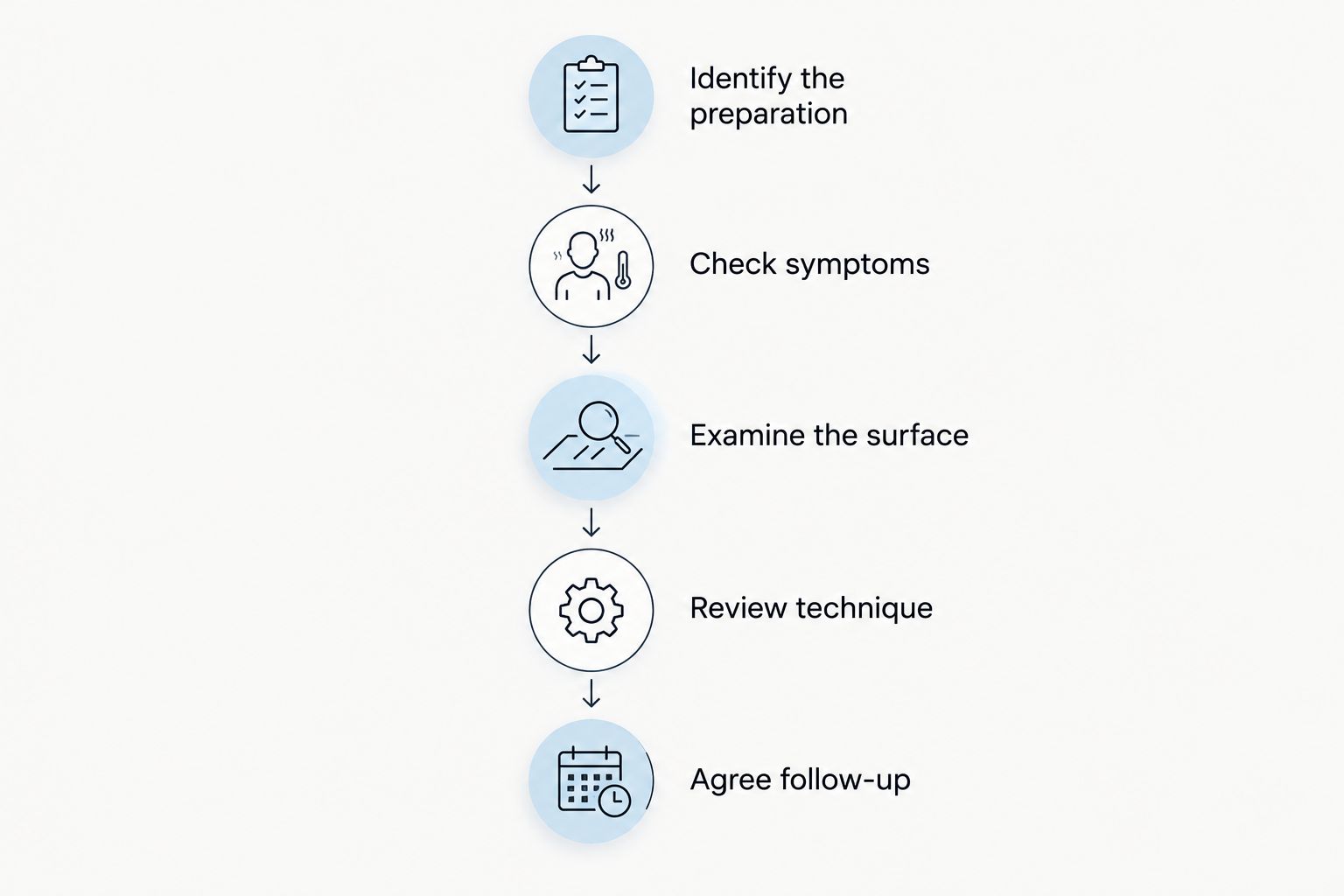
Use a repeatable sequence at a 2026 medication or dry eye review. It keeps the discussion focused without reducing the decision to treatment duration alone.
- Identify the preparation. Record the exact product, ingredients, reason for use and whether it was prescribed. Check the expiry date and the manufacturer's instructions after opening.
- Check symptoms. Ask about pain, light sensitivity, discharge, redness, waking discomfort and vision changes. Establish whether symptoms are improving, recurring or progressing.
- Examine the surface. Assess the ocular surface and eyelids within your competence and local pathway. Escalate findings that need further investigation or treatment.
- Review technique. Ask the patient to describe application, tube handling, contact lens use and the timing of other eye medicines.
- Agree follow-up. Explain what to continue, what to change through the appropriate clinician and which symptoms require urgent help. Record a review plan suited to the diagnosis.
The sequence prevents an easy mistake: discussing application technique before recognising that the patient's presentation needs urgent assessment. Clinical urgency comes before routine product counselling.
Application advice that supports safe use
Advise handwashing before application and explain that the tube tip should not touch the eye, lashes, fingers or another surface. The patient should use only a preparation intended for ophthalmic use and should not share it with anyone else.
Follow the product leaflet for the amount, frequency, storage and disposal instructions. Where other eye medicines are prescribed, check their administration instructions; ointment is generally applied after drops, but the required spacing should come from the relevant instructions or prescriber.
Contact lens wearers need explicit advice rather than assumptions. Check the preparation's compatibility instructions and do not advise applying ointment over lenses without a specific clinical plan. Patients must not drive or operate machinery while their vision remains blurred.
Can using eye ointment every night damage your eyes?
Appropriate nightly lubrication is not inherently damaging, but unsuitable ingredients, contamination or an overlooked diagnosis can cause problems. Steroid-containing ointments have additional risks that do not apply to plain lubricants.
Distinguish a temporary, expected effect from a concerning change. Brief blur after application differs from reduced vision that persists, while worsening pain or photophobia should not be dismissed as a normal consequence of a thick formulation.
Do you need to stop lubricating ointment periodically?
There is no universal requirement to take scheduled breaks from a suitable lubricating ointment. The decision to continue, reduce or change it should follow symptoms, examination and the treatment plan rather than an arbitrary stopping date.
Lubricating ointment does not create physiological dependence in the way patients often fear. Symptoms returning after stopping can reflect an ongoing ocular surface problem, so explain the difference between continuing need and addiction.
When does nightly ointment use need urgent assessment?
Pain, photophobia or reduced vision requires prompt assessment rather than an increase in ointment use. A painful red eye in a contact lens wearer needs urgent same-day assessment because microbial keratitis is a potential cause.
Sudden vision loss, significant trauma or suspected chemical injury requires emergency care through the appropriate local pathway. Do not ask the patient to finish a tube or wait for a routine review before seeking help.
For non-urgent but persistent symptoms, arrange reassessment rather than indefinite repeat advice. Increasing reliance on ointment without adequate relief is a reason to revisit the diagnosis and management plan.
FAQ
Can I use lubricating eye ointment every night for years?
Long-term nightly use can be appropriate when the lubricant suits the diagnosed condition and remains effective and well tolerated. Follow the product instructions and keep the treatment under clinical review; each tube still has its own expiry and in-use limits.
Is preservative-free eye ointment always safer?
Preservative-free does not mean universally safer or suitable for every patient. Check the full formulation, indication, handling instructions and any history of sensitivity rather than judging the preparation on that label alone.
Is blurred vision after eye ointment normal?
Temporary blurred vision is an expected effect of many lubricating ointments. Do not drive until vision is clear, and seek assessment for persistent reduction in vision, pain or light sensitivity.
Can I wear contact lenses with night-time eye ointment?
Do not assume an eye ointment is compatible with contact lenses. Follow the preparation’s instructions and your clinician’s advice; a painful red eye during contact lens wear needs urgent same-day assessment.
Can I keep using an old tube if there is ointment left?
Use the manufacturer’s expiry and after-opening instructions, not the amount remaining, to decide when to discard a tube. Do not use a tube that has passed its stated limit or is suspected to be contaminated.
What should a nightly ointment review cover in 2026?
A nightly ointment review should identify the preparation, confirm the indication, assess symptoms and ocular surface findings, and check application and handling. Medicated ointments also need review against the prescribing plan.
Where can eye care professionals find supporting education?
Scope Connect provides clinical articles, CPD-accredited courses and patient education materials for eye care professionals. These resources support learning and counselling alongside patient-specific clinical assessment.
One last thing
Long-term treatment and long-term use of the same tube are different decisions. A patient who understands why lubrication continues can still misunderstand when an opened preparation must be discarded.
At the next review in 2026, ask the patient to show you where the after-opening instructions appear on the packaging. That practical check tests understanding more directly than asking whether they know how to use their ointment.
Related guides
- Night-time eye ointments for nocturnal dry eye relief
- Eye ointments for recurrent corneal erosion management
- Ocular surface optimisation for trainee optometrists