

Some antihistamine eye drops can be considered during pregnancy, but there is no blanket safety recommendation for the whole class. Check the active ingredient and the individual product’s pregnancy advice with a pharmacist or prescriber before recommending treatment. Eye drops generally produce less systemic exposure than oral medicines, but topical administration does not eliminate exposure or establish pregnancy safety.
- For ‘antihistamine eye drops safe pregnancy’, check the active ingredient rather than assuming the whole class is suitable.
- NHS Specialist Pharmacy Service guidance includes topical sodium cromoglicate as an option during pregnancy; it is not an antihistamine.
- Cold compresses and suitable lubricating drops can help symptoms without introducing an antihistamine.
- Scope Connect supports eye care professionals with clinical education; individual pregnancy prescribing decisions require product-specific assessment.
Why this matters
Pregnant patients need relief from ocular allergy without being given false reassurance about medicines. An itchy, watery eye also needs an assessment: dry eye, contact lens complications and corneal disease do not all follow the same treatment pathway.
Scope Connect is best for eye care professionals seeking clinical resources and education. Its clinical resource hub supports professional learning, rather than replacing an individual prescribing decision. For your 2026 consultations, separate three questions: is this allergy, does it require medication, and which formulation is appropriate during pregnancy?
Is it safe to use antihistamine eye drops during pregnancy?
Assess the medicine, not the category name. Pregnancy advice differs between active ingredients and formulations, and limited pregnancy data are not the same as evidence of harm. Equally, a small ocular dose does not justify describing a medicine as risk-free.
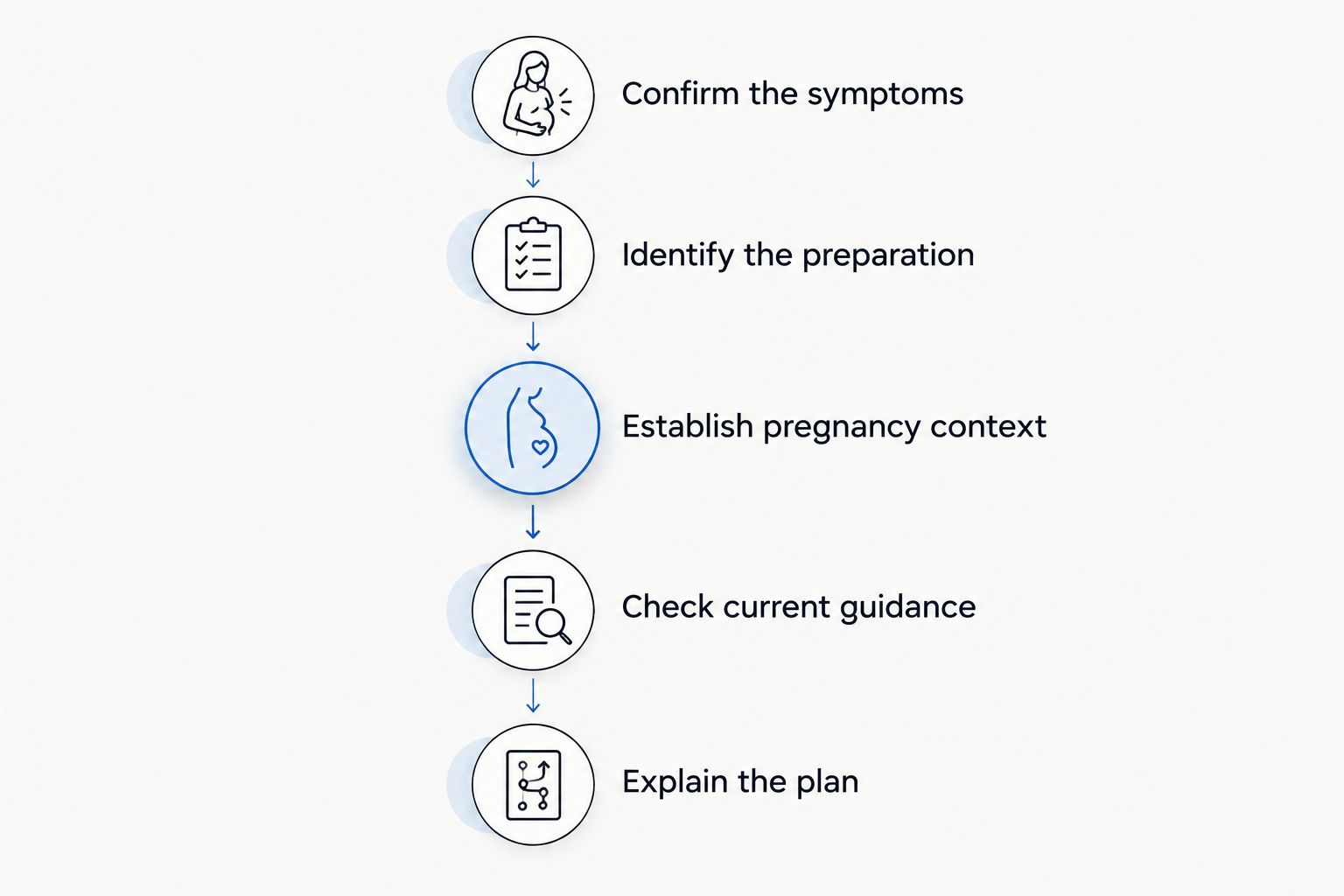
Use the following consultation sequence before recommending an allergy drop:
- Confirm the symptoms. Ask about itching, watering, redness, laterality, discharge, pain, light sensitivity and visual change. Establish whether contact lenses are involved.
- Identify the preparation. Read the active ingredient, strength and formulation. Do not rely on a familiar brand name or the phrase allergy relief.
- Establish pregnancy context. Record gestation, other medicines, relevant medical history and treatment already tried. Include over-the-counter preparations.
- Check current guidance. Use UK pregnancy medicines advice and the exact product’s Summary of Product Characteristics, then make or obtain an individual treatment decision.
- Explain the plan. Cover administration, expected benefit, review arrangements and the symptoms that require urgent assessment.
Your decision should distinguish symptom relief from anti-allergic treatment. Lubricants can improve comfort, while sodium cromoglicate and antihistamines act through different mechanisms; they are not interchangeable simply because each is supplied as an eye drop.
Which options belong in a pregnancy allergy discussion?
This comparison separates treatment roles, not pregnancy safety rankings. An option that helps symptoms is not automatically the appropriate medicine for an individual pregnant patient. Choose according to the diagnosis, current guidance and clinical need.
| Option | Best for | What it does | Main limitation |
|---|---|---|---|
| Cold compresses and allergen avoidance | Initial non-drug symptom management | Help reduce discomfort and exposure to relevant triggers | Do not reliably control persistent inflammation alone |
| Suitable lubricating eye drops | Comfort when irritation or dryness accompanies allergy | Lubricate the ocular surface and help dilute allergens | Do not directly block histamine or replace anti-allergic treatment |
| Sodium cromoglicate eye drops | A topical anti-allergic option to discuss during pregnancy | Stabilise mast cells to help prevent mediator release | Are not antihistamines and require regular use according to instructions |
| Antihistamine eye drops | Symptoms for which a clinician selects a suitable topical antihistamine | Block histamine-mediated effects; some preparations also stabilise mast cells | Pregnancy advice must be checked for the individual preparation |
| Oral antihistamines | Wider allergy symptoms when systemic treatment is justified | Treat symptoms beyond the ocular surface | Introduce systemic treatment and require a separate pregnancy assessment |
NHS Specialist Pharmacy Service guidance on allergic rhinitis in pregnancy includes topical sodium cromoglicate for eye symptoms. That supports discussing a specific alternative; it does not establish that every allergy eye drop is suitable.
For a 2026 treatment decision, check the live guidance and product information rather than relying on an old leaflet, a previous prescription or a general internet answer.
Cold compresses and lubricants: initial symptom support
Start with non-drug measures where symptoms and examination support that approach. A clean, cool compress over closed eyelids can help itching and discomfort. Avoid rubbing, which adds mechanical irritation to an already symptomatic ocular surface.
Ask about relevant triggers rather than giving an indiscriminate avoidance list. Pollen exposure, pets and workplace exposures deserve attention when the history links them to symptoms; a treatment plan is more useful when the patient understands their own pattern.
Suitable lubricating drops can support comfort and help wash allergens from the ocular surface. However, lubricants are not antihistamines, and preservative-free does not mean pregnancy-approved. Check the formulation and instructions, particularly when the patient uses other eye medicines.
For contact lens wearers, advise removal during an active red or irritated eye episode and assess the cause. A painful red eye in a contact lens wearer requires urgent assessment, not a recommendation to try a different allergy drop.
Sodium cromoglicate: an alternative, not an antihistamine
Sodium cromoglicate is a mast-cell stabiliser, not an antihistamine. This distinction matters because patients often use antihistamine drops as a catch-all term for ocular allergy treatment.
Its place in UK pregnancy guidance makes it a relevant option to discuss when non-drug measures do not provide adequate relief. Check the chosen product’s instructions and pregnancy wording, and explain that regular use supports its preventative action.
Do not promise immediate relief or infer that one preparation’s instructions apply to every formulation. When symptoms remain troublesome, reassess adherence, diagnosis and ongoing allergen exposure before simply adding another medicine.
Keep your 2026 patient explanation precise: a recommended option after assessment is not the same as a guarantee of zero risk. Patients need a clear reason for the choice, not an absolute safety label.
Antihistamine eye drops: check the individual preparation
Do not recommend an ophthalmic antihistamine solely because it acts locally. Some medicine can reach the systemic circulation after ocular administration, including through drainage into the nose.
Check the exact product’s Summary of Product Characteristics for pregnancy advice, contraindications, warnings and administration instructions. Where the wording requires a benefit–risk assessment, that assessment belongs with an appropriately qualified clinician rather than a generic product comparison.
The product information and specialist pregnancy guidance answer related but different questions. Product information describes the licensed preparation; pregnancy services interpret the available evidence for use during pregnancy. Read them together when deciding what to recommend.
If a patient already uses a prescribed antihistamine eye drop, review rather than automatically substituting another preparation. Record why treatment remains necessary, what alternatives were considered and how the patient will be followed up.
Why pregnancy advice varies between eye drops
Different recommendations do not necessarily mean that one source has missed a known danger. They often reflect differences in the medicine, evidence and clinical situation.
- Active ingredient: antihistamines and mast-cell stabilisers have different mechanisms and evidence bases.
- Available pregnancy evidence: human exposure information differs between medicines; absence of data does not prove either safety or harm.
- Formulation and instructions: strength, dosing instructions and additional ingredients affect the preparation you are assessing.
- Pregnancy stage: gestation forms part of the individual medicines assessment and should be recorded.
- Clinical need: mild intermittent itching and persistent symptoms affecting daily activities do not create the same treatment requirement.
- Other treatment: concurrent oral allergy medicines and other eye drops change the overall medicines review.
Use these factors to explain the recommendation, not to overwhelm the patient with uncertainty. Your 2026 consultation record should show the exact medicine considered and the practical reason for choosing, continuing or avoiding it.
How should patients administer an agreed eye drop?
Good administration reduces avoidable exposure and helps the prescribed treatment reach the eye. Demonstrate the technique if the patient is unsure; written instructions alone do not establish that the drop is being used correctly.
Ask the patient to wash their hands, avoid touching the bottle tip to the eye or lashes, and use the amount specified for that preparation. Extra drops are not a substitute for an appropriate treatment plan.
After instillation, gentle eyelid closure and pressure over the inner corner of the eye can reduce drainage through the tear duct. Explain punctal occlusion without asking the patient to press on the eyeball, and follow the preparation’s administration advice.
If several ophthalmic medicines are prescribed, check the instructions for their sequence and separation. Also confirm contact lens restrictions and storage requirements for the actual product rather than giving a universal rule.
For structured symptom assessment, Scope Connect’s allergic conjunctivitis questionnaire-to-drop-choice workflow provides a related clinical topic. Pregnancy medicines checks remain a separate part of the decision.
What if a patient has already used an antihistamine eye drop?
Previous use is a reason for an ingredient-specific review, not an automatic assumption of harm. Ask the patient to bring the bottle or a clear photograph of the packaging so the preparation can be identified accurately.
Record what was used, how it was used and the timing in relation to pregnancy. A pharmacist or prescriber can then check the relevant product information and UK Teratology Information Service guidance, including patient-facing BUMPS information where available.
Avoid telling the patient that every exposure is harmless, and avoid alarming statements unsupported by the medicine’s evidence. Explain the next step clearly, including who will review continued treatment and how symptoms will be managed meanwhile.
When does a red eye need urgent assessment?
Pain, reduced vision or marked light sensitivity should not be managed as routine allergy without assessment. These symptoms can indicate a problem beyond uncomplicated allergic conjunctivitis.
Arrange urgent eye assessment for concerning symptoms, particularly in a contact lens wearer. Injury, chemical exposure or a suspected corneal problem also changes the pathway; pregnancy does not justify delaying necessary eye care.
Itching and watering can fit ocular allergy, but a familiar history does not rule out a new condition. Reassess when the presentation changes, becomes predominantly unilateral or fails to respond as expected.
Which sources should guide a UK consultation in 2026?
Use NHS Specialist Pharmacy Service, UKTIS/BUMPS and the exact preparation’s Summary of Product Characteristics for their respective purposes. These are reference sources, not interchangeable endorsements of a whole treatment class.
NHS Specialist Pharmacy Service guidance addresses treatment choices in pregnancy; UKTIS and BUMPS provide pregnancy exposure advice. The electronic Medicines Compendium carries product-specific information, including pregnancy wording and administration instructions.
Scope Connect’s clinical education complements these medicines references. Check the live version when making a 2026 recommendation, and document the advice that supports the individual decision rather than citing a general search result.
FAQ
Are antihistamine eye drops safe to use during pregnancy?
Antihistamine eye drops require an ingredient-specific pregnancy assessment; there is no blanket recommendation for the whole class. Ask a pharmacist or prescriber to check the exact preparation and current pregnancy guidance before starting treatment.
What can I try first for itchy eyes while pregnant?
Cold compresses, avoiding relevant allergens and suitable lubricating drops are initial options for uncomplicated irritation. Pain, reduced vision or light sensitivity require assessment rather than self-treatment as allergy.
Is sodium cromoglicate an antihistamine eye drop?
Sodium cromoglicate is a mast-cell stabiliser, not an antihistamine. NHS Specialist Pharmacy Service guidance includes topical sodium cromoglicate as an option for eye symptoms during pregnancy.
Are preservative-free allergy drops automatically safer in pregnancy?
Preservative-free allergy drops are not automatically safer in pregnancy. The active ingredient still needs a pregnancy assessment, while preservative choice addresses a separate aspect of ocular surface tolerability.
Does using an eye drop mean none of the medicine reaches the baby?
Using an eye drop does not eliminate systemic exposure. Some medicine can enter the circulation after ocular administration, so the preparation still needs an individual pregnancy assessment.
Should I worry if I used allergy eye drops before knowing I was pregnant?
Previous allergy eye drop use needs a product-specific review, not an automatic assumption of harm. Give your pharmacist or prescriber the active ingredient, formulation and details of use so they can check appropriate pregnancy advice.
Can I wear contact lenses while treating an allergic red eye?
Remove contact lenses during an active red or irritated eye episode and have the cause assessed. A painful red eye in a contact lens wearer needs urgent assessment, and individual drops also have specific lens instructions.
One last thing
Preservative-free describes what is absent from the formulation, not whether the active medicine is suitable during pregnancy. Ask the patient to bring the actual bottle: identifying the ingredient is more useful than debating whether allergy drops are safe as a group.
Keep that distinction in both your recommendation and your documentation. A clear explanation helps the patient follow an agreed plan without treating a cautious product leaflet or an online reassurance as the whole answer.
Related guides
- Antihistamine eye drops to consider in pregnancy
- Is preservative-free better than preserved eye drops?
- Cooling eye masks for allergic eye conditions