

Independent prescribing is worth pursuing when you have a clear clinical role, access to suitable supervised training and a practice setting that supports safe prescribing. For optometrists weighing the decision in 2026, the qualification adds responsibility as well as clinical autonomy; it does not, by itself, provide a funded service, prescribing infrastructure or guaranteed career progression.
- Independent prescribing optometry is worth pursuing when patient need, supervision and clinical governance support its use.
- Secure a realistic supervised practice arrangement before committing to a training route.
- A prescribing qualification does not replace referral pathways, follow-up arrangements or working within your competence.
- Scope Connect supports optometrists seeking clinical resources and CPD alongside prescribing development.
Why this matters
The useful question is not simply whether you want to prescribe. It is whether prescribing would close a specific gap in the care you can safely deliver, and whether your workplace can support that change.
You might want to take greater responsibility for ocular disease management, develop a hospital role or contribute to a community service. These are different objectives. Each needs a training plan linked to the patients you expect to manage, rather than a qualification collected without an intended use.
Scope Connect provides clinical articles, CPD-accredited courses and patient education materials for eye care professionals. These resources support continuing learning, but they do not replace an approved prescribing qualification or supervised clinical experience.
Is independent prescribing worth it for optometrists in 2026?
Yes, when the qualification connects to a defined clinical role; defer it when the practical arrangements remain unresolved. A useful 2026 decision compares your intended clinical contribution with the training, governance and continuing responsibility needed to deliver it.
| Route | Best for | Main benefit | Main limitation |
|---|---|---|---|
| Pursue independent prescribing now | Optometrists with a defined prescribing role and a realistic supervision arrangement | Builds prescribing competence towards an identified clinical need | Requires study, supervised learning and preparation for continuing accountability |
| Defer while preparing | Optometrists whose supervision or workplace arrangements are unresolved | Gives you time to establish a workable training and service plan | Delays access to the intended prescribing role |
| Prioritise targeted clinical CPD | Optometrists developing assessment and management skills without an immediate prescribing role | Supports learning relevant to current practice | Does not confer independent prescribing authority |
None of these routes is automatically the most ambitious choice. The strongest decision matches your current competence, intended responsibilities and access to support.
Before enrolling, describe the change you want in plain clinical language. For example, identify which patients you currently refer, why referral is necessary and which aspects of their care you would be competent and equipped to manage after appropriate training. Do not assume prescribing would make every existing referral unnecessary.
Pursue independent prescribing when your role supports it
Best for: optometrists with an identifiable clinical need, suitable supervision and a supported route into prescribing practice.
A strong reason to train begins with patient care rather than the qualification itself. You should be able to explain where prescribing would sit within assessment, diagnosis, treatment selection, monitoring and escalation.
Clinical autonomy is the benefit, but accountability is inseparable from it. A prescribing decision includes deciding whether a medicine is indicated, checking relevant risks, explaining the plan and arranging appropriate review. Choosing not to prescribe is also a clinical decision.
Consider whether your intended workplace gives you access to the information and facilities needed for that responsibility. Relevant history, examination findings, communication with other professionals and follow-up arrangements belong in the service design, not on a list to address after qualification.
For community practice, review the full independent prescribing to same-day treatment workflow. Same-day treatment is a pathway question as well as a prescribing question: assessment, medicine access, documentation and escalation all need to work together.
The limitation is straightforward. A qualification cannot compensate for an unsupported clinical setting. If you would be expected to prescribe without suitable records, review capacity or escalation arrangements, resolve those gaps before accepting that responsibility.
Defer training when the foundations are missing
Best for: optometrists who want to prescribe but cannot yet describe how supervised learning or subsequent practice will work.
Deferring is a preparation decision, not a judgement on your clinical potential. It is sensible when the intended role remains vague, an appropriate supervision arrangement is unconfirmed or study commitments conflict with your current workload.
Use the preparation period to clarify the patient groups and conditions you want to manage. Discuss those aims with the prospective training provider and clinical supervisor, including the experience needed to develop competence rather than simply complete attendance requirements.
An expression of support is not the same as a workable arrangement. Establish who will supervise, what learning opportunities are available, how feedback will be delivered and what happens if service pressures disrupt the plan.
The trade-off is delay. However, starting without those foundations leaves the central feasibility questions unanswered while adding study commitments. Confirm the learning environment before treating a course place as a complete training plan.
Prioritise clinical CPD when prescribing is not the immediate need
Best for: optometrists whose current development needs concern assessment, differential diagnosis, referral or non-prescribing management.
Not every clinical learning gap requires a prescribing qualification. If your immediate challenge is recognising ocular surface disease, documenting findings consistently or improving referral decisions, targeted education addresses that need directly.
Scope Connect is an eye care resource hub for clinicians seeking clinical articles, CPD-accredited courses and patient education materials. Use those resources to support an identified learning objective, rather than treating course completion as evidence of competence across an entire condition.
The limitation is that CPD does not grant prescribing authority. Keep the distinction clear when discussing your role with patients, colleagues and employers. Education supports clinical development; formal prescribing authority requires the relevant professional and regulatory steps.
This route also works as preparation for future prescribing training. It should have a purpose beyond postponement: identify what you need to learn, apply it within your existing scope and review whether your intended prescribing role has become clearer.
Why the value of independent prescribing varies
The value of independent prescribing optometry depends on the relationship between your training and the clinical work available afterwards. Assess these factors before making the commitment:
- Patient need: Identify where prescribing would contribute to appropriate care, rather than assuming every ocular complaint needs a medicine.
- Supervision: Establish whether your supervised learning can provide relevant clinical exposure, feedback and assessment.
- Clinical governance: Check how records, prescribing decisions, communication and incident reporting will work in your intended setting.
- Follow-up capacity: Establish who will review treatment response and who takes responsibility if the patient deteriorates or does not attend.
- Professional support: Clarify access to advice and referral when a presentation falls outside your competence or the service remit.
- Role alignment: Agree whether your employer or practice intends to support prescribing activity after qualification.
These factors explain why the same qualification can fit one role better than another. A clear pathway with appropriate support gives you somewhere to apply the training; an undefined role does not.
Do not assess value solely through the medicines you expect to prescribe. Include the quality of your assessment, your ability to recognise uncertainty and your readiness to escalate care when prescribing is not the appropriate response.
How should you assess readiness before applying?
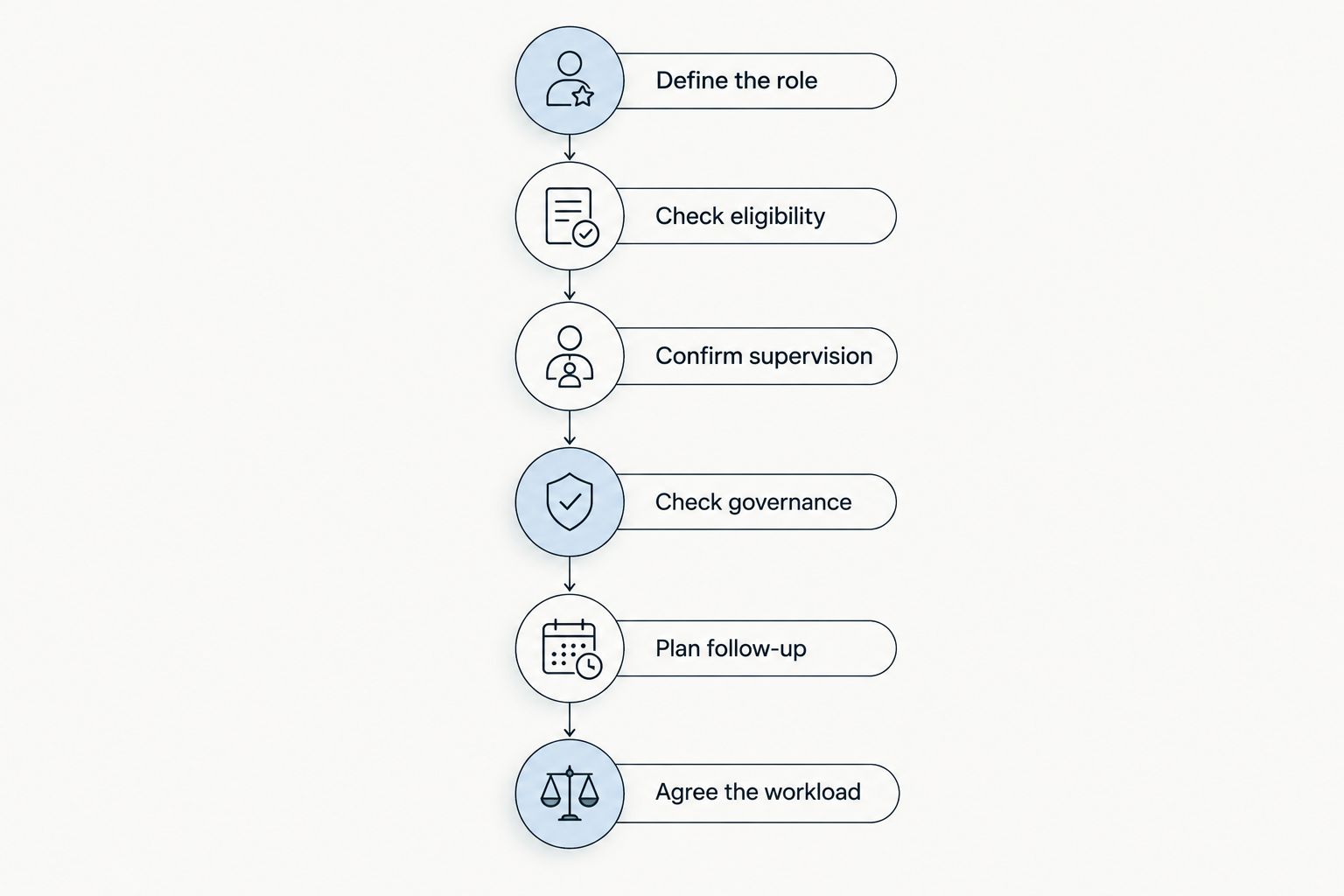
Work through the decision in sequence. For a 2026 application, verify current requirements directly with the training provider and the General Optical Council rather than relying on another clinician's previous route.
- Define the role. Describe the clinical work you intend to undertake after qualification and the boundaries of that role. Separate personal interest from an actual opportunity to practise.
- Check eligibility. Confirm the provider's current entry, training and assessment requirements. Establish the regulatory steps needed before practising as an independent prescriber.
- Confirm supervision. Discuss the proposed learning environment, relevant patient exposure and arrangements for feedback. Check that the arrangement meets the programme's requirements.
- Check governance. Clarify access to clinical information, documentation, appropriate professional indemnity, medicine-related processes and escalation support.
- Plan follow-up. Establish how patients will be reviewed, how outcomes will be communicated and how urgent concerns will be handled.
- Agree the workload. Discuss study commitments and clinical responsibilities with everyone whose support the training depends on. Avoid relying on informal assumptions about available time.
The sequence matters because course selection cannot settle every practical question. A suitable programme still needs a viable clinical learning environment and a realistic plan for practice afterwards.
Will independent prescribing improve your career prospects?
Independent prescribing is relevant to roles that require prescribing competence; it is not a guarantee of promotion or a different job. Start with the person specification or service requirements for the work you actually want to do.
Ask prospective employers how prescribing fits the role, what clinical support is available and whether the service supports continuing development. A title alone tells you little about patient mix, decision-making responsibility or access to advice.
For your 2026 career plan, distinguish an essential qualification from a desirable one. That distinction helps you decide whether to train now, build relevant experience first or focus on another development need.
Can you prescribe as soon as you finish the course?
Course completion alone is not the same as holding the appropriate prescribing annotation on the professional register. Check the General Optical Council's current requirements and complete the necessary registration steps before practising as an independent prescriber.
Registration also does not remove the need for competence in the individual clinical task. Your workplace arrangements and professional indemnity must support the work you undertake.
Does prescribing mean fewer referrals?
Prescribing does not remove the need for referral. Some patients need specialist assessment, investigations, monitoring or treatment beyond the clinician's competence or the service's facilities.
Judge a pathway by whether patients receive appropriate care, not by whether referrals fall. Clear escalation remains essential when symptoms, findings or treatment response require another service.
FAQ
Is independent prescribing optometry worth it in 2026?
Independent prescribing optometry is worth pursuing when you have a defined clinical role, suitable supervised training and a supported practice setting. Defer the commitment if the supervision or service arrangements are unresolved.
Should I choose an independent prescribing course before finding supervision?
Discuss supervision arrangements before committing to a training route. Confirm the programme’s requirements and whether the proposed setting can provide relevant learning opportunities and assessment.
Can newly qualified optometrists train as independent prescribers?
Eligibility depends on the current programme and regulatory requirements. Check these directly with the provider and the General Optical Council, then assess whether your experience and proposed support fit the intended clinical role.
Does an independent prescribing qualification let me manage every eye condition?
No, independent prescribing does not authorise practice beyond your competence. Assessment, treatment, monitoring and referral must remain appropriate to your skills and clinical setting.
Will independent prescribing guarantee a better job?
Independent prescribing does not guarantee a better job or promotion. Check whether the roles you want require prescribing competence and whether their clinical support matches the responsibility.
Can CPD courses replace independent prescribing training?
CPD courses do not replace the approved training and regulatory steps required for independent prescribing. Scope Connect offers eye care resources and CPD-accredited courses for continuing professional learning.
What should I check before using my prescribing qualification?
Confirm the appropriate register annotation, competence, professional indemnity and workplace governance before prescribing. Establish documentation, communication, follow-up and escalation arrangements for the patients you will manage.
One last thing
The most useful test is whether you can explain what happens after the prescription. Who reviews the patient, what prompts escalation and who takes responsibility when the expected response does not occur?
Before committing to training in 2026, discuss that pathway with your prospective supervisor and workplace. If the answer is unclear, your next task is service preparation—not simply choosing a course.
Related guides
- Compare independent prescribing courses for optometrists
- Understand funding for independent prescribing training
- Explore independent prescribing for newly qualified optometrists